Tabular arrangement of the chemical elements

This article is about the table used in chemistry and physics. For other uses, see [Periodic table (disambiguation)](https://en.wikipedia.org/wiki/Periodic_table_(disambiguation) "Periodic table (disambiguation)").


[![](https://en.wikipedia.org//thumb.wikimedia.org/wikipedia/commons/thumb/f/f5/Colour_18-col_PT_with_labels.svg/500px-Colour_18-col_PT_with_labels.svg.png?utm_source=en.wikipedia.org&utm_campaign=parser&utm_content=thumbnail)](https://en.wikipedia.org/wiki/File:Colour_18-col_PT_with_labels.svg)

Periodic table of the chemical elements showing the most or more commonly named [sets of elements](https://en.wikipedia.org/wiki/Names_for_sets_of_chemical_elements "Names for sets of chemical elements") (in periodic tables), and a traditional [dividing line between metals and nonmetals](https://en.wikipedia.org/wiki/Dividing_line_between_metals_and_nonmetals "Dividing line between metals and nonmetals"). The [f-block](https://en.wikipedia.org/wiki/Block_(periodic_table)#f-block "Block (periodic table)") actually fits between [groups 2](https://en.wikipedia.org/wiki/Alkaline_earth_metals "Alkaline earth metals") and [3](https://en.wikipedia.org/wiki/Scandium_group "Scandium group"); it is usually shown at the foot of the table to save horizontal space.

|                                                                                                                                                                                                        Part of a series on the                                                                                                                                                                                                        |
|---------------------------------------------------------------------------------------------------------------------------------------------------------------------------------------------------------------------------------------------------------------------------------------------------------------------------------------------------------------------------------------------------------------------------------------|
|                                                                                                                                                                                                            Periodic table                                                                                                                                                                                                             |
|                                                                                                                                                                                                          ![The periodic table.](https://en.wikipedia.org//thumb.wikimedia.org/wikipedia/commons/thumb/0/03/Simple_Periodic_Table_Chart-blocks.svg/250px-Simple_Periodic_Table_Chart-blocks.svg.png?utm_source=en.wikipedia.org&utm_campaign=parser&utm_content=thumbnail)                                                                                                                                                                                                          |
| show

Periodic table forms

-   18-column
-   32-column

-   Alternative and extended forms |
| show

Periodic table history

-   D. Mendeleev
    -   1871 table
    -   1869 predictions

-   Discovery of elements

-   **Naming and etymology**

-   -   for people
    -   for places
    -   controversies

-   (in East Asia)

-   Systematic element names |
|                                                                                                                                                                                                           **Sets of elements**                                                                                                                                                                                                            |
| show

By periodic table structure

-   **Groups (1–18)**

-   1 _(alkali metals)_
-   2 _(alkaline earth metals)_
-   3
-   4
-   5
-   6
-   7
-   8
-   9
-   10
-   11
-   12
-   13
-   14
-   15 _(pnictogens)_
-   16 _(chalcogens)_
-   17 _(halogens)_
-   18 _(noble gases)_

-   **Periods (1–7, ...)**

-   1
-   2
-   3
-   4
-   5
-   6
-   7
-   8+

-   **Blocks (s, p, d, f, ...)**

-   -   Atomic orbitals
    -   Aufbau principle |
| show

By metallic classification

-   **Metals**

-   alkali
-   alkaline earth

-   transition
-   post-transition

-   lanthanide
-   actinide

-   **Metalloids**

-   -   dividing metals and nonmetals

-   **Nonmetals**

-   nonmetal halogen
-   noble gas |
| show

By other characteristics

-   Coinage metals
-   Platinum-group metals

-   Precious metals
-   Refractory metals

-   Heavy metals
-   Light metals

-   Native metals
-   Noble metals

-   Main-group elements
-   Rare-earth elements

-   Transuranium elements

-   Major, minor and trans- actinides |
|                                                                                                                                                                                                               **Elements**                                                                                                                                                                                                                |
| show

List of chemical elements

-   by abundance (in human body)

-   by atomic properties
-   by isotope stability

-   by symbol |
| show

Properties of elements

-   Relative atomic mass
-   Crystal structure

-   Electron affinity
-   configuration

-   Electronegativity (Allen, Pauling)

-   Goldschmidt classification

-   Nutrition
-   Valence |
| show

Data pages for elements

-   Abundance
-   Atomic radius
-   Boiling point
-   Critical point
-   Density
-   Elasticity
-   Electrical resistivity
-   Electron affinity / configuration
-   Electronegativity
-   Hardness
-   Heat capacity / of fusion / of vaporization
-   Ionization energy
-   Melting point
-   Oxidation state
-   Speed of sound
-   Thermal conductivity / expansion coefficient
-   Vapor pressure |
| -   **Category**
-   **Chemistry Portal** |
| -   v
-   t
-   e |

The **periodic table**, also known as the **periodic table of the elements**, is an ordered arrangement of the [chemical elements](https://en.wikipedia.org/wiki/Chemical_element "Chemical element") into rows ("[periods](https://en.wikipedia.org/wiki/Period_(periodic_table) "Period (periodic table)")") and columns ("[groups](https://en.wikipedia.org/wiki/Group_(periodic_table) "Group (periodic table)")"). An [icon](https://en.wikipedia.org/wiki/Cultural_icon "Cultural icon") of [chemistry](https://en.wikipedia.org/wiki/Chemistry "Chemistry"), the periodic table is widely used in [physics](https://en.wikipedia.org/wiki/Physics "Physics") and other sciences. It is a depiction of the [periodic law](https://en.wikipedia.org/wiki/Periodic_trends "Periodic trends"), which states that when the elements are arranged in order of their [atomic numbers](https://en.wikipedia.org/wiki/Atomic_number "Atomic number") an approximate [recurrence of their properties](https://en.wikipedia.org/wiki/Periodic_function "Periodic function") is evident. The table is divided into four roughly rectangular areas called [blocks](https://en.wikipedia.org/wiki/Block_(periodic_table) "Block (periodic table)"). Elements in the same group tend to show similar chemical characteristics.

Vertical, horizontal and diagonal [trends](https://en.wikipedia.org/wiki/Periodic_trends "Periodic trends") characterize the periodic table. [Metallic](https://en.wikipedia.org/wiki/Metal "Metal") character increases going down a group and from right to left across a period. [Nonmetallic](https://en.wikipedia.org/wiki/Nonmetal_(chemistry) "Nonmetal (chemistry)") character increases going from the bottom left of the periodic table to the top right.

The first periodic table to become generally accepted was that of the Russian chemist [Dmitri Mendeleev](https://en.wikipedia.org/wiki/Dmitri_Mendeleev "Dmitri Mendeleev") in 1869; he formulated the periodic law as a dependence of chemical properties on [atomic mass](https://en.wikipedia.org/wiki/Atomic_mass "Atomic mass"). As not all elements were then known, there were gaps in his periodic table, and Mendeleev successfully used the periodic law to [predict some properties of some of the missing elements](https://en.wikipedia.org/wiki/Mendeleev's_predicted_elements "Mendeleev's predicted elements"). The periodic law was recognized as a fundamental discovery in the late 19th century. It was explained early in the 20th century, with the discovery of atomic numbers and associated pioneering work in [quantum mechanics](https://en.wikipedia.org/wiki/Quantum_mechanics "Quantum mechanics"), both ideas serving to illuminate the internal structure of the [atom](https://en.wikipedia.org/wiki/Atom "Atom"). A recognisably modern form of the table was reached in 1945 with [Glenn T. Seaborg](https://en.wikipedia.org/wiki/Glenn_T._Seaborg "Glenn T. Seaborg")'s discovery that the [actinides](https://en.wikipedia.org/wiki/Actinide "Actinide") were in fact f-block rather than d-block elements. The periodic table and law have become a central and indispensable part of modern chemistry.

The periodic table continues to evolve with the progress of science. In nature, only elements up to atomic number 94 exist;<sup about="#mwt16" class="mw-ref reference" id="cite_ref-transuranium_1-0" rel="dc:references" typeof="mw:Transclusion mw:Extension/ref" data-mw="{&quot;name&quot;:&quot;ref&quot;,&quot;attrs&quot;:{&quot;name&quot;:&quot;transuranium&quot;,&quot;group&quot;:&quot;lower-alpha&quot;},&quot;body&quot;:{&quot;html&quot;:&quot;&quot;},&quot;parts&quot;:[{&quot;template&quot;:{&quot;target&quot;:{&quot;wt&quot;:&quot;efn&quot;,&quot;href&quot;:&quot;./Template:Efn&quot;},&quot;params&quot;:{&quot;name&quot;:{&quot;wt&quot;:&quot;transuranium&quot;}},&quot;i&quot;:0}}]}"><a href="#cite_note-transuranium-1" data-mw-group="lower-alpha" id="mwNg"><span class="mw-reflink-text" id="mwNw"><span class="cite-bracket" id="mwOA">[</span>a<span class="cite-bracket" id="mwOQ">]</span></span></a></sup> elements beyond that are [synthetic elements](https://en.wikipedia.org/wiki/Synthetic_element "Synthetic element") that can only be obtained artificially. By 2010, the first 118 elements were known, thereby completing the first seven rows of the table;<sup about="#mwt21" class="mw-ref reference" id="cite_ref-2" rel="dc:references" typeof="mw:Extension/ref" data-mw="{&quot;name&quot;:&quot;ref&quot;,&quot;attrs&quot;:{},&quot;body&quot;:{&quot;id&quot;:&quot;mw-reference-text-cite_note-2&quot;}}"><a href="#cite_note-2" id="mwOw"><span class="mw-reflink-text" id="mwPA"><span class="cite-bracket" id="mwPQ">[</span>1<span class="cite-bracket" id="mwPg">]</span></span></a></sup> however, chemical characterization is still needed for the heaviest elements to confirm that their properties match their positions. New discoveries will extend the table [beyond these seven rows](https://en.wikipedia.org/wiki/Extended_periodic_table "Extended periodic table"), though it is not yet known how many more elements are possible; moreover, theoretical calculations suggest that this unknown region will not follow the patterns of the known part of the table. Some scientific discussion also continues regarding whether some elements are correctly positioned in the table. Many [alternative representations](https://en.wikipedia.org/wiki/Alternative_periodic_tables "Alternative periodic tables") of the periodic law exist, and there is some discussion as to whether there is an optimal form of the periodic table.

## Structure

-   [v](https://en.wikipedia.org/wiki/Template:Periodic_table "Template:Periodic table")
-   [t](https://en.wikipedia.org/wiki/Template_talk:Periodic_table "Template talk:Periodic table")
-   [e](https://en.wikipedia.org/wiki/Special:EditPage/Template:Periodic_table "Special:EditPage/Template:Periodic table")

|   Group   |              1              |           2           |            |           3            |             4             |            5             |           6            |           7           |           8           |           9            |            10            |           11            |           12            |           13           |          14           |           15            |           16            |           17           |          18           |
|-----------|-----------------------------|-----------------------|------------|------------------------|---------------------------|--------------------------|------------------------|-----------------------|-----------------------|------------------------|--------------------------|-------------------------|-------------------------|------------------------|-----------------------|-------------------------|-------------------------|------------------------|-----------------------|
|           | Hydrogen &<br>alkali metals | Alkaline earth metals |            |                        |                           |                          |                        |                       |                       |                        |                          |                         |                         |         Triels         |        Tetrels        |       Pnictogens       |      Chalcogens       |       Halogens        |    Noble<br>gases     |
| Period

1 |     Hydrogen1H1.0080      |                       |            |                        |                           |                          |                        |                       |                       |                        |                          |                         |                         |                        |                       |                         |                         |                        |   Helium2He4.0026   |
|     2     |      Lithium3Li6.94       | Beryllium4Be9.0122  |            |                        |                           |                          |                        |                       |                       |                        |                          |                         |                         |     Boron5B10.81      |    Carbon6C12.011    |   Nitrogen7N14.007    |    Oxygen8O15.999     |   Fluorine9F18.998   |    Neon10Ne20.180    |
|     3     |     Sodium11Na22.990      | Magnesium12Mg24.305 |            |                        |                           |                          |                        |                       |                       |                        |                          |                         |                         | Aluminium13Al26.982  |  Silicon14Si28.085  |  Phosphorus15P30.974  |     Sulfur16S32.06     |  Chlorine17Cl35.45   |    Argon18Ar39.95    |
|     4     |    Potassium19K39.098     |  Calcium20Ca40.078  |            |  Scandium21Sc44.956  |   Titanium22Ti47.867    |   Vanadium23V50.942    |  Chromium24Cr51.996  | Manganese25Mn54.938 |    Iron26Fe55.845    |   Cobalt27Co58.933    |    Nickel28Ni58.693     |    Copper29Cu63.546    |     Zinc30Zn65.38      |   Gallium31Ga69.723   | Germanium32Ge72.630 |   Arsenic33As74.922    |  Selenium34Se78.971   |   Bromine35Br79.904   |  Krypton36Kr83.798  |
|     5     |    Rubidium37Rb85.468     | Strontium38Sr87.62  |            |   Yttrium39Y88.906    |   Zirconium40Zr91.224   |   Niobium41Nb92.906    | Molybdenum42Mo95.95  | Technetium43Tc[97]  | Ruthenium44Ru101.07 |  Rhodium45Rh102.91   |  Palladium46Pd106.42   |    Silver47Ag107.87    |   Cadmium48Cd112.41   |   Indium49In114.82    |    Tin50Sn118.71     |  Antimony51Sb121.76   |  Tellurium52Te127.60  |    Iodine53I126.90    |   Xenon54Xe131.29    |
|     6     |     Caesium55Cs132.91     |  Barium56Ba137.33   | ![1 asterisk](https://thumb.wikimedia.org/wikipedia/commons/thumb/4/49/Asterisks_one.svg/20px-Asterisks_one.svg.png?utm_source=en.wikipedia.org&utm_campaign=parser&utm_content=thumbnail) |  Lutetium71Lu174.97  |    Hafnium72Hf178.49    |   Tantalum73Ta180.95   |  Tungsten74W183.84   |  Rhenium75Re186.21  |  Osmium76Os190.23   |   Iridium77Ir192.22   |   Platinum78Pt195.08   |     Gold79Au196.97     |   Mercury80Hg200.59   |  Thallium81Tl204.38   |    Lead82Pb207.2     |   Bismuth83Bi208.98   |   Polonium84Po[209]   |  Astatine85At[210]   |    Radon86Rn[222]    |
|     7     |     Francium87Fr[223]     |   Radium88Ra[226]   | ![1 asterisk](https://thumb.wikimedia.org/wikipedia/commons/thumb/f/fe/Asterisks_2_%28vertical%29.svg/20px-Asterisks_2_%28vertical%29.svg.png?utm_source=en.wikipedia.org&utm_campaign=parser&utm_content=thumbnail) | Lawrencium103Lr[266] | Rutherfordium104Rf[267] |   Dubnium105Db[268]    | Seaborgium106Sg[269] |  Bohrium107Bh[270]  |  Hassium108Hs[271]  | Meitnerium109Mt[278] | Darmstadtium110Ds[281] | Roentgenium111Rg[282] | Copernicium112Cn[285] |  Nihonium113Nh[286]  | Flerovium114Fl[289] |  Moscovium115Mc[290]  | Livermorium116Lv[293] | Tennessine117Ts[294] | Oganesson118Og[294] |
|           |                             |                       |            |                        |                           |                          |                        |                       |                       |                        |                          |                         |                         |                        |                       |                         |                         |                        |                       |
|           |                             |                       | ![1 asterisk](https://thumb.wikimedia.org/wikipedia/commons/thumb/4/49/Asterisks_one.svg/20px-Asterisks_one.svg.png?utm_source=en.wikipedia.org&utm_campaign=parser&utm_content=thumbnail) | Lanthanum57La138.91  |     Cerium58Ce140.12     | Praseodymium59Pr140.91 | Neodymium60Nd144.24  | Promethium61Pm[145] | Samarium62Sm150.36  |  Europium63Eu151.96  |  Gadolinium64Gd157.25  |   Terbium65Tb158.93   | Dysprosium66Dy162.50  |  Holmium67Ho164.93   |   Erbium68Er167.26   |   Thulium69Tm168.93    |  Ytterbium70Yb173.05  |                        |                       |
|           |                             |                       | ![1 asterisk](https://thumb.wikimedia.org/wikipedia/commons/thumb/f/fe/Asterisks_2_%28vertical%29.svg/20px-Asterisks_2_%28vertical%29.svg.png?utm_source=en.wikipedia.org&utm_campaign=parser&utm_content=thumbnail) |  Actinium89Ac[227]   |    Thorium90Th232.04    | Protactinium91Pa231.04 |   Uranium92U238.03   | Neptunium93Np[237]  | Plutonium94Pu[244]  |  Americium95Am[243]  |     Curium96Cm[247]     |  Berkelium97Bk[247]   | Californium98Cf[251]  | Einsteinium99Es[252] |  Fermium100Fm[257]  | Mendelevium101Md[258] |  Nobelium102No[259]   |                        |

[![](https://thumb.wikimedia.org/wikipedia/commons/thumb/c/c4/Atomic-orbital-clouds_spdf_m0.png/500px-Atomic-orbital-clouds_spdf_m0.png?utm_source=en.wikipedia.org&utm_campaign=parser&utm_content=thumbnail)](https://en.wikipedia.org/wiki/File:Atomic-orbital-clouds_spdf_m0.png)

3D views of some [hydrogen-like](https://en.wikipedia.org/wiki/Hydrogen-like_atom "Hydrogen-like atom") atomic orbitals showing probability density and phase (g orbitals and higher are not shown)

Each chemical element has a unique atomic number (_Z_— for "Zahl", German for "number") representing the number of [protons](https://en.wikipedia.org/wiki/Proton "Proton") in its [nucleus](https://en.wikipedia.org/wiki/Atomic_nucleus "Atomic nucleus").<sup about="#mwt37" id="cite_ref-neutronium_5-0" rel="dc:references" typeof="mw:Extension/ref" data-mw="{&quot;name&quot;:&quot;ref&quot;,&quot;attrs&quot;:{&quot;name&quot;:&quot;neutronium&quot;},&quot;body&quot;:{&quot;id&quot;:&quot;mw-reference-text-cite_note-neutronium-5&quot;}}"><a href="https://en.wikipedia.org/wiki/Periodic_table#cite_note-neutronium-5" id="mwVg"><span id="mwVw"><span id="mwWA">[</span>4<span id="mwWQ">]</span></span></a></sup> Each distinct atomic number therefore corresponds to a class of atom: these classes are called the [chemical elements](https://en.wikipedia.org/wiki/Chemical_element "Chemical element").<sup about="#mwt40" id="cite_ref-6" rel="dc:references" typeof="mw:Extension/ref" data-mw="{&quot;name&quot;:&quot;ref&quot;,&quot;attrs&quot;:{},&quot;body&quot;:{&quot;id&quot;:&quot;mw-reference-text-cite_note-6&quot;}}"><a href="https://en.wikipedia.org/wiki/Periodic_table#cite_note-6" id="mwWw"><span id="mwXA"><span id="mwXQ">[</span>5<span id="mwXg">]</span></span></a></sup> The chemical elements are what the periodic table classifies and organizes. [Hydrogen](https://en.wikipedia.org/wiki/Hydrogen "Hydrogen") is the element with atomic number 1; [helium](https://en.wikipedia.org/wiki/Helium "Helium"), atomic number 2; [lithium](https://en.wikipedia.org/wiki/Lithium "Lithium"), atomic number 3; and so on. Each of these names can be further abbreviated by a one- or two-letter [chemical symbol](https://en.wikipedia.org/wiki/Chemical_symbol "Chemical symbol"); those for hydrogen, helium, and lithium are respectively H, He, and Li.<sup about="#mwt41" id="cite_ref-IUPAC-redbook_7-0" rel="dc:references" typeof="mw:Extension/ref" data-mw="{&quot;name&quot;:&quot;ref&quot;,&quot;attrs&quot;:{&quot;name&quot;:&quot;IUPAC-redbook&quot;}}"><a href="https://en.wikipedia.org/wiki/Periodic_table#cite_note-IUPAC-redbook-7" id="mwYw"><span id="mwZA"><span id="mwZQ">[</span>6<span id="mwZg">]</span></span></a></sup> Neutrons do not affect the atom's chemical identity, but do affect its weight. Atoms with the same number of protons but different numbers of neutrons are called [isotopes](https://en.wikipedia.org/wiki/Isotope "Isotope") of the same chemical element.<sup about="#mwt42" id="cite_ref-IUPAC-redbook_7-1" rel="dc:references" typeof="mw:Extension/ref" data-mw="{&quot;name&quot;:&quot;ref&quot;,&quot;attrs&quot;:{&quot;name&quot;:&quot;IUPAC-redbook&quot;}}"><a href="https://en.wikipedia.org/wiki/Periodic_table#cite_note-IUPAC-redbook-7" id="mwaA"><span id="mwaQ"><span id="mwag">[</span>6<span id="mwaw">]</span></span></a></sup> Naturally occurring elements usually occur as mixes of different isotopes; since each isotope usually occurs with a characteristic abundance, naturally occurring elements have well-defined [atomic weights](https://en.wikipedia.org/wiki/Atomic_weight "Atomic weight"), defined as the average mass of a naturally occurring atom of that element.<sup about="#mwt45" id="cite_ref-ciaaw_8-0" rel="dc:references" typeof="mw:Extension/ref" data-mw="{&quot;name&quot;:&quot;ref&quot;,&quot;attrs&quot;:{&quot;name&quot;:&quot;ciaaw&quot;},&quot;body&quot;:{&quot;id&quot;:&quot;mw-reference-text-cite_note-ciaaw-8&quot;}}"><a href="https://en.wikipedia.org/wiki/Periodic_table#cite_note-ciaaw-8" id="mwbQ"><span id="mwbg"><span id="mwbw">[</span>7<span id="mwcA">]</span></span></a></sup> All elements have multiple isotopes, variants with the same number of protons but different numbers of [neutrons](https://en.wikipedia.org/wiki/Neutron "Neutron"). For example, [carbon](https://en.wikipedia.org/wiki/Carbon "Carbon") has three naturally occurring isotopes: all of its atoms have six protons and most have six neutrons as well, but about one per cent have seven neutrons, and a very small fraction have eight neutrons. Isotopes are never separated in the periodic table; they are always grouped together under a single element. When atomic mass is shown, it is usually the weighted average of naturally occurring isotopes; but if no isotopes occur naturally in significant quantities, the mass of the most stable isotope usually appears, often in parentheses.<sup about="#mwt46" id="cite_ref-Greenwood_9-0" rel="dc:references" typeof="mw:Extension/ref" data-mw="{&quot;name&quot;:&quot;ref&quot;,&quot;attrs&quot;:{&quot;name&quot;:&quot;Greenwood&quot;},&quot;body&quot;:{&quot;id&quot;:&quot;mw-reference-text-cite_note-Greenwood-9&quot;}}"><a href="https://en.wikipedia.org/wiki/Periodic_table#cite_note-Greenwood-9" id="mwcw"><span id="mwdA"><span id="mwdQ">[</span>8<span id="mwdg">]</span></span></a></sup>

In the standard periodic table, the elements are listed in order of increasing atomic number. A new row ([_period_](https://en.wikipedia.org/wiki/Period_(periodic_table) "Period (periodic table)")) is started when a new [electron shell](https://en.wikipedia.org/wiki/Electron_shell "Electron shell") has its first [electron](https://en.wikipedia.org/wiki/Electron "Electron"). Columns ([_groups_](https://en.wikipedia.org/wiki/Group_(periodic_table) "Group (periodic table)")) are determined by the [electron configuration](https://en.wikipedia.org/wiki/Electron_configuration "Electron configuration") of the atom; elements with the same number of electrons in a particular subshell fall into the same columns (e.g. [oxygen](https://en.wikipedia.org/wiki/Oxygen "Oxygen"), [sulfur](https://en.wikipedia.org/wiki/Sulfur "Sulfur"), and [selenium](https://en.wikipedia.org/wiki/Selenium "Selenium") are in the same column because they all have four electrons in the outermost p-subshell). Elements with similar chemical properties generally fall into the same group in the periodic table, although in the f-block, and to some respect in the d-block, the elements in the same period tend to have similar properties, as well. Thus, it is relatively easy to predict the chemical properties of an element if one knows the properties of the elements around it.<sup about="#mwt47" id="cite_ref-10" rel="dc:references" typeof="mw:Extension/ref" data-mw="{&quot;name&quot;:&quot;ref&quot;,&quot;attrs&quot;:{},&quot;body&quot;:{&quot;id&quot;:&quot;mw-reference-text-cite_note-10&quot;}}"><a href="https://en.wikipedia.org/wiki/Periodic_table#cite_note-10" id="mwgg"><span id="mwgw"><span id="mwhA">[</span>9<span id="mwhQ">]</span></span></a></sup>

Today, 118 elements are known, the first 94 of which are known to occur naturally on Earth.<sup about="#mwt139" id="cite_ref-ThorntonBurdette_11-0" rel="dc:references" typeof="mw:Extension/ref" data-mw="{&quot;name&quot;:&quot;ref&quot;,&quot;attrs&quot;:{&quot;name&quot;:&quot;ThorntonBurdette&quot;}}"><a href="https://en.wikipedia.org/wiki/Periodic_table#cite_note-ThorntonBurdette-11" id="mwhw"><span id="mwiA"><span id="mwiQ">[</span>10<span id="mwig">]</span></span></a></sup><sup about="#mwt48" id="cite_ref-transuranium_1-1" rel="dc:references" typeof="mw:Transclusion mw:Extension/ref" data-mw="{&quot;name&quot;:&quot;ref&quot;,&quot;attrs&quot;:{&quot;name&quot;:&quot;transuranium&quot;,&quot;group&quot;:&quot;lower-alpha&quot;},&quot;body&quot;:{&quot;id&quot;:&quot;mw-reference-text-cite_note-transuranium-1&quot;},&quot;parts&quot;:[{&quot;template&quot;:{&quot;target&quot;:{&quot;wt&quot;:&quot;efn&quot;,&quot;href&quot;:&quot;./Template:Efn&quot;},&quot;params&quot;:{&quot;1&quot;:{&quot;wt&quot;:&quot;The question of how many natural elements there are is quite complicated and is not fully resolved. The heaviest element that occurs in large quantities on Earth is element 92, [[uranium]]. However, uranium can undergo [[spontaneous fission]] in nature, and the resulting neutrons can strike other uranium atoms. If [[neutron capture]] then occurs, elements 93 and 94, [[neptunium]] and [[plutonium]], are formed via [[beta decay]];&lt;ref name=ThorntonBurdette/&gt; these are in fact more common than some of the rarest elements in the first 92, such as [[promethium]], [[astatine]], and [[francium]] (see [[Abundance of elements in Earth's crust]]). Theoretically, neutron capture on the resulting plutonium might produce even higher-numbered elements, but the quantities would be too small to be observed.&lt;ref name=ThorntonBurdette/&gt; In the early Solar System, shorter-lived elements had not yet decayed away, and consequently there were more than 94 naturally occurring elements. [[Curium]] (element 96) is the longest-lived element beyond the first 94, and is probably still being brought to Earth via [[cosmic ray]]s, but it has not been found.&lt;ref name=ThorntonBurdette&gt;{{cite journal |last1=Thornton |first1=Brett F. |last2=Burdette |first2=Shawn C. |date=2019 |title=Neutron stardust and the elements of Earth |journal=Nature Chemistry |volume=11 |issue=1 |pages=4–10 |doi=10.1038/s41557-018-0190-9 |pmid=30552435 |bibcode=2019NatCh..11....4T |s2cid=54632815  }}&lt;/ref&gt; Elements up to 99 ([[einsteinium]]) have been observed in [[Przybylski's Star]].&lt;ref name=gopka08&gt;{{cite journal |last1=Gopka |first1=V.F. |last2=Yushchenko |first2=A.V. |last3=Yushchenko |first3=V.A. |last4=Panov |first4=I.V. |last5=Kim |first5=Ch. |date=15 May 2008 |title=Identification of absorption lines of short half-life actinides in the spectrum of Przybylski's star (HD 101065) |journal=Kinematics and Physics of Celestial Bodies |volume=24 |issue=2 |pages=89–98 |doi=10.3103/S0884591308020049 |bibcode = 2008KPCB...24...89G |s2cid=120526363 }}&lt;/ref&gt; Elements up to 100 ([[fermium]]) probably occurred in the [[natural nuclear fission reactor]] at [[Oklo Mine]], [[Gabon]], but they have long since decayed away.&lt;ref name=\&quot;emsley\&quot;&gt;{{cite book |last=Emsley |first=John |date=2011 |title=Nature's Building Blocks: An A-Z guide to the elements |edition=New |publisher=Oxford University Press |location=New York, NY |isbn=978-0-19-960563-7}}&lt;/ref&gt; Even heavier elements may be produced in the [[r-process]] via [[supernova]]e or [[neutron star merger]]s, but this has not been confirmed. It is not clear how far they would extend past 100 and how long they would last: calculations suggest that nuclides of mass number around 280 to 290 are formed in the r-process, but quickly [[beta decay]] to nuclides that suffer [[spontaneous fission]], so that 99.9% of the produced [[superheavy element|superheavy]] nuclides would decay within a month.&lt;ref&gt;{{cite journal |last1=Panov |first1=I.V. |date=2017 |title=Formation of Superheavy Elements in Nature |journal=Physics of Atomic Nuclei |volume=81 |issue=1 |pages=57–65 |doi=10.1134/S1063778818010167|s2cid=125149409 }}&lt;/ref&gt; If instead they were sufficiently long-lived, they might similarly be brought to Earth via cosmic rays, but again none have been found.&lt;ref name=ThorntonBurdette/&gt;&quot;},&quot;name&quot;:{&quot;wt&quot;:&quot;transuranium&quot;}},&quot;i&quot;:0}}]}"><a href="https://en.wikipedia.org/wiki/Periodic_table#cite_note-transuranium-1" data-mw-group="lower-alpha" id="mwiw"><span id="mwjA"><span id="mwjQ">[</span>a<span id="mwjg">]</span></span></a></sup> The remaining 24, [americium](https://en.wikipedia.org/wiki/Americium "Americium") to [oganesson](https://en.wikipedia.org/wiki/Oganesson "Oganesson") (95–118), occur only when synthesized in laboratories. Of the 94 naturally occurring elements, 83 are [primordial](https://en.wikipedia.org/wiki/Primordial_element "Primordial element") and 11 occur only in decay chains of primordial elements. A few of the latter are so rare that they were not discovered in nature, but were synthesized in the laboratory before it was determined that they exist in nature: [technetium](https://en.wikipedia.org/wiki/Technetium "Technetium") (element 43), [promethium](https://en.wikipedia.org/wiki/Promethium "Promethium") (element 61), [astatine](https://en.wikipedia.org/wiki/Astatine "Astatine") (element 85), [neptunium](https://en.wikipedia.org/wiki/Neptunium "Neptunium") (element 93), and [plutonium](https://en.wikipedia.org/wiki/Plutonium "Plutonium") (element 94).<sup about="#mwt140" id="cite_ref-emsley_13-1" rel="dc:references" typeof="mw:Extension/ref" data-mw="{&quot;name&quot;:&quot;ref&quot;,&quot;attrs&quot;:{&quot;name&quot;:&quot;emsley&quot;}}"><a href="https://en.wikipedia.org/wiki/Periodic_table#cite_note-emsley-13" id="mwlw"><span id="mwmA"><span id="mwmQ">[</span>12<span id="mwmg">]</span></span></a></sup> No element heavier than [einsteinium](https://en.wikipedia.org/wiki/Einsteinium "Einsteinium") (element 99) has ever been observed in macroscopic quantities in its pure form, nor has astatine; [francium](https://en.wikipedia.org/wiki/Francium "Francium") (element 87) has been only photographed in the form of [light](https://en.wikipedia.org/wiki/Light "Light") emitted from microscopic quantities.<sup about="#mwt143" id="cite_ref-15" rel="dc:references" typeof="mw:Extension/ref" data-mw="{&quot;name&quot;:&quot;ref&quot;,&quot;attrs&quot;:{},&quot;body&quot;:{&quot;id&quot;:&quot;mw-reference-text-cite_note-15&quot;}}"><a href="https://en.wikipedia.org/wiki/Periodic_table#cite_note-15" id="mwng"><span id="mwnw"><span id="mwoA">[</span>14<span id="mwoQ">]</span></span></a></sup> Of the 94 natural elements, eighty have a stable isotope and one more ([bismuth](https://en.wikipedia.org/wiki/Bismuth "Bismuth")) has an almost-stable isotope (with a [half-life](https://en.wikipedia.org/wiki/Half-life "Half-life") of 2.01×10<sup id="mwpA">19</sup> years, over a billion times the [age of the universe](https://en.wikipedia.org/wiki/Age_of_the_universe "Age of the universe")).<sup about="#mwt146" id="cite_ref-Bi209alpha2_16-0" rel="dc:references" typeof="mw:Extension/ref" data-mw="{&quot;name&quot;:&quot;ref&quot;,&quot;attrs&quot;:{&quot;name&quot;:&quot;Bi209alpha2&quot;},&quot;body&quot;:{&quot;id&quot;:&quot;mw-reference-text-cite_note-Bi209alpha2-16&quot;}}"><a href="https://en.wikipedia.org/wiki/Periodic_table#cite_note-Bi209alpha2-16" id="mwpw"><span id="mwqA"><span id="mwqQ">[</span>15<span id="mwqg">]</span></span></a></sup><sup about="#mwt88" id="cite_ref-19" rel="dc:references" typeof="mw:Transclusion mw:Extension/ref" data-mw="{&quot;name&quot;:&quot;ref&quot;,&quot;attrs&quot;:{&quot;group&quot;:&quot;lower-alpha&quot;},&quot;body&quot;:{&quot;id&quot;:&quot;mw-reference-text-cite_note-19&quot;},&quot;parts&quot;:[{&quot;template&quot;:{&quot;target&quot;:{&quot;wt&quot;:&quot;efn&quot;,&quot;href&quot;:&quot;./Template:Efn&quot;},&quot;params&quot;:{&quot;1&quot;:{&quot;wt&quot;:&quot;Some isotopes currently considered stable are theoretically expected to be radioactive with extremely long half-lives: for instance, all the stable isotopes of elements 62 ([[samarium]]), 63 ([[europium]]), and all elements from 67 ([[holmium]]) onward are expected to undergo [[alpha decay]] or [[double beta decay]]. However, the predicted half-lives are extremely long (e.g. the alpha decay of &lt;sup&gt;208&lt;/sup&gt;Pb to the ground state of &lt;sup&gt;204&lt;/sup&gt;Hg is expected to have a half-life greater than 10&lt;sup&gt;120&lt;/sup&gt; years), and the decays have never been observed.&lt;ref name=\&quot;bellidecay\&quot;&gt;{{cite journal |last1=Belli |first1=P. |last2=Bernabei |first2=R. |last3=Danevich |first3=F. A. |last4=Incicchitti |first4=A. |last5=Tretyak |first5=V. I. |display-authors=3 |title=Experimental searches for rare alpha and beta decays |journal=European Physical Journal A |date=2019 |volume=55 |issue=8 |pages=140–1–140–7 |doi=10.1140/epja/i2019-12823-2|arxiv=1908.11458|bibcode=2019EPJA...55..140B |s2cid=201664098 }}&lt;/ref&gt;&lt;ref name=\&quot;Tretyak2002\&quot;&gt;{{Cite journal\n\n |last1=Tretyak |first1=V.I. \n |last2=Zdesenko |first2=Yu.G. \n |year=2002\n |title=Tables of Double Beta Decay Data — An Update\n |journal=[[At. Data Nucl. Data Tables]] |volume=80 |issue=1 |pages=83–116\n |doi=10.1006/adnd.2001.0873\n|bibcode=2002ADNDT..80...83T }}&lt;/ref&gt;&quot;}},&quot;i&quot;:0}}]}"><a href="https://en.wikipedia.org/wiki/Periodic_table#cite_note-19" data-mw-group="lower-alpha" id="mwqw"><span id="mwrA"><span id="mwrQ">[</span>b<span id="mwrg">]</span></span></a></sup> Two more, [thorium](https://en.wikipedia.org/wiki/Thorium "Thorium") and [uranium](https://en.wikipedia.org/wiki/Uranium "Uranium"), have isotopes undergoing [radioactive decay](https://en.wikipedia.org/wiki/Radioactive_decay "Radioactive decay") with a half-life comparable to the [age of the Earth](https://en.wikipedia.org/wiki/Age_of_the_Earth "Age of the Earth"). The stable elements plus bismuth, thorium, and uranium make up the 83 [primordial](https://en.wikipedia.org/wiki/Primordial_nuclide "Primordial nuclide") elements that survived from the Earth's formation.<sup about="#mwt105" id="cite_ref-23" rel="dc:references" typeof="mw:Transclusion mw:Extension/ref" data-mw="{&quot;name&quot;:&quot;ref&quot;,&quot;attrs&quot;:{&quot;group&quot;:&quot;lower-alpha&quot;},&quot;body&quot;:{&quot;id&quot;:&quot;mw-reference-text-cite_note-23&quot;},&quot;parts&quot;:[{&quot;template&quot;:{&quot;target&quot;:{&quot;wt&quot;:&quot;efn&quot;,&quot;href&quot;:&quot;./Template:Efn&quot;},&quot;params&quot;:{&quot;1&quot;:{&quot;wt&quot;:&quot;The half-life of [[plutonium]]'s most stable isotope is just long enough that it should also be a primordial element. A 1971 study claimed to have detected primordial plutonium,&lt;ref name=\&quot;PU244\&quot;&gt;{{cite journal |first1=D. C. |last1=Hoffman |first2=F. O. |last2=Lawrence |first3=J. L. |last3=Mewherter |first4=F. M. |last4=Rourke |title=Detection of Plutonium-244 in Nature\n |journal=[[Nature (journal)|Nature]] |volume=234 |pages= 132–134 |year=1971 |doi=10.1038/234132a0|bibcode = 1971Natur.234..132H |issue=5325|s2cid=4283169 }}&lt;/ref&gt; but a more recent study from 2012 could not detect it.&lt;ref name=\&quot;PRC\&quot;&gt;{{cite journal|last=Lachner|first=J.|display-authors=etal|date=2012|title=Attempt to detect primordial &lt;sup&gt;244&lt;/sup&gt;Pu on Earth|journal=Physical Review C|volume=85|issue=1|article-number=015801| doi=10.1103/PhysRevC.85.015801|bibcode=2012PhRvC..85a5801L}}&lt;/ref&gt; Based on its likely initial abundance in the Solar System, present experiments as of 2022 are likely about an order of magnitude away from detecting live primordial &lt;sup&gt;244&lt;/sup&gt;Pu.&lt;ref&gt;{{cite journal |last1=Wu |first1=Yang |last2=Dai |first2=Xiongxin |first3=Shan |last3=Xing |first4=Maoyi |last4=Luo |first5=Marcus |last5=Christl |first6=Hans-Arno |last6=Synal |first7=Shaochun |last7=Hou |date=2022 |title=Direct search for primordial &lt;sup&gt;244&lt;/sup&gt;Pu in Bayan Obo bastnaesite  |journal=Chinese Chemical Letters |volume=33 |issue=7 |pages=3522–3526 |doi=10.1016/j.cclet.2022.03.036 |s2cid=247443809 }}&lt;/ref&gt;&quot;}},&quot;i&quot;:0}}]}"><a href="https://en.wikipedia.org/wiki/Periodic_table#cite_note-23" data-mw-group="lower-alpha" id="mwtA"><span id="mwtQ"><span id="mwtg">[</span>c<span id="mwtw">]</span></span></a></sup> The remaining eleven natural elements decay quickly enough that their continued trace occurrence rests primarily on being constantly regenerated as intermediate products of the decay of thorium and uranium.<sup about="#mwt129" id="cite_ref-25" rel="dc:references" typeof="mw:Transclusion mw:Extension/ref" data-mw="{&quot;name&quot;:&quot;ref&quot;,&quot;attrs&quot;:{&quot;group&quot;:&quot;lower-alpha&quot;},&quot;body&quot;:{&quot;id&quot;:&quot;mw-reference-text-cite_note-25&quot;},&quot;parts&quot;:[{&quot;template&quot;:{&quot;target&quot;:{&quot;wt&quot;:&quot;efn&quot;,&quot;href&quot;:&quot;./Template:Efn&quot;},&quot;params&quot;:{&quot;1&quot;:{&quot;wt&quot;:&quot;Tiny traces of plutonium are also continually brought to Earth via cosmic rays.&lt;ref name=\&quot;WallnerFaestermann2015\&quot;&gt;{{cite journal |last1=Wallner |first1=A. |last2=Faestermann |first2=T. |last3=Feige |first3=J. |last4=Feldstein |first4=C. |last5=Knie |first5=K. |last6=Korschinek |first6=G. |last7=Kutschera |first7=W. |last8=Ofan |first8=A. |last9=Paul |first9=M. |last10=Quinto |first10=F. |last11=Rugel |first11=G. |last12=Steier |first12=P. |display-authors=6 |year=2015 |title=Abundance of live {{sup|244}}Pu in deep-sea reservoirs on Earth points to rarity of actinide nucleosynthesis |journal=Nature Communications |volume=6 |article-number=5956 |doi=10.1038/ncomms6956 |doi-access=free|pmid=25601158 |pmc=4309418 |arxiv=1509.08054|bibcode=2015NatCo...6.5956W}}&lt;/ref&gt;&quot;}},&quot;i&quot;:0}}]}"><a href="https://en.wikipedia.org/wiki/Periodic_table#cite_note-25" data-mw-group="lower-alpha" id="mwuA"><span id="mwuQ"><span id="mwug">[</span>d<span id="mwuw">]</span></span></a></sup> All 24 known artificial elements are radioactive.<sup about="#mwt147" id="cite_ref-IUPAC-redbook_7-2" rel="dc:references" typeof="mw:Extension/ref" data-mw="{&quot;name&quot;:&quot;ref&quot;,&quot;attrs&quot;:{&quot;name&quot;:&quot;IUPAC-redbook&quot;}}"><a href="https://en.wikipedia.org/wiki/Periodic_table#cite_note-IUPAC-redbook-7" id="mwvA"><span id="mwvQ"><span id="mwvg">[</span>6<span id="mwvw">]</span></span></a></sup>

### Group names and numbers

Under an international naming convention, the groups are numbered numerically from 1 to 18 from the leftmost column (the alkali metals) to the rightmost column (the noble gases). The f-block groups are ignored in this numbering.<sup about="#mwt150" id="cite_ref-IUPAC_26-0" rel="dc:references" typeof="mw:Extension/ref" data-mw="{&quot;name&quot;:&quot;ref&quot;,&quot;attrs&quot;:{&quot;name&quot;:&quot;IUPAC&quot;},&quot;body&quot;:{&quot;id&quot;:&quot;mw-reference-text-cite_note-IUPAC-26&quot;}}"><a href="https://en.wikipedia.org/wiki/Periodic_table#cite_note-IUPAC-26" id="mwwg"><span id="mwww"><span id="mwxA">[</span>22<span id="mwxQ">]</span></span></a></sup> Groups can also be named by their first element, e.g. the "scandium group" for group 3.<sup about="#mwt151" id="cite_ref-IUPAC_26-1" rel="dc:references" typeof="mw:Extension/ref" data-mw="{&quot;name&quot;:&quot;ref&quot;,&quot;attrs&quot;:{&quot;name&quot;:&quot;IUPAC&quot;}}"><a href="https://en.wikipedia.org/wiki/Periodic_table#cite_note-IUPAC-26" id="mwxw"><span id="mwyA"><span id="mwyQ">[</span>22<span id="mwyg">]</span></span></a></sup> Previously, groups were known by [Roman numerals](https://en.wikipedia.org/wiki/Roman_numerals "Roman numerals"). In the United States, the Roman numerals were followed by either an "A" (if the group was in the [s-](https://en.wikipedia.org/wiki/S-block "S-block") or [p-block](https://en.wikipedia.org/wiki/P-block "P-block")) or a "B" (if the group was in the [d-block](https://en.wikipedia.org/wiki/D-block "D-block")). The Roman numerals used correspond to the last digit of today's naming convention (e.g., the [group 4 elements](https://en.wikipedia.org/wiki/Group_4_element "Group 4 element") were group IVB, and the [group 14 elements](https://en.wikipedia.org/wiki/Carbon_group "Carbon group") were group IVA). In Europe, "A" was used for groups 1 through 7, and "B" was used for groups 11 through 17. In addition, groups 8, 9, and 10 used to be treated as one triple-sized group, known collectively in both notations as group VIII. In 1988, the new [IUPAC](https://en.wikipedia.org/wiki/IUPAC "IUPAC") (International Union of Pure and Applied Chemistry) naming system (1–18) was put into use, and the old group names (I–VIII) were deprecated.<sup about="#mwt154" id="cite_ref-Fluck_27-0" rel="dc:references" typeof="mw:Extension/ref" data-mw="{&quot;name&quot;:&quot;ref&quot;,&quot;attrs&quot;:{&quot;name&quot;:&quot;Fluck&quot;},&quot;body&quot;:{&quot;id&quot;:&quot;mw-reference-text-cite_note-Fluck-27&quot;}}"><a href="https://en.wikipedia.org/wiki/Periodic_table#cite_note-Fluck-27" id="mw2Q"><span id="mw2g"><span id="mw2w">[</span>23<span id="mw3A">]</span></span></a></sup>

-   [v](https://en.wikipedia.org/wiki/Template:Periodic_table_(group_names) "Template:Periodic table (group names)")
-   [t](https://en.wikipedia.org/wiki/Template_talk:Periodic_table_(group_names) "Template talk:Periodic table (group names)")
-   [e](https://en.wikipedia.org/wiki/Special:EditPage/Template:Periodic_table_(group_names) "Special:EditPage/Template:Periodic table (group names)")

|       IUPAC group       |         1a          |           2           |             —b             |       3c        |        4        |        5        |        6        |         7         |     8      |       9       |      10      |      11       |     12     |     13      |      14       |       15        |      16       |       17        |          18          |
|-------------------------|---------------------|-----------------------|----------------------------|-----------------|-----------------|-----------------|-----------------|-------------------|------------|---------------|--------------|---------------|------------|-------------|---------------|-----------------|---------------|-----------------|----------------------|
|   Mendeleev (I–VIII)    |         IA          |          IIA          |                            |      IIIB       |       IVB       |       VB        |       VIB       |       VIIB        |   VIIIB    |     VIIIB     |    VIIIB     |      IB       |    IIB     |    IIIB     |      IVB      |       VB        |      VIB      |      VIIB       |          d           |
|     CAS (US, A-B-A)     |         IA          |          IIA          |                            |      IIIB       |       IVB       |       VB        |       VIB       |       VIIB        |   VIIIB    |     VIIIB     |    VIIIB     |      IB       |    IIB     |    IIIA     |      IVA      |       VA        |      VIA      |      VIIA       |        VIIIA         |
| Old IUPAC (Europe, A–B) |         IA          |          IIA          |                            |      IIIA       |       IVA       |       VA        |       VIA       |       VIIA        |   VIIIB    |     VIIIB     |    VIIIB     |      IB       |    IIB     |    IIIB     |      IVB      |       VB        |      VIB      |      VIIB       |          0           |
|      Trivial namer      | H and alkali metals | alkaline earth metals | lanthanoids<br>actinoids |                 |                 |                 |                 |                   |            |               |              |               |            |   triels    |    tetrels    |   pnictogens   | chalcogens  |    halogens    |     noble gases      |
|    Name by elementr     |   lithium group    |   beryllium group    |                            | scandium group | titanium group | vanadium group | chromium group | manganese group | iron group | cobalt group | nickel group | copper group | zinc group | boron group | carbon group | nitrogen group | oxygen group | fluorine group | helium _or_ neon group |
|        Period 1         |          H          |                       |                            |                 |                 |                 |                 |                   |            |               |              |               |            |             |               |                 |               |                 |          He          |
|        Period 2         |         Li          |          Be           |                            |                 |                 |                 |                 |                   |            |               |              |               |            |      B      |       C       |        N        |       O       |        F        |          Ne          |
|        Period 3         |         Na          |          Mg           |                            |                 |                 |                 |                 |                   |            |               |              |               |            |     Al      |      Si       |        P        |       S       |       Cl        |          Ar          |
|        Period 4         |          K          |          Ca           |                            |       Sc        |       Ti        |        V        |       Cr        |        Mn         |     Fe     |      Co       |      Ni      |      Cu       |     Zn     |     Ga      |      Ge       |       As        |      Se       |       Br        |          Kr          |
|        Period 5         |         Rb          |          Sr           |                            |        Y        |       Zr        |       Nb        |       Mo        |        Tc         |     Ru     |      Rh       |      Pd      |      Ag       |     Cd     |     In      |      Sn       |       Sb        |      Te       |        I        |          Xe          |
|        Period 6         |         Cs          |          Ba           |           La–Yb            |       Lu        |       Hf        |       Ta        |        W        |        Re         |     Os     |      Ir       |      Pt      |      Au       |     Hg     |     Tl      |      Pb       |       Bi        |      Po       |       At        |          Rn          |
|        Period 7         |         Fr          |          Ra           |           Ac–No            |       Lr        |       Rf        |       Db        |       Sg        |        Bh         |     Hs     |      Mt       |      Ds      |      Rg       |     Cn     |     Nh      |      Fl       |       Mc        |      Lv       |       Ts        |          Og          |

<sup>a</sup> Group 1 is composed of hydrogen (H) and the alkali metals. Elements of the group have one s-electron in the outer electron shell. Hydrogen is not considered to be an alkali metal as it is not a metal, though it is more analogous to them than any other group. This makes the group somewhat exceptional.

<sup>b</sup> The 14 [f-block groups](https://en.wikipedia.org/wiki/F-block_groups "F-block groups") (columns) do not have a group number.

<sup>c</sup> The correct composition of group 3 is scandium (Sc), yttrium (Y), lutetium (Lu), and lawrencium (Lr), as shown here: this is endorsed by 1988<sup about="#mwt163" id="cite_ref-Fluck_27-1" rel="dc:references" typeof="mw:Extension/ref" data-mw="{&quot;name&quot;:&quot;ref&quot;,&quot;attrs&quot;:{&quot;name&quot;:&quot;Fluck&quot;},&quot;body&quot;:{&quot;html&quot;:&quot;&lt;link rel=\&quot;mw-deduplicated-inline-style\&quot; href=\&quot;mw-data:TemplateStyles:r1333433106\&quot; about=\&quot;#mwt162\&quot; typeof=\&quot;mw:Extension/templatestyles\&quot; id=\&quot;mw3g\&quot; data-mw='{\&quot;name\&quot;:\&quot;templatestyles\&quot;,\&quot;attrs\&quot;:{\&quot;src\&quot;:\&quot;Module:Citation/CS1/styles.css\&quot;},\&quot;body\&quot;:{\&quot;extsrc\&quot;:\&quot;\&quot;}}'/&gt;&lt;cite id=\&quot;CITEREFFluck1988\&quot; class=\&quot;citation journal cs1\&quot;&gt;Fluck, E. (1988). &lt;a rel=\&quot;mw:ExtLink nofollow\&quot; href=\&quot;https://www.iupac.org/publications/pac/1988/pdf/6003x0431.pdf\&quot; class=\&quot;external text\&quot; id=\&quot;mw3w\&quot;&gt;\&quot;New Notations in the Periodic Table\&quot;&lt;/a&gt; &lt;span class=\&quot;cs1-format\&quot; id=\&quot;mw4A\&quot;&gt;(PDF)&lt;/span&gt;. &lt;i id=\&quot;mw4Q\&quot;&gt;&lt;a rel=\&quot;mw:WikiLink\&quot; href=\&quot;./Pure_and_Applied_Chemistry\&quot; title=\&quot;Pure and Applied Chemistry\&quot; id=\&quot;mw4g\&quot;&gt;Pure Appl. Chem.&lt;/a&gt;&lt;/i&gt; &lt;b id=\&quot;mw4w\&quot;&gt;60&lt;/b&gt; (3): &lt;span class=\&quot;nowrap\&quot; id=\&quot;mw5A\&quot;&gt;431–&lt;/span&gt;436. &lt;a rel=\&quot;mw:WikiLink\&quot; href=\&quot;./Doi_(identifier)\&quot; title=\&quot;Doi (identifier)\&quot; class=\&quot;mw-redirect\&quot; id=\&quot;mw5Q\&quot;&gt;doi&lt;/a&gt;:&lt;a rel=\&quot;mw:ExtLink nofollow\&quot; href=\&quot;https://doi.org/10.1351%2Fpac198860030431\&quot; class=\&quot;external text\&quot; id=\&quot;mw5g\&quot;&gt;10.1351/pac198860030431&lt;/a&gt;. &lt;a rel=\&quot;mw:WikiLink\&quot; href=\&quot;./S2CID_(identifier)\&quot; title=\&quot;S2CID (identifier)\&quot; class=\&quot;mw-redirect\&quot; id=\&quot;mw5w\&quot;&gt;S2CID&lt;/a&gt;&lt;span typeof=\&quot;mw:Entity\&quot; id=\&quot;mw6A\&quot;&gt;&nbsp;&lt;/span&gt;&lt;a rel=\&quot;mw:ExtLink nofollow\&quot; href=\&quot;https://api.semanticscholar.org/CorpusID:96704008\&quot; class=\&quot;external text\&quot; id=\&quot;mw6Q\&quot;&gt;96704008&lt;/a&gt;. &lt;a rel=\&quot;mw:ExtLink nofollow\&quot; href=\&quot;https://web.archive.org/web/20120325152951/https://www.iupac.org/publications/pac/1988/pdf/6003x0431.pdf\&quot; class=\&quot;external text\&quot; id=\&quot;mw6g\&quot;&gt;Archived&lt;/a&gt; &lt;span class=\&quot;cs1-format\&quot; id=\&quot;mw6w\&quot;&gt;(PDF)&lt;/span&gt; from the original on 25 March 2012&lt;span class=\&quot;reference-accessdate\&quot; id=\&quot;mw7A\&quot;&gt;. Retrieved &lt;span class=\&quot;nowrap\&quot; id=\&quot;mw7Q\&quot;&gt;24 March&lt;/span&gt; 2012&lt;/span&gt;.&lt;/cite&gt;&lt;span title=\&quot;ctx_ver=Z39.88-2004&amp;amp;rft_val_fmt=info%3Aofi%2Ffmt%3Akev%3Amtx%3Ajournal&amp;amp;rft.genre=article&amp;amp;rft.jtitle=Pure+Appl.+Chem.&amp;amp;rft.atitle=New+Notations+in+the+Periodic+Table&amp;amp;rft.volume=60&amp;amp;rft.issue=3&amp;amp;rft.pages=431-436&amp;amp;rft.date=1988&amp;amp;rft_id=info%3Adoi%2F10.1351%2Fpac198860030431&amp;amp;rft_id=https%3A%2F%2Fapi.semanticscholar.org%2FCorpusID%3A96704008%23id-name%3DS2CID&amp;amp;rft.aulast=Fluck&amp;amp;rft.aufirst=E.&amp;amp;rft_id=https%3A%2F%2Fwww.iupac.org%2Fpublications%2Fpac%2F1988%2Fpdf%2F6003x0431.pdf&amp;amp;rfr_id=info%3Asid%2Fen.wikipedia.org%3APeriodic+table\&quot; class=\&quot;Z3988\&quot; id=\&quot;mw7g\&quot;&gt;&lt;/span&gt;&quot;}}"><a href="https://en.wikipedia.org/wiki/Periodic_table#cite_note-Fluck-27" id="mw7w"><span id="mw8A"><span id="mw8Q">[</span>23<span id="mw8g">]</span></span></a></sup> and 2021<sup about="#mwt168" id="cite_ref-2021IUPAC_28-0" rel="dc:references" typeof="mw:Extension/ref" data-mw="{&quot;name&quot;:&quot;ref&quot;,&quot;attrs&quot;:{&quot;name&quot;:&quot;2021IUPAC&quot;},&quot;body&quot;:{&quot;id&quot;:&quot;mw-reference-text-cite_note-2021IUPAC-28&quot;}}"><a href="https://en.wikipedia.org/wiki/Periodic_table#cite_note-2021IUPAC-28" id="mw8w"><span id="mw9A"><span id="mw9Q">[</span>24<span id="mw9g">]</span></span></a></sup> IUPAC reports on the question. General inorganic chemistry texts often put scandium (Sc), yttrium (Y), lanthanum (La), and actinium (Ac) in group 3, so that Ce–Lu and Th–Lr become the f-block between groups 3 and 4; this was based on incorrectly measured electron configurations from history,<sup about="#mwt173" id="cite_ref-Jensen1982_29-0" rel="dc:references" typeof="mw:Extension/ref" data-mw="{&quot;name&quot;:&quot;ref&quot;,&quot;attrs&quot;:{&quot;name&quot;:&quot;Jensen1982&quot;},&quot;body&quot;:{&quot;id&quot;:&quot;mw-reference-text-cite_note-Jensen1982-29&quot;}}"><a href="https://en.wikipedia.org/wiki/Periodic_table#cite_note-Jensen1982-29" id="mw9w"><span id="mw-A"><span id="mw-Q">[</span>25<span id="mw-g">]</span></span></a></sup> and [Lev Landau](https://en.wikipedia.org/wiki/Lev_Landau "Lev Landau") and [Evgeny Lifshitz](https://en.wikipedia.org/wiki/Evgeny_Lifshitz "Evgeny Lifshitz") already considered it incorrect in 1948.<sup about="#mwt178" id="cite_ref-Landau_30-0" rel="dc:references" typeof="mw:Extension/ref" data-mw="{&quot;name&quot;:&quot;ref&quot;,&quot;attrs&quot;:{&quot;name&quot;:&quot;Landau&quot;},&quot;body&quot;:{&quot;id&quot;:&quot;mw-reference-text-cite_note-Landau-30&quot;}}"><a href="https://en.wikipedia.org/wiki/Periodic_table#cite_note-Landau-30" id="mw-w"><span id="mw_A"><span id="mw_Q">[</span>26<span id="mw_g">]</span></span></a></sup> Arguments can still occasionally be encountered in the contemporary literature purporting to defend it, but most authors consider them logically inconsistent.<sup about="#mwt183" id="cite_ref-Jensen2015_31-0" rel="dc:references" typeof="mw:Extension/ref" data-mw="{&quot;name&quot;:&quot;ref&quot;,&quot;attrs&quot;:{&quot;name&quot;:&quot;Jensen2015&quot;},&quot;body&quot;:{&quot;id&quot;:&quot;mw-reference-text-cite_note-Jensen2015-31&quot;}}"><a href="https://en.wikipedia.org/wiki/Periodic_table#cite_note-Jensen2015-31" id="mw_w"><span id="mwAQA"><span id="mwAQE">[</span>27<span id="mwAQI">]</span></span></a></sup><sup about="#mwt188" id="cite_ref-Scerri2009_32-0" rel="dc:references" typeof="mw:Extension/ref" data-mw="{&quot;name&quot;:&quot;ref&quot;,&quot;attrs&quot;:{&quot;name&quot;:&quot;Scerri2009&quot;},&quot;body&quot;:{&quot;id&quot;:&quot;mw-reference-text-cite_note-Scerri2009-32&quot;}}"><a href="https://en.wikipedia.org/wiki/Periodic_table#cite_note-Scerri2009-32" id="mwAQM"><span id="mwAQQ"><span id="mwAQU">[</span>28<span id="mwAQY">]</span></span></a></sup><sup about="#mwt193" id="cite_ref-Chemey_33-0" rel="dc:references" typeof="mw:Extension/ref" data-mw="{&quot;name&quot;:&quot;ref&quot;,&quot;attrs&quot;:{&quot;name&quot;:&quot;Chemey&quot;},&quot;body&quot;:{&quot;id&quot;:&quot;mw-reference-text-cite_note-Chemey-33&quot;}}"><a href="https://en.wikipedia.org/wiki/Periodic_table#cite_note-Chemey-33" id="mwAQc"><span id="mwAQg"><span id="mwAQk">[</span>29<span id="mwAQo">]</span></span></a></sup> Some sources follow a compromise that puts La–Lu and Ac–Lr as the f-block rows (despite that giving 15 f-block elements in each row, which contradicts quantum mechanics), leaving the heavier members of group 3 ambiguous.<sup about="#mwt196" id="cite_ref-2021IUPAC_28-1" rel="dc:references" typeof="mw:Extension/ref" data-mw="{&quot;name&quot;:&quot;ref&quot;,&quot;attrs&quot;:{&quot;name&quot;:&quot;2021IUPAC&quot;}}"><a href="https://en.wikipedia.org/wiki/Periodic_table#cite_note-2021IUPAC-28" id="mwAQs"><span id="mwAQw"><span id="mwAQ0">[</span>24<span id="mwAQ4">]</span></span></a></sup> See also [Group 3 element#Composition](https://en.wikipedia.org/wiki/Group_3_element#Composition "Group 3 element").

<sup>d</sup> Group 18, the noble gases, had not been discovered at the time of Mendeleev's original table. Later (1902), Mendeleev accepted the evidence for their existence, and they could be placed in a new "group 0", consistently and without breaking the periodic table principle.

<sup>r</sup> Group name as recommended by IUPAC.

### Presentation forms

| Hydrogen  |           |           |         |              |           |            |           |           |            |           |             |             |         |             |           |            |               |          |            |            |           |            |              |             |                   |           |           |            |             |            |  Helium   |
|-----------|-----------|-----------|---------|--------------|-----------|------------|-----------|-----------|------------|-----------|-------------|-------------|---------|-------------|-----------|------------|---------------|----------|------------|------------|-----------|------------|--------------|-------------|-------------------|-----------|-----------|------------|-------------|------------|-----------|
|  Lithium  | Beryllium |           |         |              |           |            |           |           |            |           |             |             |         |             |           |            |               |          |            |            |           |            |              |             |                   |   Boron   |  Carbon   |  Nitrogen  |   Oxygen    |  Fluorine  |   Neon    |
|  Sodium   | Magnesium |           |         |              |           |            |           |           |            |           |             |             |         |             |           |            |               |          |            |            |           |            |              |             |                   | Aluminium |  Silicon  | Phosphorus |   Sulfur    |  Chlorine  |   Argon   |
| Potassium |  Calcium  |           |         |              |           |            |           |           |            |           |             |             |         |             |           |  Scandium  |   Titanium    | Vanadium |  Chromium  | Manganese  |   Iron    |   Cobalt   |    Nickel    |   Copper    |       Zinc        |  Gallium  | Germanium |  Arsenic   |  Selenium   |  Bromine   |  Krypton  |
| Rubidium  | Strontium |           |         |              |           |            |           |           |            |           |             |             |         |             |           |  Yttrium   |   Zirconium   | Niobium  | Molybdenum | Technetium | Ruthenium |  Rhodium   |  Palladium   |   Silver    |      Cadmium      |  Indium   |    Tin    |  Antimony  |  Tellurium  |   Iodine   |   Xenon   |
|  Caesium  |  Barium   | Lanthanum | Cerium  | Praseodymium | Neodymium | Promethium | Samarium  | Europium  | Gadolinium |  Terbium  | Dysprosium  |   Holmium   | Erbium  |   Thulium   | Ytterbium |  Lutetium  |    Hafnium    | Tantalum |  Tungsten  |  Rhenium   |  Osmium   |  Iridium   |   Platinum   |    Gold     | Mercury (element) | Thallium  |   Lead    |  Bismuth   |  Polonium   |  Astatine  |   Radon   |
| Francium  |  Radium   | Actinium  | Thorium | Protactinium |  Uranium  | Neptunium  | Plutonium | Americium |   Curium   | Berkelium | Californium | Einsteinium | Fermium | Mendelevium | Nobelium  | Lawrencium | Rutherfordium | Dubnium  | Seaborgium |  Bohrium   |  Hassium  | Meitnerium | Darmstadtium | Roentgenium |    Copernicium    | Nihonium  | Flerovium | Moscovium  | Livermorium | Tennessine | Oganesson |

32 columns

18 columns

For reasons of space,<sup about="#mwt203" id="cite_ref-Petrucci331_34-0" rel="dc:references" typeof="mw:Extension/ref" data-mw="{&quot;name&quot;:&quot;ref&quot;,&quot;attrs&quot;:{&quot;name&quot;:&quot;Petrucci331&quot;}}"><a href="https://en.wikipedia.org/wiki/Periodic_table#cite_note-Petrucci331-34" id="mwARY"><span id="mwARc"><span id="mwARg">[</span>30<span id="mwARk">]</span></span></a></sup><sup about="#mwt206" id="cite_ref-35" rel="dc:references" typeof="mw:Extension/ref" data-mw="{&quot;name&quot;:&quot;ref&quot;,&quot;attrs&quot;:{},&quot;body&quot;:{&quot;id&quot;:&quot;mw-reference-text-cite_note-35&quot;}}"><a href="https://en.wikipedia.org/wiki/Periodic_table#cite_note-35" id="mwARo"><span id="mwARs"><span id="mwARw">[</span>31<span id="mwAR0">]</span></span></a></sup> the periodic table is commonly presented with the f-block elements cut out and positioned as a distinct part below the main body.<sup about="#mwt207" id="cite_ref-cartoon_36-0" rel="dc:references" typeof="mw:Extension/ref" data-mw="{&quot;name&quot;:&quot;ref&quot;,&quot;attrs&quot;:{&quot;name&quot;:&quot;cartoon&quot;}}"><a href="https://en.wikipedia.org/wiki/Periodic_table#cite_note-cartoon-36" id="mwAR4"><span id="mwAR8"><span id="mwASA">[</span>32<span id="mwASE">]</span></span></a></sup><sup about="#mwt208" id="cite_ref-Petrucci331_34-1" rel="dc:references" typeof="mw:Extension/ref" data-mw="{&quot;name&quot;:&quot;ref&quot;,&quot;attrs&quot;:{&quot;name&quot;:&quot;Petrucci331&quot;}}"><a href="https://en.wikipedia.org/wiki/Periodic_table#cite_note-Petrucci331-34" id="mwASI"><span id="mwASM"><span id="mwASQ">[</span>30<span id="mwASU">]</span></span></a></sup><sup about="#mwt209" id="cite_ref-Fluck_27-2" rel="dc:references" typeof="mw:Extension/ref" data-mw="{&quot;name&quot;:&quot;ref&quot;,&quot;attrs&quot;:{&quot;name&quot;:&quot;Fluck&quot;}}"><a href="https://en.wikipedia.org/wiki/Periodic_table#cite_note-Fluck-27" id="mwASY"><span id="mwASc"><span id="mwASg">[</span>23<span id="mwASk">]</span></span></a></sup> This reduces the number of element columns from 32 to 18.<sup about="#mwt210" id="cite_ref-Petrucci331_34-2" rel="dc:references" typeof="mw:Extension/ref" data-mw="{&quot;name&quot;:&quot;ref&quot;,&quot;attrs&quot;:{&quot;name&quot;:&quot;Petrucci331&quot;}}"><a href="https://en.wikipedia.org/wiki/Periodic_table#cite_note-Petrucci331-34" id="mwASo"><span id="mwASs"><span id="mwASw">[</span>30<span id="mwAS0">]</span></span></a></sup>

Both forms represent the same periodic table.<sup about="#mwt211" id="cite_ref-IUPAC-redbook_7-3" rel="dc:references" typeof="mw:Extension/ref" data-mw="{&quot;name&quot;:&quot;ref&quot;,&quot;attrs&quot;:{&quot;name&quot;:&quot;IUPAC-redbook&quot;}}"><a href="https://en.wikipedia.org/wiki/Periodic_table#cite_note-IUPAC-redbook-7" id="mwAS8"><span id="mwATA"><span id="mwATE">[</span>6<span id="mwATI">]</span></span></a></sup> The form with the f-block included in the main body is sometimes called the 32-column<sup about="#mwt212" id="cite_ref-IUPAC-redbook_7-4" rel="dc:references" typeof="mw:Extension/ref" data-mw="{&quot;name&quot;:&quot;ref&quot;,&quot;attrs&quot;:{&quot;name&quot;:&quot;IUPAC-redbook&quot;}}"><a href="https://en.wikipedia.org/wiki/Periodic_table#cite_note-IUPAC-redbook-7" id="mwATM"><span id="mwATQ"><span id="mwATU">[</span>6<span id="mwATY">]</span></span></a></sup> or long form;<sup about="#mwt213" id="cite_ref-Thyssen_37-0" rel="dc:references" typeof="mw:Extension/ref" data-mw="{&quot;name&quot;:&quot;ref&quot;,&quot;attrs&quot;:{&quot;name&quot;:&quot;Thyssen&quot;}}"><a href="https://en.wikipedia.org/wiki/Periodic_table#cite_note-Thyssen-37" id="mwATc"><span id="mwATg"><span id="mwATk">[</span>33<span id="mwATo">]</span></span></a></sup> the form with the f-block cut out the 18-column<sup about="#mwt214" id="cite_ref-IUPAC-redbook_7-5" rel="dc:references" typeof="mw:Extension/ref" data-mw="{&quot;name&quot;:&quot;ref&quot;,&quot;attrs&quot;:{&quot;name&quot;:&quot;IUPAC-redbook&quot;}}"><a href="https://en.wikipedia.org/wiki/Periodic_table#cite_note-IUPAC-redbook-7" id="mwATs"><span id="mwATw"><span id="mwAT0">[</span>6<span id="mwAT4">]</span></span></a></sup> or medium-long form.<sup about="#mwt215" id="cite_ref-Thyssen_37-1" rel="dc:references" typeof="mw:Extension/ref" data-mw="{&quot;name&quot;:&quot;ref&quot;,&quot;attrs&quot;:{&quot;name&quot;:&quot;Thyssen&quot;}}"><a href="https://en.wikipedia.org/wiki/Periodic_table#cite_note-Thyssen-37" id="mwAT8"><span id="mwAUA"><span id="mwAUE">[</span>33<span id="mwAUI">]</span></span></a></sup> The 32-column form has the advantage of showing all elements in their correct sequence, but it has the disadvantage of requiring more space.<sup about="#mwt216" id="cite_ref-38" rel="dc:references" typeof="mw:Extension/ref" data-mw="{&quot;name&quot;:&quot;ref&quot;,&quot;attrs&quot;:{},&quot;body&quot;:{&quot;id&quot;:&quot;mw-reference-text-cite_note-38&quot;}}"><a href="https://en.wikipedia.org/wiki/Periodic_table#cite_note-38" id="mwAUM"><span id="mwAUQ"><span id="mwAUU">[</span>34<span id="mwAUY">]</span></span></a></sup> The form chosen is an editorial choice, and does not imply any change of scientific claim or statement. For example, when discussing [the composition of group 3](https://en.wikipedia.org/wiki/Group_3_element#Composition "Group 3 element"), the options can be shown equally (unprejudiced) in both forms.<sup about="#mwt219" id="cite_ref-2015IUPAC_39-0" rel="dc:references" typeof="mw:Extension/ref" data-mw="{&quot;name&quot;:&quot;ref&quot;,&quot;attrs&quot;:{&quot;name&quot;:&quot;2015IUPAC&quot;},&quot;body&quot;:{&quot;id&quot;:&quot;mw-reference-text-cite_note-2015IUPAC-39&quot;}}"><a href="https://en.wikipedia.org/wiki/Periodic_table#cite_note-2015IUPAC-39" id="mwAUg"><span id="mwAUk"><span id="mwAUo">[</span>35<span id="mwAUs">]</span></span></a></sup>

Periodic tables usually at least show the elements' symbols; many also provide supplementary information about the elements, either via colour-coding or as data in the cells. Tables may include extra information such as the names and atomic numbers of the elements, their blocks, natural occurrences, [standard atomic weight](https://en.wikipedia.org/wiki/Standard_atomic_weight "Standard atomic weight"), states of matter, melting and boiling points, densities, as well as provide different classifications of the elements.<sup about="#mwt220" id="cite_ref-40" rel="dc:references" typeof="mw:Transclusion mw:Extension/ref" data-mw="{&quot;name&quot;:&quot;ref&quot;,&quot;attrs&quot;:{&quot;group&quot;:&quot;lower-alpha&quot;},&quot;body&quot;:{&quot;id&quot;:&quot;mw-reference-text-cite_note-40&quot;},&quot;parts&quot;:[{&quot;template&quot;:{&quot;target&quot;:{&quot;wt&quot;:&quot;efn&quot;,&quot;href&quot;:&quot;./Template:Efn&quot;},&quot;params&quot;:{&quot;1&quot;:{&quot;wt&quot;:&quot;See for example [https://www.sigmaaldrich.com/SG/en/product/aldrich/z543209 the periodic table poster sold by Sigma-Aldrich.]&quot;}},&quot;i&quot;:0}}]}"><a href="https://en.wikipedia.org/wiki/Periodic_table#cite_note-40" data-mw-group="lower-alpha" id="mwAU4"><span id="mwAU8"><span id="mwAVA">[</span>e<span id="mwAVE">]</span></span></a></sup>

### Electron configurations

The periodic table is a graphic description of the periodic law,<sup about="#mwt225" id="cite_ref-Scerri17_41-0" rel="dc:references" typeof="mw:Extension/ref" data-mw="{&quot;name&quot;:&quot;ref&quot;,&quot;attrs&quot;:{&quot;name&quot;:&quot;Scerri17&quot;}}"><a href="https://en.wikipedia.org/wiki/Periodic_table#cite_note-Scerri17-41" id="mwAVY"><span id="mwAVc"><span id="mwAVg">[</span>36<span id="mwAVk">]</span></span></a></sup> which states that the properties and atomic structures of the chemical elements are a [periodic function](https://en.wikipedia.org/wiki/Periodic_function "Periodic function") of their atomic number.<sup about="#mwt228" id="cite_ref-42" rel="dc:references" typeof="mw:Extension/ref" data-mw="{&quot;name&quot;:&quot;ref&quot;,&quot;attrs&quot;:{},&quot;body&quot;:{&quot;id&quot;:&quot;mw-reference-text-cite_note-42&quot;}}"><a href="https://en.wikipedia.org/wiki/Periodic_table#cite_note-42" id="mwAVs"><span id="mwAVw"><span id="mwAV0">[</span>37<span id="mwAV4">]</span></span></a></sup> Elements are placed in the periodic table according to their [electron configurations](https://en.wikipedia.org/wiki/Electron_configuration "Electron configuration"),<sup about="#mwt229" id="cite_ref-Jensen2009_43-0" rel="dc:references" typeof="mw:Extension/ref" data-mw="{&quot;name&quot;:&quot;ref&quot;,&quot;attrs&quot;:{&quot;name&quot;:&quot;Jensen2009&quot;}}"><a href="https://en.wikipedia.org/wiki/Periodic_table#cite_note-Jensen2009-43" id="mwAWA"><span id="mwAWE"><span id="mwAWI">[</span>38<span id="mwAWM">]</span></span></a></sup> the periodic recurrences of which explain the [trends](https://en.wikipedia.org/wiki/Periodic_trends "Periodic trends") in properties across the periodic table.<sup about="#mwt230" id="cite_ref-FIII19_44-0" rel="dc:references" typeof="mw:Extension/ref" data-mw="{&quot;name&quot;:&quot;ref&quot;,&quot;attrs&quot;:{&quot;name&quot;:&quot;FIII19&quot;}}"><a href="https://en.wikipedia.org/wiki/Periodic_table#cite_note-FIII19-44" id="mwAWU"><span id="mwAWY"><span id="mwAWc">[</span>39<span id="mwAWg">]</span></span></a></sup>

An electron can be thought of as inhabiting an [atomic orbital](https://en.wikipedia.org/wiki/Atomic_orbital "Atomic orbital"), which characterizes the probability it can be found in any particular region around the atom. Their energies are [quantised](https://en.wikipedia.org/wiki/Quantization_(physics) "Quantization (physics)"), which is to say that they can only take discrete values. Furthermore, electrons obey the [Pauli exclusion principle](https://en.wikipedia.org/wiki/Pauli_exclusion_principle "Pauli exclusion principle"): different electrons must always be in different states. This allows classification of the possible states an electron can take in various energy levels known as shells, divided into individual subshells, which each contain one or more orbitals. Each orbital can contain up to two electrons: they are distinguished by a quantity known as [spin](https://en.wikipedia.org/wiki/Spin_(physics) "Spin (physics)"), conventionally labelled "up" or "down".<sup about="#mwt237" id="cite_ref-45" rel="dc:references" typeof="mw:Extension/ref" data-mw="{&quot;name&quot;:&quot;ref&quot;,&quot;attrs&quot;:{},&quot;body&quot;:{&quot;id&quot;:&quot;mw-reference-text-cite_note-45&quot;}}"><a href="https://en.wikipedia.org/wiki/Periodic_table#cite_note-45" id="mwAW4"><span id="mwAW8"><span id="mwAXA">[</span>40<span id="mwAXE">]</span></span></a></sup><sup about="#mwt231" id="cite_ref-47" rel="dc:references" typeof="mw:Transclusion mw:Extension/ref" data-mw="{&quot;name&quot;:&quot;ref&quot;,&quot;attrs&quot;:{&quot;group&quot;:&quot;lower-alpha&quot;},&quot;body&quot;:{&quot;id&quot;:&quot;mw-reference-text-cite_note-47&quot;},&quot;parts&quot;:[{&quot;template&quot;:{&quot;target&quot;:{&quot;wt&quot;:&quot;efn&quot;,&quot;href&quot;:&quot;./Template:Efn&quot;},&quot;params&quot;:{&quot;1&quot;:{&quot;wt&quot;:&quot;Strictly speaking, one cannot draw an orbital such that the electron is guaranteed to be inside it, but it can be drawn to guarantee a 90% probability of this for example.&lt;ref&gt;Petrucci et al., p. 306&lt;/ref&gt;&quot;}},&quot;i&quot;:0}}]}"><a href="https://en.wikipedia.org/wiki/Periodic_table#cite_note-47" data-mw-group="lower-alpha" id="mwAXI"><span id="mwAXM"><span id="mwAXQ">[</span>f<span id="mwAXU">]</span></span></a></sup> In a cold atom (one in its ground state), electrons arrange themselves in such a way that the total energy they have is minimized by occupying the lowest-energy orbitals available.<sup about="#mwt238" id="cite_ref-48" rel="dc:references" typeof="mw:Extension/ref" data-mw="{&quot;name&quot;:&quot;ref&quot;,&quot;attrs&quot;:{},&quot;body&quot;:{&quot;id&quot;:&quot;mw-reference-text-cite_note-48&quot;}}"><a href="https://en.wikipedia.org/wiki/Periodic_table#cite_note-48" id="mwAXY"><span id="mwAXc"><span id="mwAXg">[</span>42<span id="mwAXk">]</span></span></a></sup> Only the outermost electrons ([valence electrons](https://en.wikipedia.org/wiki/Valence_electron "Valence electron")) have enough energy to break free of the nucleus and participate in chemical reactions with other atoms. The others are called [core electrons](https://en.wikipedia.org/wiki/Core_electron "Core electron").<sup about="#mwt241" id="cite_ref-49" rel="dc:references" typeof="mw:Extension/ref" data-mw="{&quot;name&quot;:&quot;ref&quot;,&quot;attrs&quot;:{},&quot;body&quot;:{&quot;id&quot;:&quot;mw-reference-text-cite_note-49&quot;}}"><a href="https://en.wikipedia.org/wiki/Periodic_table#cite_note-49" id="mwAXw"><span id="mwAX0"><span id="mwAX4">[</span>43<span id="mwAX8">]</span></span></a></sup>

|           ℓ =            |    0    | 1  | 2  | 3  | 4  | 5  | 6  | Shell capacity (2_n_2)[44] |
|--------------------------|---------|-----|-----|-----|-----|-----|-----|--------------------------|
| Shell capacity (2_n_2)[44] | Orbital | s  | p  | d  | f  | g  | h  |            i             |
|          _n_ = 1           |   1s    |    |    |    |    |    |    |            2             |
|          _n_ = 2           |   2s    | 2p |    |    |    |    |    |            8             |
|          _n_ = 3           |   3s    | 3p | 3d |    |    |    |    |            18            |
|          _n_ = 4           |   4s    | 4p | 4d | 4f |    |    |    |            32            |
|          _n_ = 5           |   5s    | 5p | 5d | 5f | 5g |    |    |            50            |
|          _n_ = 6           |   6s    | 6p | 6d | 6f | 6g | 6h |    |            72            |
|          _n_ = 7           |   7s    | 7p | 7d | 7f | 7g | 7h | 7i |            98            |
| Subshell capacity (4ℓ+2) |    2    | 6  | 10 | 14 | 18 | 22 | 26 |                          |

Elements are known with up to the first seven shells occupied. The first shell contains only one orbital, a spherical s orbital. As it is in the first shell, this is called the 1s orbital. This can hold up to two electrons. The second shell similarly contains a 2s orbital, and it also contains three dumbbell-shaped 2p orbitals, and can thus fill up to eight electrons (2×1 + 2×3 = 8). The third shell contains one 3s orbital, three 3p orbitals, and five 3d orbitals, and thus has a capacity of 2×1 + 2×3 + 2×5 = 18. The fourth shell contains one 4s orbital, three 4p orbitals, five 4d orbitals, and seven 4f orbitals, thus leading to a capacity of 2×1 + 2×3 + 2×5 + 2×7 = 32.<sup about="#mwt307" id="cite_ref-Petrucci331_34-3" rel="dc:references" typeof="mw:Extension/ref" data-mw="{&quot;name&quot;:&quot;ref&quot;,&quot;attrs&quot;:{&quot;name&quot;:&quot;Petrucci331&quot;}}"><a href="https://en.wikipedia.org/wiki/Periodic_table#cite_note-Petrucci331-34" id="mwAgA"><span id="mwAgE"><span id="mwAgI">[</span>30<span id="mwAgM">]</span></span></a></sup> Higher shells contain more types of orbitals that continue the pattern, but such types of orbitals are not filled in the ground states of known elements.<sup about="#mwt308" id="cite_ref-Goudsmit_51-0" rel="dc:references" typeof="mw:Extension/ref" data-mw="{&quot;name&quot;:&quot;ref&quot;,&quot;attrs&quot;:{&quot;name&quot;:&quot;Goudsmit&quot;}}"><a href="https://en.wikipedia.org/wiki/Periodic_table#cite_note-Goudsmit-51" id="mwAgQ"><span id="mwAgU"><span id="mwAgY">[</span>45<span id="mwAgc">]</span></span></a></sup> The subshell types are characterized by the [quantum numbers](https://en.wikipedia.org/wiki/Quantum_number "Quantum number"). Four numbers describe an orbital in an atom completely: the [principal quantum number](https://en.wikipedia.org/wiki/Principal_quantum_number "Principal quantum number") _n_, the [azimuthal quantum number](https://en.wikipedia.org/wiki/Azimuthal_quantum_number "Azimuthal quantum number") ℓ (the orbital type), the [orbital magnetic quantum number](https://en.wikipedia.org/wiki/Magnetic_quantum_number "Magnetic quantum number") _m_<sub id="mwAg4">ℓ</sub>, and the [spin magnetic quantum number](https://en.wikipedia.org/wiki/Spin_quantum_number "Spin quantum number") _m<sub id="mwAhE">s</sub>_.<sup about="#mwt309" id="cite_ref-FIII19_44-1" rel="dc:references" typeof="mw:Extension/ref" data-mw="{&quot;name&quot;:&quot;ref&quot;,&quot;attrs&quot;:{&quot;name&quot;:&quot;FIII19&quot;}}"><a href="https://en.wikipedia.org/wiki/Periodic_table#cite_note-FIII19-44" id="mwAhI"><span id="mwAhM"><span id="mwAhQ">[</span>39<span id="mwAhU">]</span></span></a></sup>

#### Order of subshell filling

[![](https://thumb.wikimedia.org/wikipedia/commons/thumb/2/2e/Aufbau_Principle-en.svg/250px-Aufbau_Principle-en.svg.png?utm_source=en.wikipedia.org&utm_campaign=parser&utm_content=thumbnail)](https://en.wikipedia.org/wiki/File:Aufbau_Principle-en.svg)

Idealized order of subshell filling according to the [Madelung rule](https://en.wikipedia.org/wiki/Madelung_rule "Madelung rule")

The sequence in which the subshells are filled is given in most cases by the [Aufbau principle](https://en.wikipedia.org/wiki/Aufbau_principle "Aufbau principle"), also known as the Madelung or Klechkovsky rule (after [Erwin Madelung](https://en.wikipedia.org/wiki/Erwin_Madelung "Erwin Madelung") and [Vsevolod Klechkovsky](https://en.wikipedia.org/wiki/Vsevolod_Klechkovsky "Vsevolod Klechkovsky") respectively). This rule was first observed empirically by Madelung, and Klechkovsky and later authors gave it theoretical justification.<sup about="#mwt315" id="cite_ref-Jolly_52-0" rel="dc:references" typeof="mw:Extension/ref" data-mw="{&quot;name&quot;:&quot;ref&quot;,&quot;attrs&quot;:{&quot;name&quot;:&quot;Jolly&quot;},&quot;body&quot;:{&quot;id&quot;:&quot;mw-reference-text-cite_note-Jolly-52&quot;}}"><a href="https://en.wikipedia.org/wiki/Periodic_table#cite_note-Jolly-52" id="mwAiA"><span id="mwAiE"><span id="mwAiI">[</span>46<span id="mwAiM">]</span></span></a></sup><sup about="#mwt316" id="cite_ref-Ostrovsky_53-0" rel="dc:references" typeof="mw:Extension/ref" data-mw="{&quot;name&quot;:&quot;ref&quot;,&quot;attrs&quot;:{&quot;name&quot;:&quot;Ostrovsky&quot;}}"><a href="https://en.wikipedia.org/wiki/Periodic_table#cite_note-Ostrovsky-53" id="mwAiQ"><span id="mwAiU"><span id="mwAiY">[</span>47<span id="mwAic">]</span></span></a></sup><sup about="#mwt317" id="cite_ref-Ostrovsky1981_54-0" rel="dc:references" typeof="mw:Extension/ref" data-mw="{&quot;name&quot;:&quot;ref&quot;,&quot;attrs&quot;:{&quot;name&quot;:&quot;Ostrovsky1981&quot;}}"><a href="https://en.wikipedia.org/wiki/Periodic_table#cite_note-Ostrovsky1981-54" id="mwAig"><span id="mwAik"><span id="mwAio">[</span>48<span id="mwAis">]</span></span></a></sup><sup about="#mwt318" id="cite_ref-Wong_55-0" rel="dc:references" typeof="mw:Extension/ref" data-mw="{&quot;name&quot;:&quot;ref&quot;,&quot;attrs&quot;:{&quot;name&quot;:&quot;Wong&quot;}}"><a href="https://en.wikipedia.org/wiki/Periodic_table#cite_note-Wong-55" id="mwAiw"><span id="mwAi0"><span id="mwAi4">[</span>49<span id="mwAi8">]</span></span></a></sup><sup about="#mwt310" id="cite_ref-lowdin_56-0" rel="dc:references" typeof="mw:Transclusion mw:Extension/ref" data-mw="{&quot;name&quot;:&quot;ref&quot;,&quot;attrs&quot;:{&quot;name&quot;:&quot;lowdin&quot;,&quot;group&quot;:&quot;lower-alpha&quot;},&quot;body&quot;:{&quot;html&quot;:&quot;&quot;},&quot;parts&quot;:[{&quot;template&quot;:{&quot;target&quot;:{&quot;wt&quot;:&quot;efn&quot;,&quot;href&quot;:&quot;./Template:Efn&quot;},&quot;params&quot;:{&quot;name&quot;:{&quot;wt&quot;:&quot;lowdin&quot;}},&quot;i&quot;:0}}]}"><a href="https://en.wikipedia.org/wiki/Periodic_table#cite_note-lowdin-56" data-mw-group="lower-alpha" id="mwAjA"><span id="mwAjE"><span id="mwAjI">[</span>g<span id="mwAjM">]</span></span></a></sup> The shells overlap in energies, and the Madelung rule specifies the sequence of filling according to:<sup about="#mwt321" id="cite_ref-Ostrovsky_53-1" rel="dc:references" typeof="mw:Extension/ref" data-mw="{&quot;name&quot;:&quot;ref&quot;,&quot;attrs&quot;:{&quot;name&quot;:&quot;Ostrovsky&quot;},&quot;body&quot;:{&quot;id&quot;:&quot;mw-reference-text-cite_note-Ostrovsky-53&quot;}}"><a href="https://en.wikipedia.org/wiki/Periodic_table#cite_note-Ostrovsky-53" id="mwAjQ"><span id="mwAjU"><span id="mwAjY">[</span>47<span id="mwAjc">]</span></span></a></sup>

1s ≪ 2s < 2p ≪ 3s < 3p ≪ 4s < 3d < 4p ≪ 5s < 4d < 5p ≪ 6s < 4f < 5d < 6p ≪ 7s < 5f < 6d < 7p ≪ ...

Here the sign ≪ means "much less than" as opposed to < meaning just "less than".<sup about="#mwt322" id="cite_ref-Ostrovsky_53-2" rel="dc:references" typeof="mw:Extension/ref" data-mw="{&quot;name&quot;:&quot;ref&quot;,&quot;attrs&quot;:{&quot;name&quot;:&quot;Ostrovsky&quot;}}"><a href="https://en.wikipedia.org/wiki/Periodic_table#cite_note-Ostrovsky-53" id="mwAjs"><span id="mwAjw"><span id="mwAj0">[</span>47<span id="mwAj4">]</span></span></a></sup> Phrased differently, electrons enter orbitals in order of increasing _n_ + ℓ, and if two orbitals are available with the same value of _n_ + ℓ, the one with lower _n_ is occupied first.<sup about="#mwt323" id="cite_ref-Goudsmit_51-1" rel="dc:references" typeof="mw:Extension/ref" data-mw="{&quot;name&quot;:&quot;ref&quot;,&quot;attrs&quot;:{&quot;name&quot;:&quot;Goudsmit&quot;}}"><a href="https://en.wikipedia.org/wiki/Periodic_table#cite_note-Goudsmit-51" id="mwAkI"><span id="mwAkM"><span id="mwAkQ">[</span>45<span id="mwAkU">]</span></span></a></sup><sup about="#mwt326" id="cite_ref-Wong_55-1" rel="dc:references" typeof="mw:Extension/ref" data-mw="{&quot;name&quot;:&quot;ref&quot;,&quot;attrs&quot;:{&quot;name&quot;:&quot;Wong&quot;},&quot;body&quot;:{&quot;id&quot;:&quot;mw-reference-text-cite_note-Wong-55&quot;}}"><a href="https://en.wikipedia.org/wiki/Periodic_table#cite_note-Wong-55" id="mwAkY"><span id="mwAkc"><span id="mwAkg">[</span>49<span id="mwAkk">]</span></span></a></sup> In general, orbitals with the same value of _n_ + ℓ are similar in energy, but in the case of the s orbitals (with ℓ = 0), quantum effects raise their energy to approach that of the next _n_ + ℓ group. Hence the periodic table is usually drawn to begin each row (often called a period) with the filling of a new s orbital, which corresponds to the beginning of a new shell.<sup about="#mwt327" id="cite_ref-Ostrovsky_53-3" rel="dc:references" typeof="mw:Extension/ref" data-mw="{&quot;name&quot;:&quot;ref&quot;,&quot;attrs&quot;:{&quot;name&quot;:&quot;Ostrovsky&quot;}}"><a href="https://en.wikipedia.org/wiki/Periodic_table#cite_note-Ostrovsky-53" id="mwAk4"><span id="mwAk8"><span id="mwAlA">[</span>47<span id="mwAlE">]</span></span></a></sup><sup about="#mwt330" id="cite_ref-Ostrovsky1981_54-1" rel="dc:references" typeof="mw:Extension/ref" data-mw="{&quot;name&quot;:&quot;ref&quot;,&quot;attrs&quot;:{&quot;name&quot;:&quot;Ostrovsky1981&quot;},&quot;body&quot;:{&quot;id&quot;:&quot;mw-reference-text-cite_note-Ostrovsky1981-54&quot;}}"><a href="https://en.wikipedia.org/wiki/Periodic_table#cite_note-Ostrovsky1981-54" id="mwAlI"><span id="mwAlM"><span id="mwAlQ">[</span>48<span id="mwAlU">]</span></span></a></sup><sup about="#mwt331" id="cite_ref-Petrucci331_34-4" rel="dc:references" typeof="mw:Extension/ref" data-mw="{&quot;name&quot;:&quot;ref&quot;,&quot;attrs&quot;:{&quot;name&quot;:&quot;Petrucci331&quot;}}"><a href="https://en.wikipedia.org/wiki/Periodic_table#cite_note-Petrucci331-34" id="mwAlY"><span id="mwAlc"><span id="mwAlg">[</span>30<span id="mwAlk">]</span></span></a></sup> Thus, with the exception of the first row, each period length appears twice:<sup about="#mwt332" id="cite_ref-Ostrovsky_53-4" rel="dc:references" typeof="mw:Extension/ref" data-mw="{&quot;name&quot;:&quot;ref&quot;,&quot;attrs&quot;:{&quot;name&quot;:&quot;Ostrovsky&quot;}}"><a href="https://en.wikipedia.org/wiki/Periodic_table#cite_note-Ostrovsky-53" id="mwAlo"><span id="mwAls"><span id="mwAlw">[</span>47<span id="mwAl0">]</span></span></a></sup>

2, 8, 8, 18, 18, 32, 32, ...

The overlaps get quite close at the point where the d orbitals enter the picture,<sup about="#mwt375" id="cite_ref-Petrucci328_57-0" rel="dc:references" typeof="mw:Extension/ref" data-mw="{&quot;name&quot;:&quot;ref&quot;,&quot;attrs&quot;:{&quot;name&quot;:&quot;Petrucci328&quot;}}"><a href="https://en.wikipedia.org/wiki/Periodic_table#cite_note-Petrucci328-57" id="mwAmI"><span id="mwAmM"><span id="mwAmQ">[</span>50<span id="mwAmU">]</span></span></a></sup> and the order can shift slightly with atomic number<sup about="#mwt376" id="cite_ref-Cao_58-0" rel="dc:references" typeof="mw:Extension/ref" data-mw="{&quot;name&quot;:&quot;ref&quot;,&quot;attrs&quot;:{&quot;name&quot;:&quot;Cao&quot;}}"><a href="https://en.wikipedia.org/wiki/Periodic_table#cite_note-Cao-58" id="mwAmY"><span id="mwAmc"><span id="mwAmg">[</span>51<span id="mwAmk">]</span></span></a></sup> and atomic charge.<sup about="#mwt377" id="cite_ref-Jorgensen_59-0" rel="dc:references" typeof="mw:Extension/ref" data-mw="{&quot;name&quot;:&quot;ref&quot;,&quot;attrs&quot;:{&quot;name&quot;:&quot;Jorgensen&quot;}}"><a href="https://en.wikipedia.org/wiki/Periodic_table#cite_note-Jorgensen-59" id="mwAmo"><span id="mwAms"><span id="mwAmw">[</span>52<span id="mwAm0">]</span></span></a></sup><sup about="#mwt333" id="cite_ref-65" rel="dc:references" typeof="mw:Transclusion mw:Extension/ref" data-mw="{&quot;name&quot;:&quot;ref&quot;,&quot;attrs&quot;:{&quot;group&quot;:&quot;lower-alpha&quot;},&quot;body&quot;:{&quot;id&quot;:&quot;mw-reference-text-cite_note-65&quot;},&quot;parts&quot;:[{&quot;template&quot;:{&quot;target&quot;:{&quot;wt&quot;:&quot;efn&quot;,&quot;href&quot;:&quot;./Template:Efn&quot;},&quot;params&quot;:{&quot;1&quot;:{&quot;wt&quot;:&quot;\nOnce two to four electrons are removed, the d and f orbitals usually become lower in energy than the s ones:&lt;ref name=\&quot;Jorgensen\&quot;/&gt;\n:1s ≪ 2s &lt; 2p ≪ 3s &lt; 3p ≪ 3d &lt; 4s &lt; 4p ≪ 4d &lt; 5s &lt; 5p ≪ 4f &lt; 5d &lt; 6s &lt; 6p ≪ 5f &lt; 6d &lt; 7s &lt; 7p ≪ ...\n\nand in the limit for extremely highly charged ions, orbitals simply fill in the order of increasing ''n'' instead. There is a gradual transition between the limiting situations of highly charged ions (increasing ''n'') and neutral atoms (Madelung's rule).&lt;ref name=\&quot;Goudsmit\&quot;/&gt; Thus for example, the energy order for the 55th electron outside the xenon core proceeds as follows in the isoelectronic series of caesium (55 electrons):&lt;ref name=elyashevich/&gt;\n:Cs&lt;sup&gt;0&lt;/sup&gt;: 6s &lt; 6p &lt; 5d &lt; 7s &lt; 4f\n:Ba&lt;sup&gt;+&lt;/sup&gt;: 6s &lt; 5d &lt; 6p &lt; 7s &lt; 4f\n:La&lt;sup&gt;2+&lt;/sup&gt;: 5d &lt; 4f &lt; 6s &lt; 6p &lt; 7s\n:Ce&lt;sup&gt;3+&lt;/sup&gt;: 4f &lt; 5d &lt; 6s &lt; 6p &lt; 7s\nand in the isoelectronic series of holmium (67 electrons), a Ho&lt;sup&gt;0&lt;/sup&gt; atom is [Xe]4f&lt;sup&gt;11&lt;/sup&gt;6s&lt;sup&gt;2&lt;/sup&gt;, but Er&lt;sup&gt;+&lt;/sup&gt; is [Xe]4f&lt;sup&gt;12&lt;/sup&gt;6s&lt;sup&gt;1&lt;/sup&gt;, Tm&lt;sup&gt;2+&lt;/sup&gt; through W&lt;sup&gt;7+&lt;/sup&gt; are [Xe]4f&lt;sup&gt;13&lt;/sup&gt;, and from Re&lt;sup&gt;8+&lt;/sup&gt; onward the configuration is [Cd]4f&lt;sup&gt;14&lt;/sup&gt;5p&lt;sup&gt;5&lt;/sup&gt; following the hydrogenic order.&lt;ref name=rareearths/&gt;&lt;ref&gt;{{cite web |url=https://physics.nist.gov/cgi-bin/ASD/ie.pl?spectra=Ho-like&amp;submit=Retrieve+Data&amp;units=1&amp;format=0&amp;order=0&amp;at_num_out=on&amp;sp_name_out=on&amp;ion_charge_out=on&amp;el_name_out=on&amp;seq_out=on&amp;shells_out=on&amp;level_out=on&amp;ion_conf_out=on&amp;e_out=0&amp;unc_out=on&amp;biblio=on |title=NIST Atomic Spectra Database: Ionization Energies Data: All Ho-like |author=NIST |date=2023 |website=nist.gov |publisher=NIST |access-date=5 January 2024 |quote=}}&lt;/ref&gt;\n:\nAlso, the ordering of the orbitals between each ≪ changes somewhat throughout each period. For example, the ordering in argon and potassium is 3p ≪ 4s &lt; 4p ≪ 3d; by calcium it has become 3p ≪ 4s &lt; 3d &lt; 4p; from scandium to copper it is 3p ≪ 3d &lt; 4s &lt; 4p; and from zinc to krypton it is 3p &lt; 3d ≪ 4s &lt; 4p&lt;ref name=Cao&gt;{{cite journal |last1=Cao |first1=Changsu |last2=Vernon |first2=René E. |first3=W. H. Eugen |last3=Schwarz |first4=Jun |last4=Li |date=6 January 2021 |title=Understanding Periodic and Non-periodic Chemistry in Periodic Tables |journal=Frontiers in Chemistry |volume=8 |issue=813 |page=813 |doi=10.3389/fchem.2020.00813 |pmid=33490030 |pmc=7818537 |bibcode=2021FrCh....8..813S |doi-access=free }}&lt;/ref&gt; as the d&amp;nbsp;orbitals fall into the core at gallium.&lt;ref&gt;{{cite journal |last1=Tossell |first1=J.A. |date=1 November 1977 |title=Theoretical studies of valence orbital binding energies in solid zinc sulfide, zinc oxide, and zinc fluoride |journal=Inorganic Chemistry |volume=16 |issue=11 |pages=2944–2949 |doi=10.1021/ic50177a056}}&lt;/ref&gt;&lt;ref name=KW/&gt; Deeply buried core shells in heavy atoms thus come closer to the hydrogenic order: around osmium (''Z'' {{=}} 76) 4f falls below 5p, and around bismuth (''Z'' {{=}} 83) 4f falls below 5s as well.&lt;ref name=rareearths/&gt;\n&quot;}},&quot;i&quot;:0}}]}"><a href="https://en.wikipedia.org/wiki/Periodic_table#cite_note-65" data-mw-group="lower-alpha" id="mwAm4"><span id="mwAm8"><span id="mwAnA">[</span>h<span id="mwAnE">]</span></span></a></sup>

Starting from the simplest atom, this lets us build up the periodic table one at a time in order of atomic number, by considering the cases of single atoms. In [hydrogen](https://en.wikipedia.org/wiki/Hydrogen "Hydrogen"), there is only one electron, which must go in the lowest-energy orbital 1s. This [electron configuration](https://en.wikipedia.org/wiki/Electron_configuration "Electron configuration") is written 1s<sup id="mwAnU">1</sup>, where the superscript indicates the number of electrons in the subshell. [Helium](https://en.wikipedia.org/wiki/Helium "Helium") adds a second electron, which also goes into 1s, completely filling the first shell and giving the configuration 1s<sup id="mwAnc">2</sup>.<sup about="#mwt392" id="cite_ref-FIII19_44-2" rel="dc:references" typeof="mw:Extension/ref" data-mw="{&quot;name&quot;:&quot;ref&quot;,&quot;attrs&quot;:{&quot;name&quot;:&quot;FIII19&quot;},&quot;body&quot;:{&quot;id&quot;:&quot;mw-reference-text-cite_note-FIII19-44&quot;}}"><a href="https://en.wikipedia.org/wiki/Periodic_table#cite_note-FIII19-44" id="mwAng"><span id="mwAnk"><span id="mwAno">[</span>39<span id="mwAns">]</span></span></a></sup><sup about="#mwt395" id="cite_ref-jensenlaw_66-0" rel="dc:references" typeof="mw:Extension/ref" data-mw="{&quot;name&quot;:&quot;ref&quot;,&quot;attrs&quot;:{&quot;name&quot;:&quot;jensenlaw&quot;},&quot;body&quot;:{&quot;id&quot;:&quot;mw-reference-text-cite_note-jensenlaw-66&quot;}}"><a href="https://en.wikipedia.org/wiki/Periodic_table#cite_note-jensenlaw-66" id="mwAnw"><span id="mwAn0"><span id="mwAn4">[</span>58<span id="mwAn8">]</span></span></a></sup><sup about="#mwt378" id="cite_ref-68" rel="dc:references" typeof="mw:Transclusion mw:Extension/ref" data-mw="{&quot;name&quot;:&quot;ref&quot;,&quot;attrs&quot;:{&quot;group&quot;:&quot;lower-alpha&quot;},&quot;body&quot;:{&quot;id&quot;:&quot;mw-reference-text-cite_note-68&quot;},&quot;parts&quot;:[{&quot;template&quot;:{&quot;target&quot;:{&quot;wt&quot;:&quot;efn&quot;,&quot;href&quot;:&quot;./Template:Efn&quot;},&quot;params&quot;:{&quot;1&quot;:{&quot;wt&quot;:&quot;In fact, electron configurations represent a first-order approximation: an atom really exists in a superposition of multiple configurations, and electrons in an atom are indistinguishable.&lt;ref name=Scerri2009/&gt; The elements in the d- and f-blocks have multiple configurations separated by small energies and can change configuration depending on the chemical environment.&lt;ref name=Jorgensen/&gt; In some of the undiscovered g-block elements, mixing of configurations may become so important that the result can no longer be well-described by a single configuration.&lt;ref name=nefedov/&gt;&quot;}},&quot;i&quot;:0}}]}"><a href="https://en.wikipedia.org/wiki/Periodic_table#cite_note-68" data-mw-group="lower-alpha" id="mwAoA"><span id="mwAoE"><span id="mwAoI">[</span>i<span id="mwAoM">]</span></span></a></sup>

Starting from the third element, [lithium](https://en.wikipedia.org/wiki/Lithium "Lithium"), the first shell is full, so its third electron occupies a 2s orbital, giving a 1s<sup id="mwAoY">2</sup> 2s<sup id="mwAoc">1</sup> configuration. The 2s electron is lithium's only valence electron, as the 1s subshell is now too tightly bound to the nucleus to participate in chemical bonding to other atoms: such a shell is called a "[core shell](https://en.wikipedia.org/wiki/Core_electron "Core electron")". The 1s subshell is a core shell for all elements from lithium onward. The 2s subshell is completed by the next element [beryllium](https://en.wikipedia.org/wiki/Beryllium "Beryllium") (1s<sup id="mwAoo">2</sup> 2s<sup id="mwAos">2</sup>). The following elements then proceed to fill the 2p subshell. [Boron](https://en.wikipedia.org/wiki/Boron "Boron") (1s<sup id="mwAo0">2</sup> 2s<sup id="mwAo4">2</sup> 2p<sup id="mwAo8">1</sup>) puts its new electron in a 2p orbital; [carbon](https://en.wikipedia.org/wiki/Carbon "Carbon") (1s<sup id="mwApE">2</sup> 2s<sup id="mwApI">2</sup> 2p<sup id="mwApM">2</sup>) fills a second 2p orbital; and with [nitrogen](https://en.wikipedia.org/wiki/Nitrogen "Nitrogen") (1s<sup id="mwApU">2</sup> 2s<sup id="mwApY">2</sup> 2p<sup id="mwApc">3</sup>) all three 2p orbitals become singly occupied. This is consistent with [Hund's rule](https://en.wikipedia.org/wiki/Hund's_rule "Hund's rule"), which states that atoms usually prefer to singly occupy each orbital of the same type before filling them with the second electron. [Oxygen](https://en.wikipedia.org/wiki/Oxygen "Oxygen") (1s<sup id="mwApo">2</sup> 2s<sup id="mwAps">2</sup> 2p<sup id="mwApw">4</sup>), [fluorine](https://en.wikipedia.org/wiki/Fluorine "Fluorine") (1s<sup id="mwAp4">2</sup> 2s<sup id="mwAp8">2</sup> 2p<sup id="mwAqA">5</sup>), and [neon](https://en.wikipedia.org/wiki/Neon "Neon") (1s<sup id="mwAqI">2</sup> 2s<sup id="mwAqM">2</sup> 2p<sup id="mwAqQ">6</sup>) then complete the already singly filled 2p orbitals; the last of these fills the second shell completely.<sup about="#mwt396" id="cite_ref-FIII19_44-3" rel="dc:references" typeof="mw:Extension/ref" data-mw="{&quot;name&quot;:&quot;ref&quot;,&quot;attrs&quot;:{&quot;name&quot;:&quot;FIII19&quot;}}"><a href="https://en.wikipedia.org/wiki/Periodic_table#cite_note-FIII19-44" id="mwAqU"><span id="mwAqY"><span id="mwAqc">[</span>39<span id="mwAqg">]</span></span></a></sup><sup about="#mwt397" id="cite_ref-jensenlaw_66-1" rel="dc:references" typeof="mw:Extension/ref" data-mw="{&quot;name&quot;:&quot;ref&quot;,&quot;attrs&quot;:{&quot;name&quot;:&quot;jensenlaw&quot;}}"><a href="https://en.wikipedia.org/wiki/Periodic_table#cite_note-jensenlaw-66" id="mwAqk"><span id="mwAqo"><span id="mwAqs">[</span>58<span id="mwAqw">]</span></span></a></sup>

Starting from element 11, [sodium](https://en.wikipedia.org/wiki/Sodium "Sodium"), the second shell is full, making the second shell a core shell for this and all heavier elements. The eleventh electron begins the filling of the third shell by occupying a 3s orbital, giving a configuration of 1s<sup id="mwAq8">2</sup> 2s<sup id="mwArA">2</sup> 2p<sup id="mwArE">6</sup> 3s<sup id="mwArI">1</sup> for sodium. This configuration is abbreviated \[Ne\] 3s<sup id="mwArM">1</sup>, where \[Ne\] represents neon's configuration. [Magnesium](https://en.wikipedia.org/wiki/Magnesium "Magnesium") (\[Ne\] 3s<sup id="mwArU">2</sup>) finishes this 3s orbital, and the following six elements [aluminium](https://en.wikipedia.org/wiki/Aluminium "Aluminium"), [silicon](https://en.wikipedia.org/wiki/Silicon "Silicon"), [phosphorus](https://en.wikipedia.org/wiki/Phosphorus "Phosphorus"), [sulfur](https://en.wikipedia.org/wiki/Sulfur "Sulfur"), [chlorine](https://en.wikipedia.org/wiki/Chlorine "Chlorine"), and [argon](https://en.wikipedia.org/wiki/Argon "Argon") fill the three 3p orbitals (\[Ne\] 3s<sup id="mwArw">2</sup> 3p<sup id="mwAr0">1</sup> through \[Ne\] 3s<sup id="mwAr4">2</sup> 3p<sup id="mwAr8">6</sup>).<sup about="#mwt398" id="cite_ref-FIII19_44-4" rel="dc:references" typeof="mw:Extension/ref" data-mw="{&quot;name&quot;:&quot;ref&quot;,&quot;attrs&quot;:{&quot;name&quot;:&quot;FIII19&quot;}}"><a href="https://en.wikipedia.org/wiki/Periodic_table#cite_note-FIII19-44" id="mwAsA"><span id="mwAsE"><span id="mwAsI">[</span>39<span id="mwAsM">]</span></span></a></sup><sup about="#mwt399" id="cite_ref-jensenlaw_66-2" rel="dc:references" typeof="mw:Extension/ref" data-mw="{&quot;name&quot;:&quot;ref&quot;,&quot;attrs&quot;:{&quot;name&quot;:&quot;jensenlaw&quot;}}"><a href="https://en.wikipedia.org/wiki/Periodic_table#cite_note-jensenlaw-66" id="mwAsQ"><span id="mwAsU"><span id="mwAsY">[</span>58<span id="mwAsc">]</span></span></a></sup> This creates an analogous series in which the outer shell structures of sodium through argon are analogous to those of lithium through neon, and is the basis for the periodicity of chemical properties that the periodic table illustrates:<sup about="#mwt400" id="cite_ref-FIII19_44-5" rel="dc:references" typeof="mw:Extension/ref" data-mw="{&quot;name&quot;:&quot;ref&quot;,&quot;attrs&quot;:{&quot;name&quot;:&quot;FIII19&quot;}}"><a href="https://en.wikipedia.org/wiki/Periodic_table#cite_note-FIII19-44" id="mwAsg"><span id="mwAsk"><span id="mwAso">[</span>39<span id="mwAss">]</span></span></a></sup> at regular but changing intervals of atomic numbers, the properties of the chemical elements approximately repeat.<sup about="#mwt401" id="cite_ref-Scerri17_41-1" rel="dc:references" typeof="mw:Extension/ref" data-mw="{&quot;name&quot;:&quot;ref&quot;,&quot;attrs&quot;:{&quot;name&quot;:&quot;Scerri17&quot;},&quot;body&quot;:{&quot;id&quot;:&quot;mw-reference-text-cite_note-Scerri17-41&quot;}}"><a href="https://en.wikipedia.org/wiki/Periodic_table#cite_note-Scerri17-41" id="mwAsw"><span id="mwAs0"><span id="mwAs4">[</span>36<span id="mwAs8">]</span></span></a></sup>

The first 18 elements can thus be arranged as the start of a periodic table. Elements in the same column have the same number of valence electrons and have analogous valence electron configurations: these columns are called groups. The single exception is helium, which has two valence electrons like beryllium and magnesium, but is typically placed in the column of neon and argon to emphasise that its outer shell is full. (Some contemporary authors question even this single exception, preferring to consistently follow the valence configurations and place helium over beryllium.) There are eight columns in this periodic table fragment, corresponding to at most eight outer-shell electrons.<sup about="#mwt404" id="cite_ref-cartoon_36-1" rel="dc:references" typeof="mw:Extension/ref" data-mw="{&quot;name&quot;:&quot;ref&quot;,&quot;attrs&quot;:{&quot;name&quot;:&quot;cartoon&quot;},&quot;body&quot;:{&quot;id&quot;:&quot;mw-reference-text-cite_note-cartoon-36&quot;}}"><a href="https://en.wikipedia.org/wiki/Periodic_table#cite_note-cartoon-36" id="mwAtE"><span id="mwAtI"><span id="mwAtM">[</span>32<span id="mwAtQ">]</span></span></a></sup> A period begins when a new shell starts filling.<sup about="#mwt405" id="cite_ref-Petrucci331_34-5" rel="dc:references" typeof="mw:Extension/ref" data-mw="{&quot;name&quot;:&quot;ref&quot;,&quot;attrs&quot;:{&quot;name&quot;:&quot;Petrucci331&quot;}}"><a href="https://en.wikipedia.org/wiki/Periodic_table#cite_note-Petrucci331-34" id="mwAtU"><span id="mwAtY"><span id="mwAtc">[</span>30<span id="mwAtg">]</span></span></a></sup> Finally, the colouring illustrates the [blocks](https://en.wikipedia.org/wiki/Block_(periodic_table) "Block (periodic table)"): the elements in the s-block (coloured red) are filling s orbitals, while those in the p-block (coloured yellow) are filling p orbitals.<sup about="#mwt406" id="cite_ref-Petrucci331_34-6" rel="dc:references" typeof="mw:Extension/ref" data-mw="{&quot;name&quot;:&quot;ref&quot;,&quot;attrs&quot;:{&quot;name&quot;:&quot;Petrucci331&quot;}}"><a href="https://en.wikipedia.org/wiki/Periodic_table#cite_note-Petrucci331-34" id="mwAtw"><span id="mwAt0"><span id="mwAt4">[</span>30<span id="mwAt8">]</span></span></a></sup>

|  1<br>H  |          |          |          |         |         |          | 2<br>He  |   2×1 = **2** elements<br>1s 0p   |
|----------|----------|----------|----------|---------|---------|----------|----------|-------------------------------|
| 3<br>Li  | 4<br>Be  |  5<br>B  |  6<br>C  | 7<br>N  | 8<br>O  |  9<br>F  | 10<br>Ne | 2×(1+3) = **8** elements<br>2s 2p |
| 11<br>Na | 12<br>Mg | 13<br>Al | 14<br>Si | 15<br>P | 16<br>S | 17<br>Cl | 18<br>Ar | 2×(1+3) = **8** elements<br>3s 3p |

Starting the next row, for [potassium](https://en.wikipedia.org/wiki/Potassium "Potassium") and [calcium](https://en.wikipedia.org/wiki/Calcium "Calcium") the 4s subshell is the lowest in energy, and therefore it fills next.<sup about="#mwt467" id="cite_ref-FIII19_44-6" rel="dc:references" typeof="mw:Extension/ref" data-mw="{&quot;name&quot;:&quot;ref&quot;,&quot;attrs&quot;:{&quot;name&quot;:&quot;FIII19&quot;}}"><a href="https://en.wikipedia.org/wiki/Periodic_table#cite_note-FIII19-44" id="mwA0U"><span id="mwA0Y"><span id="mwA0c">[</span>39<span id="mwA0g">]</span></span></a></sup><sup about="#mwt468" id="cite_ref-jensenlaw_66-3" rel="dc:references" typeof="mw:Extension/ref" data-mw="{&quot;name&quot;:&quot;ref&quot;,&quot;attrs&quot;:{&quot;name&quot;:&quot;jensenlaw&quot;}}"><a href="https://en.wikipedia.org/wiki/Periodic_table#cite_note-jensenlaw-66" id="mwA0k"><span id="mwA0o"><span id="mwA0s">[</span>58<span id="mwA0w">]</span></span></a></sup> Potassium adds one electron to the 4s shell (\[Ar\] 4s<sup id="mwA00">1</sup>), and calcium then completes it (\[Ar\] 4s<sup id="mwA04">2</sup>). However, starting from [scandium](https://en.wikipedia.org/wiki/Scandium "Scandium") (\[Ar\] 3d<sup id="mwA1A">1</sup> 4s<sup id="mwA1E">2</sup>) the 3d subshell becomes the next highest in energy. The 4s and 3d subshells have approximately the same energy and they compete for filling the electrons, and so the occupation is not quite consistently filling the 3d orbitals one at a time. The precise energy ordering of 3d and 4s changes along the row, and also changes depending on how many electrons are removed from the atom. For example, due to the repulsion between the 3d electrons and the 4s ones, at [chromium](https://en.wikipedia.org/wiki/Chromium "Chromium") the 4s energy level becomes slightly higher than 3d, and so it becomes more profitable for a chromium atom to have a \[Ar\] 3d<sup id="mwA1M">5</sup> 4s<sup id="mwA1Q">1</sup> configuration than an \[Ar\] 3d<sup id="mwA1U">4</sup> 4s<sup id="mwA1Y">2</sup> one. A similar anomaly occurs at [copper](https://en.wikipedia.org/wiki/Copper "Copper"), whose atom has a \[Ar\] 3d<sup id="mwA1g">10</sup> 4s<sup id="mwA1k">1</sup> configuration rather than the expected \[Ar\] 3d<sup id="mwA1o">9</sup> 4s<sup id="mwA1s">2</sup>.<sup about="#mwt469" id="cite_ref-FIII19_44-7" rel="dc:references" typeof="mw:Extension/ref" data-mw="{&quot;name&quot;:&quot;ref&quot;,&quot;attrs&quot;:{&quot;name&quot;:&quot;FIII19&quot;}}"><a href="https://en.wikipedia.org/wiki/Periodic_table#cite_note-FIII19-44" id="mwA1w"><span id="mwA10"><span id="mwA14">[</span>39<span id="mwA18">]</span></span></a></sup> These are violations of the Madelung rule. Such anomalies, however, do not have any chemical significance:<sup about="#mwt470" id="cite_ref-Jorgensen_59-3" rel="dc:references" typeof="mw:Extension/ref" data-mw="{&quot;name&quot;:&quot;ref&quot;,&quot;attrs&quot;:{&quot;name&quot;:&quot;Jorgensen&quot;}}"><a href="https://en.wikipedia.org/wiki/Periodic_table#cite_note-Jorgensen-59" id="mwA2A"><span id="mwA2E"><span id="mwA2I">[</span>52<span id="mwA2M">]</span></span></a></sup> most chemistry is not about isolated gaseous atoms,<sup about="#mwt471" id="cite_ref-69" rel="dc:references" typeof="mw:Extension/ref" data-mw="{&quot;name&quot;:&quot;ref&quot;,&quot;attrs&quot;:{},&quot;body&quot;:{&quot;id&quot;:&quot;mw-reference-text-cite_note-69&quot;}}"><a href="https://en.wikipedia.org/wiki/Periodic_table#cite_note-69" id="mwA2Q"><span id="mwA2U"><span id="mwA2Y">[</span>60<span id="mwA2c">]</span></span></a></sup> and the various configurations are so close in energy to each other<sup about="#mwt472" id="cite_ref-Petrucci328_57-1" rel="dc:references" typeof="mw:Extension/ref" data-mw="{&quot;name&quot;:&quot;ref&quot;,&quot;attrs&quot;:{&quot;name&quot;:&quot;Petrucci328&quot;},&quot;body&quot;:{&quot;id&quot;:&quot;mw-reference-text-cite_note-Petrucci328-57&quot;}}"><a href="https://en.wikipedia.org/wiki/Periodic_table#cite_note-Petrucci328-57" id="mwA2g"><span id="mwA2k"><span id="mwA2o">[</span>50<span id="mwA2s">]</span></span></a></sup> that the presence of a nearby atom can shift the balance.<sup about="#mwt473" id="cite_ref-FIII19_44-8" rel="dc:references" typeof="mw:Extension/ref" data-mw="{&quot;name&quot;:&quot;ref&quot;,&quot;attrs&quot;:{&quot;name&quot;:&quot;FIII19&quot;}}"><a href="https://en.wikipedia.org/wiki/Periodic_table#cite_note-FIII19-44" id="mwA2w"><span id="mwA20"><span id="mwA24">[</span>39<span id="mwA28">]</span></span></a></sup> Therefore, the periodic table ignores them and considers only idealized configurations.<sup about="#mwt476" id="cite_ref-Jensen2009_43-1" rel="dc:references" typeof="mw:Extension/ref" data-mw="{&quot;name&quot;:&quot;ref&quot;,&quot;attrs&quot;:{&quot;name&quot;:&quot;Jensen2009&quot;},&quot;body&quot;:{&quot;id&quot;:&quot;mw-reference-text-cite_note-Jensen2009-43&quot;}}"><a href="https://en.wikipedia.org/wiki/Periodic_table#cite_note-Jensen2009-43" id="mwA3A"><span id="mwA3E"><span id="mwA3I">[</span>38<span id="mwA3M">]</span></span></a></sup>

At [zinc](https://en.wikipedia.org/wiki/Zinc "Zinc") (\[Ar\] 3d<sup id="mwA3Y">10</sup> 4s<sup id="mwA3c">2</sup>), the 3d orbitals are completely filled with a total of ten electrons.<sup about="#mwt477" id="cite_ref-FIII19_44-9" rel="dc:references" typeof="mw:Extension/ref" data-mw="{&quot;name&quot;:&quot;ref&quot;,&quot;attrs&quot;:{&quot;name&quot;:&quot;FIII19&quot;}}"><a href="https://en.wikipedia.org/wiki/Periodic_table#cite_note-FIII19-44" id="mwA3g"><span id="mwA3k"><span id="mwA3o">[</span>39<span id="mwA3s">]</span></span></a></sup><sup about="#mwt478" id="cite_ref-jensenlaw_66-4" rel="dc:references" typeof="mw:Extension/ref" data-mw="{&quot;name&quot;:&quot;ref&quot;,&quot;attrs&quot;:{&quot;name&quot;:&quot;jensenlaw&quot;}}"><a href="https://en.wikipedia.org/wiki/Periodic_table#cite_note-jensenlaw-66" id="mwA3w"><span id="mwA30"><span id="mwA34">[</span>58<span id="mwA38">]</span></span></a></sup> Next come the 4p orbitals, completing the row, which are filled progressively by [gallium](https://en.wikipedia.org/wiki/Gallium "Gallium") (\[Ar\] 3d<sup id="mwA4E">10</sup> 4s<sup id="mwA4I">2</sup> 4p<sup id="mwA4M">1</sup>) through [krypton](https://en.wikipedia.org/wiki/Krypton "Krypton") (\[Ar\] 3d<sup id="mwA4U">10</sup> 4s<sup id="mwA4Y">2</sup> 4p<sup id="mwA4c">6</sup>), in a manner analogous to the previous p-block elements.<sup about="#mwt479" id="cite_ref-FIII19_44-10" rel="dc:references" typeof="mw:Extension/ref" data-mw="{&quot;name&quot;:&quot;ref&quot;,&quot;attrs&quot;:{&quot;name&quot;:&quot;FIII19&quot;}}"><a href="https://en.wikipedia.org/wiki/Periodic_table#cite_note-FIII19-44" id="mwA4g"><span id="mwA4k"><span id="mwA4o">[</span>39<span id="mwA4s">]</span></span></a></sup><sup about="#mwt480" id="cite_ref-jensenlaw_66-5" rel="dc:references" typeof="mw:Extension/ref" data-mw="{&quot;name&quot;:&quot;ref&quot;,&quot;attrs&quot;:{&quot;name&quot;:&quot;jensenlaw&quot;}}"><a href="https://en.wikipedia.org/wiki/Periodic_table#cite_note-jensenlaw-66" id="mwA4w"><span id="mwA40"><span id="mwA44">[</span>58<span id="mwA48">]</span></span></a></sup> From gallium onwards, the 3d orbitals form part of the electronic core, and no longer participate in chemistry.<sup about="#mwt481" id="cite_ref-KW_64-1" rel="dc:references" typeof="mw:Extension/ref" data-mw="{&quot;name&quot;:&quot;ref&quot;,&quot;attrs&quot;:{&quot;name&quot;:&quot;KW&quot;}}"><a href="https://en.wikipedia.org/wiki/Periodic_table#cite_note-KW-64" id="mwA5A"><span id="mwA5E"><span id="mwA5I">[</span>57<span id="mwA5M">]</span></span></a></sup> The s- and p-block elements, which fill their outer shells, are called [main-group elements](https://en.wikipedia.org/wiki/Main-group_element "Main-group element"); the d-block elements (coloured blue below), which fill an inner shell, are called [transition elements](https://en.wikipedia.org/wiki/Transition_element "Transition element") (or transition metals, since they are all metals).<sup about="#mwt482" id="cite_ref-Petrucci326_70-0" rel="dc:references" typeof="mw:Extension/ref" data-mw="{&quot;name&quot;:&quot;ref&quot;,&quot;attrs&quot;:{&quot;name&quot;:&quot;Petrucci326&quot;},&quot;body&quot;:{&quot;id&quot;:&quot;mw-reference-text-cite_note-Petrucci326-70&quot;}}"><a href="https://en.wikipedia.org/wiki/Periodic_table#cite_note-Petrucci326-70" id="mwA5Y"><span id="mwA5c"><span id="mwA5g">[</span>61<span id="mwA5k">]</span></span></a></sup>

The next 18 elements fill the 5s orbitals ([rubidium](https://en.wikipedia.org/wiki/Rubidium "Rubidium") and [strontium](https://en.wikipedia.org/wiki/Strontium "Strontium")), then 4d ([yttrium](https://en.wikipedia.org/wiki/Yttrium "Yttrium") through [cadmium](https://en.wikipedia.org/wiki/Cadmium "Cadmium"), again with a few anomalies along the way), and then 5p ([indium](https://en.wikipedia.org/wiki/Indium "Indium") through [xenon](https://en.wikipedia.org/wiki/Xenon "Xenon")).<sup about="#mwt483" id="cite_ref-Petrucci331_34-7" rel="dc:references" typeof="mw:Extension/ref" data-mw="{&quot;name&quot;:&quot;ref&quot;,&quot;attrs&quot;:{&quot;name&quot;:&quot;Petrucci331&quot;}}"><a href="https://en.wikipedia.org/wiki/Periodic_table#cite_note-Petrucci331-34" id="mwA6E"><span id="mwA6I"><span id="mwA6M">[</span>30<span id="mwA6Q">]</span></span></a></sup><sup about="#mwt484" id="cite_ref-jensenlaw_66-6" rel="dc:references" typeof="mw:Extension/ref" data-mw="{&quot;name&quot;:&quot;ref&quot;,&quot;attrs&quot;:{&quot;name&quot;:&quot;jensenlaw&quot;}}"><a href="https://en.wikipedia.org/wiki/Periodic_table#cite_note-jensenlaw-66" id="mwA6U"><span id="mwA6Y"><span id="mwA6c">[</span>58<span id="mwA6g">]</span></span></a></sup> Again, from indium onward the 4d orbitals are in the core.<sup about="#mwt485" id="cite_ref-jensenlaw_66-7" rel="dc:references" typeof="mw:Extension/ref" data-mw="{&quot;name&quot;:&quot;ref&quot;,&quot;attrs&quot;:{&quot;name&quot;:&quot;jensenlaw&quot;}}"><a href="https://en.wikipedia.org/wiki/Periodic_table#cite_note-jensenlaw-66" id="mwA6k"><span id="mwA6o"><span id="mwA6s">[</span>58<span id="mwA6w">]</span></span></a></sup><sup about="#mwt488" id="cite_ref-71" rel="dc:references" typeof="mw:Extension/ref" data-mw="{&quot;name&quot;:&quot;ref&quot;,&quot;attrs&quot;:{},&quot;body&quot;:{&quot;id&quot;:&quot;mw-reference-text-cite_note-71&quot;}}"><a href="https://en.wikipedia.org/wiki/Periodic_table#cite_note-71" id="mwA60"><span id="mwA64"><span id="mwA68">[</span>62<span id="mwA7A">]</span></span></a></sup> Hence the fifth row has the same structure as the fourth.<sup about="#mwt489" id="cite_ref-Petrucci331_34-8" rel="dc:references" typeof="mw:Extension/ref" data-mw="{&quot;name&quot;:&quot;ref&quot;,&quot;attrs&quot;:{&quot;name&quot;:&quot;Petrucci331&quot;}}"><a href="https://en.wikipedia.org/wiki/Periodic_table#cite_note-Petrucci331-34" id="mwA7E"><span id="mwA7I"><span id="mwA7M">[</span>30<span id="mwA7Q">]</span></span></a></sup>

|  1<br>H  |          |          |          |          |          |          |          |          |          |          |          |          |          |          |          |          | 2<br>He  |    2×1 = **2** elements<br>1s 0d 0p     |
|----------|----------|----------|----------|----------|----------|----------|----------|----------|----------|----------|----------|----------|----------|----------|----------|----------|----------|-------------------------------------|
| 3<br>Li  | 4<br>Be  |          |          |          |          |          |          |          |          |          |          |  5<br>B  |  6<br>C  |  7<br>N  |  8<br>O  |  9<br>F  | 10<br>Ne |  2×(1+3) = **8** elements<br>2s 0d 2p   |
| 11<br>Na | 12<br>Mg |          |          |          |          |          |          |          |          |          |          | 13<br>Al | 14<br>Si | 15<br>P  | 16<br>S  | 17<br>Cl | 18<br>Ar |  2×(1+3) = **8** elements<br>3s 0d 3p   |
| 19<br>K  | 20<br>Ca | 21<br>Sc | 22<br>Ti | 23<br>V  | 24<br>Cr | 25<br>Mn | 26<br>Fe | 27<br>Co | 28<br>Ni | 29<br>Cu | 30<br>Zn | 31<br>Ga | 32<br>Ge | 33<br>As | 34<br>Se | 35<br>Br | 36<br>Kr | 2×(1+3+5) = **18** elements<br>4s 3d 4p |
| 37<br>Rb | 38<br>Sr | 39<br>Y  | 40<br>Zr | 41<br>Nb | 42<br>Mo | 43<br>Tc | 44<br>Ru | 45<br>Rh | 46<br>Pd | 47<br>Ag | 48<br>Cd | 49<br>In | 50<br>Sn | 51<br>Sb | 52<br>Te | 53<br>I  | 54<br>Xe | 2×(1+3+5) = **18** elements<br>5s 4d 5p |

The sixth row of the table likewise starts with two s-block elements: [caesium](https://en.wikipedia.org/wiki/Caesium "Caesium") and [barium](https://en.wikipedia.org/wiki/Barium "Barium").<sup about="#mwt667" id="cite_ref-jensenlaw_66-8" rel="dc:references" typeof="mw:Extension/ref" data-mw="{&quot;name&quot;:&quot;ref&quot;,&quot;attrs&quot;:{&quot;name&quot;:&quot;jensenlaw&quot;}}"><a href="https://en.wikipedia.org/wiki/Periodic_table#cite_note-jensenlaw-66" id="mwBNk"><span id="mwBNo"><span id="mwBNs">[</span>58<span id="mwBNw">]</span></span></a></sup> After this, the first f-block elements (coloured green below) begin to appear, starting with [lanthanum](https://en.wikipedia.org/wiki/Lanthanum "Lanthanum"). These are sometimes termed inner transition elements.<sup about="#mwt668" id="cite_ref-Petrucci326_70-1" rel="dc:references" typeof="mw:Extension/ref" data-mw="{&quot;name&quot;:&quot;ref&quot;,&quot;attrs&quot;:{&quot;name&quot;:&quot;Petrucci326&quot;}}"><a href="https://en.wikipedia.org/wiki/Periodic_table#cite_note-Petrucci326-70" id="mwBN4"><span id="mwBN8"><span id="mwBOA">[</span>61<span id="mwBOE">]</span></span></a></sup> As there are now not only 4f but also 5d and 6s subshells at similar energies, competition occurs once again with many irregular configurations;<sup about="#mwt669" id="cite_ref-Petrucci328_57-2" rel="dc:references" typeof="mw:Extension/ref" data-mw="{&quot;name&quot;:&quot;ref&quot;,&quot;attrs&quot;:{&quot;name&quot;:&quot;Petrucci328&quot;}}"><a href="https://en.wikipedia.org/wiki/Periodic_table#cite_note-Petrucci328-57" id="mwBOI"><span id="mwBOM"><span id="mwBOQ">[</span>50<span id="mwBOU">]</span></span></a></sup> this resulted in some dispute about where exactly the f-block is supposed to begin, but most who study the matter agree that it starts at lanthanum in accordance with the Aufbau principle.<sup about="#mwt670" id="cite_ref-Jensen-2015_72-0" rel="dc:references" typeof="mw:Extension/ref" data-mw="{&quot;name&quot;:&quot;ref&quot;,&quot;attrs&quot;:{&quot;name&quot;:&quot;Jensen-2015&quot;}}"><a href="https://en.wikipedia.org/wiki/Periodic_table#cite_note-Jensen-2015-72" id="mwBOY"><span id="mwBOc"><span id="mwBOg">[</span>63<span id="mwBOk">]</span></span></a></sup> Even though lanthanum does not itself fill the 4f subshell as a single atom, because of repulsion between electrons,<sup about="#mwt673" id="cite_ref-Jorgensen_59-4" rel="dc:references" typeof="mw:Extension/ref" data-mw="{&quot;name&quot;:&quot;ref&quot;,&quot;attrs&quot;:{&quot;name&quot;:&quot;Jorgensen&quot;},&quot;body&quot;:{&quot;id&quot;:&quot;mw-reference-text-cite_note-Jorgensen-59&quot;}}"><a href="https://en.wikipedia.org/wiki/Periodic_table#cite_note-Jorgensen-59" id="mwBOo"><span id="mwBOs"><span id="mwBOw">[</span>52<span id="mwBO0">]</span></span></a></sup> its 4f orbitals are low enough in energy to participate in chemistry.<sup about="#mwt676" id="cite_ref-Hamilton_73-0" rel="dc:references" typeof="mw:Extension/ref" data-mw="{&quot;name&quot;:&quot;ref&quot;,&quot;attrs&quot;:{&quot;name&quot;:&quot;Hamilton&quot;},&quot;body&quot;:{&quot;id&quot;:&quot;mw-reference-text-cite_note-Hamilton-73&quot;}}"><a href="https://en.wikipedia.org/wiki/Periodic_table#cite_note-Hamilton-73" id="mwBO4"><span id="mwBO8"><span id="mwBPA">[</span>64<span id="mwBPE">]</span></span></a></sup><sup about="#mwt679" id="cite_ref-elyashevich_60-1" rel="dc:references" typeof="mw:Extension/ref" data-mw="{&quot;name&quot;:&quot;ref&quot;,&quot;attrs&quot;:{&quot;name&quot;:&quot;elyashevich&quot;},&quot;body&quot;:{&quot;id&quot;:&quot;mw-reference-text-cite_note-elyashevich-60&quot;}}"><a href="https://en.wikipedia.org/wiki/Periodic_table#cite_note-elyashevich-60" id="mwBPI"><span id="mwBPM"><span id="mwBPQ">[</span>53<span id="mwBPU">]</span></span></a></sup><sup about="#mwt682" id="cite_ref-Cp3Ln_74-0" rel="dc:references" typeof="mw:Extension/ref" data-mw="{&quot;name&quot;:&quot;ref&quot;,&quot;attrs&quot;:{&quot;name&quot;:&quot;Cp3Ln&quot;},&quot;body&quot;:{&quot;id&quot;:&quot;mw-reference-text-cite_note-Cp3Ln-74&quot;}}"><a href="https://en.wikipedia.org/wiki/Periodic_table#cite_note-Cp3Ln-74" id="mwBPY"><span id="mwBPc"><span id="mwBPg">[</span>65<span id="mwBPk">]</span></span></a></sup> At [ytterbium](https://en.wikipedia.org/wiki/Ytterbium "Ytterbium"), the seven 4f orbitals are completely filled with fourteen electrons; thereafter, a series of ten transition elements ([lutetium](https://en.wikipedia.org/wiki/Lutetium "Lutetium") through [mercury](https://en.wikipedia.org/wiki/Mercury_(element) "Mercury (element)")) follows,<sup about="#mwt683" id="cite_ref-jensenlaw_66-9" rel="dc:references" typeof="mw:Extension/ref" data-mw="{&quot;name&quot;:&quot;ref&quot;,&quot;attrs&quot;:{&quot;name&quot;:&quot;jensenlaw&quot;}}"><a href="https://en.wikipedia.org/wiki/Periodic_table#cite_note-jensenlaw-66" id="mwBP0"><span id="mwBP4"><span id="mwBP8">[</span>58<span id="mwBQA">]</span></span></a></sup><sup about="#mwt686" id="cite_ref-JensenLr_75-0" rel="dc:references" typeof="mw:Extension/ref" data-mw="{&quot;name&quot;:&quot;ref&quot;,&quot;attrs&quot;:{&quot;name&quot;:&quot;JensenLr&quot;},&quot;body&quot;:{&quot;id&quot;:&quot;mw-reference-text-cite_note-JensenLr-75&quot;}}"><a href="https://en.wikipedia.org/wiki/Periodic_table#cite_note-JensenLr-75" id="mwBQE"><span id="mwBQI"><span id="mwBQM">[</span>66<span id="mwBQQ">]</span></span></a></sup><sup about="#mwt689" id="cite_ref-76" rel="dc:references" typeof="mw:Extension/ref" data-mw="{&quot;name&quot;:&quot;ref&quot;,&quot;attrs&quot;:{},&quot;body&quot;:{&quot;id&quot;:&quot;mw-reference-text-cite_note-76&quot;}}"><a href="https://en.wikipedia.org/wiki/Periodic_table#cite_note-76" id="mwBQU"><span id="mwBQY"><span id="mwBQc">[</span>67<span id="mwBQg">]</span></span></a></sup><sup about="#mwt692" id="cite_ref-LaF3_77-0" rel="dc:references" typeof="mw:Extension/ref" data-mw="{&quot;name&quot;:&quot;ref&quot;,&quot;attrs&quot;:{&quot;name&quot;:&quot;LaF3&quot;},&quot;body&quot;:{&quot;id&quot;:&quot;mw-reference-text-cite_note-LaF3-77&quot;}}"><a href="https://en.wikipedia.org/wiki/Periodic_table#cite_note-LaF3-77" id="mwBQk"><span id="mwBQo"><span id="mwBQs">[</span>68<span id="mwBQw">]</span></span></a></sup> and finally six main-group elements ([thallium](https://en.wikipedia.org/wiki/Thallium "Thallium") through [radon](https://en.wikipedia.org/wiki/Radon "Radon")) complete the period.<sup about="#mwt693" id="cite_ref-jensenlaw_66-10" rel="dc:references" typeof="mw:Extension/ref" data-mw="{&quot;name&quot;:&quot;ref&quot;,&quot;attrs&quot;:{&quot;name&quot;:&quot;jensenlaw&quot;}}"><a href="https://en.wikipedia.org/wiki/Periodic_table#cite_note-jensenlaw-66" id="mwBQ8"><span id="mwBRA"><span id="mwBRE">[</span>58<span id="mwBRI">]</span></span></a></sup><sup about="#mwt696" id="cite_ref-Pyykko_78-0" rel="dc:references" typeof="mw:Extension/ref" data-mw="{&quot;name&quot;:&quot;ref&quot;,&quot;attrs&quot;:{&quot;name&quot;:&quot;Pyykko&quot;},&quot;body&quot;:{&quot;id&quot;:&quot;mw-reference-text-cite_note-Pyykko-78&quot;}}"><a href="https://en.wikipedia.org/wiki/Periodic_table#cite_note-Pyykko-78" id="mwBRM"><span id="mwBRQ"><span id="mwBRU">[</span>69<span id="mwBRY">]</span></span></a></sup> From lutetium onwards the 4f orbitals are in the core,<sup about="#mwt697" id="cite_ref-jensenlaw_66-11" rel="dc:references" typeof="mw:Extension/ref" data-mw="{&quot;name&quot;:&quot;ref&quot;,&quot;attrs&quot;:{&quot;name&quot;:&quot;jensenlaw&quot;}}"><a href="https://en.wikipedia.org/wiki/Periodic_table#cite_note-jensenlaw-66" id="mwBRc"><span id="mwBRg"><span id="mwBRk">[</span>58<span id="mwBRo">]</span></span></a></sup><sup about="#mwt698" id="cite_ref-Cp3Ln_74-1" rel="dc:references" typeof="mw:Extension/ref" data-mw="{&quot;name&quot;:&quot;ref&quot;,&quot;attrs&quot;:{&quot;name&quot;:&quot;Cp3Ln&quot;}}"><a href="https://en.wikipedia.org/wiki/Periodic_table#cite_note-Cp3Ln-74" id="mwBRs"><span id="mwBRw"><span id="mwBR0">[</span>65<span id="mwBR4">]</span></span></a></sup> and from thallium onwards so are the 5d orbitals.<sup about="#mwt699" id="cite_ref-jensenlaw_66-12" rel="dc:references" typeof="mw:Extension/ref" data-mw="{&quot;name&quot;:&quot;ref&quot;,&quot;attrs&quot;:{&quot;name&quot;:&quot;jensenlaw&quot;}}"><a href="https://en.wikipedia.org/wiki/Periodic_table#cite_note-jensenlaw-66" id="mwBR8"><span id="mwBSA"><span id="mwBSE">[</span>58<span id="mwBSI">]</span></span></a></sup><sup about="#mwt700" id="cite_ref-KW_64-2" rel="dc:references" typeof="mw:Extension/ref" data-mw="{&quot;name&quot;:&quot;ref&quot;,&quot;attrs&quot;:{&quot;name&quot;:&quot;KW&quot;}}"><a href="https://en.wikipedia.org/wiki/Periodic_table#cite_note-KW-64" id="mwBSM"><span id="mwBSQ"><span id="mwBSU">[</span>57<span id="mwBSY">]</span></span></a></sup><sup about="#mwt703" id="cite_ref-79" rel="dc:references" typeof="mw:Extension/ref" data-mw="{&quot;name&quot;:&quot;ref&quot;,&quot;attrs&quot;:{},&quot;body&quot;:{&quot;id&quot;:&quot;mw-reference-text-cite_note-79&quot;}}"><a href="https://en.wikipedia.org/wiki/Periodic_table#cite_note-79" id="mwBSc"><span id="mwBSg"><span id="mwBSk">[</span>70<span id="mwBSo">]</span></span></a></sup>

The seventh row is analogous to the sixth row: 7s fills ([francium](https://en.wikipedia.org/wiki/Francium "Francium") and [radium](https://en.wikipedia.org/wiki/Radium "Radium")), then 5f ([actinium](https://en.wikipedia.org/wiki/Actinium "Actinium") to [nobelium](https://en.wikipedia.org/wiki/Nobelium "Nobelium")), then 6d ([lawrencium](https://en.wikipedia.org/wiki/Lawrencium "Lawrencium") to [copernicium](https://en.wikipedia.org/wiki/Copernicium "Copernicium")), and finally 7p ([nihonium](https://en.wikipedia.org/wiki/Nihonium "Nihonium") to [oganesson](https://en.wikipedia.org/wiki/Oganesson "Oganesson")).<sup about="#mwt714" id="cite_ref-jensenlaw_66-13" rel="dc:references" typeof="mw:Extension/ref" data-mw="{&quot;name&quot;:&quot;ref&quot;,&quot;attrs&quot;:{&quot;name&quot;:&quot;jensenlaw&quot;}}"><a href="https://en.wikipedia.org/wiki/Periodic_table#cite_note-jensenlaw-66" id="mwBTQ"><span id="mwBTU"><span id="mwBTY">[</span>58<span id="mwBTc">]</span></span></a></sup> Starting from lawrencium the 5f orbitals are in the core,<sup about="#mwt715" id="cite_ref-jensenlaw_66-14" rel="dc:references" typeof="mw:Extension/ref" data-mw="{&quot;name&quot;:&quot;ref&quot;,&quot;attrs&quot;:{&quot;name&quot;:&quot;jensenlaw&quot;}}"><a href="https://en.wikipedia.org/wiki/Periodic_table#cite_note-jensenlaw-66" id="mwBTg"><span id="mwBTk"><span id="mwBTo">[</span>58<span id="mwBTs">]</span></span></a></sup> and probably the 6d orbitals join the core starting from nihonium.<sup about="#mwt716" id="cite_ref-jensenlaw_66-15" rel="dc:references" typeof="mw:Extension/ref" data-mw="{&quot;name&quot;:&quot;ref&quot;,&quot;attrs&quot;:{&quot;name&quot;:&quot;jensenlaw&quot;}}"><a href="https://en.wikipedia.org/wiki/Periodic_table#cite_note-jensenlaw-66" id="mwBTw"><span id="mwBT0"><span id="mwBT4">[</span>58<span id="mwBT8">]</span></span></a></sup><sup about="#mwt719" id="cite_ref-VI_80-0" rel="dc:references" typeof="mw:Extension/ref" data-mw="{&quot;name&quot;:&quot;ref&quot;,&quot;attrs&quot;:{&quot;name&quot;:&quot;VI&quot;},&quot;body&quot;:{&quot;id&quot;:&quot;mw-reference-text-cite_note-VI-80&quot;}}"><a href="https://en.wikipedia.org/wiki/Periodic_table#cite_note-VI-80" id="mwBUA"><span id="mwBUE"><span id="mwBUI">[</span>71<span id="mwBUM">]</span></span></a></sup><sup about="#mwt704" id="cite_ref-82" rel="dc:references" typeof="mw:Transclusion mw:Extension/ref" data-mw="{&quot;name&quot;:&quot;ref&quot;,&quot;attrs&quot;:{&quot;group&quot;:&quot;lower-alpha&quot;},&quot;body&quot;:{&quot;id&quot;:&quot;mw-reference-text-cite_note-82&quot;},&quot;parts&quot;:[{&quot;template&quot;:{&quot;target&quot;:{&quot;wt&quot;:&quot;efn&quot;,&quot;href&quot;:&quot;./Template:Efn&quot;},&quot;params&quot;:{&quot;1&quot;:{&quot;wt&quot;:&quot;Compounds that would use the 6d orbitals of nihonium as valence orbitals have been theoretically investigated, but they are all expected to be too unstable to observe.&lt;ref name=\&quot;Seth\&quot;&gt;{{cite journal |last1=Seth |first1=Michael |last2=Schwerdtfeger |first2=Peter |first3=Knut |last3=Fægri |date=1999 |title=The chemistry of superheavy elements. III. Theoretical studies on element 113 compounds |journal=Journal of Chemical Physics |volume=111 |issue=14 |pages=6422–6433 |doi=10.1063/1.480168 |bibcode=1999JChPh.111.6422S|s2cid=41854842 |doi-access=free |hdl=2292/5178 |hdl-access=free }}&lt;/ref&gt;&quot;}},&quot;i&quot;:0}}]}"><a href="https://en.wikipedia.org/wiki/Periodic_table#cite_note-82" data-mw-group="lower-alpha" id="mwBUQ"><span id="mwBUU"><span id="mwBUY">[</span>j<span id="mwBUc">]</span></span></a></sup> Again there are a few anomalies along the way:<sup about="#mwt720" id="cite_ref-Petrucci331_34-9" rel="dc:references" typeof="mw:Extension/ref" data-mw="{&quot;name&quot;:&quot;ref&quot;,&quot;attrs&quot;:{&quot;name&quot;:&quot;Petrucci331&quot;},&quot;body&quot;:{&quot;id&quot;:&quot;mw-reference-text-cite_note-Petrucci331-34&quot;}}"><a href="https://en.wikipedia.org/wiki/Periodic_table#cite_note-Petrucci331-34" id="mwBUg"><span id="mwBUk"><span id="mwBUo">[</span>30<span id="mwBUs">]</span></span></a></sup> for example, as single atoms neither actinium nor [thorium](https://en.wikipedia.org/wiki/Thorium "Thorium") actually fills the 5f subshell, and lawrencium does not fill the 6d shell, but all these subshells can still become filled in chemical environments.<sup about="#mwt723" id="cite_ref-83" rel="dc:references" typeof="mw:Extension/ref" data-mw="{&quot;name&quot;:&quot;ref&quot;,&quot;attrs&quot;:{},&quot;body&quot;:{&quot;id&quot;:&quot;mw-reference-text-cite_note-83&quot;}}"><a href="https://en.wikipedia.org/wiki/Periodic_table#cite_note-83" id="mwBU0"><span id="mwBU4"><span id="mwBU8">[</span>73<span id="mwBVA">]</span></span></a></sup><sup about="#mwt726" id="cite_ref-Johansson_84-0" rel="dc:references" typeof="mw:Extension/ref" data-mw="{&quot;name&quot;:&quot;ref&quot;,&quot;attrs&quot;:{&quot;name&quot;:&quot;Johansson&quot;},&quot;body&quot;:{&quot;id&quot;:&quot;mw-reference-text-cite_note-Johansson-84&quot;}}"><a href="https://en.wikipedia.org/wiki/Periodic_table#cite_note-Johansson-84" id="mwBVE"><span id="mwBVI"><span id="mwBVM">[</span>74<span id="mwBVQ">]</span></span></a></sup><sup about="#mwt729" id="cite_ref-XuPyykko_85-0" rel="dc:references" typeof="mw:Extension/ref" data-mw="{&quot;name&quot;:&quot;ref&quot;,&quot;attrs&quot;:{&quot;name&quot;:&quot;XuPyykko&quot;},&quot;body&quot;:{&quot;id&quot;:&quot;mw-reference-text-cite_note-XuPyykko-85&quot;}}"><a href="https://en.wikipedia.org/wiki/Periodic_table#cite_note-XuPyykko-85" id="mwBVU"><span id="mwBVY"><span id="mwBVc">[</span>75<span id="mwBVg">]</span></span></a></sup> For a very long time, the seventh row was incomplete as most of its elements do not occur in nature. The missing [elements beyond uranium](https://en.wikipedia.org/wiki/Transuranic_element "Transuranic element") started to be synthesized in the laboratory in 1940, when neptunium was made.<sup about="#mwt730" id="cite_ref-Scerri354_86-0" rel="dc:references" typeof="mw:Extension/ref" data-mw="{&quot;name&quot;:&quot;ref&quot;,&quot;attrs&quot;:{&quot;name&quot;:&quot;Scerri354&quot;}}"><a href="https://en.wikipedia.org/wiki/Periodic_table#cite_note-Scerri354-86" id="mwBVo"><span id="mwBVs"><span id="mwBVw">[</span>76<span id="mwBV0">]</span></span></a></sup> (However, the first element to be discovered by synthesis rather than in nature was technetium in 1937.) The row was completed with the synthesis of [tennessine](https://en.wikipedia.org/wiki/Tennessine "Tennessine") in 2009<sup about="#mwt733" id="cite_ref-117s_87-0" rel="dc:references" typeof="mw:Extension/ref" data-mw="{&quot;name&quot;:&quot;ref&quot;,&quot;attrs&quot;:{&quot;name&quot;:&quot;117s&quot;},&quot;body&quot;:{&quot;id&quot;:&quot;mw-reference-text-cite_note-117s-87&quot;}}"><a href="https://en.wikipedia.org/wiki/Periodic_table#cite_note-117s-87" id="mwBV8"><span id="mwBWA"><span id="mwBWE">[</span>77<span id="mwBWI">]</span></span></a></sup> (the last element oganesson had already been made in 2002),<sup about="#mwt736" id="cite_ref-pp2002_88-0" rel="dc:references" typeof="mw:Extension/ref" data-mw="{&quot;name&quot;:&quot;ref&quot;,&quot;attrs&quot;:{&quot;name&quot;:&quot;pp2002&quot;},&quot;body&quot;:{&quot;id&quot;:&quot;mw-reference-text-cite_note-pp2002-88&quot;}}"><a href="https://en.wikipedia.org/wiki/Periodic_table#cite_note-pp2002-88" id="mwBWM"><span id="mwBWQ"><span id="mwBWU">[</span>78<span id="mwBWY">]</span></span></a></sup> and the last elements in this seventh row were given names in 2016.<sup about="#mwt739" id="cite_ref-IUPAC-20161130_89-0" rel="dc:references" typeof="mw:Extension/ref" data-mw="{&quot;name&quot;:&quot;ref&quot;,&quot;attrs&quot;:{&quot;name&quot;:&quot;IUPAC-20161130&quot;},&quot;body&quot;:{&quot;id&quot;:&quot;mw-reference-text-cite_note-IUPAC-20161130-89&quot;}}"><a href="https://en.wikipedia.org/wiki/Periodic_table#cite_note-IUPAC-20161130-89" id="mwBWc"><span id="mwBWg"><span id="mwBWk">[</span>79<span id="mwBWo">]</span></span></a></sup>

|  1<br>H  |          |          |          |          |          |          |          |          |          |          |          |          |           |           |           |           |           |           |           |           |           |           |           |           |           |           |           |           |           |           |  2<br>He  |     2×1 = **2** elements<br>1s 0f 0d 0p      |
|----------|----------|----------|----------|----------|----------|----------|----------|----------|----------|----------|----------|----------|-----------|-----------|-----------|-----------|-----------|-----------|-----------|-----------|-----------|-----------|-----------|-----------|-----------|-----------|-----------|-----------|-----------|-----------|-----------|------------------------------------------|
| 3<br>Li  | 4<br>Be  |          |          |          |          |          |          |          |          |          |          |          |           |           |           |           |           |           |           |           |           |           |           |           |           |  5<br>B   |  6<br>C   |  7<br>N   |  8<br>O   |  9<br>F   | 10<br>Ne  |   2×(1+3) = **8** elements<br>2s 0f 0d 2p    |
| 11<br>Na | 12<br>Mg |          |          |          |          |          |          |          |          |          |          |          |           |           |           |           |           |           |           |           |           |           |           |           |           | 13<br>Al  | 14<br>Si  |  15<br>P  |  16<br>S  | 17<br>Cl  | 18<br>Ar  |   2×(1+3) = **8** elements<br>3s 0f 0d 3p    |
| 19<br>K  | 20<br>Ca |          |          |          |          |          |          |          |          |          |          |          |           |           |           | 21<br>Sc  | 22<br>Ti  |  23<br>V  | 24<br>Cr  | 25<br>Mn  | 26<br>Fe  | 27<br>Co  | 28<br>Ni  | 29<br>Cu  | 30<br>Zn  | 31<br>Ga  | 32<br>Ge  | 33<br>As  | 34<br>Se  | 35<br>Br  | 36<br>Kr  |  2×(1+3+5) = **18** elements<br>4s 0f 3d 4p  |
| 37<br>Rb | 38<br>Sr |          |          |          |          |          |          |          |          |          |          |          |           |           |           |  39<br>Y  | 40<br>Zr  | 41<br>Nb  | 42<br>Mo  | 43<br>Tc  | 44<br>Ru  | 45<br>Rh  | 46<br>Pd  | 47<br>Ag  | 48<br>Cd  | 49<br>In  | 50<br>Sn  | 51<br>Sb  | 52<br>Te  |  53<br>I  | 54<br>Xe  |  2×(1+3+5) = **18** elements<br>5s 0f 4d 5p  |
| 55<br>Cs | 56<br>Ba | 57<br>La | 58<br>Ce | 59<br>Pr | 60<br>Nd | 61<br>Pm | 62<br>Sm | 63<br>Eu | 64<br>Gd | 65<br>Tb | 66<br>Dy | 67<br>Ho | 68<br>Er  | 69<br>Tm  | 70<br>Yb  | 71<br>Lu  | 72<br>Hf  | 73<br>Ta  |  74<br>W  | 75<br>Re  | 76<br>Os  | 77<br>Ir  | 78<br>Pt  | 79<br>Au  | 80<br>Hg  | 81<br>Tl  | 82<br>Pb  | 83<br>Bi  | 84<br>Po  | 85<br>At  | 86<br>Rn  | 2×(1+3+5+7) = **32** elements<br>6s 4f 5d 6p |
| 87<br>Fr | 88<br>Ra | 89<br>Ac | 90<br>Th | 91<br>Pa | 92<br>U  | 93<br>Np | 94<br>Pu | 95<br>Am | 96<br>Cm | 97<br>Bk | 98<br>Cf | 99<br>Es | 100<br>Fm | 101<br>Md | 102<br>No | 103<br>Lr | 104<br>Rf | 105<br>Db | 106<br>Sg | 107<br>Bh | 108<br>Hs | 109<br>Mt | 110<br>Ds | 111<br>Rg | 112<br>Cn | 113<br>Nh | 114<br>Fl | 115<br>Mc | 116<br>Lv | 117<br>Ts | 118<br>Og | 2×(1+3+5+7) = **32** elements<br>7s 5f 6d 7p |

This completes the modern periodic table, with all seven rows completely filled to capacity.<sup about="#mwt1119" id="cite_ref-IUPAC-20161130_89-1" rel="dc:references" typeof="mw:Extension/ref" data-mw="{&quot;name&quot;:&quot;ref&quot;,&quot;attrs&quot;:{&quot;name&quot;:&quot;IUPAC-20161130&quot;}}"><a href="https://en.wikipedia.org/wiki/Periodic_table#cite_note-IUPAC-20161130-89" id="mwB-Y"><span id="mwB-c"><span id="mwB-g">[</span>79<span id="mwB-k">]</span></span></a></sup>

### Electron configuration table

The following table shows the electron configuration of a neutral gas-phase atom of each element. Different configurations can be favoured in different chemical environments.<sup about="#mwt1122" id="cite_ref-Jorgensen_59-5" rel="dc:references" typeof="mw:Extension/ref" data-mw="{&quot;name&quot;:&quot;ref&quot;,&quot;attrs&quot;:{&quot;name&quot;:&quot;Jorgensen&quot;}}"><a href="https://en.wikipedia.org/wiki/Periodic_table#cite_note-Jorgensen-59" id="mwB-4"><span id="mwB-8"><span id="mwB_A">[</span>52<span id="mwB_E">]</span></span></a></sup> The main-group elements have entirely regular electron configurations; the transition and inner transition elements show twenty irregularities due to the aforementioned competition between subshells close in energy level. For the last ten elements (109–118), experimental data is lacking<sup about="#mwt1125" id="cite_ref-90" rel="dc:references" typeof="mw:Extension/ref" data-mw="{&quot;name&quot;:&quot;ref&quot;,&quot;attrs&quot;:{},&quot;body&quot;:{&quot;id&quot;:&quot;mw-reference-text-cite_note-90&quot;}}"><a href="https://en.wikipedia.org/wiki/Periodic_table#cite_note-90" id="mwB_I"><span id="mwB_M"><span id="mwB_Q">[</span>80<span id="mwB_U">]</span></span></a></sup> and therefore calculated configurations have been shown instead.<sup about="#mwt1129" id="cite_ref-91" rel="dc:references" typeof="mw:Extension/ref" data-mw="{&quot;name&quot;:&quot;ref&quot;,&quot;attrs&quot;:{},&quot;body&quot;:{&quot;id&quot;:&quot;mw-reference-text-cite_note-91&quot;}}"><a href="https://en.wikipedia.org/wiki/Periodic_table#cite_note-91" id="mwB_Y"><span id="mwB_c"><span id="mwB_g">[</span>81<span id="mwB_k">]</span></span></a></sup> Completely filled subshells have been greyed out.

| -   v
-   t
-   e

Electron configurations of the chemical elements (neutral gaseous atoms in the ground state; predictions for elements 109–118) | -   v
-   t
-   e

Electron configurations of the chemical elements (neutral gaseous atoms in the ground state; predictions for elements 109–118) | -   v
-   t
-   e

Electron configurations of the chemical elements (neutral gaseous atoms in the ground state; predictions for elements 109–118) | -   v
-   t
-   e

Electron configurations of the chemical elements (neutral gaseous atoms in the ground state; predictions for elements 109–118) | -   v
-   t
-   e

Electron configurations of the chemical elements (neutral gaseous atoms in the ground state; predictions for elements 109–118) | -   v
-   t
-   e

Electron configurations of the chemical elements (neutral gaseous atoms in the ground state; predictions for elements 109–118) | -   v
-   t
-   e

Electron configurations of the chemical elements (neutral gaseous atoms in the ground state; predictions for elements 109–118) | -   v
-   t
-   e

Electron configurations of the chemical elements (neutral gaseous atoms in the ground state; predictions for elements 109–118) | -   v
-   t
-   e

Electron configurations of the chemical elements (neutral gaseous atoms in the ground state; predictions for elements 109–118) | -   v
-   t
-   e

Electron configurations of the chemical elements (neutral gaseous atoms in the ground state; predictions for elements 109–118) | -   v
-   t
-   e

Electron configurations of the chemical elements (neutral gaseous atoms in the ground state; predictions for elements 109–118) | -   v
-   t
-   e

Electron configurations of the chemical elements (neutral gaseous atoms in the ground state; predictions for elements 109–118) | -   v
-   t
-   e

Electron configurations of the chemical elements (neutral gaseous atoms in the ground state; predictions for elements 109–118) | -   v
-   t
-   e

Electron configurations of the chemical elements (neutral gaseous atoms in the ground state; predictions for elements 109–118) | -   v
-   t
-   e

Electron configurations of the chemical elements (neutral gaseous atoms in the ground state; predictions for elements 109–118) | -   v
-   t
-   e

Electron configurations of the chemical elements (neutral gaseous atoms in the ground state; predictions for elements 109–118) | -   v
-   t
-   e

Electron configurations of the chemical elements (neutral gaseous atoms in the ground state; predictions for elements 109–118) | -   v
-   t
-   e

Electron configurations of the chemical elements (neutral gaseous atoms in the ground state; predictions for elements 109–118) | -   v
-   t
-   e

Electron configurations of the chemical elements (neutral gaseous atoms in the ground state; predictions for elements 109–118) | -   v
-   t
-   e

Electron configurations of the chemical elements (neutral gaseous atoms in the ground state; predictions for elements 109–118) | -   v
-   t
-   e

Electron configurations of the chemical elements (neutral gaseous atoms in the ground state; predictions for elements 109–118) | -   v
-   t
-   e

Electron configurations of the chemical elements (neutral gaseous atoms in the ground state; predictions for elements 109–118) | -   v
-   t
-   e

Electron configurations of the chemical elements (neutral gaseous atoms in the ground state; predictions for elements 109–118) | -   v
-   t
-   e

Electron configurations of the chemical elements (neutral gaseous atoms in the ground state; predictions for elements 109–118) | -   v
-   t
-   e

Electron configurations of the chemical elements (neutral gaseous atoms in the ground state; predictions for elements 109–118) | -   v
-   t
-   e

Electron configurations of the chemical elements (neutral gaseous atoms in the ground state; predictions for elements 109–118) | -   v
-   t
-   e

Electron configurations of the chemical elements (neutral gaseous atoms in the ground state; predictions for elements 109–118) | -   v
-   t
-   e

Electron configurations of the chemical elements (neutral gaseous atoms in the ground state; predictions for elements 109–118) | -   v
-   t
-   e

Electron configurations of the chemical elements (neutral gaseous atoms in the ground state; predictions for elements 109–118) | -   v
-   t
-   e

Electron configurations of the chemical elements (neutral gaseous atoms in the ground state; predictions for elements 109–118) | -   v
-   t
-   e

Electron configurations of the chemical elements (neutral gaseous atoms in the ground state; predictions for elements 109–118) | -   v
-   t
-   e

Electron configurations of the chemical elements (neutral gaseous atoms in the ground state; predictions for elements 109–118) | -   v
-   t
-   e

Electron configurations of the chemical elements (neutral gaseous atoms in the ground state; predictions for elements 109–118) |
|---------------------------------------------------------------------------------------------------------------------------------------------------|---------------------------------------------------------------------------------------------------------------------------------------------------|---------------------------------------------------------------------------------------------------------------------------------------------------|---------------------------------------------------------------------------------------------------------------------------------------------------|---------------------------------------------------------------------------------------------------------------------------------------------------|---------------------------------------------------------------------------------------------------------------------------------------------------|---------------------------------------------------------------------------------------------------------------------------------------------------|---------------------------------------------------------------------------------------------------------------------------------------------------|---------------------------------------------------------------------------------------------------------------------------------------------------|---------------------------------------------------------------------------------------------------------------------------------------------------|---------------------------------------------------------------------------------------------------------------------------------------------------|---------------------------------------------------------------------------------------------------------------------------------------------------|---------------------------------------------------------------------------------------------------------------------------------------------------|---------------------------------------------------------------------------------------------------------------------------------------------------|---------------------------------------------------------------------------------------------------------------------------------------------------|---------------------------------------------------------------------------------------------------------------------------------------------------|---------------------------------------------------------------------------------------------------------------------------------------------------|---------------------------------------------------------------------------------------------------------------------------------------------------|---------------------------------------------------------------------------------------------------------------------------------------------------|---------------------------------------------------------------------------------------------------------------------------------------------------|---------------------------------------------------------------------------------------------------------------------------------------------------|---------------------------------------------------------------------------------------------------------------------------------------------------|---------------------------------------------------------------------------------------------------------------------------------------------------|---------------------------------------------------------------------------------------------------------------------------------------------------|---------------------------------------------------------------------------------------------------------------------------------------------------|---------------------------------------------------------------------------------------------------------------------------------------------------|---------------------------------------------------------------------------------------------------------------------------------------------------|---------------------------------------------------------------------------------------------------------------------------------------------------|---------------------------------------------------------------------------------------------------------------------------------------------------|---------------------------------------------------------------------------------------------------------------------------------------------------|---------------------------------------------------------------------------------------------------------------------------------------------------|---------------------------------------------------------------------------------------------------------------------------------------------------|---------------------------------------------------------------------------------------------------------------------------------------------------|
|                                                                      Group:                                                                       |                                                                         1                                                                         |                                                                         2                                                                         |                                                                                                                                                  |                                                                                                                                                  |                                                                                                                                                  |                                                                                                                                                  |                                                                                                                                                  |                                                                                                                                                  |                                                                                                                                                  |                                                                                                                                                  |                                                                                                                                                  |                                                                                                                                                  |                                                                                                                                                  |                                                                                                                                                  |                                                                                                                                                  |                                                                                                                                                  |                                                                         3                                                                         |                                                                         4                                                                         |                                                                         5                                                                         |                                                                         6                                                                         |                                                                         7                                                                         |                                                                         8                                                                         |                                                                         9                                                                         |                                                                        10                                                                         |                                                                        11                                                                         |                                                                        12                                                                         |                                                                        13                                                                         |                                                                        14                                                                         |                                                                        15                                                                         |                                                                        16                                                                         |                                                                        17                                                                         |                                                                        18                                                                         |
|                                                                        1s:                                                                        |                                                                    1<br>**H**<br>1                                                                    |                                                                                                                                                   |                                                                                                                                                   |                                                                                                                                                   |                                                                                                                                                   |                                                                                                                                                   |                                                                                                                                                   |                                                                                                                                                   |                                                                                                                                                   |                                                                                                                                                   |                                                                                                                                                   |                                                                                                                                                   |                                                                                                                                                   |                                                                                                                                                   |                                                                                                                                                   |                                                                                                                                                   |                                                                                                                                                   |                                                                                                                                                   |                                                                                                                                                   |                                                                                                                                                   |                                                                                                                                                   |                                                                                                                                                   |                                                                                                                                                   |                                                                                                                                                   |                                                                                                                                                   |                                                                                                                                                   |                                                                                                                                                   |                                                                                                                                                   |                                                                                                                                                   |                                                                                                                                                   |                                                                                                                                                   |                                                                   2<br>**He**<br>2                                                                    |
|                                                                [He]<br>2s:<br>2p:                                                                 |                                                                 3<br>**Li**<br>1<br>-                                                                 |                                                                 4<br>**Be**<br>2<br>-                                                                 |                                                                                                                                                   |                                                                                                                                                   |                                                                                                                                                   |                                                                                                                                                   |                                                                                                                                                   |                                                                                                                                                   |                                                                                                                                                   |                                                                                                                                                   |                                                                                                                                                   |                                                                                                                                                   |                                                                                                                                                   |                                                                                                                                                   |                                                                                                                                                   |                                                                                                                                                   |                                                                                                                                                   |                                                                                                                                                   |                                                                                                                                                   |                                                                                                                                                   |                                                                                                                                                   |                                                                                                                                                   |                                                                                                                                                   |                                                                                                                                                   |                                                                                                                                                   |                                                                                                                                                   |                                                                 5<br>**B**<br>2<br>1                                                                  |                                                                 6<br>**C**<br>2<br>2                                                                  |                                                                 7<br>**N**<br>2<br>3                                                                  |                                                                 8<br>**O**<br>2<br>4                                                                  |                                                                 9<br>**F**<br>2<br>5                                                                  |                                                                10<br>**Ne**<br>2<br>6                                                                 |
|                                                                [Ne]<br>3s:<br>3p:                                                                 |                                                                11<br>**Na**<br>1<br>-                                                                 |                                                                12<br>**Mg**<br>2<br>-                                                                 |                                                                                                                                                   |                                                                                                                                                   |                                                                                                                                                   |                                                                                                                                                   |                                                                                                                                                   |                                                                                                                                                   |                                                                                                                                                   |                                                                                                                                                   |                                                                                                                                                   |                                                                                                                                                   |                                                                                                                                                   |                                                                                                                                                   |                                                                                                                                                   |                                                                                                                                                   |                                                                                                                                                   |                                                                                                                                                   |                                                                                                                                                   |                                                                                                                                                   |                                                                                                                                                   |                                                                                                                                                   |                                                                                                                                                   |                                                                                                                                                   |                                                                                                                                                   |                                                                                                                                                   |                                                                13<br>**Al**<br>2<br>1                                                                 |                                                                14<br>**Si**<br>2<br>2                                                                 |                                                                 15<br>**P**<br>2<br>3                                                                 |                                                                 16<br>**S**<br>2<br>4                                                                 |                                                                17<br>**Cl**<br>2<br>5                                                                 |                                                                18<br>**Ar**<br>2<br>6                                                                 |
|                                                             [Ar]<br>4s:<br>3d:<br>4p:                                                             |                                                              19<br>**K**<br>1<br>-<br>-                                                               |                                                              20<br>**Ca**<br>2<br>-<br>-                                                              |                                                                                                                                                   |                                                                                                                                                   |                                                                                                                                                   |                                                                                                                                                   |                                                                                                                                                   |                                                                                                                                                   |                                                                                                                                                   |                                                                                                                                                   |                                                                                                                                                   |                                                                                                                                                   |                                                                                                                                                   |                                                                                                                                                   |                                                                                                                                                   |                                                                                                                                                   |                                                              21<br>**Sc**<br>2<br>1<br>-                                                              |                                                              22<br>**Ti**<br>2<br>2<br>-                                                              |                                                              23<br>**V**<br>2<br>3<br>-                                                               |                                                              24<br>**Cr**<br>1<br>5<br>-                                                              |                                                              25<br>**Mn**<br>2<br>5<br>-                                                              |                                                              26<br>**Fe**<br>2<br>6<br>-                                                              |                                                              27<br>**Co**<br>2<br>7<br>-                                                              |                                                              28<br>**Ni**<br>2<br>8<br>-                                                              |                                                             29<br>**Cu**<br>1<br>10<br>-                                                              |                                                             30<br>**Zn**<br>2<br>10<br>-                                                              |                                                             31<br>**Ga**<br>2<br>10<br>1                                                              |                                                             32<br>**Ge**<br>2<br>10<br>2                                                              |                                                             33<br>**As**<br>2<br>10<br>3                                                              |                                                             34<br>**Se**<br>2<br>10<br>4                                                              |                                                             35<br>**Br**<br>2<br>10<br>5                                                              |                                                             36<br>**Kr**<br>2<br>10<br>6                                                              |
|                                                             [Kr]<br>5s:<br>4d:<br>5p:                                                             |                                                              37<br>**Rb**<br>1<br>-<br>-                                                              |                                                              38<br>**Sr**<br>2<br>-<br>-                                                              |                                                                                                                                                   |                                                                                                                                                   |                                                                                                                                                   |                                                                                                                                                   |                                                                                                                                                   |                                                                                                                                                   |                                                                                                                                                   |                                                                                                                                                   |                                                                                                                                                   |                                                                                                                                                   |                                                                                                                                                   |                                                                                                                                                   |                                                                                                                                                   |                                                                                                                                                   |                                                              39<br>**Y**<br>2<br>1<br>-                                                               |                                                              40<br>**Zr**<br>2<br>2<br>-                                                              |                                                              41<br>**Nb**<br>1<br>4<br>-                                                              |                                                              42<br>**Mo**<br>1<br>5<br>-                                                              |                                                              43<br>**Tc**<br>2<br>5<br>-                                                              |                                                              44<br>**Ru**<br>1<br>7<br>-                                                              |                                                              45<br>**Rh**<br>1<br>8<br>-                                                              |                                                             46<br>**Pd**<br>-<br>10<br>-                                                              |                                                             47<br>**Ag**<br>1<br>10<br>-                                                              |                                                             48<br>**Cd**<br>2<br>10<br>-                                                              |                                                             49<br>**In**<br>2<br>10<br>1                                                              |                                                             50<br>**Sn**<br>2<br>10<br>2                                                              |                                                             51<br>**Sb**<br>2<br>10<br>3                                                              |                                                             52<br>**Te**<br>2<br>10<br>4                                                              |                                                              53<br>**I**<br>2<br>10<br>5                                                              |                                                             54<br>**Xe**<br>2<br>10<br>6                                                              |
|                                                         [Xe]<br>6s:<br>4f:<br>5d:<br>6p:                                                          |                                                           55<br>**Cs**<br>1<br>-<br>-<br>-                                                            |                                                           56<br>**Ba**<br>2<br>-<br>-<br>-                                                            |                                                           57<br>**La**<br>2<br>-<br>1<br>-                                                            |                                                           58<br>**Ce**<br>2<br>1<br>1<br>-                                                            |                                                           59<br>**Pr**<br>2<br>3<br>-<br>-                                                            |                                                           60<br>**Nd**<br>2<br>4<br>-<br>-                                                            |                                                           61<br>**Pm**<br>2<br>5<br>-<br>-                                                            |                                                           62<br>**Sm**<br>2<br>6<br>-<br>-                                                            |                                                           63<br>**Eu**<br>2<br>7<br>-<br>-                                                            |                                                           64<br>**Gd**<br>2<br>7<br>1<br>-                                                            |                                                           65<br>**Tb**<br>2<br>9<br>-<br>-                                                            |                                                           66<br>**Dy**<br>2<br>10<br>-<br>-                                                           |                                                           67<br>**Ho**<br>2<br>11<br>-<br>-                                                           |                                                           68<br>**Er**<br>2<br>12<br>-<br>-                                                           |                                                           69<br>**Tm**<br>2<br>13<br>-<br>-                                                           |                                                           70<br>**Yb**<br>2<br>14<br>-<br>-                                                           |                                                           71<br>**Lu**<br>2<br>14<br>1<br>-                                                           |                                                           72<br>**Hf**<br>2<br>14<br>2<br>-                                                           |                                                           73<br>**Ta**<br>2<br>14<br>3<br>-                                                           |                                                           74<br>**W**<br>2<br>14<br>4<br>-                                                            |                                                           75<br>**Re**<br>2<br>14<br>5<br>-                                                           |                                                           76<br>**Os**<br>2<br>14<br>6<br>-                                                           |                                                           77<br>**Ir**<br>2<br>14<br>7<br>-                                                           |                                                           78<br>**Pt**<br>1<br>14<br>9<br>-                                                           |                                                          79<br>**Au**<br>1<br>14<br>10<br>-                                                           |                                                          80<br>**Hg**<br>2<br>14<br>10<br>-                                                           |                                                          81<br>**Tl**<br>2<br>14<br>10<br>1                                                           |                                                          82<br>**Pb**<br>2<br>14<br>10<br>2                                                           |                                                          83<br>**Bi**<br>2<br>14<br>10<br>3                                                           |                                                          84<br>**Po**<br>2<br>14<br>10<br>4                                                           |                                                          85<br>**At**<br>2<br>14<br>10<br>5                                                           |                                                          86<br>**Rn**<br>2<br>14<br>10<br>6                                                           |
|                                                         [Rn]<br>7s:<br>5f:<br>6d:<br>7p:                                                          |                                                           87<br>**Fr**<br>1<br>-<br>-<br>-                                                            |                                                           88<br>**Ra**<br>2<br>-<br>-<br>-                                                            |                                                           89<br>**Ac**<br>2<br>-<br>1<br>-                                                            |                                                           90<br>**Th**<br>2<br>-<br>2<br>-                                                            |                                                           91<br>**Pa**<br>2<br>2<br>1<br>-                                                            |                                                            92<br>**U**<br>2<br>3<br>1<br>-                                                            |                                                           93<br>**Np**<br>2<br>4<br>1<br>-                                                            |                                                           94<br>**Pu**<br>2<br>6<br>-<br>-                                                            |                                                           95<br>**Am**<br>2<br>7<br>-<br>-                                                            |                                                           96<br>**Cm**<br>2<br>7<br>1<br>-                                                            |                                                           97<br>**Bk**<br>2<br>9<br>-<br>-                                                            |                                                           98<br>**Cf**<br>2<br>10<br>-<br>-                                                           |                                                           99<br>**Es**<br>2<br>11<br>-<br>-                                                           |                                                          100<br>**Fm**<br>2<br>12<br>-<br>-                                                           |                                                          101<br>**Md**<br>2<br>13<br>-<br>-                                                           |                                                          102<br>**No**<br>2<br>14<br>-<br>-                                                           |                                                          103<br>**Lr**<br>2<br>14<br>-<br>1                                                           |                                                          104<br>**Rf**<br>2<br>14<br>2<br>-                                                           |                                                          105<br>**Db**<br>2<br>14<br>3<br>-                                                           |                                                          106<br>**Sg**<br>2<br>14<br>4<br>-                                                           |                                                          107<br>**Bh**<br>2<br>14<br>5<br>-                                                           |                                                          108<br>**Hs**<br>2<br>14<br>6<br>-                                                           |                                                          109<br>**Mt**<br>2<br>14<br>7<br>-                                                           |                                                          110<br>**Ds**<br>2<br>14<br>8<br>-                                                           |                                                          111<br>**Rg**<br>2<br>14<br>9<br>-                                                           |                                                          112<br>**Cn**<br>2<br>14<br>10<br>-                                                          |                                                          113<br>**Nh**<br>2<br>14<br>10<br>1                                                          |                                                          114<br>**Fl**<br>2<br>14<br>10<br>2                                                          |                                                          115<br>**Mc**<br>2<br>14<br>10<br>3                                                          |                                                          116<br>**Lv**<br>2<br>14<br>10<br>4                                                          |                                                          117<br>**Ts**<br>2<br>14<br>10<br>5                                                          |                                                          118<br>**Og**<br>2<br>14<br>10<br>6                                                          |
| s-block

f-block

d-block

p-block | s-block

f-block

d-block

p-block | s-block

f-block

d-block

p-block | s-block

f-block

d-block

p-block | s-block

f-block

d-block

p-block | s-block

f-block

d-block

p-block | s-block

f-block

d-block

p-block | s-block

f-block

d-block

p-block | s-block

f-block

d-block

p-block | s-block

f-block

d-block

p-block | s-block

f-block

d-block

p-block | s-block

f-block

d-block

p-block | s-block

f-block

d-block

p-block | s-block

f-block

d-block

p-block | s-block

f-block

d-block

p-block | s-block

f-block

d-block

p-block | s-block

f-block

d-block

p-block | s-block

f-block

d-block

p-block | s-block

f-block

d-block

p-block | s-block

f-block

d-block

p-block | s-block

f-block

d-block

p-block | s-block

f-block

d-block

p-block | s-block

f-block

d-block

p-block | s-block

f-block

d-block

p-block | s-block

f-block

d-block

p-block | s-block

f-block

d-block

p-block | s-block

f-block

d-block

p-block | s-block

f-block

d-block

p-block | s-block

f-block

d-block

p-block | s-block

f-block

d-block

p-block | s-block

f-block

d-block

p-block | s-block

f-block

d-block

p-block | s-block

f-block

d-block

p-block |

## Variations

### Period 1

Although the modern periodic table is standard today, the placement of the period 1 elements hydrogen and helium remains an open issue under discussion, and some variation can be found.<sup about="#mwt1136" id="cite_ref-KW_64-3" rel="dc:references" typeof="mw:Extension/ref" data-mw="{&quot;name&quot;:&quot;ref&quot;,&quot;attrs&quot;:{&quot;name&quot;:&quot;KW&quot;}}"><a href="https://en.wikipedia.org/wiki/Periodic_table#cite_note-KW-64" id="mwCAA"><span id="mwCAE"><span id="mwCAI">[</span>57<span id="mwCAM">]</span></span></a></sup><sup about="#mwt1139" id="cite_ref-Lemonick_92-0" rel="dc:references" typeof="mw:Extension/ref" data-mw="{&quot;name&quot;:&quot;ref&quot;,&quot;attrs&quot;:{&quot;name&quot;:&quot;Lemonick&quot;},&quot;body&quot;:{&quot;id&quot;:&quot;mw-reference-text-cite_note-Lemonick-92&quot;}}"><a href="https://en.wikipedia.org/wiki/Periodic_table#cite_note-Lemonick-92" id="mwCAQ"><span id="mwCAU"><span id="mwCAY">[</span>82<span id="mwCAc">]</span></span></a></sup> Following their respective s<sup id="mwCAg">1</sup> and s<sup id="mwCAk">2</sup> electron configurations, hydrogen would be placed in group 1, and helium would be placed in group 2.<sup about="#mwt1140" id="cite_ref-KW_64-4" rel="dc:references" typeof="mw:Extension/ref" data-mw="{&quot;name&quot;:&quot;ref&quot;,&quot;attrs&quot;:{&quot;name&quot;:&quot;KW&quot;}}"><a href="https://en.wikipedia.org/wiki/Periodic_table#cite_note-KW-64" id="mwCAo"><span id="mwCAs"><span id="mwCAw">[</span>57<span id="mwCA0">]</span></span></a></sup> The group 1 placement of hydrogen is common, but helium is almost always placed in group 18 with the other noble gases.<sup about="#mwt1141" id="cite_ref-IUPAC-redbook_7-6" rel="dc:references" typeof="mw:Extension/ref" data-mw="{&quot;name&quot;:&quot;ref&quot;,&quot;attrs&quot;:{&quot;name&quot;:&quot;IUPAC-redbook&quot;}}"><a href="https://en.wikipedia.org/wiki/Periodic_table#cite_note-IUPAC-redbook-7" id="mwCA4"><span id="mwCA8"><span id="mwCBA">[</span>6<span id="mwCBE">]</span></span></a></sup> The debate has to do with conflicting understandings of the extent to which chemical or electronic properties should decide periodic table placement.<sup about="#mwt1142" id="cite_ref-Lemonick_92-1" rel="dc:references" typeof="mw:Extension/ref" data-mw="{&quot;name&quot;:&quot;ref&quot;,&quot;attrs&quot;:{&quot;name&quot;:&quot;Lemonick&quot;}}"><a href="https://en.wikipedia.org/wiki/Periodic_table#cite_note-Lemonick-92" id="mwCBI"><span id="mwCBM"><span id="mwCBQ">[</span>82<span id="mwCBU">]</span></span></a></sup>

Like the group 1 metals, hydrogen has one electron in its outermost shell<sup about="#mwt1143" id="cite_ref-Gray12_93-0" rel="dc:references" typeof="mw:Extension/ref" data-mw="{&quot;name&quot;:&quot;ref&quot;,&quot;attrs&quot;:{&quot;name&quot;:&quot;Gray12&quot;},&quot;body&quot;:{&quot;id&quot;:&quot;mw-reference-text-cite_note-Gray12-93&quot;}}"><a href="https://en.wikipedia.org/wiki/Periodic_table#cite_note-Gray12-93" id="mwCBc"><span id="mwCBg"><span id="mwCBk">[</span>83<span id="mwCBo">]</span></span></a></sup> and typically loses its only electron in chemical reactions.<sup about="#mwt1144" id="cite_ref-Vlasov_94-0" rel="dc:references" typeof="mw:Extension/ref" data-mw="{&quot;name&quot;:&quot;ref&quot;,&quot;attrs&quot;:{&quot;name&quot;:&quot;Vlasov&quot;}}"><a href="https://en.wikipedia.org/wiki/Periodic_table#cite_note-Vlasov-94" id="mwCBs"><span id="mwCBw"><span id="mwCB0">[</span>84<span id="mwCB4">]</span></span></a></sup> Hydrogen has some metal-like chemical properties, being able to displace some metals from their [salts](https://en.wikipedia.org/wiki/Salt_(chemistry) "Salt (chemistry)").<sup about="#mwt1147" id="cite_ref-Vlasov_94-1" rel="dc:references" typeof="mw:Extension/ref" data-mw="{&quot;name&quot;:&quot;ref&quot;,&quot;attrs&quot;:{&quot;name&quot;:&quot;Vlasov&quot;},&quot;body&quot;:{&quot;id&quot;:&quot;mw-reference-text-cite_note-Vlasov-94&quot;}}"><a href="https://en.wikipedia.org/wiki/Periodic_table#cite_note-Vlasov-94" id="mwCCA"><span id="mwCCE"><span id="mwCCI">[</span>84<span id="mwCCM">]</span></span></a></sup> But it forms a diatomic nonmetallic gas at standard conditions, unlike the alkali metals which are reactive solid metals. This and hydrogen's formation of [hydrides](https://en.wikipedia.org/wiki/Hydride "Hydride"), in which it gains an electron, brings it close to the properties of the [halogens](https://en.wikipedia.org/wiki/Halogen "Halogen") which do the same<sup about="#mwt1148" id="cite_ref-Vlasov_94-2" rel="dc:references" typeof="mw:Extension/ref" data-mw="{&quot;name&quot;:&quot;ref&quot;,&quot;attrs&quot;:{&quot;name&quot;:&quot;Vlasov&quot;}}"><a href="https://en.wikipedia.org/wiki/Periodic_table#cite_note-Vlasov-94" id="mwCCY"><span id="mwCCc"><span id="mwCCg">[</span>84<span id="mwCCk">]</span></span></a></sup> (though it is rarer for hydrogen to form H<sup id="mwCCo">−</sup> than H<sup id="mwCCs">+</sup>).<sup about="#mwt1151" id="cite_ref-raynercanham_95-0" rel="dc:references" typeof="mw:Extension/ref" data-mw="{&quot;name&quot;:&quot;ref&quot;,&quot;attrs&quot;:{&quot;name&quot;:&quot;raynercanham&quot;},&quot;body&quot;:{&quot;id&quot;:&quot;mw-reference-text-cite_note-raynercanham-95&quot;}}"><a href="https://en.wikipedia.org/wiki/Periodic_table#cite_note-raynercanham-95" id="mwCCw"><span id="mwCC0"><span id="mwCC4">[</span>85<span id="mwCC8">]</span></span></a></sup> Moreover, the lightest two halogens ([fluorine](https://en.wikipedia.org/wiki/Fluorine "Fluorine") and [chlorine](https://en.wikipedia.org/wiki/Chlorine "Chlorine")) are gaseous like hydrogen at standard conditions.<sup about="#mwt1152" id="cite_ref-Vlasov_94-3" rel="dc:references" typeof="mw:Extension/ref" data-mw="{&quot;name&quot;:&quot;ref&quot;,&quot;attrs&quot;:{&quot;name&quot;:&quot;Vlasov&quot;}}"><a href="https://en.wikipedia.org/wiki/Periodic_table#cite_note-Vlasov-94" id="mwCDI"><span id="mwCDM"><span id="mwCDQ">[</span>84<span id="mwCDU">]</span></span></a></sup> Some properties of hydrogen are not a good fit for either group: hydrogen is neither highly oxidizing nor highly reducing and is not reactive with water.<sup about="#mwt1153" id="cite_ref-raynercanham_95-1" rel="dc:references" typeof="mw:Extension/ref" data-mw="{&quot;name&quot;:&quot;ref&quot;,&quot;attrs&quot;:{&quot;name&quot;:&quot;raynercanham&quot;}}"><a href="https://en.wikipedia.org/wiki/Periodic_table#cite_note-raynercanham-95" id="mwCDY"><span id="mwCDc"><span id="mwCDg">[</span>85<span id="mwCDk">]</span></span></a></sup> Hydrogen thus has properties corresponding to both those of the alkali metals and the halogens, but matches neither group perfectly, and is thus difficult to place by its chemistry.<sup about="#mwt1154" id="cite_ref-Vlasov_94-4" rel="dc:references" typeof="mw:Extension/ref" data-mw="{&quot;name&quot;:&quot;ref&quot;,&quot;attrs&quot;:{&quot;name&quot;:&quot;Vlasov&quot;}}"><a href="https://en.wikipedia.org/wiki/Periodic_table#cite_note-Vlasov-94" id="mwCDo"><span id="mwCDs"><span id="mwCDw">[</span>84<span id="mwCD0">]</span></span></a></sup> Therefore, while the electronic placement of hydrogen in group 1 predominates, some rarer arrangements show either hydrogen in group 17,<sup about="#mwt1157" id="cite_ref-96" rel="dc:references" typeof="mw:Extension/ref" data-mw="{&quot;name&quot;:&quot;ref&quot;,&quot;attrs&quot;:{},&quot;body&quot;:{&quot;id&quot;:&quot;mw-reference-text-cite_note-96&quot;}}"><a href="https://en.wikipedia.org/wiki/Periodic_table#cite_note-96" id="mwCD4"><span id="mwCD8"><span id="mwCEA">[</span>86<span id="mwCEE">]</span></span></a></sup> duplicate hydrogen in both groups 1 and 17,<sup about="#mwt1160" id="cite_ref-97" rel="dc:references" typeof="mw:Extension/ref" data-mw="{&quot;name&quot;:&quot;ref&quot;,&quot;attrs&quot;:{},&quot;body&quot;:{&quot;id&quot;:&quot;mw-reference-text-cite_note-97&quot;}}"><a href="https://en.wikipedia.org/wiki/Periodic_table#cite_note-97" id="mwCEI"><span id="mwCEM"><span id="mwCEQ">[</span>87<span id="mwCEU">]</span></span></a></sup><sup about="#mwt1161" id="cite_ref-Kaesz_98-0" rel="dc:references" typeof="mw:Extension/ref" data-mw="{&quot;name&quot;:&quot;ref&quot;,&quot;attrs&quot;:{&quot;name&quot;:&quot;Kaesz&quot;}}"><a href="https://en.wikipedia.org/wiki/Periodic_table#cite_note-Kaesz-98" id="mwCEY"><span id="mwCEc"><span id="mwCEg">[</span>88<span id="mwCEk">]</span></span></a></sup> or float it separately from all groups.<sup about="#mwt1164" id="cite_ref-Kaesz_98-1" rel="dc:references" typeof="mw:Extension/ref" data-mw="{&quot;name&quot;:&quot;ref&quot;,&quot;attrs&quot;:{&quot;name&quot;:&quot;Kaesz&quot;},&quot;body&quot;:{&quot;id&quot;:&quot;mw-reference-text-cite_note-Kaesz-98&quot;}}"><a href="https://en.wikipedia.org/wiki/Periodic_table#cite_note-Kaesz-98" id="mwCEo"><span id="mwCEs"><span id="mwCEw">[</span>88<span id="mwCE0">]</span></span></a></sup><sup about="#mwt1165" id="cite_ref-GE_99-0" rel="dc:references" typeof="mw:Extension/ref" data-mw="{&quot;name&quot;:&quot;ref&quot;,&quot;attrs&quot;:{&quot;name&quot;:&quot;GE&quot;},&quot;body&quot;:{&quot;id&quot;:&quot;mw-reference-text-cite_note-GE-99&quot;}}"><a href="https://en.wikipedia.org/wiki/Periodic_table#cite_note-GE-99" id="mwCE4"><span id="mwCE8"><span id="mwCFA">[</span>89<span id="mwCFE">]</span></span></a></sup><sup about="#mwt1166" id="cite_ref-KW_64-5" rel="dc:references" typeof="mw:Extension/ref" data-mw="{&quot;name&quot;:&quot;ref&quot;,&quot;attrs&quot;:{&quot;name&quot;:&quot;KW&quot;}}"><a href="https://en.wikipedia.org/wiki/Periodic_table#cite_note-KW-64" id="mwCFI"><span id="mwCFM"><span id="mwCFQ">[</span>57<span id="mwCFU">]</span></span></a></sup> This last option has nonetheless been criticized by the chemist and philosopher of science [Eric Scerri](https://en.wikipedia.org/wiki/Eric_Scerri "Eric Scerri") on the grounds that it appears to imply that hydrogen is above the periodic law altogether, unlike all the other elements.<sup about="#mwt1169" id="cite_ref-100" rel="dc:references" typeof="mw:Extension/ref" data-mw="{&quot;name&quot;:&quot;ref&quot;,&quot;attrs&quot;:{},&quot;body&quot;:{&quot;id&quot;:&quot;mw-reference-text-cite_note-100&quot;}}"><a href="https://en.wikipedia.org/wiki/Periodic_table#cite_note-100" id="mwCFc"><span id="mwCFg"><span id="mwCFk">[</span>90<span id="mwCFo">]</span></span></a></sup>

Helium is the only element that routinely occupies a position in the periodic table that is not consistent with its electronic structure. It has two electrons in its outermost shell, whereas the other noble gases have eight; and it is an s-block element, whereas all other noble gases are p-block elements. However it is unreactive at standard conditions, and has a full outer shell: these properties are like the noble gases in group 18, but not at all like the reactive alkaline earth metals of group 2. For these reasons helium is nearly universally placed in group 18<sup about="#mwt1170" id="cite_ref-IUPAC-redbook_7-7" rel="dc:references" typeof="mw:Extension/ref" data-mw="{&quot;name&quot;:&quot;ref&quot;,&quot;attrs&quot;:{&quot;name&quot;:&quot;IUPAC-redbook&quot;}}"><a href="https://en.wikipedia.org/wiki/Periodic_table#cite_note-IUPAC-redbook-7" id="mwCFw"><span id="mwCF0"><span id="mwCF4">[</span>6<span id="mwCF8">]</span></span></a></sup> which its properties best match;<sup about="#mwt1171" id="cite_ref-KW_64-6" rel="dc:references" typeof="mw:Extension/ref" data-mw="{&quot;name&quot;:&quot;ref&quot;,&quot;attrs&quot;:{&quot;name&quot;:&quot;KW&quot;}}"><a href="https://en.wikipedia.org/wiki/Periodic_table#cite_note-KW-64" id="mwCGA"><span id="mwCGE"><span id="mwCGI">[</span>57<span id="mwCGM">]</span></span></a></sup> a proposal to move helium to group 2 was rejected by IUPAC in 1988 for these reasons.<sup about="#mwt1172" id="cite_ref-Fluck_27-3" rel="dc:references" typeof="mw:Extension/ref" data-mw="{&quot;name&quot;:&quot;ref&quot;,&quot;attrs&quot;:{&quot;name&quot;:&quot;Fluck&quot;}}"><a href="https://en.wikipedia.org/wiki/Periodic_table#cite_note-Fluck-27" id="mwCGQ"><span id="mwCGU"><span id="mwCGY">[</span>23<span id="mwCGc">]</span></span></a></sup> Nonetheless, helium is still occasionally placed in group 2 today,<sup about="#mwt1175" id="cite_ref-shattered_101-0" rel="dc:references" typeof="mw:Extension/ref" data-mw="{&quot;name&quot;:&quot;ref&quot;,&quot;attrs&quot;:{&quot;name&quot;:&quot;shattered&quot;},&quot;body&quot;:{&quot;id&quot;:&quot;mw-reference-text-cite_note-shattered-101&quot;}}"><a href="https://en.wikipedia.org/wiki/Periodic_table#cite_note-shattered-101" id="mwCGg"><span id="mwCGk"><span id="mwCGo">[</span>91<span id="mwCGs">]</span></span></a></sup> and some of its physical and chemical properties are closer to the group 2 elements and support the electronic placement.<sup about="#mwt1176" id="cite_ref-Gray12_93-1" rel="dc:references" typeof="mw:Extension/ref" data-mw="{&quot;name&quot;:&quot;ref&quot;,&quot;attrs&quot;:{&quot;name&quot;:&quot;Gray12&quot;}}"><a href="https://en.wikipedia.org/wiki/Periodic_table#cite_note-Gray12-93" id="mwCGw"><span id="mwCG0"><span id="mwCG4">[</span>83<span id="mwCG8">]</span></span></a></sup><sup about="#mwt1179" id="cite_ref-KW_64-7" rel="dc:references" typeof="mw:Extension/ref" data-mw="{&quot;name&quot;:&quot;ref&quot;,&quot;attrs&quot;:{&quot;name&quot;:&quot;KW&quot;},&quot;body&quot;:{&quot;id&quot;:&quot;mw-reference-text-cite_note-KW-64&quot;}}"><a href="https://en.wikipedia.org/wiki/Periodic_table#cite_note-KW-64" id="mwCHA"><span id="mwCHE"><span id="mwCHI">[</span>57<span id="mwCHM">]</span></span></a></sup> Solid helium crystallises in a [hexagonal close-packed](https://en.wikipedia.org/wiki/Hexagonal_close-packed "Hexagonal close-packed") structure, which matches beryllium and magnesium in group 2, but not the other noble gases in group 18.<sup about="#mwt1182" id="cite_ref-Kurushkin_102-0" rel="dc:references" typeof="mw:Extension/ref" data-mw="{&quot;name&quot;:&quot;ref&quot;,&quot;attrs&quot;:{&quot;name&quot;:&quot;Kurushkin&quot;},&quot;body&quot;:{&quot;id&quot;:&quot;mw-reference-text-cite_note-Kurushkin-102&quot;}}"><a href="https://en.wikipedia.org/wiki/Periodic_table#cite_note-Kurushkin-102" id="mwCHU"><span id="mwCHY"><span id="mwCHc">[</span>92<span id="mwCHg">]</span></span></a></sup> Recent theoretical developments in noble gas chemistry, in which helium is expected to show slightly less inertness than neon and to form (HeO)(LiF)<sub id="mwCHk">2</sub> with a structure similar to the analogous beryllium compound (but with no expected neon analogue), have resulted in more chemists advocating a placement of helium in group 2. This relates to the electronic argument, as the reason for neon's greater inertness is repulsion from its filled p-shell that helium lacks, though realistically it is unlikely that helium-containing molecules will be stable outside extreme low-temperature conditions (around 10 [K](https://en.wikipedia.org/wiki/Kelvin "Kelvin")).<sup about="#mwt1183" id="cite_ref-PTSS_103-0" rel="dc:references" typeof="mw:Extension/ref" data-mw="{&quot;name&quot;:&quot;ref&quot;,&quot;attrs&quot;:{&quot;name&quot;:&quot;PTSS&quot;}}"><a href="https://en.wikipedia.org/wiki/Periodic_table#cite_note-PTSS-103" id="mwCHw"><span id="mwCH0"><span id="mwCH4">[</span>93<span id="mwCH8">]</span></span></a></sup><sup about="#mwt1186" id="cite_ref-grochala_104-0" rel="dc:references" typeof="mw:Extension/ref" data-mw="{&quot;name&quot;:&quot;ref&quot;,&quot;attrs&quot;:{&quot;name&quot;:&quot;grochala&quot;},&quot;body&quot;:{&quot;id&quot;:&quot;mw-reference-text-cite_note-grochala-104&quot;}}"><a href="https://en.wikipedia.org/wiki/Periodic_table#cite_note-grochala-104" id="mwCIA"><span id="mwCIE"><span id="mwCII">[</span>94<span id="mwCIM">]</span></span></a></sup><sup about="#mwt1189" id="cite_ref-105" rel="dc:references" typeof="mw:Extension/ref" data-mw="{&quot;name&quot;:&quot;ref&quot;,&quot;attrs&quot;:{},&quot;body&quot;:{&quot;id&quot;:&quot;mw-reference-text-cite_note-105&quot;}}"><a href="https://en.wikipedia.org/wiki/Periodic_table#cite_note-105" id="mwCIQ"><span id="mwCIU"><span id="mwCIY">[</span>95<span id="mwCIc">]</span></span></a></sup><sup about="#mwt1192" id="cite_ref-106" rel="dc:references" typeof="mw:Extension/ref" data-mw="{&quot;name&quot;:&quot;ref&quot;,&quot;attrs&quot;:{},&quot;body&quot;:{&quot;id&quot;:&quot;mw-reference-text-cite_note-106&quot;}}"><a href="https://en.wikipedia.org/wiki/Periodic_table#cite_note-106" id="mwCIg"><span id="mwCIk"><span id="mwCIo">[</span>96<span id="mwCIs">]</span></span></a></sup>

The [first-row anomaly](https://en.wikipedia.org/wiki/Nonmetal_(chemistry)#First-row_anomaly "Nonmetal (chemistry)") in the periodic table has additionally been cited to support moving helium to group 2. It arises because the first orbital of any type is unusually small, since unlike its higher analogues, it does not experience interelectronic repulsion from a smaller orbital of the same type. This makes the first row of elements in each block have unusually small atoms, and such elements tend to exhibit characteristic kinds of anomalies for their group. Some chemists arguing for the repositioning of helium have pointed out that helium exhibits similar anomalies if it is placed in group 2, but not if it is placed in group 18: on the other hand, neon, which would be the first group 18 element if helium was removed from that spot, does exhibit similar anomalies.<sup about="#mwt1193" id="cite_ref-PTSS_103-1" rel="dc:references" typeof="mw:Extension/ref" data-mw="{&quot;name&quot;:&quot;ref&quot;,&quot;attrs&quot;:{&quot;name&quot;:&quot;PTSS&quot;}}"><a href="https://en.wikipedia.org/wiki/Periodic_table#cite_note-PTSS-103" id="mwCI4"><span id="mwCI8"><span id="mwCJA">[</span>93<span id="mwCJE">]</span></span></a></sup> The relationship between helium and beryllium is then argued to resemble that between hydrogen and lithium, a placement which is much more commonly accepted.<sup about="#mwt1194" id="cite_ref-grochala_104-1" rel="dc:references" typeof="mw:Extension/ref" data-mw="{&quot;name&quot;:&quot;ref&quot;,&quot;attrs&quot;:{&quot;name&quot;:&quot;grochala&quot;}}"><a href="https://en.wikipedia.org/wiki/Periodic_table#cite_note-grochala-104" id="mwCJI"><span id="mwCJM"><span id="mwCJQ">[</span>94<span id="mwCJU">]</span></span></a></sup> For example, because of this trend in the sizes of orbitals, a large difference in atomic radii between the first and second members of each main group is seen in groups 1 and 13–17: it exists between neon and argon, and between helium and beryllium, but not between helium and neon. This similarly affects the noble gases' boiling points and solubilities in water, where helium is too close to neon, and the large difference characteristic between the first two elements of a group appears only between neon and argon. Moving helium to group 2 makes this trend consistent in groups 2 and 18 as well, by making helium the first group 2 element and neon the first group 18 element: both exhibit the characteristic properties of a [kainosymmetric](https://en.wikipedia.org/wiki/Kainosymmetric "Kainosymmetric") first element of a group.<sup about="#mwt1195" id="cite_ref-SB23_107-0" rel="dc:references" typeof="mw:Extension/ref" data-mw="{&quot;name&quot;:&quot;ref&quot;,&quot;attrs&quot;:{&quot;name&quot;:&quot;SB23&quot;}}"><a href="https://en.wikipedia.org/wiki/Periodic_table#cite_note-SB23-107" id="mwCJc"><span id="mwCJg"><span id="mwCJk">[</span>97<span id="mwCJo">]</span></span></a></sup><sup about="#mwt1196" id="cite_ref-108" rel="dc:references" typeof="mw:Extension/ref" data-mw="{&quot;name&quot;:&quot;ref&quot;,&quot;attrs&quot;:{},&quot;body&quot;:{&quot;id&quot;:&quot;mw-reference-text-cite_note-108&quot;}}"><a href="https://en.wikipedia.org/wiki/Periodic_table#cite_note-108" id="mwCJs"><span id="mwCJw"><span id="mwCJ0">[</span>98<span id="mwCJ4">]</span></span></a></sup> The group 18 placement of helium nonetheless remains near-universal due to its extreme inertness.<sup about="#mwt1199" id="cite_ref-109" rel="dc:references" typeof="mw:Extension/ref" data-mw="{&quot;name&quot;:&quot;ref&quot;,&quot;attrs&quot;:{},&quot;body&quot;:{&quot;id&quot;:&quot;mw-reference-text-cite_note-109&quot;}}"><a href="https://en.wikipedia.org/wiki/Periodic_table#cite_note-109" id="mwCJ8"><span id="mwCKA"><span id="mwCKE">[</span>99<span id="mwCKI">]</span></span></a></sup> Additionally, tables that float both hydrogen and helium outside all groups may rarely be encountered.<sup about="#mwt1200" id="cite_ref-GE_99-1" rel="dc:references" typeof="mw:Extension/ref" data-mw="{&quot;name&quot;:&quot;ref&quot;,&quot;attrs&quot;:{&quot;name&quot;:&quot;GE&quot;}}"><a href="https://en.wikipedia.org/wiki/Periodic_table#cite_note-GE-99" id="mwCKM"><span id="mwCKQ"><span id="mwCKU">[</span>89<span id="mwCKY">]</span></span></a></sup><sup about="#mwt1201" id="cite_ref-KW_64-8" rel="dc:references" typeof="mw:Extension/ref" data-mw="{&quot;name&quot;:&quot;ref&quot;,&quot;attrs&quot;:{&quot;name&quot;:&quot;KW&quot;}}"><a href="https://en.wikipedia.org/wiki/Periodic_table#cite_note-KW-64" id="mwCKc"><span id="mwCKg"><span id="mwCKk">[</span>57<span id="mwCKo">]</span></span></a></sup><sup about="#mwt1202" id="cite_ref-jensenlaw_66-16" rel="dc:references" typeof="mw:Extension/ref" data-mw="{&quot;name&quot;:&quot;ref&quot;,&quot;attrs&quot;:{&quot;name&quot;:&quot;jensenlaw&quot;}}"><a href="https://en.wikipedia.org/wiki/Periodic_table#cite_note-jensenlaw-66" id="mwCKs"><span id="mwCKw"><span id="mwCK0">[</span>58<span id="mwCK4">]</span></span></a></sup>

### Group 3

In many periodic tables, the f-block is shifted one element to the right, so that lanthanum and actinium become d-block elements in group 3, and Ce–Lu and Th–Lr form the f-block. Thus the d-block is split into two very uneven portions. This is a holdover from early mistaken measurements of electron configurations; modern measurements are more consistent with the form with lutetium and lawrencium in group 3, and with La–Yb and Ac–No as the f-block.<sup about="#mwt1208" id="cite_ref-Jensen1982_29-1" rel="dc:references" typeof="mw:Extension/ref" data-mw="{&quot;name&quot;:&quot;ref&quot;,&quot;attrs&quot;:{&quot;name&quot;:&quot;Jensen1982&quot;}}"><a href="https://en.wikipedia.org/wiki/Periodic_table#cite_note-Jensen1982-29" id="mwCLU"><span id="mwCLY"><span id="mwCLc">[</span>25<span id="mwCLg">]</span></span></a></sup><sup about="#mwt1209" id="cite_ref-wulfsberg53_110-0" rel="dc:references" typeof="mw:Extension/ref" data-mw="{&quot;name&quot;:&quot;ref&quot;,&quot;attrs&quot;:{&quot;name&quot;:&quot;wulfsberg53&quot;}}"><a href="https://en.wikipedia.org/wiki/Periodic_table#cite_note-wulfsberg53-110" id="mwCLk"><span id="mwCLo"><span id="mwCLs">[</span>100<span id="mwCLw">]</span></span></a></sup>

The 4f shell is completely filled at ytterbium, and for that reason [Lev Landau](https://en.wikipedia.org/wiki/Lev_Landau "Lev Landau") and [Evgeny Lifshitz](https://en.wikipedia.org/wiki/Evgeny_Lifshitz "Evgeny Lifshitz") in 1948 considered it incorrect to group lutetium as an f-block element.<sup about="#mwt1210" id="cite_ref-Landau_30-1" rel="dc:references" typeof="mw:Extension/ref" data-mw="{&quot;name&quot;:&quot;ref&quot;,&quot;attrs&quot;:{&quot;name&quot;:&quot;Landau&quot;}}"><a href="https://en.wikipedia.org/wiki/Periodic_table#cite_note-Landau-30" id="mwCMA"><span id="mwCME"><span id="mwCMI">[</span>26<span id="mwCMM">]</span></span></a></sup> They did not yet take the step of removing lanthanum from the d-block as well, but [Jun Kondō](https://en.wikipedia.org/wiki/Jun_Kond%C5%8D "Jun Kondō") realized in 1963 that lanthanum's low-temperature [superconductivity](https://en.wikipedia.org/wiki/Superconductivity "Superconductivity") implied the activity of its 4f shell.<sup about="#mwt1211" id="cite_ref-Kondo_111-0" rel="dc:references" typeof="mw:Extension/ref" data-mw="{&quot;name&quot;:&quot;ref&quot;,&quot;attrs&quot;:{&quot;name&quot;:&quot;Kondo&quot;}}"><a href="https://en.wikipedia.org/wiki/Periodic_table#cite_note-Kondo-111" id="mwCMY"><span id="mwCMc"><span id="mwCMg">[</span>101<span id="mwCMk">]</span></span></a></sup> In 1965, David C. Hamilton linked this observation to its position in the periodic table, and argued that the f-block should be composed of the elements La–Yb and Ac–No.<sup about="#mwt1212" id="cite_ref-Hamilton_73-1" rel="dc:references" typeof="mw:Extension/ref" data-mw="{&quot;name&quot;:&quot;ref&quot;,&quot;attrs&quot;:{&quot;name&quot;:&quot;Hamilton&quot;}}"><a href="https://en.wikipedia.org/wiki/Periodic_table#cite_note-Hamilton-73" id="mwCMo"><span id="mwCMs"><span id="mwCMw">[</span>64<span id="mwCM0">]</span></span></a></sup> Since then, physical, chemical, and electronic evidence has supported this assignment.<sup about="#mwt1213" id="cite_ref-Jensen1982_29-2" rel="dc:references" typeof="mw:Extension/ref" data-mw="{&quot;name&quot;:&quot;ref&quot;,&quot;attrs&quot;:{&quot;name&quot;:&quot;Jensen1982&quot;}}"><a href="https://en.wikipedia.org/wiki/Periodic_table#cite_note-Jensen1982-29" id="mwCM4"><span id="mwCM8"><span id="mwCNA">[</span>25<span id="mwCNE">]</span></span></a></sup><sup about="#mwt1214" id="cite_ref-Fluck_27-4" rel="dc:references" typeof="mw:Extension/ref" data-mw="{&quot;name&quot;:&quot;ref&quot;,&quot;attrs&quot;:{&quot;name&quot;:&quot;Fluck&quot;}}"><a href="https://en.wikipedia.org/wiki/Periodic_table#cite_note-Fluck-27" id="mwCNI"><span id="mwCNM"><span id="mwCNQ">[</span>23<span id="mwCNU">]</span></span></a></sup><sup about="#mwt1215" id="cite_ref-wulfsberg53_110-1" rel="dc:references" typeof="mw:Extension/ref" data-mw="{&quot;name&quot;:&quot;ref&quot;,&quot;attrs&quot;:{&quot;name&quot;:&quot;wulfsberg53&quot;},&quot;body&quot;:{&quot;id&quot;:&quot;mw-reference-text-cite_note-wulfsberg53-110&quot;}}"><a href="https://en.wikipedia.org/wiki/Periodic_table#cite_note-wulfsberg53-110" id="mwCNY"><span id="mwCNc"><span id="mwCNg">[</span>100<span id="mwCNk">]</span></span></a></sup> The issue was brought to wide attention by [William B. Jensen](https://en.wikipedia.org/wiki/William_B._Jensen "William B. Jensen") in 1982,<sup about="#mwt1216" id="cite_ref-Jensen1982_29-3" rel="dc:references" typeof="mw:Extension/ref" data-mw="{&quot;name&quot;:&quot;ref&quot;,&quot;attrs&quot;:{&quot;name&quot;:&quot;Jensen1982&quot;}}"><a href="https://en.wikipedia.org/wiki/Periodic_table#cite_note-Jensen1982-29" id="mwCNs"><span id="mwCNw"><span id="mwCN0">[</span>25<span id="mwCN4">]</span></span></a></sup> and the reassignment of lutetium and lawrencium to group 3 was supported by IUPAC reports dating from 1988 (when the 1–18 group numbers were recommended)<sup about="#mwt1217" id="cite_ref-Fluck_27-5" rel="dc:references" typeof="mw:Extension/ref" data-mw="{&quot;name&quot;:&quot;ref&quot;,&quot;attrs&quot;:{&quot;name&quot;:&quot;Fluck&quot;}}"><a href="https://en.wikipedia.org/wiki/Periodic_table#cite_note-Fluck-27" id="mwCN8"><span id="mwCOA"><span id="mwCOE">[</span>23<span id="mwCOI">]</span></span></a></sup> and 2021.<sup about="#mwt1218" id="cite_ref-2021IUPAC_28-2" rel="dc:references" typeof="mw:Extension/ref" data-mw="{&quot;name&quot;:&quot;ref&quot;,&quot;attrs&quot;:{&quot;name&quot;:&quot;2021IUPAC&quot;}}"><a href="https://en.wikipedia.org/wiki/Periodic_table#cite_note-2021IUPAC-28" id="mwCOM"><span id="mwCOQ"><span id="mwCOU">[</span>24<span id="mwCOY">]</span></span></a></sup> The variation nonetheless still exists because most textbook writers are not aware of the issue.<sup about="#mwt1219" id="cite_ref-Jensen1982_29-4" rel="dc:references" typeof="mw:Extension/ref" data-mw="{&quot;name&quot;:&quot;ref&quot;,&quot;attrs&quot;:{&quot;name&quot;:&quot;Jensen1982&quot;}}"><a href="https://en.wikipedia.org/wiki/Periodic_table#cite_note-Jensen1982-29" id="mwCOc"><span id="mwCOg"><span id="mwCOk">[</span>25<span id="mwCOo">]</span></span></a></sup>

A third form can sometimes be encountered in which the spaces below yttrium in group 3 are left empty, such as the table appearing on the IUPAC web site,<sup about="#mwt1220" id="cite_ref-IUPAC-redbook_7-8" rel="dc:references" typeof="mw:Extension/ref" data-mw="{&quot;name&quot;:&quot;ref&quot;,&quot;attrs&quot;:{&quot;name&quot;:&quot;IUPAC-redbook&quot;}}"><a href="https://en.wikipedia.org/wiki/Periodic_table#cite_note-IUPAC-redbook-7" id="mwCOw"><span id="mwCO0"><span id="mwCO4">[</span>6<span id="mwCO8">]</span></span></a></sup> but this creates an inconsistency with quantum mechanics by making the f-block 15 elements wide (La–Lu and Ac–Lr) even though only 14 electrons can fit in an f-subshell.<sup about="#mwt1221" id="cite_ref-2021IUPAC_28-3" rel="dc:references" typeof="mw:Extension/ref" data-mw="{&quot;name&quot;:&quot;ref&quot;,&quot;attrs&quot;:{&quot;name&quot;:&quot;2021IUPAC&quot;}}"><a href="https://en.wikipedia.org/wiki/Periodic_table#cite_note-2021IUPAC-28" id="mwCPA"><span id="mwCPE"><span id="mwCPI">[</span>24<span id="mwCPM">]</span></span></a></sup> There is moreover some confusion in the literature on which elements are then implied to be in group 3.<sup about="#mwt1222" id="cite_ref-2021IUPAC_28-4" rel="dc:references" typeof="mw:Extension/ref" data-mw="{&quot;name&quot;:&quot;ref&quot;,&quot;attrs&quot;:{&quot;name&quot;:&quot;2021IUPAC&quot;}}"><a href="https://en.wikipedia.org/wiki/Periodic_table#cite_note-2021IUPAC-28" id="mwCPQ"><span id="mwCPU"><span id="mwCPY">[</span>24<span id="mwCPc">]</span></span></a></sup><sup about="#mwt1223" id="cite_ref-Thyssen_37-2" rel="dc:references" typeof="mw:Extension/ref" data-mw="{&quot;name&quot;:&quot;ref&quot;,&quot;attrs&quot;:{&quot;name&quot;:&quot;Thyssen&quot;}}"><a href="https://en.wikipedia.org/wiki/Periodic_table#cite_note-Thyssen-37" id="mwCPg"><span id="mwCPk"><span id="mwCPo">[</span>33<span id="mwCPs">]</span></span></a></sup><sup about="#mwt1226" id="cite_ref-JWP_112-0" rel="dc:references" typeof="mw:Extension/ref" data-mw="{&quot;name&quot;:&quot;ref&quot;,&quot;attrs&quot;:{&quot;name&quot;:&quot;JWP&quot;},&quot;body&quot;:{&quot;id&quot;:&quot;mw-reference-text-cite_note-JWP-112&quot;}}"><a href="https://en.wikipedia.org/wiki/Periodic_table#cite_note-JWP-112" id="mwCPw"><span id="mwCP0"><span id="mwCP4">[</span>102<span id="mwCP8">]</span></span></a></sup><sup about="#mwt1229" id="cite_ref-Karol_113-0" rel="dc:references" typeof="mw:Extension/ref" data-mw="{&quot;name&quot;:&quot;ref&quot;,&quot;attrs&quot;:{&quot;name&quot;:&quot;Karol&quot;},&quot;body&quot;:{&quot;id&quot;:&quot;mw-reference-text-cite_note-Karol-113&quot;}}"><a href="https://en.wikipedia.org/wiki/Periodic_table#cite_note-Karol-113" id="mwCQA"><span id="mwCQE"><span id="mwCQI">[</span>103<span id="mwCQM">]</span></span></a></sup><sup about="#mwt1232" id="cite_ref-114" rel="dc:references" typeof="mw:Extension/ref" data-mw="{&quot;name&quot;:&quot;ref&quot;,&quot;attrs&quot;:{},&quot;body&quot;:{&quot;id&quot;:&quot;mw-reference-text-cite_note-114&quot;}}"><a href="https://en.wikipedia.org/wiki/Periodic_table#cite_note-114" id="mwCQQ"><span id="mwCQU"><span id="mwCQY">[</span>104<span id="mwCQc">]</span></span></a></sup> While the 2021 IUPAC report noted that 15-element-wide f-blocks are supported by some practitioners of a specialized branch of [relativistic quantum mechanics](https://en.wikipedia.org/wiki/Relativistic_quantum_mechanics "Relativistic quantum mechanics") focusing on the properties of [superheavy elements](https://en.wikipedia.org/wiki/Superheavy_element "Superheavy element"), the project's opinion was that such interest-dependent concerns should not have any bearing on how the periodic table is presented to "the general chemical and scientific community".<sup about="#mwt1233" id="cite_ref-2021IUPAC_28-5" rel="dc:references" typeof="mw:Extension/ref" data-mw="{&quot;name&quot;:&quot;ref&quot;,&quot;attrs&quot;:{&quot;name&quot;:&quot;2021IUPAC&quot;}}"><a href="https://en.wikipedia.org/wiki/Periodic_table#cite_note-2021IUPAC-28" id="mwCQo"><span id="mwCQs"><span id="mwCQw">[</span>24<span id="mwCQ0">]</span></span></a></sup> Other authors focusing on superheavy elements since clarified that the "15th entry of the f-block represents the first slot of the d-block which is left vacant to indicate the place of the f-block inserts", which would imply that this form still has lutetium and lawrencium (the 15th entries in question) as d-block elements in group 3.<sup about="#mwt1234" id="cite_ref-smits_115-0" rel="dc:references" typeof="mw:Extension/ref" data-mw="{&quot;name&quot;:&quot;ref&quot;,&quot;attrs&quot;:{&quot;name&quot;:&quot;smits&quot;}}"><a href="https://en.wikipedia.org/wiki/Periodic_table#cite_note-smits-115" id="mwCQ4"><span id="mwCQ8"><span id="mwCRA">[</span>105<span id="mwCRE">]</span></span></a></sup> Indeed, when IUPAC publications expand the table to 32 columns, they make this clear and place lutetium and lawrencium under yttrium in group 3.<sup about="#mwt1237" id="cite_ref-116" rel="dc:references" typeof="mw:Extension/ref" data-mw="{&quot;name&quot;:&quot;ref&quot;,&quot;attrs&quot;:{},&quot;body&quot;:{&quot;id&quot;:&quot;mw-reference-text-cite_note-116&quot;}}"><a href="https://en.wikipedia.org/wiki/Periodic_table#cite_note-116" id="mwCRI"><span id="mwCRM"><span id="mwCRQ">[</span>106<span id="mwCRU">]</span></span></a></sup><sup about="#mwt1240" id="cite_ref-117" rel="dc:references" typeof="mw:Extension/ref" data-mw="{&quot;name&quot;:&quot;ref&quot;,&quot;attrs&quot;:{},&quot;body&quot;:{&quot;id&quot;:&quot;mw-reference-text-cite_note-117&quot;}}"><a href="https://en.wikipedia.org/wiki/Periodic_table#cite_note-117" id="mwCRY"><span id="mwCRc"><span id="mwCRg">[</span>107<span id="mwCRk">]</span></span></a></sup>

Several arguments in favour of Sc-Y-La-Ac can be encountered in the literature,<sup about="#mwt1243" id="cite_ref-118" rel="dc:references" typeof="mw:Extension/ref" data-mw="{&quot;name&quot;:&quot;ref&quot;,&quot;attrs&quot;:{},&quot;body&quot;:{&quot;id&quot;:&quot;mw-reference-text-cite_note-118&quot;}}"><a href="https://en.wikipedia.org/wiki/Periodic_table#cite_note-118" id="mwCRs"><span id="mwCRw"><span id="mwCR0">[</span>108<span id="mwCR4">]</span></span></a></sup><sup about="#mwt1246" id="cite_ref-119" rel="dc:references" typeof="mw:Extension/ref" data-mw="{&quot;name&quot;:&quot;ref&quot;,&quot;attrs&quot;:{},&quot;body&quot;:{&quot;id&quot;:&quot;mw-reference-text-cite_note-119&quot;}}"><a href="https://en.wikipedia.org/wiki/Periodic_table#cite_note-119" id="mwCR8"><span id="mwCSA"><span id="mwCSE">[</span>109<span id="mwCSI">]</span></span></a></sup> but they have been challenged as being logically inconsistent.<sup about="#mwt1247" id="cite_ref-Jensen-2015_72-1" rel="dc:references" typeof="mw:Extension/ref" data-mw="{&quot;name&quot;:&quot;ref&quot;,&quot;attrs&quot;:{&quot;name&quot;:&quot;Jensen-2015&quot;}}"><a href="https://en.wikipedia.org/wiki/Periodic_table#cite_note-Jensen-2015-72" id="mwCSM"><span id="mwCSQ"><span id="mwCSU">[</span>63<span id="mwCSY">]</span></span></a></sup><sup about="#mwt1248" id="cite_ref-Scerri2009_32-2" rel="dc:references" typeof="mw:Extension/ref" data-mw="{&quot;name&quot;:&quot;ref&quot;,&quot;attrs&quot;:{&quot;name&quot;:&quot;Scerri2009&quot;}}"><a href="https://en.wikipedia.org/wiki/Periodic_table#cite_note-Scerri2009-32" id="mwCSc"><span id="mwCSg"><span id="mwCSk">[</span>28<span id="mwCSo">]</span></span></a></sup><sup about="#mwt1249" id="cite_ref-Chemey_33-1" rel="dc:references" typeof="mw:Extension/ref" data-mw="{&quot;name&quot;:&quot;ref&quot;,&quot;attrs&quot;:{&quot;name&quot;:&quot;Chemey&quot;}}"><a href="https://en.wikipedia.org/wiki/Periodic_table#cite_note-Chemey-33" id="mwCSs"><span id="mwCSw"><span id="mwCS0">[</span>29<span id="mwCS4">]</span></span></a></sup> For example, it has been argued that lanthanum and actinium cannot be f-block elements because as individual gas-phase atoms, they have not begun to fill the f-subshells.<sup about="#mwt1252" id="cite_ref-Lavelle_120-0" rel="dc:references" typeof="mw:Extension/ref" data-mw="{&quot;name&quot;:&quot;ref&quot;,&quot;attrs&quot;:{&quot;name&quot;:&quot;Lavelle&quot;},&quot;body&quot;:{&quot;id&quot;:&quot;mw-reference-text-cite_note-Lavelle-120&quot;}}"><a href="https://en.wikipedia.org/wiki/Periodic_table#cite_note-Lavelle-120" id="mwCS8"><span id="mwCTA"><span id="mwCTE">[</span>110<span id="mwCTI">]</span></span></a></sup> But the same is true of thorium which is never disputed as an f-block element,<sup about="#mwt1253" id="cite_ref-2021IUPAC_28-6" rel="dc:references" typeof="mw:Extension/ref" data-mw="{&quot;name&quot;:&quot;ref&quot;,&quot;attrs&quot;:{&quot;name&quot;:&quot;2021IUPAC&quot;}}"><a href="https://en.wikipedia.org/wiki/Periodic_table#cite_note-2021IUPAC-28" id="mwCTM"><span id="mwCTQ"><span id="mwCTU">[</span>24<span id="mwCTY">]</span></span></a></sup><sup about="#mwt1254" id="cite_ref-Jensen1982_29-5" rel="dc:references" typeof="mw:Extension/ref" data-mw="{&quot;name&quot;:&quot;ref&quot;,&quot;attrs&quot;:{&quot;name&quot;:&quot;Jensen1982&quot;}}"><a href="https://en.wikipedia.org/wiki/Periodic_table#cite_note-Jensen1982-29" id="mwCTc"><span id="mwCTg"><span id="mwCTk">[</span>25<span id="mwCTo">]</span></span></a></sup> and this argument overlooks the problem on the other end: that the f-shells complete filling at ytterbium and nobelium, matching the Sc-Y-Lu-Lr form, and not at lutetium and lawrencium as the Sc-Y-La-Ac form would have it.<sup about="#mwt1257" id="cite_ref-johnson_121-0" rel="dc:references" typeof="mw:Extension/ref" data-mw="{&quot;name&quot;:&quot;ref&quot;,&quot;attrs&quot;:{&quot;name&quot;:&quot;johnson&quot;},&quot;body&quot;:{&quot;id&quot;:&quot;mw-reference-text-cite_note-johnson-121&quot;}}"><a href="https://en.wikipedia.org/wiki/Periodic_table#cite_note-johnson-121" id="mwCTs"><span id="mwCTw"><span id="mwCT0">[</span>111<span id="mwCT4">]</span></span></a></sup> Not only are such exceptional configurations in the minority,<sup about="#mwt1258" id="cite_ref-johnson_121-1" rel="dc:references" typeof="mw:Extension/ref" data-mw="{&quot;name&quot;:&quot;ref&quot;,&quot;attrs&quot;:{&quot;name&quot;:&quot;johnson&quot;}}"><a href="https://en.wikipedia.org/wiki/Periodic_table#cite_note-johnson-121" id="mwCT8"><span id="mwCUA"><span id="mwCUE">[</span>111<span id="mwCUI">]</span></span></a></sup> but they have also in any case never been considered as relevant for positioning any other elements on the periodic table: in gaseous atoms, the d-shells complete their filling at copper, palladium, and gold, but it is universally accepted by chemists that these configurations are exceptional and that the d-block really ends in accordance with the Madelung rule at zinc, cadmium, and mercury.<sup about="#mwt1259" id="cite_ref-Thyssen_37-3" rel="dc:references" typeof="mw:Extension/ref" data-mw="{&quot;name&quot;:&quot;ref&quot;,&quot;attrs&quot;:{&quot;name&quot;:&quot;Thyssen&quot;}}"><a href="https://en.wikipedia.org/wiki/Periodic_table#cite_note-Thyssen-37" id="mwCUM"><span id="mwCUQ"><span id="mwCUU">[</span>33<span id="mwCUY">]</span></span></a></sup> The relevant fact for placement<sup about="#mwt1260" id="cite_ref-Jensen2009_43-2" rel="dc:references" typeof="mw:Extension/ref" data-mw="{&quot;name&quot;:&quot;ref&quot;,&quot;attrs&quot;:{&quot;name&quot;:&quot;Jensen2009&quot;}}"><a href="https://en.wikipedia.org/wiki/Periodic_table#cite_note-Jensen2009-43" id="mwCUc"><span id="mwCUg"><span id="mwCUk">[</span>38<span id="mwCUo">]</span></span></a></sup><sup about="#mwt1261" id="cite_ref-JensenLr_75-1" rel="dc:references" typeof="mw:Extension/ref" data-mw="{&quot;name&quot;:&quot;ref&quot;,&quot;attrs&quot;:{&quot;name&quot;:&quot;JensenLr&quot;}}"><a href="https://en.wikipedia.org/wiki/Periodic_table#cite_note-JensenLr-75" id="mwCUs"><span id="mwCUw"><span id="mwCU0">[</span>66<span id="mwCU4">]</span></span></a></sup> is that lanthanum and actinium (like thorium) have valence f orbitals that can become occupied in chemical environments, whereas lutetium and lawrencium do not:<sup about="#mwt1262" id="cite_ref-jensenlaw_66-17" rel="dc:references" typeof="mw:Extension/ref" data-mw="{&quot;name&quot;:&quot;ref&quot;,&quot;attrs&quot;:{&quot;name&quot;:&quot;jensenlaw&quot;}}"><a href="https://en.wikipedia.org/wiki/Periodic_table#cite_note-jensenlaw-66" id="mwCVA"><span id="mwCVE"><span id="mwCVI">[</span>58<span id="mwCVM">]</span></span></a></sup><sup about="#mwt1265" id="cite_ref-Wittig_122-0" rel="dc:references" typeof="mw:Extension/ref" data-mw="{&quot;name&quot;:&quot;ref&quot;,&quot;attrs&quot;:{&quot;name&quot;:&quot;Wittig&quot;},&quot;body&quot;:{&quot;id&quot;:&quot;mw-reference-text-cite_note-Wittig-122&quot;}}"><a href="https://en.wikipedia.org/wiki/Periodic_table#cite_note-Wittig-122" id="mwCVQ"><span id="mwCVU"><span id="mwCVY">[</span>112<span id="mwCVc">]</span></span></a></sup><sup about="#mwt1266" id="cite_ref-XuPyykko_85-1" rel="dc:references" typeof="mw:Extension/ref" data-mw="{&quot;name&quot;:&quot;ref&quot;,&quot;attrs&quot;:{&quot;name&quot;:&quot;XuPyykko&quot;}}"><a href="https://en.wikipedia.org/wiki/Periodic_table#cite_note-XuPyykko-85" id="mwCVg"><span id="mwCVk"><span id="mwCVo">[</span>75<span id="mwCVs">]</span></span></a></sup> their f-shells are in the core, and cannot be used for chemical reactions.<sup about="#mwt1267" id="cite_ref-Cp3Ln_74-2" rel="dc:references" typeof="mw:Extension/ref" data-mw="{&quot;name&quot;:&quot;ref&quot;,&quot;attrs&quot;:{&quot;name&quot;:&quot;Cp3Ln&quot;}}"><a href="https://en.wikipedia.org/wiki/Periodic_table#cite_note-Cp3Ln-74" id="mwCVw"><span id="mwCV0"><span id="mwCV4">[</span>65<span id="mwCV8">]</span></span></a></sup><sup about="#mwt1268" id="cite_ref-wulfsberg26_123-0" rel="dc:references" typeof="mw:Extension/ref" data-mw="{&quot;name&quot;:&quot;ref&quot;,&quot;attrs&quot;:{&quot;name&quot;:&quot;wulfsberg26&quot;}}"><a href="https://en.wikipedia.org/wiki/Periodic_table#cite_note-wulfsberg26-123" id="mwCWA"><span id="mwCWE"><span id="mwCWI">[</span>113<span id="mwCWM">]</span></span></a></sup> Thus the relationship between yttrium and lanthanum is only a secondary relationship between elements with the same number of valence electrons but different kinds of valence orbitals, such as that between chromium and uranium; whereas the relationship between yttrium and lutetium is primary, sharing both valence electron count and valence orbital type.<sup about="#mwt1269" id="cite_ref-jensenlaw_66-18" rel="dc:references" typeof="mw:Extension/ref" data-mw="{&quot;name&quot;:&quot;ref&quot;,&quot;attrs&quot;:{&quot;name&quot;:&quot;jensenlaw&quot;}}"><a href="https://en.wikipedia.org/wiki/Periodic_table#cite_note-jensenlaw-66" id="mwCWQ"><span id="mwCWU"><span id="mwCWY">[</span>58<span id="mwCWc">]</span></span></a></sup>

## Periodic trends

As chemical reactions involve the valence electrons,<sup about="#mwt1272" id="cite_ref-cartoon_36-2" rel="dc:references" typeof="mw:Extension/ref" data-mw="{&quot;name&quot;:&quot;ref&quot;,&quot;attrs&quot;:{&quot;name&quot;:&quot;cartoon&quot;}}"><a href="https://en.wikipedia.org/wiki/Periodic_table#cite_note-cartoon-36" id="mwCWw"><span id="mwCW0"><span id="mwCW4">[</span>32<span id="mwCW8">]</span></span></a></sup> elements with similar outer electron configurations may be expected to react similarly and form compounds with similar proportions of elements in them.<sup about="#mwt1273" id="cite_ref-Greenwood27_124-0" rel="dc:references" typeof="mw:Extension/ref" data-mw="{&quot;name&quot;:&quot;ref&quot;,&quot;attrs&quot;:{&quot;name&quot;:&quot;Greenwood27&quot;}}"><a href="https://en.wikipedia.org/wiki/Periodic_table#cite_note-Greenwood27-124" id="mwCXA"><span id="mwCXE"><span id="mwCXI">[</span>114<span id="mwCXM">]</span></span></a></sup> Such elements are placed in the same group, and thus there tend to be clear similarities and trends in chemical behaviour as one proceeds down a group.<sup about="#mwt1276" id="cite_ref-125" rel="dc:references" typeof="mw:Extension/ref" data-mw="{&quot;name&quot;:&quot;ref&quot;,&quot;attrs&quot;:{},&quot;body&quot;:{&quot;id&quot;:&quot;mw-reference-text-cite_note-125&quot;}}"><a href="https://en.wikipedia.org/wiki/Periodic_table#cite_note-125" id="mwCXQ"><span id="mwCXU"><span id="mwCXY">[</span>115<span id="mwCXc">]</span></span></a></sup> As analogous configurations occur at regular intervals, the properties of the elements thus exhibit periodic recurrences, hence the name of the periodic table and the periodic law. These periodic recurrences were noticed well before the underlying theory that explains them was developed.<sup about="#mwt1279" id="cite_ref-Myers_126-0" rel="dc:references" typeof="mw:Extension/ref" data-mw="{&quot;name&quot;:&quot;ref&quot;,&quot;attrs&quot;:{&quot;name&quot;:&quot;Myers&quot;},&quot;body&quot;:{&quot;id&quot;:&quot;mw-reference-text-cite_note-Myers-126&quot;}}"><a href="https://en.wikipedia.org/wiki/Periodic_table#cite_note-Myers-126" id="mwCXg"><span id="mwCXk"><span id="mwCXo">[</span>116<span id="mwCXs">]</span></span></a></sup><sup about="#mwt1282" id="cite_ref-chang2_127-0" rel="dc:references" typeof="mw:Extension/ref" data-mw="{&quot;name&quot;:&quot;ref&quot;,&quot;attrs&quot;:{&quot;name&quot;:&quot;chang2&quot;},&quot;body&quot;:{&quot;id&quot;:&quot;mw-reference-text-cite_note-chang2-127&quot;}}"><a href="https://en.wikipedia.org/wiki/Periodic_table#cite_note-chang2-127" id="mwCXw"><span id="mwCX0"><span id="mwCX4">[</span>117<span id="mwCX8">]</span></span></a></sup>

### Atomic radius

Historically, the physical size of atoms was unknown until the early 20th century. The first calculated estimate of the atomic radius of hydrogen was published by physicist [Arthur Haas](https://en.wikipedia.org/wiki/Arthur_Erich_Haas "Arthur Erich Haas") in 1910 to within an order of magnitude (a factor of 10) of the accepted value, the [Bohr radius](https://en.wikipedia.org/wiki/Bohr_radius "Bohr radius") (~0.529 Å). In his model, Haas used a single-electron configuration based on the classical atomic model proposed by [J. J. Thomson](https://en.wikipedia.org/wiki/J._J._Thomson "J. J. Thomson") in 1904, often called the [plum-pudding model](https://en.wikipedia.org/wiki/Plum-pudding_model "Plum-pudding model").<sup about="#mwt1283" id="cite_ref-128" rel="dc:references" typeof="mw:Extension/ref" data-mw="{&quot;name&quot;:&quot;ref&quot;,&quot;attrs&quot;:{},&quot;body&quot;:{&quot;id&quot;:&quot;mw-reference-text-cite_note-128&quot;}}"><a href="https://en.wikipedia.org/wiki/Periodic_table#cite_note-128" id="mwCYY"><span id="mwCYc"><span id="mwCYg">[</span>118<span id="mwCYk">]</span></span></a></sup>

[Atomic radii](https://en.wikipedia.org/wiki/Atomic_radius "Atomic radius") (the size of atoms) are dependent on the sizes of their outermost orbitals.<sup about="#mwt1285" id="cite_ref-SB23_107-1" rel="dc:references" typeof="mw:Extension/ref" data-mw="{&quot;name&quot;:&quot;ref&quot;,&quot;attrs&quot;:{&quot;name&quot;:&quot;SB23&quot;},&quot;body&quot;:{&quot;id&quot;:&quot;mw-reference-text-cite_note-SB23-107&quot;}}"><a href="https://en.wikipedia.org/wiki/Periodic_table#cite_note-SB23-107" id="mwCYw"><span id="mwCY0"><span id="mwCY4">[</span>97<span id="mwCY8">]</span></span></a></sup> They generally decrease going left to right along the main-group elements, because the nuclear charge increases but the outer electrons are still in the same shell. However, going down a column, the radii generally increase, because the outermost electrons are in higher shells that are thus further away from the nucleus.<sup about="#mwt1286" id="cite_ref-cartoon_36-3" rel="dc:references" typeof="mw:Extension/ref" data-mw="{&quot;name&quot;:&quot;ref&quot;,&quot;attrs&quot;:{&quot;name&quot;:&quot;cartoon&quot;}}"><a href="https://en.wikipedia.org/wiki/Periodic_table#cite_note-cartoon-36" id="mwCZA"><span id="mwCZE"><span id="mwCZI">[</span>32<span id="mwCZM">]</span></span></a></sup><sup about="#mwt1289" id="cite_ref-chemguidear_129-0" rel="dc:references" typeof="mw:Extension/ref" data-mw="{&quot;name&quot;:&quot;ref&quot;,&quot;attrs&quot;:{&quot;name&quot;:&quot;chemguidear&quot;},&quot;body&quot;:{&quot;id&quot;:&quot;mw-reference-text-cite_note-chemguidear-129&quot;}}"><a href="https://en.wikipedia.org/wiki/Periodic_table#cite_note-chemguidear-129" id="mwCZQ"><span id="mwCZU"><span id="mwCZY">[</span>119<span id="mwCZc">]</span></span></a></sup> The first row of each block is abnormally small, due to an effect called [kainosymmetry](https://en.wikipedia.org/wiki/Kainosymmetry "Kainosymmetry") or primogenic repulsion:<sup about="#mwt1292" id="cite_ref-130" rel="dc:references" typeof="mw:Extension/ref" data-mw="{&quot;name&quot;:&quot;ref&quot;,&quot;attrs&quot;:{},&quot;body&quot;:{&quot;id&quot;:&quot;mw-reference-text-cite_note-130&quot;}}"><a href="https://en.wikipedia.org/wiki/Periodic_table#cite_note-130" id="mwCZk"><span id="mwCZo"><span id="mwCZs">[</span>120<span id="mwCZw">]</span></span></a></sup> the 1s, 2p, 3d, and 4f subshells have no inner analogues. For example, the 2p orbitals do not experience strong repulsion from the 1s and 2s orbitals, which have quite different angular charge distributions, and hence are not very large; but the 3p orbitals experience strong repulsion from the 2p orbitals, which have similar angular charge distributions. Thus higher s-, p-, d-, and f-subshells experience strong repulsion from their inner analogues, which have approximately the same angular distribution of charge, and must expand to avoid this. This makes significant differences arise between the small 2p elements, which prefer [multiple bonding](https://en.wikipedia.org/wiki/Multiple_bond "Multiple bond"), and the larger 3p and higher p-elements, which do not.<sup about="#mwt1293" id="cite_ref-SB23_107-2" rel="dc:references" typeof="mw:Extension/ref" data-mw="{&quot;name&quot;:&quot;ref&quot;,&quot;attrs&quot;:{&quot;name&quot;:&quot;SB23&quot;}}"><a href="https://en.wikipedia.org/wiki/Periodic_table#cite_note-SB23-107" id="mwCZ4"><span id="mwCZ8"><span id="mwCaA">[</span>97<span id="mwCaE">]</span></span></a></sup> Similar anomalies arise for the 1s, 2p, 3d, 4f, and the hypothetical 5g elements:<sup about="#mwt1296" id="cite_ref-Kaupp_131-0" rel="dc:references" typeof="mw:Extension/ref" data-mw="{&quot;name&quot;:&quot;ref&quot;,&quot;attrs&quot;:{&quot;name&quot;:&quot;Kaupp&quot;},&quot;body&quot;:{&quot;id&quot;:&quot;mw-reference-text-cite_note-Kaupp-131&quot;}}"><a href="https://en.wikipedia.org/wiki/Periodic_table#cite_note-Kaupp-131" id="mwCaM"><span id="mwCaQ"><span id="mwCaU">[</span>121<span id="mwCaY">]</span></span></a></sup> the degree of this first-row anomaly is highest for the s-block, is moderate for the p-block, and is less pronounced for the d- and f-blocks.<sup about="#mwt1297" id="cite_ref-PTSS2_132-0" rel="dc:references" typeof="mw:Extension/ref" data-mw="{&quot;name&quot;:&quot;ref&quot;,&quot;attrs&quot;:{&quot;name&quot;:&quot;PTSS2&quot;}}"><a href="https://en.wikipedia.org/wiki/Periodic_table#cite_note-PTSS2-132" id="mwCac"><span id="mwCag"><span id="mwCak">[</span>122<span id="mwCao">]</span></span></a></sup>

In the transition elements, an inner shell is filling, but the size of the atom is still determined by the outer electrons. The increasing nuclear charge across the series and the increased number of inner electrons for shielding somewhat compensate each other, so the decrease in radius is smaller.<sup about="#mwt1304" id="cite_ref-chemguidear_129-1" rel="dc:references" typeof="mw:Extension/ref" data-mw="{&quot;name&quot;:&quot;ref&quot;,&quot;attrs&quot;:{&quot;name&quot;:&quot;chemguidear&quot;}}"><a href="https://en.wikipedia.org/wiki/Periodic_table#cite_note-chemguidear-129" id="mwCaw"><span id="mwCa0"><span id="mwCa4">[</span>119<span id="mwCa8">]</span></span></a></sup> The 4p and 5d atoms, coming immediately after new types of transition series are first introduced, are smaller than would have been expected,<sup about="#mwt1305" id="cite_ref-Greenwood29_133-0" rel="dc:references" typeof="mw:Extension/ref" data-mw="{&quot;name&quot;:&quot;ref&quot;,&quot;attrs&quot;:{&quot;name&quot;:&quot;Greenwood29&quot;},&quot;body&quot;:{&quot;id&quot;:&quot;mw-reference-text-cite_note-Greenwood29-133&quot;}}"><a href="https://en.wikipedia.org/wiki/Periodic_table#cite_note-Greenwood29-133" id="mwCbA"><span id="mwCbE"><span id="mwCbI">[</span>123<span id="mwCbM">]</span></span></a></sup> because the added core 3d and 4f subshells provide only incomplete shielding of the nuclear charge for the outer electrons. Hence for example gallium atoms are slightly smaller than aluminium atoms.<sup about="#mwt1306" id="cite_ref-SB23_107-3" rel="dc:references" typeof="mw:Extension/ref" data-mw="{&quot;name&quot;:&quot;ref&quot;,&quot;attrs&quot;:{&quot;name&quot;:&quot;SB23&quot;}}"><a href="https://en.wikipedia.org/wiki/Periodic_table#cite_note-SB23-107" id="mwCbQ"><span id="mwCbU"><span id="mwCbY">[</span>97<span id="mwCbc">]</span></span></a></sup> Together with kainosymmetry, this results in an even-odd difference between the periods (except in the s-block)<sup about="#mwt1298" id="cite_ref-134" rel="dc:references" typeof="mw:Transclusion mw:Extension/ref" data-mw="{&quot;name&quot;:&quot;ref&quot;,&quot;attrs&quot;:{&quot;group&quot;:&quot;lower-alpha&quot;},&quot;body&quot;:{&quot;id&quot;:&quot;mw-reference-text-cite_note-134&quot;},&quot;parts&quot;:[{&quot;template&quot;:{&quot;target&quot;:{&quot;wt&quot;:&quot;efn&quot;,&quot;href&quot;:&quot;./Template:Efn&quot;},&quot;params&quot;:{&quot;1&quot;:{&quot;wt&quot;:&quot;Properties of the p-block elements nevertheless do affect the succeeding s-block elements. The 3s shell in sodium is above a kainosymmetric 2p core, but the 4s shell in potassium is above the much larger 3p core. Hence while one would have already expected potassium atoms to be larger than sodium atoms, the size difference is greater than usual.&lt;ref name=SB23/&gt;&quot;}},&quot;i&quot;:0}}]}"><a href="https://en.wikipedia.org/wiki/Periodic_table#cite_note-134" data-mw-group="lower-alpha" id="mwCbg"><span id="mwCbk"><span id="mwCbo">[</span>k<span id="mwCbs">]</span></span></a></sup> that is sometimes known as secondary periodicity: elements in even periods have smaller atomic radii and prefer to lose fewer electrons, while elements in odd periods (except the first) differ in the opposite direction. Thus for example many properties in the p-block show a zigzag rather than a smooth trend along the group. For example, phosphorus and antimony in odd periods of group 15 readily reach the +5 oxidation state, whereas nitrogen, arsenic, and bismuth in even periods prefer to stay at +3.<sup about="#mwt1307" id="cite_ref-PTSS2_132-1" rel="dc:references" typeof="mw:Extension/ref" data-mw="{&quot;name&quot;:&quot;ref&quot;,&quot;attrs&quot;:{&quot;name&quot;:&quot;PTSS2&quot;}}"><a href="https://en.wikipedia.org/wiki/Periodic_table#cite_note-PTSS2-132" id="mwCbw"><span id="mwCb0"><span id="mwCb4">[</span>122<span id="mwCb8">]</span></span></a></sup><sup about="#mwt1310" id="cite_ref-135" rel="dc:references" typeof="mw:Extension/ref" data-mw="{&quot;name&quot;:&quot;ref&quot;,&quot;attrs&quot;:{},&quot;body&quot;:{&quot;id&quot;:&quot;mw-reference-text-cite_note-135&quot;}}"><a href="https://en.wikipedia.org/wiki/Periodic_table#cite_note-135" id="mwCcA"><span id="mwCcE"><span id="mwCcI">[</span>124<span id="mwCcM">]</span></span></a></sup> A similar situation holds for the d-block, with lutetium through tungsten atoms being slightly smaller than yttrium through molybdenum atoms respectively.<sup about="#mwt1313" id="cite_ref-136" rel="dc:references" typeof="mw:Extension/ref" data-mw="{&quot;name&quot;:&quot;ref&quot;,&quot;attrs&quot;:{},&quot;body&quot;:{&quot;id&quot;:&quot;mw-reference-text-cite_note-136&quot;}}"><a href="https://en.wikipedia.org/wiki/Periodic_table#cite_note-136" id="mwCcQ"><span id="mwCcU"><span id="mwCcY">[</span>125<span id="mwCcc">]</span></span></a></sup><sup about="#mwt1316" id="cite_ref-Calc1_137-0" rel="dc:references" typeof="mw:Extension/ref" data-mw="{&quot;name&quot;:&quot;ref&quot;,&quot;attrs&quot;:{&quot;name&quot;:&quot;Calc1&quot;},&quot;body&quot;:{&quot;id&quot;:&quot;mw-reference-text-cite_note-Calc1-137&quot;}}"><a href="https://en.wikipedia.org/wiki/Periodic_table#cite_note-Calc1-137" id="mwCcg"><span id="mwCck"><span id="mwCco">[</span>126<span id="mwCcs">]</span></span></a></sup>

[![](https://thumb.wikimedia.org/wikipedia/commons/thumb/9/99/Pouring_liquid_mercury_bionerd.jpg/250px-Pouring_liquid_mercury_bionerd.jpg?utm_source=en.wikipedia.org&utm_campaign=parser&utm_content=thumbnail)](https://en.wikipedia.org/wiki/File:Pouring_liquid_mercury_bionerd.jpg)

Liquid mercury. Its liquid state at standard conditions is the result of relativistic effects.<sup about="#mwt1317" id="cite_ref-PekkaPyykko_138-0" rel="dc:references" typeof="mw:Extension/ref" data-mw="{&quot;name&quot;:&quot;ref&quot;,&quot;attrs&quot;:{&quot;name&quot;:&quot;PekkaPyykko&quot;}}"><a href="https://en.wikipedia.org/wiki/Periodic_table#cite_note-PekkaPyykko-138" id="mwCdA"><span id="mwCdE"><span id="mwCdI">[</span>127<span id="mwCdM">]</span></span></a></sup>

Thallium and lead atoms are about the same size as indium and tin atoms respectively, but from bismuth to radon the 6p atoms are larger than the analogous 5p atoms. This happens because when atomic nuclei become highly charged, [special relativity](https://en.wikipedia.org/wiki/Special_relativity "Special relativity") becomes needed to gauge the effect of the nucleus on the electron cloud. These [relativistic effects](https://en.wikipedia.org/wiki/Relativistic_quantum_chemistry "Relativistic quantum chemistry") result in heavy elements increasingly having differing properties compared to their lighter homologues in the periodic table. [Spin–orbit interaction](https://en.wikipedia.org/wiki/Spin%E2%80%93orbit_interaction "Spin–orbit interaction") splits the p subshell: one p orbital is relativistically stabilized and shrunken (it fills in thallium and lead), but the other two (filling in bismuth through radon) are relativistically destabilized and expanded.<sup about="#mwt1318" id="cite_ref-SB23_107-5" rel="dc:references" typeof="mw:Extension/ref" data-mw="{&quot;name&quot;:&quot;ref&quot;,&quot;attrs&quot;:{&quot;name&quot;:&quot;SB23&quot;}}"><a href="https://en.wikipedia.org/wiki/Periodic_table#cite_note-SB23-107" id="mwCdo"><span id="mwCds"><span id="mwCdw">[</span>97<span id="mwCd0">]</span></span></a></sup> Relativistic effects also explain why [gold](https://en.wikipedia.org/wiki/Gold "Gold") is golden and [mercury](https://en.wikipedia.org/wiki/Mercury_(element) "Mercury (element)") is a liquid at room temperature.<sup about="#mwt1321" id="cite_ref-PekkaPyykko_138-1" rel="dc:references" typeof="mw:Extension/ref" data-mw="{&quot;name&quot;:&quot;ref&quot;,&quot;attrs&quot;:{&quot;name&quot;:&quot;PekkaPyykko&quot;},&quot;body&quot;:{&quot;id&quot;:&quot;mw-reference-text-cite_note-PekkaPyykko-138&quot;}}"><a href="https://en.wikipedia.org/wiki/Periodic_table#cite_note-PekkaPyykko-138" id="mwCeA"><span id="mwCeE"><span id="mwCeI">[</span>127<span id="mwCeM">]</span></span></a></sup><sup about="#mwt1324" id="cite_ref-Norrby_139-0" rel="dc:references" typeof="mw:Extension/ref" data-mw="{&quot;name&quot;:&quot;ref&quot;,&quot;attrs&quot;:{&quot;name&quot;:&quot;Norrby&quot;},&quot;body&quot;:{&quot;id&quot;:&quot;mw-reference-text-cite_note-Norrby-139&quot;}}"><a href="https://en.wikipedia.org/wiki/Periodic_table#cite_note-Norrby-139" id="mwCeQ"><span id="mwCeU"><span id="mwCeY">[</span>128<span id="mwCec">]</span></span></a></sup> They are expected to become very strong in the late seventh period, potentially leading to a collapse of periodicity.<sup about="#mwt1325" id="cite_ref-actrev_140-0" rel="dc:references" typeof="mw:Extension/ref" data-mw="{&quot;name&quot;:&quot;ref&quot;,&quot;attrs&quot;:{&quot;name&quot;:&quot;actrev&quot;}}"><a href="https://en.wikipedia.org/wiki/Periodic_table#cite_note-actrev-140" id="mwCeg"><span id="mwCek"><span id="mwCeo">[</span>129<span id="mwCes">]</span></span></a></sup> Electron configurations are only clearly known until element 108 ([hassium](https://en.wikipedia.org/wiki/Hassium "Hassium")), and experimental chemistry beyond 108 has only been done for elements 112 ([copernicium](https://en.wikipedia.org/wiki/Copernicium "Copernicium")) through 115 ([moscovium](https://en.wikipedia.org/wiki/Moscovium "Moscovium")), so the chemical characterization of the heaviest elements remains a topic of current research.<sup about="#mwt1328" id="cite_ref-Schändel_2003_277_141-0" rel="dc:references" typeof="mw:Extension/ref" data-mw="{&quot;name&quot;:&quot;ref&quot;,&quot;attrs&quot;:{&quot;name&quot;:&quot;Schändel 2003 277&quot;},&quot;body&quot;:{&quot;id&quot;:&quot;mw-reference-text-cite_note-Schändel_2003_277-141&quot;}}"><a href="https://en.wikipedia.org/wiki/Periodic_table#cite_note-Sch%C3%A4ndel_2003_277-141" id="mwCe8"><span id="mwCfA"><span id="mwCfE">[</span>130<span id="mwCfI">]</span></span></a></sup><sup about="#mwt1331" id="cite_ref-moscovium_142-0" rel="dc:references" typeof="mw:Extension/ref" data-mw="{&quot;name&quot;:&quot;ref&quot;,&quot;attrs&quot;:{&quot;name&quot;:&quot;moscovium&quot;},&quot;body&quot;:{&quot;id&quot;:&quot;mw-reference-text-cite_note-moscovium-142&quot;}}"><a href="https://en.wikipedia.org/wiki/Periodic_table#cite_note-moscovium-142" id="mwCfM"><span id="mwCfQ"><span id="mwCfU">[</span>131<span id="mwCfY">]</span></span></a></sup>

The trend that atomic radii decrease from left to right is also present in [ionic radii](https://en.wikipedia.org/wiki/Ionic_radius "Ionic radius"), though it is more difficult to examine because the most common ions of consecutive elements normally differ in charge. Ions with the same electron configuration decrease in size as their atomic number rises, due to increased attraction from the more positively charged nucleus: thus for example ionic radii decrease in the series Se<sup id="mwCfk">2−</sup>, Br<sup id="mwCfo">−</sup>, Rb<sup id="mwCfs">+</sup>, Sr<sup id="mwCfw">2+</sup>, Y<sup id="mwCf0">3+</sup>, Zr<sup id="mwCf4">4+</sup>, Nb<sup id="mwCf8">5+</sup>, Mo<sup id="mwCgA">6+</sup>, Tc<sup id="mwCgE">7+</sup>. Ions of the same element get smaller as more electrons are removed, because the attraction from the nucleus begins to outweigh the repulsion between electrons that causes electron clouds to expand: thus for example ionic radii decrease in the series V<sup id="mwCgI">2+</sup>, V<sup id="mwCgM">3+</sup>, V<sup id="mwCgQ">4+</sup>, V<sup id="mwCgU">5+</sup>.<sup about="#mwt1332" id="cite_ref-143" rel="dc:references" typeof="mw:Extension/ref" data-mw="{&quot;name&quot;:&quot;ref&quot;,&quot;attrs&quot;:{},&quot;body&quot;:{&quot;id&quot;:&quot;mw-reference-text-cite_note-143&quot;}}"><a href="https://en.wikipedia.org/wiki/Periodic_table#cite_note-143" id="mwCgY"><span id="mwCgc"><span id="mwCgg">[</span>132<span id="mwCgk">]</span></span></a></sup>

### Ionisation energy

[![](https://thumb.wikimedia.org/wikipedia/commons/thumb/b/b6/First_Ionization_Energy_blocks.svg/500px-First_Ionization_Energy_blocks.svg.png?utm_source=en.wikipedia.org&utm_campaign=parser&utm_content=thumbnail)](https://en.wikipedia.org/wiki/File:First_Ionization_Energy_blocks.svg)

Graph of first ionisation energies of the elements in electronvolts (predictions used for elements 109–118)

The first [ionisation energy](https://en.wikipedia.org/wiki/Ionisation_energy "Ionisation energy") of an atom is the energy required to remove an electron from it. This varies with the atomic radius: ionisation energy increases left to right and down to up, because electrons that are closer to the nucleus are held more tightly and are more difficult to remove. Ionisation energy thus is minimized at the first element of each period – hydrogen and the [alkali metals](https://en.wikipedia.org/wiki/Alkali_metal "Alkali metal") – and then generally rises until it reaches the [noble gas](https://en.wikipedia.org/wiki/Noble_gas "Noble gas") at the right edge of the period.<sup about="#mwt1333" id="cite_ref-cartoon_36-4" rel="dc:references" typeof="mw:Extension/ref" data-mw="{&quot;name&quot;:&quot;ref&quot;,&quot;attrs&quot;:{&quot;name&quot;:&quot;cartoon&quot;}}"><a href="https://en.wikipedia.org/wiki/Periodic_table#cite_note-cartoon-36" id="mwChM"><span id="mwChQ"><span id="mwChU">[</span>32<span id="mwChY">]</span></span></a></sup> There are some exceptions to this trend, such as oxygen, where the electron being removed is paired and thus interelectronic repulsion makes it easier to remove than expected.<sup about="#mwt1334" id="cite_ref-Greenwood294_144-0" rel="dc:references" typeof="mw:Extension/ref" data-mw="{&quot;name&quot;:&quot;ref&quot;,&quot;attrs&quot;:{&quot;name&quot;:&quot;Greenwood294&quot;},&quot;body&quot;:{&quot;id&quot;:&quot;mw-reference-text-cite_note-Greenwood294-144&quot;}}"><a href="https://en.wikipedia.org/wiki/Periodic_table#cite_note-Greenwood294-144" id="mwChc"><span id="mwChg"><span id="mwChk">[</span>133<span id="mwCho">]</span></span></a></sup>

In the transition series, the outer electrons are preferentially lost even though the inner orbitals are filling. For example, in the 3d series, the 4s electrons are lost first even though the 3d orbitals are being filled. The shielding effect of adding an extra 3d electron approximately compensates the rise in nuclear charge, and therefore the ionisation energies stay mostly constant, though there is a small increase especially at the end of each transition series.<sup about="#mwt1337" id="cite_ref-chemguideIE_145-0" rel="dc:references" typeof="mw:Extension/ref" data-mw="{&quot;name&quot;:&quot;ref&quot;,&quot;attrs&quot;:{&quot;name&quot;:&quot;chemguideIE&quot;},&quot;body&quot;:{&quot;id&quot;:&quot;mw-reference-text-cite_note-chemguideIE-145&quot;}}"><a href="https://en.wikipedia.org/wiki/Periodic_table#cite_note-chemguideIE-145" id="mwChw"><span id="mwCh0"><span id="mwCh4">[</span>134<span id="mwCh8">]</span></span></a></sup>

As metal atoms tend to lose electrons in chemical reactions, ionisation energy is generally correlated with chemical reactivity, although there are other factors involved as well.<sup about="#mwt1338" id="cite_ref-chemguideIE_145-1" rel="dc:references" typeof="mw:Extension/ref" data-mw="{&quot;name&quot;:&quot;ref&quot;,&quot;attrs&quot;:{&quot;name&quot;:&quot;chemguideIE&quot;}}"><a href="https://en.wikipedia.org/wiki/Periodic_table#cite_note-chemguideIE-145" id="mwCiE"><span id="mwCiI"><span id="mwCiM">[</span>134<span id="mwCiQ">]</span></span></a></sup>

### Electron affinity

[![](https://thumb.wikimedia.org/wikipedia/commons/thumb/6/6c/Electron_affinity_of_the_elements.svg/500px-Electron_affinity_of_the_elements.svg.png?utm_source=en.wikipedia.org&utm_campaign=parser&utm_content=thumbnail)](https://en.wikipedia.org/wiki/File:Electron_affinity_of_the_elements.svg)

Trend in electron affinities

The opposite property to ionisation energy is the [electron affinity](https://en.wikipedia.org/wiki/Electron_affinity "Electron affinity"), which is the energy released when adding an electron to the atom.<sup about="#mwt1339" id="cite_ref-chemguideea_146-0" rel="dc:references" typeof="mw:Extension/ref" data-mw="{&quot;name&quot;:&quot;ref&quot;,&quot;attrs&quot;:{&quot;name&quot;:&quot;chemguideea&quot;}}"><a href="https://en.wikipedia.org/wiki/Periodic_table#cite_note-chemguideea-146" id="mwCiw"><span id="mwCi0"><span id="mwCi4">[</span>135<span id="mwCi8">]</span></span></a></sup> A passing electron will be more readily attracted to an atom if it feels the pull of the nucleus more strongly, and especially if there is an available partially filled outer orbital that can accommodate it. Therefore, electron affinity tends to increase down to up and left to right. The exception is the last column, the noble gases, which have a full shell and have no room for another electron. This gives the [halogens](https://en.wikipedia.org/wiki/Halogen "Halogen") in the next-to-last column the highest electron affinities.<sup about="#mwt1340" id="cite_ref-cartoon_36-5" rel="dc:references" typeof="mw:Extension/ref" data-mw="{&quot;name&quot;:&quot;ref&quot;,&quot;attrs&quot;:{&quot;name&quot;:&quot;cartoon&quot;}}"><a href="https://en.wikipedia.org/wiki/Periodic_table#cite_note-cartoon-36" id="mwCjE"><span id="mwCjI"><span id="mwCjM">[</span>32<span id="mwCjQ">]</span></span></a></sup>

Some atoms, like the noble gases, have no electron affinity: they cannot form stable gas-phase anions.<sup about="#mwt1343" id="cite_ref-147" rel="dc:references" typeof="mw:Extension/ref" data-mw="{&quot;name&quot;:&quot;ref&quot;,&quot;attrs&quot;:{},&quot;body&quot;:{&quot;id&quot;:&quot;mw-reference-text-cite_note-147&quot;}}"><a href="https://en.wikipedia.org/wiki/Periodic_table#cite_note-147" id="mwCjY"><span id="mwCjc"><span id="mwCjg">[</span>136<span id="mwCjk">]</span></span></a></sup> (They can form metastable [resonances](https://en.wikipedia.org/wiki/Resonance_(particle_physics) "Resonance (particle physics)") if the incoming electron arrives with enough kinetic energy, but these inevitably and rapidly [autodetach](https://en.wikipedia.org/wiki/Autoionization "Autoionization"): for example, the lifetime of the most long-lived He<sup id="mwCjw">−</sup> level is about 359 microseconds.)<sup about="#mwt1346" id="cite_ref-148" rel="dc:references" typeof="mw:Extension/ref" data-mw="{&quot;name&quot;:&quot;ref&quot;,&quot;attrs&quot;:{},&quot;body&quot;:{&quot;id&quot;:&quot;mw-reference-text-cite_note-148&quot;}}"><a href="https://en.wikipedia.org/wiki/Periodic_table#cite_note-148" id="mwCj4"><span id="mwCj8"><span id="mwCkA">[</span>137<span id="mwCkE">]</span></span></a></sup> The noble gases, having high ionisation energies and no electron affinity, have little inclination towards gaining or losing electrons and are generally unreactive.<sup about="#mwt1347" id="cite_ref-cartoon_36-6" rel="dc:references" typeof="mw:Extension/ref" data-mw="{&quot;name&quot;:&quot;ref&quot;,&quot;attrs&quot;:{&quot;name&quot;:&quot;cartoon&quot;}}"><a href="https://en.wikipedia.org/wiki/Periodic_table#cite_note-cartoon-36" id="mwCkI"><span id="mwCkM"><span id="mwCkQ">[</span>32<span id="mwCkU">]</span></span></a></sup>

Some exceptions to the trends occur: oxygen and fluorine have lower electron affinities than their heavier homologues sulfur and chlorine, because they are small atoms and hence the newly added electron would experience significant repulsion from the already present ones. For the nonmetallic elements, electron affinity likewise somewhat correlates with reactivity, but not perfectly since other factors are involved. For example, fluorine has a lower electron affinity than chlorine (because of extreme interelectronic repulsion for the very small fluorine atom), but is more reactive.<sup about="#mwt1350" id="cite_ref-chemguideea_146-1" rel="dc:references" typeof="mw:Extension/ref" data-mw="{&quot;name&quot;:&quot;ref&quot;,&quot;attrs&quot;:{&quot;name&quot;:&quot;chemguideea&quot;},&quot;body&quot;:{&quot;id&quot;:&quot;mw-reference-text-cite_note-chemguideea-146&quot;}}"><a href="https://en.wikipedia.org/wiki/Periodic_table#cite_note-chemguideea-146" id="mwCkc"><span id="mwCkg"><span id="mwCkk">[</span>135<span id="mwCko">]</span></span></a></sup>

### Valence and oxidation states

![](https://thumb.wikimedia.org/wikipedia/commons/thumb/d/d6/Oxid_olovnat%C3%BD.JPG/250px-Oxid_olovnat%C3%BD.JPG?utm_source=en.wikipedia.org&utm_campaign=parser&utm_content=thumbnail)

![](https://thumb.wikimedia.org/wikipedia/commons/thumb/d/df/Lead_dioxide.jpg/120px-Lead_dioxide.jpg?utm_source=en.wikipedia.org&utm_campaign=parser&utm_content=thumbnail)

The [valence](https://en.wikipedia.org/wiki/Valence_(chemistry) "Valence (chemistry)") of an element can be defined either as the number of hydrogen atoms that can combine with it to form a simple binary hydride, or as twice the number of oxygen atoms that can combine with it to form a simple binary oxide (that is, not a [peroxide](https://en.wikipedia.org/wiki/Peroxide "Peroxide") or a [superoxide](https://en.wikipedia.org/wiki/Superoxide "Superoxide")).<sup about="#mwt1359" id="cite_ref-johnson_121-2" rel="dc:references" typeof="mw:Extension/ref" data-mw="{&quot;name&quot;:&quot;ref&quot;,&quot;attrs&quot;:{&quot;name&quot;:&quot;johnson&quot;}}"><a href="https://en.wikipedia.org/wiki/Periodic_table#cite_note-johnson-121" id="mwClE"><span id="mwClI"><span id="mwClM">[</span>111<span id="mwClQ">]</span></span></a></sup> The valences of the main-group elements are directly related to the group number: the hydrides in the main groups 1–2 and 13–17 follow the formulae MH, MH<sub id="mwClU">2</sub>, MH<sub id="mwClY">3</sub>, MH<sub id="mwClc">4</sub>, MH<sub id="mwClg">3</sub>, MH<sub id="mwClk">2</sub>, and finally MH. The highest oxides instead increase in valence, following the formulae M<sub id="mwClo">2</sub>O, MO, M<sub id="mwCls">2</sub>O<sub id="mwClw">3</sub>, MO<sub id="mwCl0">2</sub>, M<sub id="mwCl4">2</sub>O<sub id="mwCl8">5</sub>, MO<sub id="mwCmA">3</sub>, M<sub id="mwCmE">2</sub>O<sub id="mwCmI">7</sub>.<sup about="#mwt1353" id="cite_ref-149" rel="dc:references" typeof="mw:Transclusion mw:Extension/ref" data-mw="{&quot;name&quot;:&quot;ref&quot;,&quot;attrs&quot;:{&quot;group&quot;:&quot;lower-alpha&quot;},&quot;body&quot;:{&quot;id&quot;:&quot;mw-reference-text-cite_note-149&quot;},&quot;parts&quot;:[{&quot;template&quot;:{&quot;target&quot;:{&quot;wt&quot;:&quot;efn&quot;,&quot;href&quot;:&quot;./Template:Efn&quot;},&quot;params&quot;:{&quot;1&quot;:{&quot;wt&quot;:&quot;There are many lower oxides as well: for example, [[phosphorus]] in group 15 forms two oxides, [[phosphorus trioxide|P&lt;sub&gt;2&lt;/sub&gt;O&lt;sub&gt;3&lt;/sub&gt;]] and [[phosphorus pentoxide|P&lt;sub&gt;2&lt;/sub&gt;O&lt;sub&gt;5&lt;/sub&gt;]].&lt;ref name=\&quot;Greenwood27\&quot;&gt;Greenwood and Earnshaw, pp. 27–9&lt;/ref&gt;&quot;}},&quot;i&quot;:0}}]}"><a href="https://en.wikipedia.org/wiki/Periodic_table#cite_note-149" data-mw-group="lower-alpha" id="mwCmM"><span id="mwCmQ"><span id="mwCmU">[</span>l<span id="mwCmY">]</span></span></a></sup> Today the notion of valence has been extended by that of the [oxidation state](https://en.wikipedia.org/wiki/Oxidation_state "Oxidation state"), which is the formal charge left on an element when all other elements in a compound have been removed as their ions.<sup about="#mwt1360" id="cite_ref-Greenwood27_124-2" rel="dc:references" typeof="mw:Extension/ref" data-mw="{&quot;name&quot;:&quot;ref&quot;,&quot;attrs&quot;:{&quot;name&quot;:&quot;Greenwood27&quot;}}"><a href="https://en.wikipedia.org/wiki/Periodic_table#cite_note-Greenwood27-124" id="mwCmg"><span id="mwCmk"><span id="mwCmo">[</span>114<span id="mwCms">]</span></span></a></sup>

The electron configuration suggests a ready explanation from the number of electrons available for bonding;<sup about="#mwt1361" id="cite_ref-Greenwood27_124-3" rel="dc:references" typeof="mw:Extension/ref" data-mw="{&quot;name&quot;:&quot;ref&quot;,&quot;attrs&quot;:{&quot;name&quot;:&quot;Greenwood27&quot;}}"><a href="https://en.wikipedia.org/wiki/Periodic_table#cite_note-Greenwood27-124" id="mwCm0"><span id="mwCm4"><span id="mwCm8">[</span>114<span id="mwCnA">]</span></span></a></sup> indeed, the number of valence electrons starts at 1 in group 1, and then increases towards the right side of the periodic table, only resetting at 3 whenever each new block starts. Thus in period 6, Cs–Ba have 1–2 valence electrons; La–Yb have 3–16; Lu–Hg have 3–12; and Tl–Rn have 3–8.<sup about="#mwt1362" id="cite_ref-wulfsberg26_123-1" rel="dc:references" typeof="mw:Extension/ref" data-mw="{&quot;name&quot;:&quot;ref&quot;,&quot;attrs&quot;:{&quot;name&quot;:&quot;wulfsberg26&quot;},&quot;body&quot;:{&quot;id&quot;:&quot;mw-reference-text-cite_note-wulfsberg26-123&quot;}}"><a href="https://en.wikipedia.org/wiki/Periodic_table#cite_note-wulfsberg26-123" id="mwCnE"><span id="mwCnI"><span id="mwCnM">[</span>113<span id="mwCnQ">]</span></span></a></sup> However, towards the right side of the d- and f-blocks, the theoretical maximum corresponding to using all valence electrons is not achievable at all;<sup about="#mwt1363" id="cite_ref-150" rel="dc:references" typeof="mw:Extension/ref" data-mw="{&quot;name&quot;:&quot;ref&quot;,&quot;attrs&quot;:{},&quot;body&quot;:{&quot;id&quot;:&quot;mw-reference-text-cite_note-150&quot;}}"><a href="https://en.wikipedia.org/wiki/Periodic_table#cite_note-150" id="mwCnU"><span id="mwCnY"><span id="mwCnc">[</span>138<span id="mwCng">]</span></span></a></sup> the same situation affects oxygen, fluorine, and the light noble gases up to krypton.<sup about="#mwt1364" id="cite_ref-151" rel="dc:references" typeof="mw:Extension/ref" data-mw="{&quot;name&quot;:&quot;ref&quot;,&quot;attrs&quot;:{},&quot;body&quot;:{&quot;id&quot;:&quot;mw-reference-text-cite_note-151&quot;}}"><a href="https://en.wikipedia.org/wiki/Periodic_table#cite_note-151" id="mwCnk"><span id="mwCno"><span id="mwCns">[</span>139<span id="mwCnw">]</span></span></a></sup>

|   |    1    |    2    |         |         |         |         |         |         |         |          |          |          |          |          |          |          |    3    |    4    |    5    |    6    |    7    |    8    |    9    |    10    |    11    |    12    |   13    |   14    |   15    |   16    |   17    |   18    |
|-----|---------|---------|---------|---------|---------|---------|---------|---------|---------|----------|----------|----------|----------|----------|----------|----------|---------|---------|---------|---------|---------|---------|---------|----------|----------|----------|---------|---------|---------|---------|---------|---------|
| 1 | H<br>1  |         |         |         |         |         |         |         |         |          |          |          |          |          |          |          |         |         |         |         |         |         |         |          |          |          |         |         |         |         |         | He<br>2 |
| 2 | Li<br>1 | Be<br>2 |         |         |         |         |         |         |         |          |          |          |          |          |          |          |         |         |         |         |         |         |         |          |          |          | B<br>3  | C<br>4  | N<br>5  | O<br>6  | F<br>7  | Ne<br>8 |
| 3 | Na<br>1 | Mg<br>2 |         |         |         |         |         |         |         |          |          |          |          |          |          |          |         |         |         |         |         |         |         |          |          |          | Al<br>3 | Si<br>4 | P<br>5  | S<br>6  | Cl<br>7 | Ar<br>8 |
| 4 | K<br>1  | Ca<br>2 |         |         |         |         |         |         |         |          |          |          |          |          |          |          | Sc<br>3 | Ti<br>4 | V<br>5  | Cr<br>6 | Mn<br>7 | Fe<br>8 | Co<br>9 | Ni<br>10 | Cu<br>11 | Zn<br>12 | Ga<br>3 | Ge<br>4 | As<br>5 | Se<br>6 | Br<br>7 | Kr<br>8 |
| 5 | Rb<br>1 | Sr<br>2 |         |         |         |         |         |         |         |          |          |          |          |          |          |          | Y<br>3  | Zr<br>4 | Nb<br>5 | Mo<br>6 | Tc<br>7 | Ru<br>8 | Rh<br>9 | Pd<br>10 | Ag<br>11 | Cd<br>12 | In<br>3 | Sn<br>4 | Sb<br>5 | Te<br>6 | I<br>7  | Xe<br>8 |
| 6 | Cs<br>1 | Ba<br>2 | La<br>3 | Ce<br>4 | Pr<br>5 | Nd<br>6 | Pm<br>7 | Sm<br>8 | Eu<br>9 | Gd<br>10 | Tb<br>11 | Dy<br>12 | Ho<br>13 | Er<br>14 | Tm<br>15 | Yb<br>16 | Lu<br>3 | Hf<br>4 | Ta<br>5 | W<br>6  | Re<br>7 | Os<br>8 | Ir<br>9 | Pt<br>10 | Au<br>11 | Hg<br>12 | Tl<br>3 | Pb<br>4 | Bi<br>5 | Po<br>6 | At<br>7 | Rn<br>8 |
| 7 | Fr<br>1 | Ra<br>2 | Ac<br>3 | Th<br>4 | Pa<br>5 | U<br>6  | Np<br>7 | Pu<br>8 | Am<br>9 | Cm<br>10 | Bk<br>11 | Cf<br>12 | Es<br>13 | Fm<br>14 | Md<br>15 | No<br>16 | Lr<br>3 | Rf<br>4 | Db<br>5 | Sg<br>6 | Bh<br>7 | Hs<br>8 | Mt<br>9 | Ds<br>10 | Rg<br>11 | Cn<br>12 | Nh<br>3 | Fl<br>4 | Mc<br>5 | Lv<br>6 | Ts<br>7 | Og<br>8 |

A full explanation requires considering the energy that would be released in forming compounds with different valences rather than simply considering electron configurations alone.<sup about="#mwt1732" id="cite_ref-Greenwood113_152-0" rel="dc:references" typeof="mw:Extension/ref" data-mw="{&quot;name&quot;:&quot;ref&quot;,&quot;attrs&quot;:{&quot;name&quot;:&quot;Greenwood113&quot;},&quot;body&quot;:{&quot;id&quot;:&quot;mw-reference-text-cite_note-Greenwood113-152&quot;}}"><a href="https://en.wikipedia.org/wiki/Periodic_table#cite_note-Greenwood113-152" id="mwDCQ"><span id="mwDCU"><span id="mwDCY">[</span>140<span id="mwDCc">]</span></span></a></sup> For example, magnesium forms Mg<sup id="mwDCg">2+</sup> rather than Mg<sup id="mwDCk">+</sup> cations when dissolved in water, because the latter would spontaneously [disproportionate](https://en.wikipedia.org/wiki/Disproportionation "Disproportionation") into Mg<sup id="mwDCs">0</sup> and Mg<sup id="mwDCw">2+</sup> cations. This is because the [enthalpy](https://en.wikipedia.org/wiki/Enthalpy "Enthalpy") of hydration (surrounding the cation with water molecules) increases in magnitude with the charge and radius of the ion. In Mg<sup id="mwDC4">+</sup>, the outermost orbital (which determines ionic radius) is still 3s, so the hydration enthalpy is small and insufficient to compensate the energy required to remove the electron; but ionizing again to Mg<sup id="mwDC8">2+</sup> uncovers the core 2p subshell, making the hydration enthalpy large enough to allow magnesium(II) compounds to form. For similar reasons, the common oxidation states of the heavier p-block elements (where the ns electrons become lower in energy than the np) tend to vary by steps of 2, because that is necessary to uncover an inner subshell and decrease the ionic radius (e.g. Tl<sup id="mwDDA">+</sup> uncovers 6s, and Tl<sup id="mwDDE">3+</sup> uncovers 5d, so once thallium loses two electrons it tends to lose the third one as well). Analogous arguments based on [orbital hybridization](https://en.wikipedia.org/wiki/Orbital_hybridization "Orbital hybridization") can be used for the less electronegative p-block elements.<sup about="#mwt1733" id="cite_ref-sb45_153-0" rel="dc:references" typeof="mw:Extension/ref" data-mw="{&quot;name&quot;:&quot;ref&quot;,&quot;attrs&quot;:{&quot;name&quot;:&quot;sb45&quot;},&quot;body&quot;:{&quot;id&quot;:&quot;mw-reference-text-cite_note-sb45-153&quot;}}"><a href="https://en.wikipedia.org/wiki/Periodic_table#cite_note-sb45-153" id="mwDDM"><span id="mwDDQ"><span id="mwDDU">[</span>141<span id="mwDDY">]</span></span></a></sup><sup about="#mwt1719" id="cite_ref-155" rel="dc:references" typeof="mw:Transclusion mw:Extension/ref" data-mw="{&quot;name&quot;:&quot;ref&quot;,&quot;attrs&quot;:{&quot;group&quot;:&quot;lower-alpha&quot;},&quot;body&quot;:{&quot;id&quot;:&quot;mw-reference-text-cite_note-155&quot;},&quot;parts&quot;:[{&quot;template&quot;:{&quot;target&quot;:{&quot;wt&quot;:&quot;efn&quot;,&quot;href&quot;:&quot;./Template:Efn&quot;},&quot;params&quot;:{&quot;1&quot;:{&quot;wt&quot;:&quot;The normally \&quot;forbidden\&quot; intermediate oxidation states may be stabilized by forming [[Dimer (chemistry)|dimers]], as in [Cl&lt;sub&gt;3&lt;/sub&gt;Ga–GaCl&lt;sub&gt;3&lt;/sub&gt;]&lt;sup&gt;2−&lt;/sup&gt; (gallium in the +2 oxidation state) or [[disulfur decafluoride|S&lt;sub&gt;2&lt;/sub&gt;F&lt;sub&gt;10&lt;/sub&gt;]] (sulfur in the +5 oxidation state).&lt;ref name=sb45/&gt; Some compounds that appear to be in such intermediate oxidation states are actually mixed-valence compounds, such as [[antimony tetroxide|Sb&lt;sub&gt;2&lt;/sub&gt;O&lt;sub&gt;4&lt;/sub&gt;]], which contains both Sb(III) and Sb(V).&lt;ref name=\&quot;Amador\&quot;&gt;{{cite journal | last1 = Amador | first1 = J. | last2 = Puebla | first2 = E. Gutierrez | last3 = Monge | first3 = M. A. | last4 = Rasines | first4 = I. | last5 = Valero | first5 = C. Ruiz | year = 1988 | title = Diantimony Tetraoxides Revisited | journal = Inorganic Chemistry | volume = 27 | issue = 8 | pages = 1367–1370 | doi = 10.1021/ic00281a011 }}&lt;/ref&gt;&quot;}},&quot;i&quot;:0}}]}"><a href="https://en.wikipedia.org/wiki/Periodic_table#cite_note-155" data-mw-group="lower-alpha" id="mwDDc"><span id="mwDDg"><span id="mwDDk">[</span>m<span id="mwDDo">]</span></span></a></sup>

[![](https://thumb.wikimedia.org/wikipedia/commons/thumb/4/43/Transition_metal_oxidation_states.svg/960px-Transition_metal_oxidation_states.svg.png?utm_source=en.wikipedia.org&utm_campaign=parser&utm_content=thumbnail)](https://en.wikipedia.org/wiki/File:Transition_metal_oxidation_states.svg)

Oxidation states of the transition metals. The solid dots show common oxidation states, and the hollow dots show possible but unlikely states.

For transition metals, common oxidation states are nearly always at least +2 for similar reasons (uncovering the next subshell); this holds even for the metals with anomalous d<sup id="mwDEA">x+1</sup>s<sup id="mwDEE">1</sup> or d<sup id="mwDEI">x+2</sup>s<sup id="mwDEM">0</sup> configurations (except for [silver](https://en.wikipedia.org/wiki/Silver "Silver")), because repulsion between d-electrons means that the movement of the second electron from the s- to the d-subshell does not appreciably change its ionisation energy.<sup about="#mwt1734" id="cite_ref-sb134_156-0" rel="dc:references" typeof="mw:Extension/ref" data-mw="{&quot;name&quot;:&quot;ref&quot;,&quot;attrs&quot;:{&quot;name&quot;:&quot;sb134&quot;},&quot;body&quot;:{&quot;id&quot;:&quot;mw-reference-text-cite_note-sb134-156&quot;}}"><a href="https://en.wikipedia.org/wiki/Periodic_table#cite_note-sb134-156" id="mwDEU"><span id="mwDEY"><span id="mwDEc">[</span>143<span id="mwDEg">]</span></span></a></sup> Because ionizing the transition metals further does not uncover any new inner subshells, their oxidation states tend to vary by steps of 1 instead.<sup about="#mwt1735" id="cite_ref-sb45_153-2" rel="dc:references" typeof="mw:Extension/ref" data-mw="{&quot;name&quot;:&quot;ref&quot;,&quot;attrs&quot;:{&quot;name&quot;:&quot;sb45&quot;}}"><a href="https://en.wikipedia.org/wiki/Periodic_table#cite_note-sb45-153" id="mwDEk"><span id="mwDEo"><span id="mwDEs">[</span>141<span id="mwDEw">]</span></span></a></sup> The lanthanides and late actinides generally show a stable +3 oxidation state, removing the outer s-electrons and then (usually) one electron from the (n−2)f orbitals, that are similar in energy to ns.<sup about="#mwt1736" id="cite_ref-sb178_157-0" rel="dc:references" typeof="mw:Extension/ref" data-mw="{&quot;name&quot;:&quot;ref&quot;,&quot;attrs&quot;:{&quot;name&quot;:&quot;sb178&quot;}}"><a href="https://en.wikipedia.org/wiki/Periodic_table#cite_note-sb178-157" id="mwDE4"><span id="mwDE8"><span id="mwDFA">[</span>144<span id="mwDFE">]</span></span></a></sup> The common and maximum oxidation states of the d- and f-block elements tend to depend on the ionisation energies. As the energy difference between the (n−1)d and ns orbitals rises along each transition series, it becomes less energetically favourable to ionize further electrons. Thus, the early transition metal groups tend to prefer higher oxidation states, but the +2 oxidation state becomes more stable for the late transition metal groups. The highest formal oxidation state thus increases from +3 at the beginning of each d-block row, to +7 or +8 in the middle (e.g. [OsO<sub id="mwDFM">4</sub>](https://en.wikipedia.org/wiki/Osmium_tetroxide "Osmium tetroxide")), and then decrease to +2 at the end.<sup about="#mwt1737" id="cite_ref-sb134_156-1" rel="dc:references" typeof="mw:Extension/ref" data-mw="{&quot;name&quot;:&quot;ref&quot;,&quot;attrs&quot;:{&quot;name&quot;:&quot;sb134&quot;}}"><a href="https://en.wikipedia.org/wiki/Periodic_table#cite_note-sb134-156" id="mwDFQ"><span id="mwDFU"><span id="mwDFY">[</span>143<span id="mwDFc">]</span></span></a></sup> The lanthanides and late actinides usually have high fourth ionisation energies and hence rarely surpass the +3 oxidation state, whereas early actinides have low fourth ionisation energies and so for example neptunium and plutonium can reach +7.<sup about="#mwt1738" id="cite_ref-johnson_121-3" rel="dc:references" typeof="mw:Extension/ref" data-mw="{&quot;name&quot;:&quot;ref&quot;,&quot;attrs&quot;:{&quot;name&quot;:&quot;johnson&quot;}}"><a href="https://en.wikipedia.org/wiki/Periodic_table#cite_note-johnson-121" id="mwDFg"><span id="mwDFk"><span id="mwDFo">[</span>111<span id="mwDFs">]</span></span></a></sup><sup about="#mwt1739" id="cite_ref-sb134_156-2" rel="dc:references" typeof="mw:Extension/ref" data-mw="{&quot;name&quot;:&quot;ref&quot;,&quot;attrs&quot;:{&quot;name&quot;:&quot;sb134&quot;}}"><a href="https://en.wikipedia.org/wiki/Periodic_table#cite_note-sb134-156" id="mwDFw"><span id="mwDF0"><span id="mwDF4">[</span>143<span id="mwDF8">]</span></span></a></sup><sup about="#mwt1740" id="cite_ref-sb178_157-1" rel="dc:references" typeof="mw:Extension/ref" data-mw="{&quot;name&quot;:&quot;ref&quot;,&quot;attrs&quot;:{&quot;name&quot;:&quot;sb178&quot;},&quot;body&quot;:{&quot;id&quot;:&quot;mw-reference-text-cite_note-sb178-157&quot;}}"><a href="https://en.wikipedia.org/wiki/Periodic_table#cite_note-sb178-157" id="mwDGA"><span id="mwDGE"><span id="mwDGI">[</span>144<span id="mwDGM">]</span></span></a></sup> The very last actinides go further than the lanthanides towards low oxidation states: mendelevium is more easily reduced to the +2 state than thulium or even europium (the lanthanide with the most stable +2 state, on account of its half-filled f-shell), and nobelium outright favours +2 over +3, in contrast to ytterbium.<sup about="#mwt1741" id="cite_ref-rareearths_61-2" rel="dc:references" typeof="mw:Extension/ref" data-mw="{&quot;name&quot;:&quot;ref&quot;,&quot;attrs&quot;:{&quot;name&quot;:&quot;rareearths&quot;}}"><a href="https://en.wikipedia.org/wiki/Periodic_table#cite_note-rareearths-61" id="mwDGQ"><span id="mwDGU"><span id="mwDGY">[</span>54<span id="mwDGc">]</span></span></a></sup>

As elements in the same group share the same valence configurations, they usually exhibit similar chemical behaviour. For example, the [alkali metals](https://en.wikipedia.org/wiki/Alkali_metal "Alkali metal") in the first group all have one valence electron, and form a very homogeneous class of elements: they are all soft and reactive metals. However, there are many factors involved, and groups can often be rather heterogeneous. For instance, hydrogen also has one valence electron and is in the same group as the alkali metals, but its chemical behaviour is quite different. The stable elements of [group 14](https://en.wikipedia.org/wiki/Carbon_group "Carbon group") comprise a nonmetal ([carbon](https://en.wikipedia.org/wiki/Carbon "Carbon")), two semiconductors ([silicon](https://en.wikipedia.org/wiki/Silicon "Silicon") and [germanium](https://en.wikipedia.org/wiki/Germanium "Germanium")), and two metals ([tin](https://en.wikipedia.org/wiki/Tin "Tin") and [lead](https://en.wikipedia.org/wiki/Lead "Lead")); they are nonetheless united by having four valence electrons.<sup about="#mwt1742" id="cite_ref-Scerri14_158-0" rel="dc:references" typeof="mw:Extension/ref" data-mw="{&quot;name&quot;:&quot;ref&quot;,&quot;attrs&quot;:{&quot;name&quot;:&quot;Scerri14&quot;},&quot;body&quot;:{&quot;id&quot;:&quot;mw-reference-text-cite_note-Scerri14-158&quot;}}"><a href="https://en.wikipedia.org/wiki/Periodic_table#cite_note-Scerri14-158" id="mwDHA"><span id="mwDHE"><span id="mwDHI">[</span>145<span id="mwDHM">]</span></span></a></sup> This often leads to similarities in maximum and minimum oxidation states (e.g. [sulfur](https://en.wikipedia.org/wiki/Sulfur "Sulfur") and [selenium](https://en.wikipedia.org/wiki/Selenium "Selenium") in [group 16](https://en.wikipedia.org/wiki/Chalcogen "Chalcogen") both have maximum oxidation state +6, as in [SO<sub id="mwDHg">3</sub>](https://en.wikipedia.org/wiki/Sulfur_trioxide "Sulfur trioxide") and [SeO<sub id="mwDHo">3</sub>](https://en.wikipedia.org/wiki/Selenium_trioxide "Selenium trioxide"), and minimum oxidation state −2, as in [sulfides](https://en.wikipedia.org/wiki/Sulfide "Sulfide") and [selenides](https://en.wikipedia.org/wiki/Selenide "Selenide")); but not always (e.g. [oxygen](https://en.wikipedia.org/wiki/Oxygen "Oxygen") is not known to form oxidation state +6, despite being in the same group as sulfur and selenium).<sup about="#mwt1743" id="cite_ref-jensenlaw_66-19" rel="dc:references" typeof="mw:Extension/ref" data-mw="{&quot;name&quot;:&quot;ref&quot;,&quot;attrs&quot;:{&quot;name&quot;:&quot;jensenlaw&quot;}}"><a href="https://en.wikipedia.org/wiki/Periodic_table#cite_note-jensenlaw-66" id="mwDH4"><span id="mwDH8"><span id="mwDIA">[</span>58<span id="mwDIE">]</span></span></a></sup>

### Electronegativity

[![A water molecule is put into a see-through egg shape, which is colour-coded by electrostatic potential. A concentration of red is near the top of the shape, where the oxygen atom is, and gradually shifts through yellow, green, and then to blue near the lower-right and lower-left corners of the shape where the hydrogen atoms are.](https://upload.wikimedia.org/wikipedia/commons/d/d4/Electrostatic_Potential.jpg?utm_source=en.wikipedia.org&utm_campaign=parser&utm_content=thumbnail_unscaled)](https://en.wikipedia.org/wiki/File:Electrostatic_Potential.jpg)

Electrostatic potential map of a water molecule, where the oxygen atom has a more negative charge (red) than the positive (blue) hydrogen atoms

Another important property of elements is their [electronegativity](https://en.wikipedia.org/wiki/Electronegativity "Electronegativity"). Atoms can form [covalent bonds](https://en.wikipedia.org/wiki/Covalent_bond "Covalent bond") to each other by sharing electrons in pairs, creating an overlap of valence orbitals. The degree to which each atom attracts the shared electron pair depends on the atom's electronegativity<sup about="#mwt1744" id="cite_ref-Greenwood25_159-0" rel="dc:references" typeof="mw:Extension/ref" data-mw="{&quot;name&quot;:&quot;ref&quot;,&quot;attrs&quot;:{&quot;name&quot;:&quot;Greenwood25&quot;}}"><a href="https://en.wikipedia.org/wiki/Periodic_table#cite_note-Greenwood25-159" id="mwDIo"><span id="mwDIs"><span id="mwDIw">[</span>146<span id="mwDI0">]</span></span></a></sup> – the tendency of an atom towards gaining or losing electrons.<sup about="#mwt1745" id="cite_ref-cartoon_36-7" rel="dc:references" typeof="mw:Extension/ref" data-mw="{&quot;name&quot;:&quot;ref&quot;,&quot;attrs&quot;:{&quot;name&quot;:&quot;cartoon&quot;}}"><a href="https://en.wikipedia.org/wiki/Periodic_table#cite_note-cartoon-36" id="mwDI4"><span id="mwDI8"><span id="mwDJA">[</span>32<span id="mwDJE">]</span></span></a></sup> The more electronegative atom will tend to attract the electron pair more, and the less electronegative (or more electropositive) one will attract it less. In extreme cases, the electron can be thought of as having been passed completely from the more electropositive atom to the more electronegative one, though this is a simplification. The bond then binds two ions, one positive (having given up the electron) and one negative (having accepted it), and is termed an [ionic bond](https://en.wikipedia.org/wiki/Ionic_bond "Ionic bond").<sup about="#mwt1746" id="cite_ref-cartoon_36-8" rel="dc:references" typeof="mw:Extension/ref" data-mw="{&quot;name&quot;:&quot;ref&quot;,&quot;attrs&quot;:{&quot;name&quot;:&quot;cartoon&quot;}}"><a href="https://en.wikipedia.org/wiki/Periodic_table#cite_note-cartoon-36" id="mwDJM"><span id="mwDJQ"><span id="mwDJU">[</span>32<span id="mwDJY">]</span></span></a></sup>

Electronegativity depends on how strongly the nucleus can attract an electron pair, and so it exhibits a similar variation to the other properties already discussed: electronegativity tends to fall going up to down, and rise going left to right. The alkali and alkaline earth metals are among the most electropositive elements, while the chalcogens, halogens, and noble gases are among the most electronegative ones.<sup about="#mwt1747" id="cite_ref-Greenwood25_159-1" rel="dc:references" typeof="mw:Extension/ref" data-mw="{&quot;name&quot;:&quot;ref&quot;,&quot;attrs&quot;:{&quot;name&quot;:&quot;Greenwood25&quot;}}"><a href="https://en.wikipedia.org/wiki/Periodic_table#cite_note-Greenwood25-159" id="mwDJg"><span id="mwDJk"><span id="mwDJo">[</span>146<span id="mwDJs">]</span></span></a></sup>

Electronegativity is generally measured on the Pauling scale, on which the most electronegative reactive atom ([fluorine](https://en.wikipedia.org/wiki/Fluorine "Fluorine")) is given electronegativity 4.0, and the least electronegative atom ([caesium](https://en.wikipedia.org/wiki/Caesium "Caesium")) is given electronegativity 0.79.<sup about="#mwt1748" id="cite_ref-cartoon_36-9" rel="dc:references" typeof="mw:Extension/ref" data-mw="{&quot;name&quot;:&quot;ref&quot;,&quot;attrs&quot;:{&quot;name&quot;:&quot;cartoon&quot;}}"><a href="https://en.wikipedia.org/wiki/Periodic_table#cite_note-cartoon-36" id="mwDJ8"><span id="mwDKA"><span id="mwDKE">[</span>32<span id="mwDKI">]</span></span></a></sup> In fact [neon](https://en.wikipedia.org/wiki/Neon "Neon") is the most electronegative element, but the Pauling scale cannot measure its electronegativity because it does not form covalent bonds with most elements.<sup about="#mwt1751" id="cite_ref-160" rel="dc:references" typeof="mw:Extension/ref" data-mw="{&quot;name&quot;:&quot;ref&quot;,&quot;attrs&quot;:{},&quot;body&quot;:{&quot;id&quot;:&quot;mw-reference-text-cite_note-160&quot;}}"><a href="https://en.wikipedia.org/wiki/Periodic_table#cite_note-160" id="mwDKQ"><span id="mwDKU"><span id="mwDKY">[</span>147<span id="mwDKc">]</span></span></a></sup>

An element's electronegativity varies with the identity and number of the atoms it is bonded to, as well as how many electrons it has already lost: an atom becomes more electronegative when it has lost more electrons.<sup about="#mwt1752" id="cite_ref-Greenwood25_159-2" rel="dc:references" typeof="mw:Extension/ref" data-mw="{&quot;name&quot;:&quot;ref&quot;,&quot;attrs&quot;:{&quot;name&quot;:&quot;Greenwood25&quot;},&quot;body&quot;:{&quot;id&quot;:&quot;mw-reference-text-cite_note-Greenwood25-159&quot;}}"><a href="https://en.wikipedia.org/wiki/Periodic_table#cite_note-Greenwood25-159" id="mwDKk"><span id="mwDKo"><span id="mwDKs">[</span>146<span id="mwDKw">]</span></span></a></sup> This sometimes makes a large difference: lead in the +2 oxidation state has electronegativity 1.87 on the Pauling scale, while lead in the +4 oxidation state has electronegativity 2.33.<sup about="#mwt1755" id="cite_ref-161" rel="dc:references" typeof="mw:Extension/ref" data-mw="{&quot;name&quot;:&quot;ref&quot;,&quot;attrs&quot;:{},&quot;body&quot;:{&quot;id&quot;:&quot;mw-reference-text-cite_note-161&quot;}}"><a href="https://en.wikipedia.org/wiki/Periodic_table#cite_note-161" id="mwDK0"><span id="mwDK4"><span id="mwDK8">[</span>148<span id="mwDLA">]</span></span></a></sup>

### Metallicity

[![](https://thumb.wikimedia.org/wikipedia/commons/thumb/8/89/Diamond_cubic_animation.gif/250px-Diamond_cubic_animation.gif?utm_source=en.wikipedia.org&utm_campaign=parser&utm_content=thumbnail)](https://en.wikipedia.org/wiki/File:Diamond_cubic_animation.gif)

The diamond-cubic structure, a giant covalent structure adopted by carbon (as diamond), as well as by silicon, germanium, and (grey) tin, all in group 14.  
(In grey tin, the band gap vanishes and metallization occurs.<sup about="#mwt1758" id="cite_ref-162" rel="dc:references" typeof="mw:Extension/ref" data-mw="{&quot;name&quot;:&quot;ref&quot;,&quot;attrs&quot;:{},&quot;body&quot;:{&quot;id&quot;:&quot;mw-reference-text-cite_note-162&quot;}}"><a href="https://en.wikipedia.org/wiki/Periodic_table#cite_note-162" id="mwDLc"><span id="mwDLg"><span id="mwDLk">[</span>149<span id="mwDLo">]</span></span></a></sup> Tin has another allotrope, white tin, whose structure is even more metallic.)

A simple substance is a substance formed from atoms of one chemical element. The simple substances of the more electronegative atoms tend to share electrons (form covalent bonds) with each other. They form either small molecules (like hydrogen or oxygen) or giant structures stretching indefinitely (like carbon or silicon). The noble gases simply stay as single atoms, as they already have a full shell.<sup about="#mwt1759" id="cite_ref-cartoon_36-10" rel="dc:references" typeof="mw:Extension/ref" data-mw="{&quot;name&quot;:&quot;ref&quot;,&quot;attrs&quot;:{&quot;name&quot;:&quot;cartoon&quot;}}"><a href="https://en.wikipedia.org/wiki/Periodic_table#cite_note-cartoon-36" id="mwDLw"><span id="mwDL0"><span id="mwDL4">[</span>32<span id="mwDL8">]</span></span></a></sup> Substances composed of discrete molecules or single atoms are held together by weaker attractive forces between the molecules, such as the [London dispersion force](https://en.wikipedia.org/wiki/London_dispersion_force "London dispersion force"): as electrons move within the molecules, they create momentary imbalances of electrical charge, which induce similar imbalances on nearby molecules and create synchronized movements of electrons across many neighbouring molecules.<sup about="#mwt1762" id="cite_ref-163" rel="dc:references" typeof="mw:Extension/ref" data-mw="{&quot;name&quot;:&quot;ref&quot;,&quot;attrs&quot;:{},&quot;body&quot;:{&quot;id&quot;:&quot;mw-reference-text-cite_note-163&quot;}}"><a href="https://en.wikipedia.org/wiki/Periodic_table#cite_note-163" id="mwDME"><span id="mwDMI"><span id="mwDMM">[</span>150<span id="mwDMQ">]</span></span></a></sup>

[![](https://thumb.wikimedia.org/wikipedia/commons/thumb/f/f0/Graphite-and-diamond-with-scale.jpg/250px-Graphite-and-diamond-with-scale.jpg?utm_source=en.wikipedia.org&utm_campaign=parser&utm_content=thumbnail)](https://en.wikipedia.org/wiki/File:Graphite-and-diamond-with-scale.jpg)

Graphite and diamond, two allotropes of carbon

The more electropositive atoms tend to instead lose electrons, creating a "sea" of electrons engulfing cations.<sup about="#mwt1773" id="cite_ref-cartoon_36-11" rel="dc:references" typeof="mw:Extension/ref" data-mw="{&quot;name&quot;:&quot;ref&quot;,&quot;attrs&quot;:{&quot;name&quot;:&quot;cartoon&quot;}}"><a href="https://en.wikipedia.org/wiki/Periodic_table#cite_note-cartoon-36" id="mwDMo"><span id="mwDMs"><span id="mwDMw">[</span>32<span id="mwDM0">]</span></span></a></sup> The outer orbitals of one atom overlap to share electrons with all its neighbours, creating a giant structure of molecular orbitals extending over all the atoms.<sup about="#mwt1776" id="cite_ref-chemguidemetal_164-0" rel="dc:references" typeof="mw:Extension/ref" data-mw="{&quot;name&quot;:&quot;ref&quot;,&quot;attrs&quot;:{&quot;name&quot;:&quot;chemguidemetal&quot;},&quot;body&quot;:{&quot;id&quot;:&quot;mw-reference-text-cite_note-chemguidemetal-164&quot;}}"><a href="https://en.wikipedia.org/wiki/Periodic_table#cite_note-chemguidemetal-164" id="mwDM4"><span id="mwDM8"><span id="mwDNA">[</span>151<span id="mwDNE">]</span></span></a></sup> This negatively charged "sea" pulls on all the ions and keeps them together in a [metallic bond](https://en.wikipedia.org/wiki/Metallic_bond "Metallic bond"). Elements forming such bonds are often called [metals](https://en.wikipedia.org/wiki/Metal "Metal"); those which do not are often called [nonmetals](https://en.wikipedia.org/wiki/Nonmetal_(chemistry) "Nonmetal (chemistry)").<sup about="#mwt1777" id="cite_ref-cartoon_36-12" rel="dc:references" typeof="mw:Extension/ref" data-mw="{&quot;name&quot;:&quot;ref&quot;,&quot;attrs&quot;:{&quot;name&quot;:&quot;cartoon&quot;}}"><a href="https://en.wikipedia.org/wiki/Periodic_table#cite_note-cartoon-36" id="mwDNU"><span id="mwDNY"><span id="mwDNc">[</span>32<span id="mwDNg">]</span></span></a></sup> Some elements can form multiple simple substances with different structures: these are called [allotropes](https://en.wikipedia.org/wiki/Allotrope "Allotrope"). For example, [diamond](https://en.wikipedia.org/wiki/Diamond "Diamond") and [graphite](https://en.wikipedia.org/wiki/Graphite "Graphite") are two allotropes of carbon.<sup about="#mwt1778" id="cite_ref-Scerri14_158-1" rel="dc:references" typeof="mw:Extension/ref" data-mw="{&quot;name&quot;:&quot;ref&quot;,&quot;attrs&quot;:{&quot;name&quot;:&quot;Scerri14&quot;}}"><a href="https://en.wikipedia.org/wiki/Periodic_table#cite_note-Scerri14-158" id="mwDNw"><span id="mwDN0"><span id="mwDN4">[</span>145<span id="mwDN8">]</span></span></a></sup><sup about="#mwt1763" id="cite_ref-166" rel="dc:references" typeof="mw:Transclusion mw:Extension/ref" data-mw="{&quot;name&quot;:&quot;ref&quot;,&quot;attrs&quot;:{&quot;group&quot;:&quot;lower-alpha&quot;},&quot;body&quot;:{&quot;id&quot;:&quot;mw-reference-text-cite_note-166&quot;},&quot;parts&quot;:[{&quot;template&quot;:{&quot;target&quot;:{&quot;wt&quot;:&quot;efn&quot;,&quot;href&quot;:&quot;./Template:Efn&quot;},&quot;params&quot;:{&quot;1&quot;:{&quot;wt&quot;:&quot;The boundary between dispersion forces and metallic bonding is gradual, like that between ionic and covalent bonding. Characteristic metallic properties do not appear in small mercury clusters, but do appear in large ones.&lt;ref&gt;{{cite journal |last1=Pastor |first1=G. M. |last2=Stampfli |first2=P. |last3=Bennemann |first3=K. |date=1988 |title=On the transition from Van der Waals- to metallic bonding in Hg-clusters as a function of cluster size |url= |journal=Physica Scripta |volume=38 |issue=4 |pages=623–626 |doi=10.1088/0031-8949/38/4/022 |bibcode=1988PhyS...38..623P |s2cid=250842014 }}&lt;/ref&gt;&quot;}},&quot;i&quot;:0}}]}"><a href="https://en.wikipedia.org/wiki/Periodic_table#cite_note-166" data-mw-group="lower-alpha" id="mwDOA"><span id="mwDOE"><span id="mwDOI">[</span>n<span id="mwDOM">]</span></span></a></sup>

The metallicity of an element can be predicted from electronic properties. When atomic orbitals overlap during metallic or covalent bonding, they create both bonding and antibonding [molecular orbitals](https://en.wikipedia.org/wiki/Molecular_orbital "Molecular orbital") of equal capacity, with the antibonding orbitals of higher energy. Net bonding character occurs when there are more electrons in the bonding orbitals than there are in the antibonding orbitals. Metallic bonding is thus possible when the number of electrons delocalized by each atom is less than twice the number of orbitals contributing to the overlap. This is the situation for elements in groups 1 through 13; they also have too few valence electrons to form giant covalent structures where all atoms take equivalent positions, and so almost all of them metallise. The exceptions are hydrogen and boron, which have too high an ionisation energy. Hydrogen thus forms a covalent H<sub id="mwDOY">2</sub> molecule, and boron forms a giant covalent structure based on icosahedral B<sub id="mwDOc">12</sub> clusters. In a metal, the bonding and antibonding orbitals have overlapping energies, creating a single band that electrons can freely flow through, allowing for electrical conduction.<sup about="#mwt1779" id="cite_ref-Siekierski_167-0" rel="dc:references" typeof="mw:Extension/ref" data-mw="{&quot;name&quot;:&quot;ref&quot;,&quot;attrs&quot;:{&quot;name&quot;:&quot;Siekierski&quot;},&quot;body&quot;:{&quot;id&quot;:&quot;mw-reference-text-cite_note-Siekierski-167&quot;}}"><a href="https://en.wikipedia.org/wiki/Periodic_table#cite_note-Siekierski-167" id="mwDOg"><span id="mwDOk"><span id="mwDOo">[</span>153<span id="mwDOs">]</span></span></a></sup>

[![](https://thumb.wikimedia.org/wikipedia/commons/thumb/e/ef/Solid_state_electronic_band_structure.svg/500px-Solid_state_electronic_band_structure.svg.png?utm_source=en.wikipedia.org&utm_campaign=parser&utm_content=thumbnail)](https://en.wikipedia.org/wiki/File:Solid_state_electronic_band_structure.svg)

Graph of carbon atoms being brought together to form a diamond crystal, demonstrating formation of the electronic band structure and band gap. The right graph shows the energy levels as a function of the spacing between atoms. When far apart _(right side of graph)_ all the atoms have discrete valence orbitals _p_ and _s_ with the same energies. However, when the atoms come closer _(left side)_, their electron orbitals begin to spatially overlap. The orbitals [hybridize](https://en.wikipedia.org/wiki/Hybridization_(chemistry) "Hybridization (chemistry)") into _N_ molecular orbitals each with a different energy, where _N_ is the number of atoms in the crystal. Since _N_ is such a large number, adjacent orbitals are extremely close together in energy so the orbitals can be considered a continuous energy band. At the actual diamond crystal cell size (denoted by _a_), two bands are formed, called the valence and conduction bands, separated by a 5.5 [eV](https://en.wikipedia.org/wiki/Electronvolt "Electronvolt") band gap. (Here only the valence 2s and 2p electrons have been illustrated; the 1s orbitals do not significantly overlap, so the bands formed from them are much narrower.)

In group 14, both metallic and covalent bonding become possible. In a diamond crystal, covalent bonds between carbon atoms are strong, because they have a small atomic radius and thus the nucleus has more of a hold on the electrons. Therefore, the bonding orbitals that result are much lower in energy than the antibonding orbitals, and there is no overlap, so electrical conduction becomes impossible: carbon is a nonmetal. However, covalent bonding becomes weaker for larger atoms and the energy gap between the bonding and antibonding orbitals decreases. Therefore, silicon and germanium have smaller [band gaps](https://en.wikipedia.org/wiki/Band_gap "Band gap") and are [semiconductors](https://en.wikipedia.org/wiki/Semiconductor "Semiconductor") at ambient conditions: electrons can cross the gap when thermally excited. (Boron is also a semiconductor at ambient conditions.) The band gap disappears in tin, so that tin and lead become metals.<sup about="#mwt1780" id="cite_ref-Siekierski_167-1" rel="dc:references" typeof="mw:Extension/ref" data-mw="{&quot;name&quot;:&quot;ref&quot;,&quot;attrs&quot;:{&quot;name&quot;:&quot;Siekierski&quot;}}"><a href="https://en.wikipedia.org/wiki/Periodic_table#cite_note-Siekierski-167" id="mwDP4"><span id="mwDP8"><span id="mwDQA">[</span>153<span id="mwDQE">]</span></span></a></sup> As the temperature rises, all nonmetals develop some semiconducting properties, to a greater or lesser extent depending on the size of the band gap. Thus metals and nonmetals may be distinguished by the temperature dependence of their electrical conductivity: a metal's conductivity lowers as temperature rises (because thermal motion makes it more difficult for the electrons to flow freely), whereas a nonmetal's conductivity rises (as more electrons may be excited to cross the gap).<sup about="#mwt1781" id="cite_ref-steudel_168-0" rel="dc:references" typeof="mw:Extension/ref" data-mw="{&quot;name&quot;:&quot;ref&quot;,&quot;attrs&quot;:{&quot;name&quot;:&quot;steudel&quot;}}"><a href="https://en.wikipedia.org/wiki/Periodic_table#cite_note-steudel-168" id="mwDQI"><span id="mwDQM"><span id="mwDQQ">[</span>154<span id="mwDQU">]</span></span></a></sup>

Elements in groups 15 through 17 have too many electrons to form giant covalent molecules that stretch in all three dimensions. For the lighter elements, the bonds in small diatomic molecules are so strong that a condensed phase is disfavoured: thus nitrogen (N<sub id="mwDQc">2</sub>), oxygen (O<sub id="mwDQg">2</sub>), white phosphorus and yellow arsenic (P<sub id="mwDQk">4</sub> and As<sub id="mwDQo">4</sub>), sulfur and red selenium (S<sub id="mwDQs">8</sub> and Se<sub id="mwDQw">8</sub>), and the stable halogens (F<sub id="mwDQ0">2</sub>, Cl<sub id="mwDQ4">2</sub>, Br<sub id="mwDQ8">2</sub>, and I<sub id="mwDRA">2</sub>) readily form covalent molecules with few atoms. The heavier ones tend to form long chains (e.g. red phosphorus, grey selenium, tellurium) or layered structures (e.g. carbon as graphite, black phosphorus, grey arsenic, antimony, bismuth) that only extend in one or two rather than three dimensions. Both kinds of structures can be found as allotropes of phosphorus, arsenic, and selenium, although the long-chained allotropes are more stable in all three. As these structures do not use all their orbitals for bonding, they end up with bonding, nonbonding, and antibonding bands in order of increasing energy. Similarly to group 14, the band gaps shrink for the heavier elements and free movement of electrons between the chains or layers becomes possible. Thus for example black phosphorus, black arsenic, grey selenium, tellurium, and iodine are semiconductors; grey arsenic, antimony, and bismuth are [semimetals](https://en.wikipedia.org/wiki/Semimetal "Semimetal") (exhibiting quasi-metallic conduction, with a very small band overlap); and polonium and probably astatine are true metals.<sup about="#mwt1795" id="cite_ref-Siekierski_167-2" rel="dc:references" typeof="mw:Extension/ref" data-mw="{&quot;name&quot;:&quot;ref&quot;,&quot;attrs&quot;:{&quot;name&quot;:&quot;Siekierski&quot;}}"><a href="https://en.wikipedia.org/wiki/Periodic_table#cite_note-Siekierski-167" id="mwDRI"><span id="mwDRM"><span id="mwDRQ">[</span>153<span id="mwDRU">]</span></span></a></sup> Finally, the natural group 18 elements all stay as individual atoms.<sup about="#mwt1796" id="cite_ref-Siekierski_167-3" rel="dc:references" typeof="mw:Extension/ref" data-mw="{&quot;name&quot;:&quot;ref&quot;,&quot;attrs&quot;:{&quot;name&quot;:&quot;Siekierski&quot;}}"><a href="https://en.wikipedia.org/wiki/Periodic_table#cite_note-Siekierski-167" id="mwDRY"><span id="mwDRc"><span id="mwDRg">[</span>153<span id="mwDRk">]</span></span></a></sup><sup about="#mwt1782" id="cite_ref-170" rel="dc:references" typeof="mw:Transclusion mw:Extension/ref" data-mw="{&quot;name&quot;:&quot;ref&quot;,&quot;attrs&quot;:{&quot;group&quot;:&quot;lower-alpha&quot;},&quot;body&quot;:{&quot;id&quot;:&quot;mw-reference-text-cite_note-170&quot;},&quot;parts&quot;:[{&quot;template&quot;:{&quot;target&quot;:{&quot;wt&quot;:&quot;efn&quot;,&quot;href&quot;:&quot;./Template:Efn&quot;},&quot;params&quot;:{&quot;1&quot;:{&quot;wt&quot;:&quot;All this describes the situation at standard pressure. Under sufficiently high pressure, the band gaps of any solid drop to zero and metallization occurs. Thus for example at about 170&amp;nbsp;[[bar (unit)|kbar]] iodine becomes a metal,&lt;ref name=Siekierski/&gt; and [[metallic hydrogen]] should form at pressures of about four million atmospheres.&lt;ref&gt;{{cite journal |last1=McMinis |first1=J. |last2=Clay |first2=R.C. |last3=Lee |first3=D. |last4=Morales |first4=M.A. |year=2015 |title=Molecular to Atomic Phase Transition in Hydrogen under High Pressure |journal=[[Physical Review Letters|Phys. Rev. Lett.]] |volume=114 |issue=10 |article-number=105305 |doi=10.1103/PhysRevLett.114.105305 |pmid=25815944 |bibcode=2015PhRvL.114j5305M|doi-access=free }}&lt;/ref&gt; See [[metallization pressure]] for values for all nonmetals.&quot;}},&quot;i&quot;:0}}]}"><a href="https://en.wikipedia.org/wiki/Periodic_table#cite_note-170" data-mw-group="lower-alpha" id="mwDRo"><span id="mwDRs"><span id="mwDRw">[</span>o<span id="mwDR0">]</span></span></a></sup>

The dividing line between metals and nonmetals is roughly diagonal from top left to bottom right, with the transition series appearing to the left of this diagonal (as they have many available orbitals for overlap). This is expected, as metallicity tends to be correlated with electropositivity and the willingness to lose electrons, which increases right to left and up to down. Thus the metals greatly outnumber the nonmetals. Elements near the borderline are difficult to classify: they tend to have properties that are intermediate between those of metals and nonmetals, and may have some properties characteristic of both. They are often termed semimetals or [metalloids](https://en.wikipedia.org/wiki/Metalloid "Metalloid").<sup about="#mwt1797" id="cite_ref-cartoon_36-13" rel="dc:references" typeof="mw:Extension/ref" data-mw="{&quot;name&quot;:&quot;ref&quot;,&quot;attrs&quot;:{&quot;name&quot;:&quot;cartoon&quot;}}"><a href="https://en.wikipedia.org/wiki/Periodic_table#cite_note-cartoon-36" id="mwDSA"><span id="mwDSE"><span id="mwDSI">[</span>32<span id="mwDSM">]</span></span></a></sup> The term "semimetal" used in this sense should not be confused with its strict physical sense having to do with band structure: bismuth is physically a semimetal, but is generally considered a metal by chemists.<sup about="#mwt1800" id="cite_ref-hawkes_171-0" rel="dc:references" typeof="mw:Extension/ref" data-mw="{&quot;name&quot;:&quot;ref&quot;,&quot;attrs&quot;:{&quot;name&quot;:&quot;hawkes&quot;},&quot;body&quot;:{&quot;id&quot;:&quot;mw-reference-text-cite_note-hawkes-171&quot;}}"><a href="https://en.wikipedia.org/wiki/Periodic_table#cite_note-hawkes-171" id="mwDSQ"><span id="mwDSU"><span id="mwDSY">[</span>156<span id="mwDSc">]</span></span></a></sup>

The following table considers the most stable allotropes at standard conditions. The elements coloured yellow form simple substances that are well-characterised by metallic bonding. Elements coloured light blue form giant network covalent structures, whereas those coloured dark blue form small covalently bonded molecules that are held together by weaker [van der Waals forces](https://en.wikipedia.org/wiki/Van_der_Waals_force "Van der Waals force"). The noble gases are coloured in violet: their molecules are single atoms and no covalent bonding occurs. Greyed-out cells are for elements which have not been prepared in sufficient quantities for their most stable allotropes to have been characterized in this way. Theoretical considerations and current experimental evidence suggest that all of those elements would metallise if they could form condensed phases,<sup about="#mwt1847" id="cite_ref-Siekierski_167-5" rel="dc:references" typeof="mw:Extension/ref" data-mw="{&quot;name&quot;:&quot;ref&quot;,&quot;attrs&quot;:{&quot;name&quot;:&quot;Siekierski&quot;}}"><a href="https://en.wikipedia.org/wiki/Periodic_table#cite_note-Siekierski-167" id="mwDSo"><span id="mwDSs"><span id="mwDSw">[</span>153<span id="mwDS0">]</span></span></a></sup> except perhaps for oganesson.<sup about="#mwt1850" id="cite_ref-semiconductor_172-0" rel="dc:references" typeof="mw:Extension/ref" data-mw="{&quot;name&quot;:&quot;ref&quot;,&quot;attrs&quot;:{&quot;name&quot;:&quot;semiconductor&quot;},&quot;body&quot;:{&quot;id&quot;:&quot;mw-reference-text-cite_note-semiconductor-172&quot;}}"><a href="https://en.wikipedia.org/wiki/Periodic_table#cite_note-semiconductor-172" id="mwDS4"><span id="mwDS8"><span id="mwDTA">[</span>157<span id="mwDTE">]</span></span></a></sup><sup about="#mwt1801" id="cite_ref-182" rel="dc:references" typeof="mw:Transclusion mw:Extension/ref" data-mw="{&quot;name&quot;:&quot;ref&quot;,&quot;attrs&quot;:{&quot;group&quot;:&quot;lower-alpha&quot;},&quot;body&quot;:{&quot;id&quot;:&quot;mw-reference-text-cite_note-182&quot;},&quot;parts&quot;:[{&quot;template&quot;:{&quot;target&quot;:{&quot;wt&quot;:&quot;efn&quot;,&quot;href&quot;:&quot;./Template:Efn&quot;},&quot;params&quot;:{&quot;1&quot;:{&quot;wt&quot;:&quot;Descriptions of the structures formed by the elements can be found throughout Greenwood and Earnshaw. There are two borderline cases. Arsenic's most stable form conducts electricity like a metal, but the bonding is significantly more localized to the nearest neighbours than it is for the similar structures of antimony and bismuth,&lt;ref&gt;{{cite book |last=Smith |first=J. D. |date=1973 |title=The Chemistry of Arsenic, Antimony and Bismuth |publisher=Pergamon Press |page=556 |isbn=}}&lt;/ref&gt; and unlike normal metals it does not have a long liquid range, but rather sublimes instead. Hence its structure is better treated as network covalent.&lt;ref&gt;{{cite book |last1=Rayner-Canham |first1=Geoff |last2=Overton |first2=Tina |date=2008 |title=Descriptive Inorganic Chemistry |edition=5th |url= |location=New York |publisher=W. H. Freeman and Company |page=194 |isbn=978-1-4292-2434-5}}&lt;/ref&gt; Carbon as [[graphite]] shows metallic conduction parallel to its planes, but is a semiconductor perpendicular to them. Some computations predict copernicium and flerovium to be nonmetallic,&lt;ref name=CRNL/&gt;&lt;ref name=Florez/&gt; but the most recent experiments on them suggest that they are metallic.&lt;ref name=superheavy/&gt;&lt;ref name=Ingo/&gt;&lt;ref name=Yakushev/&gt; Astatine is calculated to metallise at standard conditions,&lt;ref name=\&quot;Hermann\&quot;&gt;{{cite journal\n|doi=10.1103/PhysRevLett.111.116404|title=Condensed Astatine: Monatomic and Metallic|year=2013|last1=Hermann|first1=A.|last2=Hoffmann|first2=R.|last3=Ashcroft|first3=N. W.|journal=Physical Review Letters|volume=111|issue=11|pages=116404-1–116404-5|bibcode=2013PhRvL.111k6404H|pmid=24074111}}&lt;/ref&gt; so presumably tennessine should as well.&lt;ref&gt;{{cite news |last=Ball |first=Philip |date=13 September 2013 |title=\nMetallic properties predicted for astatine |url=https://www.chemistryworld.com/news/metallic-properties-predicted-for-astatine/6582.article |work=Chemistry World |location= |access-date=7 April 2023}}&lt;/ref&gt;&quot;}},&quot;i&quot;:0}}]}"><a href="https://en.wikipedia.org/wiki/Periodic_table#cite_note-182" data-mw-group="lower-alpha" id="mwDTI"><span id="mwDTM"><span id="mwDTQ">[</span>p<span id="mwDTU">]</span></span></a></sup>

| -   v
-   t
-   e

Bonding of simple substances in the periodic table | -   v
-   t
-   e

Bonding of simple substances in the periodic table | -   v
-   t
-   e

Bonding of simple substances in the periodic table | -   v
-   t
-   e

Bonding of simple substances in the periodic table | -   v
-   t
-   e

Bonding of simple substances in the periodic table | -   v
-   t
-   e

Bonding of simple substances in the periodic table | -   v
-   t
-   e

Bonding of simple substances in the periodic table | -   v
-   t
-   e

Bonding of simple substances in the periodic table | -   v
-   t
-   e

Bonding of simple substances in the periodic table | -   v
-   t
-   e

Bonding of simple substances in the periodic table | -   v
-   t
-   e

Bonding of simple substances in the periodic table | -   v
-   t
-   e

Bonding of simple substances in the periodic table | -   v
-   t
-   e

Bonding of simple substances in the periodic table | -   v
-   t
-   e

Bonding of simple substances in the periodic table | -   v
-   t
-   e

Bonding of simple substances in the periodic table | -   v
-   t
-   e

Bonding of simple substances in the periodic table | -   v
-   t
-   e

Bonding of simple substances in the periodic table | -   v
-   t
-   e

Bonding of simple substances in the periodic table | -   v
-   t
-   e

Bonding of simple substances in the periodic table | -   v
-   t
-   e

Bonding of simple substances in the periodic table | -   v
-   t
-   e

Bonding of simple substances in the periodic table | -   v
-   t
-   e

Bonding of simple substances in the periodic table | -   v
-   t
-   e

Bonding of simple substances in the periodic table | -   v
-   t
-   e

Bonding of simple substances in the periodic table | -   v
-   t
-   e

Bonding of simple substances in the periodic table | -   v
-   t
-   e

Bonding of simple substances in the periodic table | -   v
-   t
-   e

Bonding of simple substances in the periodic table | -   v
-   t
-   e

Bonding of simple substances in the periodic table | -   v
-   t
-   e

Bonding of simple substances in the periodic table | -   v
-   t
-   e

Bonding of simple substances in the periodic table | -   v
-   t
-   e

Bonding of simple substances in the periodic table | -   v
-   t
-   e

Bonding of simple substances in the periodic table | -   v
-   t
-   e

Bonding of simple substances in the periodic table |
|-----------------------------------------------------------------------|-----------------------------------------------------------------------|-----------------------------------------------------------------------|-----------------------------------------------------------------------|-----------------------------------------------------------------------|-----------------------------------------------------------------------|-----------------------------------------------------------------------|-----------------------------------------------------------------------|-----------------------------------------------------------------------|-----------------------------------------------------------------------|-----------------------------------------------------------------------|-----------------------------------------------------------------------|-----------------------------------------------------------------------|-----------------------------------------------------------------------|-----------------------------------------------------------------------|-----------------------------------------------------------------------|-----------------------------------------------------------------------|-----------------------------------------------------------------------|-----------------------------------------------------------------------|-----------------------------------------------------------------------|-----------------------------------------------------------------------|-----------------------------------------------------------------------|-----------------------------------------------------------------------|-----------------------------------------------------------------------|-----------------------------------------------------------------------|-----------------------------------------------------------------------|-----------------------------------------------------------------------|-----------------------------------------------------------------------|-----------------------------------------------------------------------|-----------------------------------------------------------------------|-----------------------------------------------------------------------|-----------------------------------------------------------------------|-----------------------------------------------------------------------|
|                                                                       |                                   1                                   |                                   2                                   |                                                                       |                                                                       |                                                                       |                                                                       |                                                                       |                                                                       |                                                                       |                                                                       |                                                                       |                                                                       |                                                                       |                                                                       |                                                                       |                                                                       |                                   3                                   |                                   4                                   |                                   5                                   |                                   6                                   |                                   7                                   |                                   8                                   |                                   9                                   |                                  10                                   |                                  11                                   |                                  12                                   |                                  13                                   |                                  14                                   |                                  15                                   |                                  16                                   |                                  17                                   |                                  18                                   |
|                                Group →                                |                                Group →                                |                                Group →                                |
|                               ↓ Period                                |                               ↓ Period                                |                               ↓ Period                                |
|                                   1                                   |                                   H                                   |                                                                       |                                                                       |                                                                       |                                                                       |                                                                       |                                                                       |                                                                       |                                                                       |                                                                       |                                                                       |                                                                       |                                                                       |                                                                       |                                                                       |                                                                       |                                                                       |                                                                       |                                                                       |                                                                       |                                                                       |                                                                       |                                                                       |                                                                       |                                                                       |                                                                       |                                                                       |                                                                       |                                                                       |                                                                       |                                                                       |                                  He                                   |
|                                   2                                   |                                  Li                                   |                                  Be                                   |                                                                       |                                                                       |                                                                       |                                                                       |                                                                       |                                                                       |                                                                       |                                                                       |                                                                       |                                                                       |                                                                       |                                                                       |                                                                       |                                                                       |                                                                       |                                                                       |                                                                       |                                                                       |                                                                       |                                                                       |                                                                       |                                                                       |                                                                       |                                                                       |                                   B                                   |                                   C                                   |                                   N                                   |                                   O                                   |                                   F                                   |                                  Ne                                   |
|                                   3                                   |                                  Na                                   |                                  Mg                                   |                                                                       |                                                                       |                                                                       |                                                                       |                                                                       |                                                                       |                                                                       |                                                                       |                                                                       |                                                                       |                                                                       |                                                                       |                                                                       |                                                                       |                                                                       |                                                                       |                                                                       |                                                                       |                                                                       |                                                                       |                                                                       |                                                                       |                                                                       |                                                                       |                                  Al                                   |                                  Si                                   |                                   P                                   |                                   S                                   |                                  Cl                                   |                                  Ar                                   |
|                                   4                                   |                                   K                                   |                                  Ca                                   |                                                                       |                                                                       |                                                                       |                                                                       |                                                                       |                                                                       |                                                                       |                                                                       |                                                                       |                                                                       |                                                                       |                                                                       |                                                                       |                                                                       |                                  Sc                                   |                                  Ti                                   |                                   V                                   |                                  Cr                                   |                                  Mn                                   |                                  Fe                                   |                                  Co                                   |                                  Ni                                   |                                  Cu                                   |                                  Zn                                   |                                  Ga                                   |                                  Ge                                   |                                  As                                   |                                  Se                                   |                                  Br                                   |                                  Kr                                   |
|                                   5                                   |                                  Rb                                   |                                  Sr                                   |                                                                       |                                                                       |                                                                       |                                                                       |                                                                       |                                                                       |                                                                       |                                                                       |                                                                       |                                                                       |                                                                       |                                                                       |                                                                       |                                                                       |                                   Y                                   |                                  Zr                                   |                                  Nb                                   |                                  Mo                                   |                                  Tc                                   |                                  Ru                                   |                                  Rh                                   |                                  Pd                                   |                                  Ag                                   |                                  Cd                                   |                                  In                                   |                                  Sn                                   |                                  Sb                                   |                                  Te                                   |                                   I                                   |                                  Xe                                   |
|                                   6                                   |                                  Cs                                   |                                  Ba                                   |                                  La                                   |                                  Ce                                   |                                  Pr                                   |                                  Nd                                   |                                  Pm                                   |                                  Sm                                   |                                  Eu                                   |                                  Gd                                   |                                  Tb                                   |                                  Dy                                   |                                  Ho                                   |                                  Er                                   |                                  Tm                                   |                                  Yb                                   |                                  Lu                                   |                                  Hf                                   |                                  Ta                                   |                                   W                                   |                                  Re                                   |                                  Os                                   |                                  Ir                                   |                                  Pt                                   |                                  Au                                   |                                  Hg                                   |                                  Tl                                   |                                  Pb                                   |                                  Bi                                   |                                  Po                                   |                                  At                                   |                                  Rn                                   |
|                                   7                                   |                                  Fr                                   |                                  Ra                                   |                                  Ac                                   |                                  Th                                   |                                  Pa                                   |                                   U                                   |                                  Np                                   |                                  Pu                                   |                                  Am                                   |                                  Cm                                   |                                  Bk                                   |                                  Cf                                   |                                  Es                                   |                                  Fm                                   |                                  Md                                   |                                  No                                   |                                  Lr                                   |                                  Rf                                   |                                  Db                                   |                                  Sg                                   |                                  Bh                                   |                                  Hs                                   |                                  Mt                                   |                                  Ds                                   |                                  Rg                                   |                                  Cn                                   |                                  Nh                                   |                                  Fl                                   |                                  Mc                                   |                                  Lv                                   |                                  Ts                                   |                                  Og                                   |
|                                 <br>                                  |

-   [![Iron, a metal](https://thumb.wikimedia.org/wikipedia/commons/thumb/a/ad/Iron_electrolytic_and_1cm3_cube.jpg/330px-Iron_electrolytic_and_1cm3_cube.jpg?utm_source=en.wikipedia.org&utm_campaign=parser&utm_content=thumbnail)](https://en.wikipedia.org/wiki/File:Iron_electrolytic_and_1cm3_cube.jpg "Iron, a metal")
    
    Iron, a metal
    
-   [![Sulfur, a nonmetal](https://thumb.wikimedia.org/wikipedia/commons/thumb/8/88/Sulfur_-_El_Desierto_mine%2C_San_Pablo_de_Napa%2C_Daniel_Campos_Province%2C_Potos%C3%AD%2C_Bolivia.jpg/250px-Sulfur_-_El_Desierto_mine%2C_San_Pablo_de_Napa%2C_Daniel_Campos_Province%2C_Potos%C3%AD%2C_Bolivia.jpg?utm_source=en.wikipedia.org&utm_campaign=parser&utm_content=thumbnail)](https://en.wikipedia.org/wiki/File:Sulfur_-_El_Desierto_mine,_San_Pablo_de_Napa,_Daniel_Campos_Province,_Potos%C3%AD,_Bolivia.jpg "Sulfur, a nonmetal")
    
    Sulfur, a nonmetal
    
-   [![Arsenic, an element often called a semi-metal or metalloid](https://thumb.wikimedia.org/wikipedia/commons/thumb/7/7b/Arsen_1a.jpg/330px-Arsen_1a.jpg?utm_source=en.wikipedia.org&utm_campaign=parser&utm_content=thumbnail)](https://en.wikipedia.org/wiki/File:Arsen_1a.jpg "Arsenic, an element often called a semi-metal or metalloid")
    
    Arsenic, an element often called a semi-metal or metalloid
    

Generally, metals are shiny and dense.<sup about="#mwt1893" id="cite_ref-cartoon_36-14" rel="dc:references" typeof="mw:Extension/ref" data-mw="{&quot;name&quot;:&quot;ref&quot;,&quot;attrs&quot;:{&quot;name&quot;:&quot;cartoon&quot;}}"><a href="https://en.wikipedia.org/wiki/Periodic_table#cite_note-cartoon-36" id="mwDUs"><span id="mwDUw"><span id="mwDU0">[</span>32<span id="mwDU4">]</span></span></a></sup> They usually have high melting and boiling points due to the strength of the metallic bond, and are often malleable and ductile (easily stretched and shaped) because the atoms can move relative to each other without breaking the metallic bond.<sup about="#mwt1896" id="cite_ref-chemguidem_183-0" rel="dc:references" typeof="mw:Extension/ref" data-mw="{&quot;name&quot;:&quot;ref&quot;,&quot;attrs&quot;:{&quot;name&quot;:&quot;chemguidem&quot;},&quot;body&quot;:{&quot;id&quot;:&quot;mw-reference-text-cite_note-chemguidem-183&quot;}}"><a href="https://en.wikipedia.org/wiki/Periodic_table#cite_note-chemguidem-183" id="mwDU8"><span id="mwDVA"><span id="mwDVE">[</span>167<span id="mwDVI">]</span></span></a></sup> They conduct electricity because their electrons are free to move in all three dimensions. Similarly, they conduct heat, which is transferred by the electrons as extra [kinetic energy](https://en.wikipedia.org/wiki/Kinetic_energy "Kinetic energy"): they move faster. These properties persist in the liquid state, as although the crystal structure is destroyed on melting, the atoms still touch and the metallic bond persists, though it is weakened.<sup about="#mwt1897" id="cite_ref-chemguidem_183-1" rel="dc:references" typeof="mw:Extension/ref" data-mw="{&quot;name&quot;:&quot;ref&quot;,&quot;attrs&quot;:{&quot;name&quot;:&quot;chemguidem&quot;}}"><a href="https://en.wikipedia.org/wiki/Periodic_table#cite_note-chemguidem-183" id="mwDVQ"><span id="mwDVU"><span id="mwDVY">[</span>167<span id="mwDVc">]</span></span></a></sup> Metals tend to be reactive towards nonmetals.<sup about="#mwt1898" id="cite_ref-cartoon_36-15" rel="dc:references" typeof="mw:Extension/ref" data-mw="{&quot;name&quot;:&quot;ref&quot;,&quot;attrs&quot;:{&quot;name&quot;:&quot;cartoon&quot;}}"><a href="https://en.wikipedia.org/wiki/Periodic_table#cite_note-cartoon-36" id="mwDVg"><span id="mwDVk"><span id="mwDVo">[</span>32<span id="mwDVs">]</span></span></a></sup> Some exceptions can be found to these generalizations: for example, beryllium, chromium,<sup about="#mwt1899" id="cite_ref-raynercanham_95-2" rel="dc:references" typeof="mw:Extension/ref" data-mw="{&quot;name&quot;:&quot;ref&quot;,&quot;attrs&quot;:{&quot;name&quot;:&quot;raynercanham&quot;}}"><a href="https://en.wikipedia.org/wiki/Periodic_table#cite_note-raynercanham-95" id="mwDVw"><span id="mwDV0"><span id="mwDV4">[</span>85<span id="mwDV8">]</span></span></a></sup> manganese,<sup about="#mwt1902" id="cite_ref-Holl_184-0" rel="dc:references" typeof="mw:Extension/ref" data-mw="{&quot;name&quot;:&quot;ref&quot;,&quot;attrs&quot;:{&quot;name&quot;:&quot;Holl&quot;},&quot;body&quot;:{&quot;id&quot;:&quot;mw-reference-text-cite_note-Holl-184&quot;}}"><a href="https://en.wikipedia.org/wiki/Periodic_table#cite_note-Holl-184" id="mwDWA"><span id="mwDWE"><span id="mwDWI">[</span>168<span id="mwDWM">]</span></span></a></sup> antimony,<sup about="#mwt1905" id="cite_ref-wiberg_holleman_185-0" rel="dc:references" typeof="mw:Extension/ref" data-mw="{&quot;name&quot;:&quot;ref&quot;,&quot;attrs&quot;:{&quot;name&quot;:&quot;wiberg_holleman&quot;},&quot;body&quot;:{&quot;id&quot;:&quot;mw-reference-text-cite_note-wiberg_holleman-185&quot;}}"><a href="https://en.wikipedia.org/wiki/Periodic_table#cite_note-wiberg_holleman-185" id="mwDWQ"><span id="mwDWU"><span id="mwDWY">[</span>169<span id="mwDWc">]</span></span></a></sup> bismuth,<sup about="#mwt1908" id="cite_ref-CRC_186-0" rel="dc:references" typeof="mw:Extension/ref" data-mw="{&quot;name&quot;:&quot;ref&quot;,&quot;attrs&quot;:{&quot;name&quot;:&quot;CRC&quot;},&quot;body&quot;:{&quot;id&quot;:&quot;mw-reference-text-cite_note-CRC-186&quot;}}"><a href="https://en.wikipedia.org/wiki/Periodic_table#cite_note-CRC-186" id="mwDWg"><span id="mwDWk"><span id="mwDWo">[</span>170<span id="mwDWs">]</span></span></a></sup> and uranium are brittle (not an exhaustive list);<sup about="#mwt1909" id="cite_ref-raynercanham_95-3" rel="dc:references" typeof="mw:Extension/ref" data-mw="{&quot;name&quot;:&quot;ref&quot;,&quot;attrs&quot;:{&quot;name&quot;:&quot;raynercanham&quot;}}"><a href="https://en.wikipedia.org/wiki/Periodic_table#cite_note-raynercanham-95" id="mwDWw"><span id="mwDW0"><span id="mwDW4">[</span>85<span id="mwDW8">]</span></span></a></sup> chromium is extremely hard;<sup about="#mwt1912" id="cite_ref-r1_187-0" rel="dc:references" typeof="mw:Extension/ref" data-mw="{&quot;name&quot;:&quot;ref&quot;,&quot;attrs&quot;:{&quot;name&quot;:&quot;r1&quot;},&quot;body&quot;:{&quot;id&quot;:&quot;mw-reference-text-cite_note-r1-187&quot;}}"><a href="https://en.wikipedia.org/wiki/Periodic_table#cite_note-r1-187" id="mwDXA"><span id="mwDXE"><span id="mwDXI">[</span>171<span id="mwDXM">]</span></span></a></sup> gallium, rubidium, caesium, and mercury are liquid at or close to room temperature;<sup about="#mwt1855" id="cite_ref-188" rel="dc:references" typeof="mw:Transclusion mw:Extension/ref" data-mw="{&quot;name&quot;:&quot;ref&quot;,&quot;attrs&quot;:{&quot;group&quot;:&quot;lower-alpha&quot;},&quot;body&quot;:{&quot;id&quot;:&quot;mw-reference-text-cite_note-188&quot;},&quot;parts&quot;:[{&quot;template&quot;:{&quot;target&quot;:{&quot;wt&quot;:&quot;efn&quot;,&quot;href&quot;:&quot;./Template:Efn&quot;},&quot;params&quot;:{&quot;1&quot;:{&quot;wt&quot;:&quot;See [[melting points of the elements (data page)]]. The same is probably true of francium, but due to its extreme instability, this has never been experimentally confirmed. Copernicium and flerovium are expected to be liquids,&lt;ref name=\&quot;CRNL\&quot;&gt;{{cite journal |last1=Mewes |first1=J.-M. |last2=Smits |first2=O. R. |last3=Kresse |first3=G. |last4=Schwerdtfeger |first4=P. |title=Copernicium is a Relativistic Noble Liquid |journal=Angewandte Chemie International Edition |date=2019 |volume=58|issue=50|pages=17964–17968|doi=10.1002/anie.201906966 |pmid=31596013 |pmc=6916354 |bibcode=2019ACIE...5817964M |url=}}&lt;/ref&gt;&lt;ref name=Florez&gt;{{cite journal |last1=Florez |first1=Edison |last2=Smits |first2=Odile R. |last3=Mewes |first3=Jan-Michael |last4=Jerabek |first4=Paul |last5=Schwerdtfeger |first5=Peter |date=2022 |title=From the gas phase to the solid state: The chemical bonding in the superheavy element flerovium |journal=The Journal of Chemical Physics |volume=157 |issue=6 |page=064304 |doi=10.1063/5.0097642|pmid=35963734 |bibcode=2022JChPh.157f4304F |s2cid=250539378 }}&lt;/ref&gt; similar to mercury, and experimental evidence suggests that they are metals.&lt;ref name=\&quot;superheavy\&quot;&gt;\n{{Cite web\n|last1=Gäggeler\n|first1=H. W.\n|year=2007\n|title=Gas Phase Chemistry of Superheavy Elements\n|url=https://lch.web.psi.ch/files/lectures/TexasA&amp;M/TexasA&amp;M.pdf\n|pages=26–28\n|publisher=[[Paul Scherrer Institute]]\n|archive-url=https://web.archive.org/web/20120220090755/https://lch.web.psi.ch/files/lectures/TexasA%26M/TexasA%26M.pdf\n|archive-date=20 February 2012\n}}&lt;/ref&gt;&lt;ref name=Ingo&gt;{{cite news |last=Ingo |first=Peter |date=15 September 2022 |title=Study shows flerovium is the most volatile metal in the periodic table |url=https://phys.org/news/2022-09-flerovium-volatile-metal-periodic-table.html |work=phys.org&lt;!--but provided by GSI Helmholtz--&gt; |location= |access-date=22 November 2022}}&lt;/ref&gt;&lt;ref name=Yakushev&gt;{{cite journal |last1=Yakushev |first1=A. |last2=Lens |first2=L. |first3=Ch. E. |last3=Düllmann |first4=J. |last4=Khuyagbaatar |first5=E. |last5=Jäger |first6=J. |last6=Krier |first7=J. |last7=Runke |first8=H. M. |last8=Albers |first9=M. |last9=Asai |first10=M. |last10=Block |first11=J. |last11=Despotopulos |first12=A. |last12=Di Nitto |first13=K. |last13=Eberhardt |first14=U. |last14=Forsberg |first15=P. |last15=Golubev |first16=M. |last16=Götz |first17=S. |last17=Götz |first18=H. |last18=Haba |first19=L. |last19=Harkness-Brennan |first20=R.-D. |last20=Herzberg |first21=F. P. |last21=Heßberger |first22=D. |last22=Hinde |first23=A. |last23=Hübner |first24=D. |last24=Judson |first25=B. |last25=Kindler |first26=Y. |last26=Komori |first27=J. |last27=Konki |first28=J. V. |last28=Kratz |first29=N. |last29=Kurz |first30=M. |last30=Laatiaoui |first31=S. |last31=Lahiri |first32=B. |last32=Lommel |first33=M. |last33=Maiti |first34=A. K. |last34=Mistry |first35=Ch. |last35=Mokry |first36=K. J. |last36=Moody |first37=Y. |last37=Nagame |first38=J. P. |last38=Omtvedt |first39=P. |last39=Papadakis |first40=V. |last40=Pershina |first41=D. |last41=Rudolph |first42=L. G. |last42=Samiento |first43=T. K. |last43=Sato |first44=M. |last44=Schädel |first45=P. |last45=Scharrer |first46=B. |last46=Schausten |first47=D. A. |last47=Shaughnessy |first48=J. |last48=Steiner |first49=P. |last49=Thörle-Pospiech |first50=A. |last50=Toyoshima |first51=N. |last51=Trautmann |first52=K. |last52=Tsukada |first53=J. |last53=Uusitalo |first54=K.-O. |last54=Voss |first55=A. |last55=Ward |first56=M. |last56=Wegrzecki |first57=N. |last57=Wiehl |first58=E. |last58=Williams |first59=V. |last59=Yakusheva |display-authors=3 |date=25 August 2022 |title=On the adsorption and reactivity of element 114, flerovium |journal=Frontiers in Chemistry |volume=10 |article-number=976635 |doi=10.3389/fchem.2022.976635 |pmid=36092655 |pmc=9453156 |bibcode=2022FrCh...10.6635Y |doi-access=free }}&lt;/ref&gt;&quot;}},&quot;i&quot;:0}}]}"><a href="https://en.wikipedia.org/wiki/Periodic_table#cite_note-188" data-mw-group="lower-alpha" id="mwDXQ"><span id="mwDXU"><span id="mwDXY">[</span>q<span id="mwDXc">]</span></span></a></sup> and [noble metals](https://en.wikipedia.org/wiki/Noble_metal "Noble metal") such as gold are chemically very inert.<sup about="#mwt1915" id="cite_ref-189" rel="dc:references" typeof="mw:Extension/ref" data-mw="{&quot;name&quot;:&quot;ref&quot;,&quot;attrs&quot;:{},&quot;body&quot;:{&quot;id&quot;:&quot;mw-reference-text-cite_note-189&quot;}}"><a href="https://en.wikipedia.org/wiki/Periodic_table#cite_note-189" id="mwDXk"><span id="mwDXo"><span id="mwDXs">[</span>172<span id="mwDXw">]</span></span></a></sup><sup about="#mwt1918" id="cite_ref-190" rel="dc:references" typeof="mw:Extension/ref" data-mw="{&quot;name&quot;:&quot;ref&quot;,&quot;attrs&quot;:{},&quot;body&quot;:{&quot;id&quot;:&quot;mw-reference-text-cite_note-190&quot;}}"><a href="https://en.wikipedia.org/wiki/Periodic_table#cite_note-190" id="mwDX0"><span id="mwDX4"><span id="mwDX8">[</span>173<span id="mwDYA">]</span></span></a></sup>

Nonmetals exhibit different properties. Those forming giant covalent crystals exhibit high melting and boiling points, as it takes considerable energy to overcome the strong covalent bonds. Those forming discrete molecules are held together mostly by dispersion forces, which are more easily overcome; thus they tend to have lower melting and boiling points,<sup about="#mwt1921" id="cite_ref-191" rel="dc:references" typeof="mw:Extension/ref" data-mw="{&quot;name&quot;:&quot;ref&quot;,&quot;attrs&quot;:{},&quot;body&quot;:{&quot;id&quot;:&quot;mw-reference-text-cite_note-191&quot;}}"><a href="https://en.wikipedia.org/wiki/Periodic_table#cite_note-191" id="mwDYI"><span id="mwDYM"><span id="mwDYQ">[</span>174<span id="mwDYU">]</span></span></a></sup> and many are liquids or gases at room temperature.<sup about="#mwt1922" id="cite_ref-cartoon_36-16" rel="dc:references" typeof="mw:Extension/ref" data-mw="{&quot;name&quot;:&quot;ref&quot;,&quot;attrs&quot;:{&quot;name&quot;:&quot;cartoon&quot;}}"><a href="https://en.wikipedia.org/wiki/Periodic_table#cite_note-cartoon-36" id="mwDYY"><span id="mwDYc"><span id="mwDYg">[</span>32<span id="mwDYk">]</span></span></a></sup> Nonmetals are often dull-looking. They tend to be reactive towards metals, except for the noble gases, which are inert towards most substances.<sup about="#mwt1923" id="cite_ref-cartoon_36-17" rel="dc:references" typeof="mw:Extension/ref" data-mw="{&quot;name&quot;:&quot;ref&quot;,&quot;attrs&quot;:{&quot;name&quot;:&quot;cartoon&quot;}}"><a href="https://en.wikipedia.org/wiki/Periodic_table#cite_note-cartoon-36" id="mwDYo"><span id="mwDYs"><span id="mwDYw">[</span>32<span id="mwDY0">]</span></span></a></sup> They are brittle when solid as their atoms are held tightly in place. They are less dense and conduct electricity poorly,<sup about="#mwt1924" id="cite_ref-cartoon_36-18" rel="dc:references" typeof="mw:Extension/ref" data-mw="{&quot;name&quot;:&quot;ref&quot;,&quot;attrs&quot;:{&quot;name&quot;:&quot;cartoon&quot;}}"><a href="https://en.wikipedia.org/wiki/Periodic_table#cite_note-cartoon-36" id="mwDY4"><span id="mwDY8"><span id="mwDZA">[</span>32<span id="mwDZE">]</span></span></a></sup> because there are no mobile electrons.<sup about="#mwt1927" id="cite_ref-group4_192-0" rel="dc:references" typeof="mw:Extension/ref" data-mw="{&quot;name&quot;:&quot;ref&quot;,&quot;attrs&quot;:{&quot;name&quot;:&quot;group4&quot;},&quot;body&quot;:{&quot;id&quot;:&quot;mw-reference-text-cite_note-group4-192&quot;}}"><a href="https://en.wikipedia.org/wiki/Periodic_table#cite_note-group4-192" id="mwDZI"><span id="mwDZM"><span id="mwDZQ">[</span>175<span id="mwDZU">]</span></span></a></sup> Near the borderline, band gaps are small and thus many elements in that region are semiconductors, such as silicon, germanium,<sup about="#mwt1928" id="cite_ref-group4_192-1" rel="dc:references" typeof="mw:Extension/ref" data-mw="{&quot;name&quot;:&quot;ref&quot;,&quot;attrs&quot;:{&quot;name&quot;:&quot;group4&quot;}}"><a href="https://en.wikipedia.org/wiki/Periodic_table#cite_note-group4-192" id="mwDZY"><span id="mwDZc"><span id="mwDZg">[</span>175<span id="mwDZk">]</span></span></a></sup> and tellurium.<sup about="#mwt1929" id="cite_ref-Siekierski_167-6" rel="dc:references" typeof="mw:Extension/ref" data-mw="{&quot;name&quot;:&quot;ref&quot;,&quot;attrs&quot;:{&quot;name&quot;:&quot;Siekierski&quot;}}"><a href="https://en.wikipedia.org/wiki/Periodic_table#cite_note-Siekierski-167" id="mwDZo"><span id="mwDZs"><span id="mwDZw">[</span>153<span id="mwDZ0">]</span></span></a></sup> Selenium has both a semiconducting grey allotrope and an insulating red allotrope; arsenic has a metallic grey allotrope, a semiconducting black allotrope, and an insulating yellow allotrope (though the last is unstable at ambient conditions).<sup about="#mwt1930" id="cite_ref-steudel_168-1" rel="dc:references" typeof="mw:Extension/ref" data-mw="{&quot;name&quot;:&quot;ref&quot;,&quot;attrs&quot;:{&quot;name&quot;:&quot;steudel&quot;}}"><a href="https://en.wikipedia.org/wiki/Periodic_table#cite_note-steudel-168" id="mwDZ4"><span id="mwDZ8"><span id="mwDaA">[</span>154<span id="mwDaE">]</span></span></a></sup> Again there are exceptions; for example, diamond has the highest thermal conductivity of all known materials, greater than any metal.<sup about="#mwt1933" id="cite_ref-PNU_193-0" rel="dc:references" typeof="mw:Extension/ref" data-mw="{&quot;name&quot;:&quot;ref&quot;,&quot;attrs&quot;:{&quot;name&quot;:&quot;PNU&quot;},&quot;body&quot;:{&quot;id&quot;:&quot;mw-reference-text-cite_note-PNU-193&quot;}}"><a href="https://en.wikipedia.org/wiki/Periodic_table#cite_note-PNU-193" id="mwDaI"><span id="mwDaM"><span id="mwDaQ">[</span>176<span id="mwDaU">]</span></span></a></sup>

It is common to designate a class of metalloids straddling the boundary between metals and nonmetals, as elements in that region are intermediate in both physical and chemical properties.<sup about="#mwt1960" id="cite_ref-cartoon_36-19" rel="dc:references" typeof="mw:Extension/ref" data-mw="{&quot;name&quot;:&quot;ref&quot;,&quot;attrs&quot;:{&quot;name&quot;:&quot;cartoon&quot;}}"><a href="https://en.wikipedia.org/wiki/Periodic_table#cite_note-cartoon-36" id="mwDac"><span id="mwDag"><span id="mwDak">[</span>32<span id="mwDao">]</span></span></a></sup> However, no consensus exists in the literature for precisely which elements should be so designated. When such a category is used, silicon, germanium, arsenic, and tellurium are almost always included, and boron and antimony usually are; but most sources include other elements as well, without agreement on which extra elements should be added, and some others subtract from this list instead.<sup about="#mwt1934" id="cite_ref-metalloids_198-0" rel="dc:references" typeof="mw:Transclusion mw:Extension/ref" data-mw="{&quot;name&quot;:&quot;ref&quot;,&quot;attrs&quot;:{&quot;name&quot;:&quot;metalloids&quot;,&quot;group&quot;:&quot;lower-alpha&quot;},&quot;body&quot;:{&quot;id&quot;:&quot;mw-reference-text-cite_note-metalloids-198&quot;},&quot;parts&quot;:[{&quot;template&quot;:{&quot;target&quot;:{&quot;wt&quot;:&quot;efn&quot;,&quot;href&quot;:&quot;./Template:Efn&quot;},&quot;params&quot;:{&quot;1&quot;:{&quot;wt&quot;:&quot;See [[lists of metalloids]]. For example, a periodic table used by the American Chemical Society includes polonium as a metalloid,&lt;ref name=\&quot;ACS\&quot; /&gt; but one used by the Royal Society of Chemistry does not,&lt;ref&gt;{{cite web |url=https://www.rsc.org/periodic-table |title=Periodic Table |date=2021 |website=www.rsc.org |publisher=[[Royal Society of Chemistry]] |access-date=27 March 2021 |archive-date=21 March 2021 |archive-url=https://web.archive.org/web/20210321033913/https://www.rsc.org/periodic-table |url-status=live }}&lt;/ref&gt; and that included in the ''[[Encyclopædia Britannica]]'' does not refer to metalloids or semi-metals at all.&lt;ref name=\&quot;EB\&quot; /&gt; Classification can change even within a single work. For example, Sherwin and Weston's ''Chemistry of the Non-Metallic Elements'' (1966) has a periodic table on p. 7 classifying antimony as a nonmetal, but on p. 115 it is called a metal.&lt;ref&gt;{{cite book |last1=Sherwin |first1=E. |last2=Weston |first2=G. J. |editor=Spice, J. E. |date=1966 |title=Chemistry of the Non-Metallic Elements |publisher=Pergamon Press |isbn=978-1-4831-3905-0}}&lt;/ref&gt;&quot;},&quot;name&quot;:{&quot;wt&quot;:&quot;metalloids&quot;}},&quot;i&quot;:0}}]}"><a href="https://en.wikipedia.org/wiki/Periodic_table#cite_note-metalloids-198" data-mw-group="lower-alpha" id="mwDas"><span id="mwDaw"><span id="mwDa0">[</span>r<span id="mwDa4">]</span></span></a></sup> For example, unlike all the other elements generally considered metalloids or nonmetals, antimony's only stable form has metallic conductivity. Moreover, the element resembles bismuth and, more generally, the other p-block metals in its physical and chemical behaviour. On this basis some authors have argued that it is better classified as a metal than as a metalloid.<sup about="#mwt1961" id="cite_ref-raynercanham_95-4" rel="dc:references" typeof="mw:Extension/ref" data-mw="{&quot;name&quot;:&quot;ref&quot;,&quot;attrs&quot;:{&quot;name&quot;:&quot;raynercanham&quot;}}"><a href="https://en.wikipedia.org/wiki/Periodic_table#cite_note-raynercanham-95" id="mwDa8"><span id="mwDbA"><span id="mwDbE">[</span>85<span id="mwDbI">]</span></span></a></sup><sup about="#mwt1962" id="cite_ref-hawkes_171-1" rel="dc:references" typeof="mw:Extension/ref" data-mw="{&quot;name&quot;:&quot;ref&quot;,&quot;attrs&quot;:{&quot;name&quot;:&quot;hawkes&quot;}}"><a href="https://en.wikipedia.org/wiki/Periodic_table#cite_note-hawkes-171" id="mwDbM"><span id="mwDbQ"><span id="mwDbU">[</span>156<span id="mwDbY">]</span></span></a></sup><sup about="#mwt1965" id="cite_ref-steudel_168-2" rel="dc:references" typeof="mw:Extension/ref" data-mw="{&quot;name&quot;:&quot;ref&quot;,&quot;attrs&quot;:{&quot;name&quot;:&quot;steudel&quot;},&quot;body&quot;:{&quot;id&quot;:&quot;mw-reference-text-cite_note-steudel-168&quot;}}"><a href="https://en.wikipedia.org/wiki/Periodic_table#cite_note-steudel-168" id="mwDbc"><span id="mwDbg"><span id="mwDbk">[</span>154<span id="mwDbo">]</span></span></a></sup> On the other hand, selenium has some semiconducting properties in its most stable form (though it also has insulating allotropes) and it has been argued that it should be considered a metalloid<sup about="#mwt1966" id="cite_ref-hawkes_171-2" rel="dc:references" typeof="mw:Extension/ref" data-mw="{&quot;name&quot;:&quot;ref&quot;,&quot;attrs&quot;:{&quot;name&quot;:&quot;hawkes&quot;}}"><a href="https://en.wikipedia.org/wiki/Periodic_table#cite_note-hawkes-171" id="mwDbs"><span id="mwDbw"><span id="mwDb0">[</span>156<span id="mwDb4">]</span></span></a></sup> – though this situation also holds for phosphorus,<sup about="#mwt1967" id="cite_ref-steudel_168-3" rel="dc:references" typeof="mw:Extension/ref" data-mw="{&quot;name&quot;:&quot;ref&quot;,&quot;attrs&quot;:{&quot;name&quot;:&quot;steudel&quot;}}"><a href="https://en.wikipedia.org/wiki/Periodic_table#cite_note-steudel-168" id="mwDb8"><span id="mwDcA"><span id="mwDcE">[</span>154<span id="mwDcI">]</span></span></a></sup> which is a much rarer inclusion among the metalloids.<sup about="#mwt1957" id="cite_ref-metalloids_198-1" rel="dc:references" typeof="mw:Transclusion mw:Extension/ref" data-mw="{&quot;name&quot;:&quot;ref&quot;,&quot;attrs&quot;:{&quot;name&quot;:&quot;metalloids&quot;,&quot;group&quot;:&quot;lower-alpha&quot;},&quot;body&quot;:{&quot;html&quot;:&quot;&quot;},&quot;parts&quot;:[{&quot;template&quot;:{&quot;target&quot;:{&quot;wt&quot;:&quot;efn&quot;,&quot;href&quot;:&quot;./Template:Efn&quot;},&quot;params&quot;:{&quot;name&quot;:{&quot;wt&quot;:&quot;metalloids&quot;}},&quot;i&quot;:0}}]}"><a href="https://en.wikipedia.org/wiki/Periodic_table#cite_note-metalloids-198" data-mw-group="lower-alpha" id="mwDcM"><span id="mwDcQ"><span id="mwDcU">[</span>r<span id="mwDcY">]</span></span></a></sup>

### Further manifestations of periodicity

There are some other relationships throughout the periodic table between elements that are not in the same group, such as the [diagonal relationships](https://en.wikipedia.org/wiki/Diagonal_relationship "Diagonal relationship") between elements that are diagonally adjacent (e.g. lithium and magnesium).<sup about="#mwt1968" id="cite_ref-PTSS2_132-2" rel="dc:references" typeof="mw:Extension/ref" data-mw="{&quot;name&quot;:&quot;ref&quot;,&quot;attrs&quot;:{&quot;name&quot;:&quot;PTSS2&quot;},&quot;body&quot;:{&quot;id&quot;:&quot;mw-reference-text-cite_note-PTSS2-132&quot;}}"><a href="https://en.wikipedia.org/wiki/Periodic_table#cite_note-PTSS2-132" id="mwDco"><span id="mwDcs"><span id="mwDcw">[</span>122<span id="mwDc0">]</span></span></a></sup> Some similarities can also be found between the main groups and the transition metal groups, or between the early actinides and early transition metals, when the elements have the same number of valence electrons. Thus uranium somewhat resembles chromium and tungsten in group 6,<sup about="#mwt1969" id="cite_ref-PTSS2_132-3" rel="dc:references" typeof="mw:Extension/ref" data-mw="{&quot;name&quot;:&quot;ref&quot;,&quot;attrs&quot;:{&quot;name&quot;:&quot;PTSS2&quot;}}"><a href="https://en.wikipedia.org/wiki/Periodic_table#cite_note-PTSS2-132" id="mwDc4"><span id="mwDc8"><span id="mwDdA">[</span>122<span id="mwDdE">]</span></span></a></sup> as all three have six valence electrons.<sup about="#mwt1970" id="cite_ref-Jensen_199-0" rel="dc:references" typeof="mw:Extension/ref" data-mw="{&quot;name&quot;:&quot;ref&quot;,&quot;attrs&quot;:{&quot;name&quot;:&quot;Jensen&quot;}}"><a href="https://en.wikipedia.org/wiki/Periodic_table#cite_note-Jensen-199" id="mwDdI"><span id="mwDdM"><span id="mwDdQ">[</span>181<span id="mwDdU">]</span></span></a></sup> Relationships between elements with the same number of valence electrons but different types of valence orbital have been called secondary or isodonor relationships: they usually have the same maximum oxidation states, but not the same minimum oxidation states. For example, chlorine and manganese both have +7 as their maximum oxidation state (e.g. [Cl<sub id="mwDdc">2</sub>O<sub id="mwDdg">7</sub>](https://en.wikipedia.org/wiki/Dichlorine_heptoxide "Dichlorine heptoxide") and [Mn<sub id="mwDdo">2</sub>O<sub id="mwDds">7</sub>](https://en.wikipedia.org/wiki/Manganese_heptoxide "Manganese heptoxide")), but their respective minimum oxidation states are −1 (e.g. [HCl](https://en.wikipedia.org/wiki/Hydrogen_chloride "Hydrogen chloride")) and −3 (K<sub id="mwDd0">3</sub>\[Mn(CO)<sub id="mwDd4">4</sub>\]). Elements with the same number of valence vacancies but different numbers of valence electrons are related by a tertiary or isoacceptor relationship: they usually have similar minimum but not maximum oxidation states. For example, hydrogen and chlorine both have −1 as their minimum oxidation state (in [hydrides](https://en.wikipedia.org/wiki/Hydride "Hydride") and [chlorides](https://en.wikipedia.org/wiki/Chloride "Chloride")), but hydrogen's maximum oxidation state is +1 (e.g. [H<sub id="mwDeI">2</sub>O](https://en.wikipedia.org/wiki/Water "Water")) while chlorine's is +7.<sup about="#mwt1971" id="cite_ref-jensenlaw_66-20" rel="dc:references" typeof="mw:Extension/ref" data-mw="{&quot;name&quot;:&quot;ref&quot;,&quot;attrs&quot;:{&quot;name&quot;:&quot;jensenlaw&quot;}}"><a href="https://en.wikipedia.org/wiki/Periodic_table#cite_note-jensenlaw-66" id="mwDeM"><span id="mwDeQ"><span id="mwDeU">[</span>58<span id="mwDeY">]</span></span></a></sup>

Many other physical properties of the elements exhibit periodic variation in accordance with the periodic law, such as [melting points](https://en.wikipedia.org/wiki/Melting_point "Melting point"), [boiling points](https://en.wikipedia.org/wiki/Boiling_point "Boiling point"), [heats of fusion](https://en.wikipedia.org/wiki/Heat_of_fusion "Heat of fusion"), [heats of vaporization](https://en.wikipedia.org/wiki/Heat_of_vaporisation "Heat of vaporisation"), [atomisation energy](https://en.wikipedia.org/wiki/Atomisation_energy "Atomisation energy"), and so on. Similar periodic variations appear for the compounds of the elements, which can be observed by comparing hydrides, oxides, sulfides, halides, and so on.<sup about="#mwt1972" id="cite_ref-Greenwood25_159-3" rel="dc:references" typeof="mw:Extension/ref" data-mw="{&quot;name&quot;:&quot;ref&quot;,&quot;attrs&quot;:{&quot;name&quot;:&quot;Greenwood25&quot;}}"><a href="https://en.wikipedia.org/wiki/Periodic_table#cite_note-Greenwood25-159" id="mwDe0"><span id="mwDe4"><span id="mwDe8">[</span>146<span id="mwDfA">]</span></span></a></sup> Chemical properties are more difficult to describe quantitatively, but likewise exhibit their own periodicities. Examples include the variation in the [acidic](https://en.wikipedia.org/wiki/Acid "Acid") and [basic](https://en.wikipedia.org/wiki/Base_(chemistry) "Base (chemistry)") properties of the elements and their compounds, the stabilities of compounds, and methods of isolating the elements.<sup about="#mwt1973" id="cite_ref-Greenwood27_124-4" rel="dc:references" typeof="mw:Extension/ref" data-mw="{&quot;name&quot;:&quot;ref&quot;,&quot;attrs&quot;:{&quot;name&quot;:&quot;Greenwood27&quot;}}"><a href="https://en.wikipedia.org/wiki/Periodic_table#cite_note-Greenwood27-124" id="mwDfM"><span id="mwDfQ"><span id="mwDfU">[</span>114<span id="mwDfY">]</span></span></a></sup> Periodicity is and has been used very widely to predict the properties of unknown new elements and new compounds, and is central to modern chemistry.<sup about="#mwt1974" id="cite_ref-Greenwood29bis_200-0" rel="dc:references" typeof="mw:Extension/ref" data-mw="{&quot;name&quot;:&quot;ref&quot;,&quot;attrs&quot;:{&quot;name&quot;:&quot;Greenwood29bis&quot;},&quot;body&quot;:{&quot;id&quot;:&quot;mw-reference-text-cite_note-Greenwood29bis-200&quot;}}"><a href="https://en.wikipedia.org/wiki/Periodic_table#cite_note-Greenwood29bis-200" id="mwDfc"><span id="mwDfg"><span id="mwDfk">[</span>182<span id="mwDfo">]</span></span></a></sup>

## Classification of elements

[![](https://thumb.wikimedia.org/wikipedia/commons/thumb/2/2e/Simple_Periodic_Table_Chart-en.svg/500px-Simple_Periodic_Table_Chart-en.svg.png?utm_source=en.wikipedia.org&utm_campaign=parser&utm_content=thumbnail)](https://en.wikipedia.org/wiki/File:Simple_Periodic_Table_Chart-en.svg)

A periodic table colour-coded to show some commonly used sets of similar elements. The categories and their boundaries differ somewhat between sources.<sup about="#mwt2002" id="cite_ref-ACS_194-1" rel="dc:references" typeof="mw:Extension/ref" data-mw="{&quot;name&quot;:&quot;ref&quot;,&quot;attrs&quot;:{&quot;name&quot;:&quot;ACS&quot;},&quot;body&quot;:{&quot;id&quot;:&quot;mw-reference-text-cite_note-ACS-194&quot;}}"><a href="https://en.wikipedia.org/wiki/Periodic_table#cite_note-ACS-194" id="mwDgA"><span id="mwDgE"><span id="mwDgI">[</span>177<span id="mwDgM">]</span></span></a></sup> Lutetium and lawrencium in group 3 are also transition metals.<sup about="#mwt2003" id="cite_ref-jensenlaw_66-21" rel="dc:references" typeof="mw:Extension/ref" data-mw="{&quot;name&quot;:&quot;ref&quot;,&quot;attrs&quot;:{&quot;name&quot;:&quot;jensenlaw&quot;}}"><a href="https://en.wikipedia.org/wiki/Periodic_table#cite_note-jensenlaw-66" id="mwDgQ"><span id="mwDgU"><span id="mwDgY">[</span>58<span id="mwDgc">]</span></span></a></sup>

Many terms have been used in the literature to describe sets of elements that behave similarly. The group names _alkali metal_, _alkaline earth metal_, _triel_, _tetrel_, _pnictogen_, _chalcogen_, _halogen_, and _noble gas_ are acknowledged by IUPAC; the other groups can be referred to by their number, or by their first element (e.g., group 6 is the chromium group).<sup about="#mwt2004" id="cite_ref-IUPAC_26-2" rel="dc:references" typeof="mw:Extension/ref" data-mw="{&quot;name&quot;:&quot;ref&quot;,&quot;attrs&quot;:{&quot;name&quot;:&quot;IUPAC&quot;}}"><a href="https://en.wikipedia.org/wiki/Periodic_table#cite_note-IUPAC-26" id="mwDhM"><span id="mwDhQ"><span id="mwDhU">[</span>22<span id="mwDhY">]</span></span></a></sup><sup about="#mwt2007" id="cite_ref-201" rel="dc:references" typeof="mw:Extension/ref" data-mw="{&quot;name&quot;:&quot;ref&quot;,&quot;attrs&quot;:{},&quot;body&quot;:{&quot;id&quot;:&quot;mw-reference-text-cite_note-201&quot;}}"><a href="https://en.wikipedia.org/wiki/Periodic_table#cite_note-201" id="mwDhc"><span id="mwDhg"><span id="mwDhk">[</span>183<span id="mwDho">]</span></span></a></sup> Some divide the p-block elements from groups 13 to 16 by metallicity,<sup about="#mwt2008" id="cite_ref-EB_196-1" rel="dc:references" typeof="mw:Extension/ref" data-mw="{&quot;name&quot;:&quot;ref&quot;,&quot;attrs&quot;:{&quot;name&quot;:&quot;EB&quot;}}"><a href="https://en.wikipedia.org/wiki/Periodic_table#cite_note-EB-196" id="mwDhs"><span id="mwDhw"><span id="mwDh0">[</span>179<span id="mwDh4">]</span></span></a></sup><sup about="#mwt2009" id="cite_ref-ACS_194-2" rel="dc:references" typeof="mw:Extension/ref" data-mw="{&quot;name&quot;:&quot;ref&quot;,&quot;attrs&quot;:{&quot;name&quot;:&quot;ACS&quot;}}"><a href="https://en.wikipedia.org/wiki/Periodic_table#cite_note-ACS-194" id="mwDh8"><span id="mwDiA"><span id="mwDiE">[</span>177<span id="mwDiI">]</span></span></a></sup> although there is neither an IUPAC definition nor a precise consensus on exactly which elements should be considered metals, nonmetals, or semi-metals (sometimes called metalloids).<sup about="#mwt2010" id="cite_ref-EB_196-2" rel="dc:references" typeof="mw:Extension/ref" data-mw="{&quot;name&quot;:&quot;ref&quot;,&quot;attrs&quot;:{&quot;name&quot;:&quot;EB&quot;}}"><a href="https://en.wikipedia.org/wiki/Periodic_table#cite_note-EB-196" id="mwDiM"><span id="mwDiQ"><span id="mwDiU">[</span>179<span id="mwDiY">]</span></span></a></sup><sup about="#mwt2011" id="cite_ref-ACS_194-3" rel="dc:references" typeof="mw:Extension/ref" data-mw="{&quot;name&quot;:&quot;ref&quot;,&quot;attrs&quot;:{&quot;name&quot;:&quot;ACS&quot;}}"><a href="https://en.wikipedia.org/wiki/Periodic_table#cite_note-ACS-194" id="mwDic"><span id="mwDig"><span id="mwDik">[</span>177<span id="mwDio">]</span></span></a></sup><sup about="#mwt2012" id="cite_ref-IUPAC_26-3" rel="dc:references" typeof="mw:Extension/ref" data-mw="{&quot;name&quot;:&quot;ref&quot;,&quot;attrs&quot;:{&quot;name&quot;:&quot;IUPAC&quot;}}"><a href="https://en.wikipedia.org/wiki/Periodic_table#cite_note-IUPAC-26" id="mwDis"><span id="mwDiw"><span id="mwDi0">[</span>22<span id="mwDi4">]</span></span></a></sup> Neither is there a consensus on what the metals succeeding the transition metals ought to be called, with _[post-transition metal](https://en.wikipedia.org/wiki/Post-transition_metal "Post-transition metal")_ and _poor metal_ being among the possibilities having been used. Some advanced monographs exclude the elements of group 12 from the transition metals on the grounds of their sometimes quite different chemical properties, but this is not a universal practice<sup about="#mwt2015" id="cite_ref-202" rel="dc:references" typeof="mw:Extension/ref" data-mw="{&quot;name&quot;:&quot;ref&quot;,&quot;attrs&quot;:{},&quot;body&quot;:{&quot;id&quot;:&quot;mw-reference-text-cite_note-202&quot;}}"><a href="https://en.wikipedia.org/wiki/Periodic_table#cite_note-202" id="mwDjI"><span id="mwDjM"><span id="mwDjQ">[</span>184<span id="mwDjU">]</span></span></a></sup> and IUPAC does not presently mention it as allowable in its _Principles of Chemical Nomenclature_.<sup about="#mwt2018" id="cite_ref-203" rel="dc:references" typeof="mw:Extension/ref" data-mw="{&quot;name&quot;:&quot;ref&quot;,&quot;attrs&quot;:{},&quot;body&quot;:{&quot;id&quot;:&quot;mw-reference-text-cite_note-203&quot;}}"><a href="https://en.wikipedia.org/wiki/Periodic_table#cite_note-203" id="mwDjc"><span id="mwDjg"><span id="mwDjk">[</span>185<span id="mwDjo">]</span></span></a></sup>

The _lanthanides_ are considered to be the elements La–Lu, which are all very similar to each other: historically they included only Ce–Lu, but lanthanum became included by common usage.<sup about="#mwt2019" id="cite_ref-IUPAC_26-4" rel="dc:references" typeof="mw:Extension/ref" data-mw="{&quot;name&quot;:&quot;ref&quot;,&quot;attrs&quot;:{&quot;name&quot;:&quot;IUPAC&quot;}}"><a href="https://en.wikipedia.org/wiki/Periodic_table#cite_note-IUPAC-26" id="mwDj0"><span id="mwDj4"><span id="mwDj8">[</span>22<span id="mwDkA">]</span></span></a></sup> The _[rare earth elements](https://en.wikipedia.org/wiki/Rare_earth_element "Rare earth element")_ (or rare earth metals) add scandium and yttrium to the lanthanides.<sup about="#mwt2020" id="cite_ref-IUPAC_26-5" rel="dc:references" typeof="mw:Extension/ref" data-mw="{&quot;name&quot;:&quot;ref&quot;,&quot;attrs&quot;:{&quot;name&quot;:&quot;IUPAC&quot;}}"><a href="https://en.wikipedia.org/wiki/Periodic_table#cite_note-IUPAC-26" id="mwDkM"><span id="mwDkQ"><span id="mwDkU">[</span>22<span id="mwDkY">]</span></span></a></sup> The _actinides_ are considered to be the elements Ac–Lr (historically Th–Lr),<sup about="#mwt2021" id="cite_ref-IUPAC_26-6" rel="dc:references" typeof="mw:Extension/ref" data-mw="{&quot;name&quot;:&quot;ref&quot;,&quot;attrs&quot;:{&quot;name&quot;:&quot;IUPAC&quot;}}"><a href="https://en.wikipedia.org/wiki/Periodic_table#cite_note-IUPAC-26" id="mwDkg"><span id="mwDkk"><span id="mwDko">[</span>22<span id="mwDks">]</span></span></a></sup> although variation of properties in this set is much greater than within the lanthanides.<sup about="#mwt2022" id="cite_ref-Jorgensen_59-6" rel="dc:references" typeof="mw:Extension/ref" data-mw="{&quot;name&quot;:&quot;ref&quot;,&quot;attrs&quot;:{&quot;name&quot;:&quot;Jorgensen&quot;}}"><a href="https://en.wikipedia.org/wiki/Periodic_table#cite_note-Jorgensen-59" id="mwDkw"><span id="mwDk0"><span id="mwDk4">[</span>52<span id="mwDk8">]</span></span></a></sup> IUPAC recommends the names _lanthanoids_ and _actinoids_ to avoid ambiguity, as the -ide suffix typically denotes a negative ion; however _lanthanides_ and _actinides_ remain common.<sup about="#mwt2023" id="cite_ref-IUPAC_26-7" rel="dc:references" typeof="mw:Extension/ref" data-mw="{&quot;name&quot;:&quot;ref&quot;,&quot;attrs&quot;:{&quot;name&quot;:&quot;IUPAC&quot;}}"><a href="https://en.wikipedia.org/wiki/Periodic_table#cite_note-IUPAC-26" id="mwDlQ"><span id="mwDlU"><span id="mwDlY">[</span>22<span id="mwDlc">]</span></span></a></sup> With the increasing recognition of lutetium and lawrencium as d-block elements, some authors began to define the lanthanides as La–Yb and the actinides as Ac–No, matching the f-block.<sup about="#mwt2024" id="cite_ref-KW_64-9" rel="dc:references" typeof="mw:Extension/ref" data-mw="{&quot;name&quot;:&quot;ref&quot;,&quot;attrs&quot;:{&quot;name&quot;:&quot;KW&quot;}}"><a href="https://en.wikipedia.org/wiki/Periodic_table#cite_note-KW-64" id="mwDlg"><span id="mwDlk"><span id="mwDlo">[</span>57<span id="mwDls">]</span></span></a></sup><sup about="#mwt2025" id="cite_ref-Jensen1982_29-6" rel="dc:references" typeof="mw:Extension/ref" data-mw="{&quot;name&quot;:&quot;ref&quot;,&quot;attrs&quot;:{&quot;name&quot;:&quot;Jensen1982&quot;}}"><a href="https://en.wikipedia.org/wiki/Periodic_table#cite_note-Jensen1982-29" id="mwDlw"><span id="mwDl0"><span id="mwDl4">[</span>25<span id="mwDl8">]</span></span></a></sup><sup about="#mwt2028" id="cite_ref-204" rel="dc:references" typeof="mw:Extension/ref" data-mw="{&quot;name&quot;:&quot;ref&quot;,&quot;attrs&quot;:{},&quot;body&quot;:{&quot;id&quot;:&quot;mw-reference-text-cite_note-204&quot;}}"><a href="https://en.wikipedia.org/wiki/Periodic_table#cite_note-204" id="mwDmA"><span id="mwDmE"><span id="mwDmI">[</span>186<span id="mwDmM">]</span></span></a></sup><sup about="#mwt2031" id="cite_ref-205" rel="dc:references" typeof="mw:Extension/ref" data-mw="{&quot;name&quot;:&quot;ref&quot;,&quot;attrs&quot;:{},&quot;body&quot;:{&quot;id&quot;:&quot;mw-reference-text-cite_note-205&quot;}}"><a href="https://en.wikipedia.org/wiki/Periodic_table#cite_note-205" id="mwDmQ"><span id="mwDmU"><span id="mwDmY">[</span>187<span id="mwDmc">]</span></span></a></sup><sup about="#mwt2034" id="cite_ref-206" rel="dc:references" typeof="mw:Extension/ref" data-mw="{&quot;name&quot;:&quot;ref&quot;,&quot;attrs&quot;:{},&quot;body&quot;:{&quot;id&quot;:&quot;mw-reference-text-cite_note-206&quot;}}"><a href="https://en.wikipedia.org/wiki/Periodic_table#cite_note-206" id="mwDmg"><span id="mwDmk"><span id="mwDmo">[</span>188<span id="mwDms">]</span></span></a></sup><sup about="#mwt2037" id="cite_ref-sacotton_207-0" rel="dc:references" typeof="mw:Extension/ref" data-mw="{&quot;name&quot;:&quot;ref&quot;,&quot;attrs&quot;:{&quot;name&quot;:&quot;sacotton&quot;},&quot;body&quot;:{&quot;id&quot;:&quot;mw-reference-text-cite_note-sacotton-207&quot;}}"><a href="https://en.wikipedia.org/wiki/Periodic_table#cite_note-sacotton-207" id="mwDmw"><span id="mwDm0"><span id="mwDm4">[</span>189<span id="mwDm8">]</span></span></a></sup> The _transactinides_ or _[superheavy elements](https://en.wikipedia.org/wiki/Superheavy_element "Superheavy element")_ are the short-lived elements beyond the actinides, starting at lawrencium or rutherfordium (depending on where the actinides are taken to end).<sup about="#mwt2038" id="cite_ref-sacotton_207-1" rel="dc:references" typeof="mw:Extension/ref" data-mw="{&quot;name&quot;:&quot;ref&quot;,&quot;attrs&quot;:{&quot;name&quot;:&quot;sacotton&quot;}}"><a href="https://en.wikipedia.org/wiki/Periodic_table#cite_note-sacotton-207" id="mwDnM"><span id="mwDnQ"><span id="mwDnU">[</span>189<span id="mwDnY">]</span></span></a></sup><sup about="#mwt2041" id="cite_ref-Neve_208-0" rel="dc:references" typeof="mw:Extension/ref" data-mw="{&quot;name&quot;:&quot;ref&quot;,&quot;attrs&quot;:{&quot;name&quot;:&quot;Neve&quot;},&quot;body&quot;:{&quot;id&quot;:&quot;mw-reference-text-cite_note-Neve-208&quot;}}"><a href="https://en.wikipedia.org/wiki/Periodic_table#cite_note-Neve-208" id="mwDnc"><span id="mwDng"><span id="mwDnk">[</span>190<span id="mwDno">]</span></span></a></sup><sup about="#mwt2044" id="cite_ref-Mingos_209-0" rel="dc:references" typeof="mw:Extension/ref" data-mw="{&quot;name&quot;:&quot;ref&quot;,&quot;attrs&quot;:{&quot;name&quot;:&quot;Mingos&quot;},&quot;body&quot;:{&quot;id&quot;:&quot;mw-reference-text-cite_note-Mingos-209&quot;}}"><a href="https://en.wikipedia.org/wiki/Periodic_table#cite_note-Mingos-209" id="mwDns"><span id="mwDnw"><span id="mwDn0">[</span>191<span id="mwDn4">]</span></span></a></sup><sup about="#mwt2047" id="cite_ref-210" rel="dc:references" typeof="mw:Extension/ref" data-mw="{&quot;name&quot;:&quot;ref&quot;,&quot;attrs&quot;:{},&quot;body&quot;:{&quot;id&quot;:&quot;mw-reference-text-cite_note-210&quot;}}"><a href="https://en.wikipedia.org/wiki/Periodic_table#cite_note-210" id="mwDn8"><span id="mwDoA"><span id="mwDoE">[</span>192<span id="mwDoI">]</span></span></a></sup><sup about="#mwt2050" id="cite_ref-211" rel="dc:references" typeof="mw:Extension/ref" data-mw="{&quot;name&quot;:&quot;ref&quot;,&quot;attrs&quot;:{},&quot;body&quot;:{&quot;id&quot;:&quot;mw-reference-text-cite_note-211&quot;}}"><a href="https://en.wikipedia.org/wiki/Periodic_table#cite_note-211" id="mwDoM"><span id="mwDoQ"><span id="mwDoU">[</span>193<span id="mwDoY">]</span></span></a></sup>

Many more categorizations exist and are used according to certain disciplines. In astrophysics, a metal is defined as any element with atomic number greater than 2, i.e. anything except hydrogen and helium.<sup about="#mwt2053" id="cite_ref-212" rel="dc:references" typeof="mw:Extension/ref" data-mw="{&quot;name&quot;:&quot;ref&quot;,&quot;attrs&quot;:{},&quot;body&quot;:{&quot;id&quot;:&quot;mw-reference-text-cite_note-212&quot;}}"><a href="https://en.wikipedia.org/wiki/Periodic_table#cite_note-212" id="mwDog"><span id="mwDok"><span id="mwDoo">[</span>194<span id="mwDos">]</span></span></a></sup> The term "semimetal" has a different definition in physics than it does in chemistry: bismuth is a semimetal by physical definitions, but chemists generally consider it a metal.<sup about="#mwt2056" id="cite_ref-213" rel="dc:references" typeof="mw:Extension/ref" data-mw="{&quot;name&quot;:&quot;ref&quot;,&quot;attrs&quot;:{},&quot;body&quot;:{&quot;id&quot;:&quot;mw-reference-text-cite_note-213&quot;}}"><a href="https://en.wikipedia.org/wiki/Periodic_table#cite_note-213" id="mwDow"><span id="mwDo0"><span id="mwDo4">[</span>195<span id="mwDo8">]</span></span></a></sup> A few terms are widely used, but without any very formal definition, such as "[heavy metal](https://en.wikipedia.org/wiki/Heavy_metals "Heavy metals")", which has been given such a wide range of definitions that it has been criticized as "effectively meaningless".<sup about="#mwt2059" id="cite_ref-214" rel="dc:references" typeof="mw:Extension/ref" data-mw="{&quot;name&quot;:&quot;ref&quot;,&quot;attrs&quot;:{},&quot;body&quot;:{&quot;id&quot;:&quot;mw-reference-text-cite_note-214&quot;}}"><a href="https://en.wikipedia.org/wiki/Periodic_table#cite_note-214" id="mwDpE"><span id="mwDpI"><span id="mwDpM">[</span>196<span id="mwDpQ">]</span></span></a></sup>

The scope of terms varies significantly between authors. For example, according to IUPAC, the noble gases extend to include the whole group, including the very radioactive superheavy element oganesson.<sup about="#mwt2062" id="cite_ref-215" rel="dc:references" typeof="mw:Extension/ref" data-mw="{&quot;name&quot;:&quot;ref&quot;,&quot;attrs&quot;:{},&quot;body&quot;:{&quot;id&quot;:&quot;mw-reference-text-cite_note-215&quot;}}"><a href="https://en.wikipedia.org/wiki/Periodic_table#cite_note-215" id="mwDpY"><span id="mwDpc"><span id="mwDpg">[</span>197<span id="mwDpk">]</span></span></a></sup> However, among those who specialize in the superheavy elements, this is not often done: in this case "noble gas" is typically taken to imply the unreactive behaviour of the lighter elements of the group. Since calculations generally predict that oganesson should not be particularly inert due to relativistic effects, and may not even be a gas at room temperature if it could be produced in bulk, its status as a noble gas is often questioned in this context.<sup about="#mwt2065" id="cite_ref-216" rel="dc:references" typeof="mw:Extension/ref" data-mw="{&quot;name&quot;:&quot;ref&quot;,&quot;attrs&quot;:{},&quot;body&quot;:{&quot;id&quot;:&quot;mw-reference-text-cite_note-216&quot;}}"><a href="https://en.wikipedia.org/wiki/Periodic_table#cite_note-216" id="mwDpo"><span id="mwDps"><span id="mwDpw">[</span>198<span id="mwDp0">]</span></span></a></sup> Furthermore, national variations are sometimes encountered: in Japan, alkaline earth metals often do not include beryllium and magnesium as their behaviour is different from the heavier group 2 metals.<sup about="#mwt2068" id="cite_ref-217" rel="dc:references" typeof="mw:Extension/ref" data-mw="{&quot;name&quot;:&quot;ref&quot;,&quot;attrs&quot;:{},&quot;body&quot;:{&quot;id&quot;:&quot;mw-reference-text-cite_note-217&quot;}}"><a href="https://en.wikipedia.org/wiki/Periodic_table#cite_note-217" id="mwDp4"><span id="mwDp8"><span id="mwDqA">[</span>199<span id="mwDqE">]</span></span></a></sup>

## History

### Early history

In 1817, German physicist [Johann Wolfgang Döbereiner](https://en.wikipedia.org/wiki/Johann_Wolfgang_D%C3%B6bereiner "Johann Wolfgang Döbereiner") began one of the earliest attempts to classify the elements.<sup about="#mwt2075" id="cite_ref-218" rel="dc:references" typeof="mw:Extension/ref" data-mw="{&quot;name&quot;:&quot;ref&quot;,&quot;attrs&quot;:{},&quot;body&quot;:{&quot;id&quot;:&quot;mw-reference-text-cite_note-218&quot;}}"><a href="https://en.wikipedia.org/wiki/Periodic_table#cite_note-218" id="mwDqo"><span id="mwDqs"><span id="mwDqw">[</span>200<span id="mwDq0">]</span></span></a></sup> In 1829, he found that he could form some of the elements into groups of three, with the members of each group having related properties. He termed these groups [triads](https://en.wikipedia.org/wiki/D%C3%B6bereiner's_triads "Döbereiner's triads").<sup about="#mwt2079" id="cite_ref-219" rel="dc:references" typeof="mw:Extension/ref" data-mw="{&quot;name&quot;:&quot;ref&quot;,&quot;attrs&quot;:{},&quot;body&quot;:{&quot;id&quot;:&quot;mw-reference-text-cite_note-219&quot;}}"><a href="https://en.wikipedia.org/wiki/Periodic_table#cite_note-219" id="mwDq8"><span id="mwDrA"><span id="mwDrE">[</span>201<span id="mwDrI">]</span></span></a></sup><sup about="#mwt2082" id="cite_ref-220" rel="dc:references" typeof="mw:Extension/ref" data-mw="{&quot;name&quot;:&quot;ref&quot;,&quot;attrs&quot;:{},&quot;body&quot;:{&quot;id&quot;:&quot;mw-reference-text-cite_note-220&quot;}}"><a href="https://en.wikipedia.org/wiki/Periodic_table#cite_note-220" id="mwDrM"><span id="mwDrQ"><span id="mwDrU">[</span>202<span id="mwDrY">]</span></span></a></sup> Chlorine, bromine, and iodine formed a triad; as did calcium, strontium, and barium; lithium, sodium, and potassium; and sulfur, selenium, and tellurium.<sup about="#mwt2083" id="cite_ref-221" rel="dc:references" typeof="mw:Extension/ref" data-mw="{&quot;name&quot;:&quot;ref&quot;,&quot;attrs&quot;:{},&quot;body&quot;:{&quot;id&quot;:&quot;mw-reference-text-cite_note-221&quot;}}"><a href="https://en.wikipedia.org/wiki/Periodic_table#cite_note-221" id="mwDrc"><span id="mwDrg"><span id="mwDrk">[</span>203<span id="mwDro">]</span></span></a></sup> Various chemists continued his work and were able to identify more and more relationships between small groups of elements. However, they could not build one scheme that encompassed them all.<sup about="#mwt2086" id="cite_ref-222" rel="dc:references" typeof="mw:Extension/ref" data-mw="{&quot;name&quot;:&quot;ref&quot;,&quot;attrs&quot;:{},&quot;body&quot;:{&quot;id&quot;:&quot;mw-reference-text-cite_note-222&quot;}}"><a href="https://en.wikipedia.org/wiki/Periodic_table#cite_note-222" id="mwDrs"><span id="mwDrw"><span id="mwDr0">[</span>204<span id="mwDr4">]</span></span></a></sup>

[![Newlands's table of the elements.](https://upload.wikimedia.org/wikipedia/commons/e/e5/Newlands_periodiska_system_1866.png?utm_source=en.wikipedia.org&utm_campaign=parser&utm_content=thumbnail_unscaled)](https://en.wikipedia.org/wiki/File:Newlands_periodiska_system_1866.png)

Newlands's table of the elements in 1866.

[John Newlands](https://en.wikipedia.org/wiki/John_Newlands_(chemist) "John Newlands (chemist)") published a letter in the _Chemical News_ in February 1863 on the periodicity among the chemical elements.<sup about="#mwt2089" id="cite_ref-EB1911_223-0" rel="dc:references" typeof="mw:Extension/ref" data-mw="{&quot;name&quot;:&quot;ref&quot;,&quot;attrs&quot;:{&quot;name&quot;:&quot;EB1911&quot;},&quot;body&quot;:{&quot;id&quot;:&quot;mw-reference-text-cite_note-EB1911-223&quot;}}"><a href="https://en.wikipedia.org/wiki/Periodic_table#cite_note-EB1911-223" id="mwDsY"><span id="mwDsc"><span id="mwDsg">[</span>205<span id="mwDsk">]</span></span></a></sup> In 1864 Newlands published an article in the _Chemical News_ showing that if the elements are arranged in the order of their atomic weights, those having consecutive numbers frequently either belong to the same group or occupy similar positions in different groups, and he pointed out that each eighth element starting from a given one is in this arrangement a kind of repetition of the first, like the eighth note of an octave in music (The Law of Octaves).<sup about="#mwt2090" id="cite_ref-EB1911_223-1" rel="dc:references" typeof="mw:Extension/ref" data-mw="{&quot;name&quot;:&quot;ref&quot;,&quot;attrs&quot;:{&quot;name&quot;:&quot;EB1911&quot;}}"><a href="https://en.wikipedia.org/wiki/Periodic_table#cite_note-EB1911-223" id="mwDss"><span id="mwDsw"><span id="mwDs0">[</span>205<span id="mwDs4">]</span></span></a></sup> However, Newlands's formulation only worked well for the main-group elements, and encountered serious problems with the others.<sup about="#mwt2091" id="cite_ref-jensenlaw_66-22" rel="dc:references" typeof="mw:Extension/ref" data-mw="{&quot;name&quot;:&quot;ref&quot;,&quot;attrs&quot;:{&quot;name&quot;:&quot;jensenlaw&quot;}}"><a href="https://en.wikipedia.org/wiki/Periodic_table#cite_note-jensenlaw-66" id="mwDs8"><span id="mwDtA"><span id="mwDtE">[</span>58<span id="mwDtI">]</span></span></a></sup>

German chemist [Lothar Meyer](https://en.wikipedia.org/wiki/Lothar_Meyer "Lothar Meyer") noted the sequences of similar chemical and physical properties repeated at periodic intervals. According to him, if the atomic weights were plotted as ordinates (i.e. vertically) and the atomic volumes as abscissas (i.e. horizontally)—the curve obtained a series of maximums and minimums—the most [electropositive](https://en.wikipedia.org/wiki/Electropositive "Electropositive") elements would appear at the peaks of the curve in the order of their atomic weights. In 1864, a book of his was published; it contained an early version of the periodic table containing 28 elements, and classified elements into six families by their [valence](https://en.wikipedia.org/wiki/Valence_(chemistry) "Valence (chemistry)")—for the first time, elements had been grouped according to their valence. Works on organizing the elements by atomic weight had until then been stymied by inaccurate measurements of the atomic weights.<sup about="#mwt2093" id="cite_ref-Meyer_table_224-0" rel="dc:references" typeof="mw:Extension/ref" data-mw="{&quot;name&quot;:&quot;ref&quot;,&quot;attrs&quot;:{&quot;name&quot;:&quot;Meyer table&quot;},&quot;body&quot;:{&quot;id&quot;:&quot;mw-reference-text-cite_note-Meyer_table-224&quot;}}"><a href="https://en.wikipedia.org/wiki/Periodic_table#cite_note-Meyer_table-224" id="mwDtc"><span id="mwDtg"><span id="mwDtk">[</span>206<span id="mwDto">]</span></span></a></sup> In 1868, he revised his table, but this revision was published as a draft only after his death.<sup about="#mwt2094" id="cite_ref-225" rel="dc:references" typeof="mw:Extension/ref" data-mw="{&quot;name&quot;:&quot;ref&quot;,&quot;attrs&quot;:{},&quot;body&quot;:{&quot;id&quot;:&quot;mw-reference-text-cite_note-225&quot;}}"><a href="https://en.wikipedia.org/wiki/Periodic_table#cite_note-225" id="mwDts"><span id="mwDtw"><span id="mwDt0">[</span>207<span id="mwDt4">]</span></span></a></sup>

### Mendeleev

[![](https://thumb.wikimedia.org/wikipedia/commons/thumb/e/e5/1869-periodic-table.jpg/120px-1869-periodic-table.jpg?utm_source=en.wikipedia.org&utm_campaign=parser&utm_content=thumbnail)](https://en.wikipedia.org/wiki/File:1869-periodic-table.jpg)

[![](https://thumb.wikimedia.org/wikipedia/commons/thumb/5/55/Mendelejevs_periodiska_system_1871.png/330px-Mendelejevs_periodiska_system_1871.png?utm_source=en.wikipedia.org&utm_campaign=parser&utm_content=thumbnail)](https://en.wikipedia.org/wiki/File:Mendelejevs_periodiska_system_1871.png)

The definitive breakthrough came from the Russian chemist [Dmitri Mendeleev](https://en.wikipedia.org/wiki/Dmitri_Mendeleev "Dmitri Mendeleev"). Although other chemists (including Meyer) had found some other versions of the periodic system at about the same time, Mendeleev was the most dedicated to developing and defending his system, and it was his system that most affected the scientific community.<sup about="#mwt2098" id="cite_ref-226" rel="dc:references" typeof="mw:Extension/ref" data-mw="{&quot;name&quot;:&quot;ref&quot;,&quot;attrs&quot;:{},&quot;body&quot;:{&quot;id&quot;:&quot;mw-reference-text-cite_note-226&quot;}}"><a href="https://en.wikipedia.org/wiki/Periodic_table#cite_note-226" id="mwDuM"><span id="mwDuQ"><span id="mwDuU">[</span>208<span id="mwDuY">]</span></span></a></sup> On 17 February 1869 (1 March 1869 in the Gregorian calendar), Mendeleev began arranging the elements and comparing them by their atomic weights. He began with a few elements, and over the course of the day his system grew until it encompassed most of the known elements. After he found a consistent arrangement, his printed table appeared in May 1869 in the journal of the Russian Chemical Society.<sup about="#mwt2099" id="cite_ref-Scerri117_227-0" rel="dc:references" typeof="mw:Extension/ref" data-mw="{&quot;name&quot;:&quot;ref&quot;,&quot;attrs&quot;:{&quot;name&quot;:&quot;Scerri117&quot;},&quot;body&quot;:{&quot;id&quot;:&quot;mw-reference-text-cite_note-Scerri117-227&quot;}}"><a href="https://en.wikipedia.org/wiki/Periodic_table#cite_note-Scerri117-227" id="mwDuc"><span id="mwDug"><span id="mwDuk">[</span>209<span id="mwDuo">]</span></span></a></sup> When elements did not appear to fit in the system, he boldly predicted that either valencies or atomic weights had been measured incorrectly, or that there was a missing element yet to be discovered.<sup about="#mwt2100" id="cite_ref-jensenlaw_66-23" rel="dc:references" typeof="mw:Extension/ref" data-mw="{&quot;name&quot;:&quot;ref&quot;,&quot;attrs&quot;:{&quot;name&quot;:&quot;jensenlaw&quot;}}"><a href="https://en.wikipedia.org/wiki/Periodic_table#cite_note-jensenlaw-66" id="mwDus"><span id="mwDuw"><span id="mwDu0">[</span>58<span id="mwDu4">]</span></span></a></sup> In 1871, Mendeleev published a long article, including an updated form of his table, that made his predictions for unknown elements explicit. Mendeleev predicted the properties of three of these unknown elements in detail: then-missing heavier homologues of boron, aluminium, and silicon; he named them eka-boron, eka-aluminium, and eka-silicon ("eka" being Sanskrit for "one").<sup about="#mwt2101" id="cite_ref-Scerri117_227-1" rel="dc:references" typeof="mw:Extension/ref" data-mw="{&quot;name&quot;:&quot;ref&quot;,&quot;attrs&quot;:{&quot;name&quot;:&quot;Scerri117&quot;}}"><a href="https://en.wikipedia.org/wiki/Periodic_table#cite_note-Scerri117-227" id="mwDu8"><span id="mwDvA"><span id="mwDvE">[</span>209<span id="mwDvI">]</span></span></a></sup><sup about="#mwt2104" id="cite_ref-mendeleev1871_228-0" rel="dc:references" typeof="mw:Extension/ref" data-mw="{&quot;name&quot;:&quot;ref&quot;,&quot;attrs&quot;:{&quot;name&quot;:&quot;mendeleev1871&quot;},&quot;body&quot;:{&quot;id&quot;:&quot;mw-reference-text-cite_note-mendeleev1871-228&quot;}}"><a href="https://en.wikipedia.org/wiki/Periodic_table#cite_note-mendeleev1871-228" id="mwDvM"><span id="mwDvQ"><span id="mwDvU">[</span>210<span id="mwDvY">]</span></span></a></sup><sup about="#mwt2097" typeof="mw:Transclusion" id="mwDvc" data-mw="{&quot;parts&quot;:[{&quot;template&quot;:{&quot;target&quot;:{&quot;wt&quot;:&quot;rp&quot;,&quot;href&quot;:&quot;./Template:Rp&quot;},&quot;params&quot;:{&quot;1&quot;:{&quot;wt&quot;:&quot;45&quot;}},&quot;i&quot;:0}}]}"><span title="Page / location: 45"><span typeof="mw:Entity">:</span><span typeof="mw:Entity"> </span>45<span typeof="mw:Entity"> </span></span></sup>  In 1875, the French chemist [Paul-Émile Lecoq de Boisbaudran](https://en.wikipedia.org/wiki/Paul-%C3%89mile_Lecoq_de_Boisbaudran "Paul-Émile Lecoq de Boisbaudran"), working without knowledge of Mendeleev's prediction, discovered a new element in a sample of the mineral [sphalerite](https://en.wikipedia.org/wiki/Sphalerite "Sphalerite"), and named it gallium. He isolated the element and began determining its properties. Mendeleev, reading de Boisbaudran's publication, sent a letter claiming that gallium was his predicted eka-aluminium. Although Lecoq de Boisbaudran was initially sceptical, and suspected that Mendeleev was trying to take credit for his discovery, he later admitted that Mendeleev was correct.<sup about="#mwt2105" id="cite_ref-229" rel="dc:references" typeof="mw:Extension/ref" data-mw="{&quot;name&quot;:&quot;ref&quot;,&quot;attrs&quot;:{},&quot;body&quot;:{&quot;id&quot;:&quot;mw-reference-text-cite_note-229&quot;}}"><a href="https://en.wikipedia.org/wiki/Periodic_table#cite_note-229" id="mwDvo"><span id="mwDvs"><span id="mwDvw">[</span>211<span id="mwDv0">]</span></span></a></sup> In 1879, the Swedish chemist [Lars Fredrik Nilson](https://en.wikipedia.org/wiki/Lars_Fredrik_Nilson "Lars Fredrik Nilson") discovered a new element, which he named scandium: it turned out to be eka-boron. Eka-silicon was found in 1886 by German chemist [Clemens Winkler](https://en.wikipedia.org/wiki/Clemens_Winkler "Clemens Winkler"), who named it germanium. The properties of gallium, scandium, and germanium matched what Mendeleev had predicted.<sup about="#mwt2106" id="cite_ref-230" rel="dc:references" typeof="mw:Extension/ref" data-mw="{&quot;name&quot;:&quot;ref&quot;,&quot;attrs&quot;:{},&quot;body&quot;:{&quot;id&quot;:&quot;mw-reference-text-cite_note-230&quot;}}"><a href="https://en.wikipedia.org/wiki/Periodic_table#cite_note-230" id="mwDwA"><span id="mwDwE"><span id="mwDwI">[</span>212<span id="mwDwM">]</span></span></a></sup> In 1889, Mendeleev noted at the Faraday Lecture to the Royal Institution in London that he had not expected to live long enough "to mention their discovery to the Chemical Society of Great Britain as a confirmation of the exactitude and generality of the periodic law".<sup about="#mwt2109" id="cite_ref-231" rel="dc:references" typeof="mw:Extension/ref" data-mw="{&quot;name&quot;:&quot;ref&quot;,&quot;attrs&quot;:{},&quot;body&quot;:{&quot;id&quot;:&quot;mw-reference-text-cite_note-231&quot;}}"><a href="https://en.wikipedia.org/wiki/Periodic_table#cite_note-231" id="mwDwQ"><span id="mwDwU"><span id="mwDwY">[</span>213<span id="mwDwc">]</span></span></a></sup> Even the discovery of the noble gases at the close of the 19th century, which Mendeleev had not predicted, fitted neatly into his scheme as an eighth main group.<sup about="#mwt2110" id="cite_ref-Scerri164_232-0" rel="dc:references" typeof="mw:Extension/ref" data-mw="{&quot;name&quot;:&quot;ref&quot;,&quot;attrs&quot;:{&quot;name&quot;:&quot;Scerri164&quot;},&quot;body&quot;:{&quot;id&quot;:&quot;mw-reference-text-cite_note-Scerri164-232&quot;}}"><a href="https://en.wikipedia.org/wiki/Periodic_table#cite_note-Scerri164-232" id="mwDwg"><span id="mwDwk"><span id="mwDwo">[</span>214<span id="mwDws">]</span></span></a></sup>

Mendeleev nevertheless had some trouble fitting the known lanthanides into his scheme, as they did not exhibit the periodic change in valencies that the other elements did. After much investigation, the Czech chemist [Bohuslav Brauner](https://en.wikipedia.org/wiki/Bohuslav_Brauner "Bohuslav Brauner") suggested in 1902 that the lanthanides could all be placed together in one group on the periodic table. He named this the "asteroid hypothesis" as an astronomical analogy: just as there is an [asteroid belt](https://en.wikipedia.org/wiki/Asteroid_belt "Asteroid belt") instead of a single planet between Mars and Jupiter, so the place below yttrium was thought to be occupied by all the lanthanides instead of just one element.<sup about="#mwt2111" id="cite_ref-Thyssen_37-4" rel="dc:references" typeof="mw:Extension/ref" data-mw="{&quot;name&quot;:&quot;ref&quot;,&quot;attrs&quot;:{&quot;name&quot;:&quot;Thyssen&quot;}}"><a href="https://en.wikipedia.org/wiki/Periodic_table#cite_note-Thyssen-37" id="mwDw8"><span id="mwDxA"><span id="mwDxE">[</span>33<span id="mwDxI">]</span></span></a></sup>

### Atomic number

[![](https://thumb.wikimedia.org/wikipedia/commons/thumb/e/e7/Extended_periodic_table_van_den_Broek.jpg/500px-Extended_periodic_table_van_den_Broek.jpg?utm_source=en.wikipedia.org&utm_campaign=parser&utm_content=thumbnail)](https://en.wikipedia.org/wiki/File:Extended_periodic_table_van_den_Broek.jpg)

Periodic table of [Antonius van den Broek](https://en.wikipedia.org/wiki/Antonius_van_den_Broek "Antonius van den Broek")

After the internal structure of the atom was probed, amateur Dutch physicist [Antonius van den Broek](https://en.wikipedia.org/wiki/Antonius_van_den_Broek "Antonius van den Broek") proposed in 1913 that the nuclear charge determined the placement of elements in the periodic table.<sup about="#mwt2114" id="cite_ref-moseley2010_233-0" rel="dc:references" typeof="mw:Extension/ref" data-mw="{&quot;name&quot;:&quot;ref&quot;,&quot;attrs&quot;:{&quot;name&quot;:&quot;moseley2010&quot;},&quot;body&quot;:{&quot;id&quot;:&quot;mw-reference-text-cite_note-moseley2010-233&quot;}}"><a href="https://en.wikipedia.org/wiki/Periodic_table#cite_note-moseley2010-233" id="mwDxs"><span id="mwDxw"><span id="mwDx0">[</span>215<span id="mwDx4">]</span></span></a></sup><sup about="#mwt2117" id="cite_ref-broek_234-0" rel="dc:references" typeof="mw:Extension/ref" data-mw="{&quot;name&quot;:&quot;ref&quot;,&quot;attrs&quot;:{&quot;name&quot;:&quot;broek&quot;},&quot;body&quot;:{&quot;id&quot;:&quot;mw-reference-text-cite_note-broek-234&quot;}}"><a href="https://en.wikipedia.org/wiki/Periodic_table#cite_note-broek-234" id="mwDx8"><span id="mwDyA"><span id="mwDyE">[</span>216<span id="mwDyI">]</span></span></a></sup> The New Zealand physicist [Ernest Rutherford](https://en.wikipedia.org/wiki/Ernest_Rutherford "Ernest Rutherford") coined the word "atomic number" for this nuclear charge.<sup about="#mwt2118" id="cite_ref-235" rel="dc:references" typeof="mw:Extension/ref" data-mw="{&quot;name&quot;:&quot;ref&quot;,&quot;attrs&quot;:{},&quot;body&quot;:{&quot;id&quot;:&quot;mw-reference-text-cite_note-235&quot;}}"><a href="https://en.wikipedia.org/wiki/Periodic_table#cite_note-235" id="mwDyQ"><span id="mwDyU"><span id="mwDyY">[</span>217<span id="mwDyc">]</span></span></a></sup> In van den Broek's published article he illustrated the first electronic periodic table showing the elements arranged according to the number of their electrons.<sup about="#mwt2119" id="cite_ref-broek_234-1" rel="dc:references" typeof="mw:Extension/ref" data-mw="{&quot;name&quot;:&quot;ref&quot;,&quot;attrs&quot;:{&quot;name&quot;:&quot;broek&quot;}}"><a href="https://en.wikipedia.org/wiki/Periodic_table#cite_note-broek-234" id="mwDyg"><span id="mwDyk"><span id="mwDyo">[</span>216<span id="mwDys">]</span></span></a></sup> Rutherford confirmed in his 1914 paper that Bohr had accepted the view of van den Broek.<sup about="#mwt2122" id="cite_ref-236" rel="dc:references" typeof="mw:Extension/ref" data-mw="{&quot;name&quot;:&quot;ref&quot;,&quot;attrs&quot;:{},&quot;body&quot;:{&quot;id&quot;:&quot;mw-reference-text-cite_note-236&quot;}}"><a href="https://en.wikipedia.org/wiki/Periodic_table#cite_note-236" id="mwDyw"><span id="mwDy0"><span id="mwDy4">[</span>218<span id="mwDy8">]</span></span></a></sup>

The same year, English physicist [Henry Moseley](https://en.wikipedia.org/wiki/Henry_Moseley "Henry Moseley") using [X-ray spectroscopy](https://en.wikipedia.org/wiki/X-ray_spectroscopy "X-ray spectroscopy") confirmed van den Broek's proposal experimentally. Moseley determined the value of the nuclear charge of each element from [aluminium](https://en.wikipedia.org/wiki/Aluminium "Aluminium") to [gold](https://en.wikipedia.org/wiki/Gold "Gold") and showed that Mendeleev's ordering actually places the elements in sequential order by nuclear charge.<sup about="#mwt2125" id="cite_ref-237" rel="dc:references" typeof="mw:Extension/ref" data-mw="{&quot;name&quot;:&quot;ref&quot;,&quot;attrs&quot;:{},&quot;body&quot;:{&quot;id&quot;:&quot;mw-reference-text-cite_note-237&quot;}}"><a href="https://en.wikipedia.org/wiki/Periodic_table#cite_note-237" id="mwDzU"><span id="mwDzY"><span id="mwDzc">[</span>219<span id="mwDzg">]</span></span></a></sup> Nuclear charge is identical to [proton](https://en.wikipedia.org/wiki/Proton "Proton") count and determines the value of the atomic number (_Z_) of each element. Using atomic number gives a definitive, integer-based sequence for the elements. Moseley's research immediately resolved discrepancies between atomic weight and chemical properties; these were cases such as tellurium and iodine, where atomic number increases but atomic weight decreases.<sup about="#mwt2126" id="cite_ref-moseley2010_233-1" rel="dc:references" typeof="mw:Extension/ref" data-mw="{&quot;name&quot;:&quot;ref&quot;,&quot;attrs&quot;:{&quot;name&quot;:&quot;moseley2010&quot;}}"><a href="https://en.wikipedia.org/wiki/Periodic_table#cite_note-moseley2010-233" id="mwDzs"><span id="mwDzw"><span id="mwDz0">[</span>215<span id="mwDz4">]</span></span></a></sup> Although Moseley was soon killed in World War I, the Swedish physicist [Manne Siegbahn](https://en.wikipedia.org/wiki/Manne_Siegbahn "Manne Siegbahn") continued his work up to [uranium](https://en.wikipedia.org/wiki/Uranium "Uranium"), and established that it was the element with the highest atomic number then known (92).<sup about="#mwt2129" id="cite_ref-238" rel="dc:references" typeof="mw:Extension/ref" data-mw="{&quot;name&quot;:&quot;ref&quot;,&quot;attrs&quot;:{},&quot;body&quot;:{&quot;id&quot;:&quot;mw-reference-text-cite_note-238&quot;}}"><a href="https://en.wikipedia.org/wiki/Periodic_table#cite_note-238" id="mwD0E"><span id="mwD0I"><span id="mwD0M">[</span>220<span id="mwD0Q">]</span></span></a></sup> Based on Moseley and Siegbahn's research, it was also known which atomic numbers corresponded to missing elements yet to be found: 43, 61, 72, 75, 85, and 87.<sup about="#mwt2130" id="cite_ref-moseley2010_233-2" rel="dc:references" typeof="mw:Extension/ref" data-mw="{&quot;name&quot;:&quot;ref&quot;,&quot;attrs&quot;:{&quot;name&quot;:&quot;moseley2010&quot;}}"><a href="https://en.wikipedia.org/wiki/Periodic_table#cite_note-moseley2010-233" id="mwD0U"><span id="mwD0Y"><span id="mwD0c">[</span>215<span id="mwD0g">]</span></span></a></sup> (Element 75 had in fact already been found by Japanese chemist [Masataka Ogawa](https://en.wikipedia.org/wiki/Masataka_Ogawa "Masataka Ogawa") in 1908 and named _nipponium_, but he mistakenly assigned it as element 43 instead of 75 and so his discovery was not generally recognized until later. The contemporarily accepted discovery of element 75 came in 1925, when [Walter Noddack](https://en.wikipedia.org/wiki/Walter_Noddack "Walter Noddack"), [Ida Tacke](https://en.wikipedia.org/wiki/Ida_Tacke "Ida Tacke"), and [Otto Berg](https://en.wikipedia.org/wiki/Otto_Berg_(scientist) "Otto Berg (scientist)") independently rediscovered it and gave it its present name, [rhenium](https://en.wikipedia.org/wiki/Rhenium "Rhenium").)<sup about="#mwt2133" id="cite_ref-nipponium2022_239-0" rel="dc:references" typeof="mw:Extension/ref" data-mw="{&quot;name&quot;:&quot;ref&quot;,&quot;attrs&quot;:{&quot;name&quot;:&quot;nipponium2022&quot;},&quot;body&quot;:{&quot;id&quot;:&quot;mw-reference-text-cite_note-nipponium2022-239&quot;}}"><a href="https://en.wikipedia.org/wiki/Periodic_table#cite_note-nipponium2022-239" id="mwD08"><span id="mwD1A"><span id="mwD1E">[</span>221<span id="mwD1I">]</span></span></a></sup>

The dawn of atomic physics also clarified the situation of [isotopes](https://en.wikipedia.org/wiki/Isotope "Isotope"). In the [decay chains](https://en.wikipedia.org/wiki/Decay_chain "Decay chain") of the primordial radioactive elements thorium and uranium, it soon became evident that there were many apparent new elements that had different atomic weights but exactly the same chemical properties. In 1913, [Frederick Soddy](https://en.wikipedia.org/wiki/Frederick_Soddy "Frederick Soddy") coined the term "isotope" to describe this situation, and considered isotopes to merely be different forms of the same chemical element. This furthermore clarified discrepancies such as tellurium and iodine: tellurium's natural isotopic composition is weighted towards heavier isotopes than iodine's, but tellurium has a lower atomic number.<sup about="#mwt2136" id="cite_ref-7elements_240-0" rel="dc:references" typeof="mw:Extension/ref" data-mw="{&quot;name&quot;:&quot;ref&quot;,&quot;attrs&quot;:{&quot;name&quot;:&quot;7elements&quot;},&quot;body&quot;:{&quot;id&quot;:&quot;mw-reference-text-cite_note-7elements-240&quot;}}"><a href="https://en.wikipedia.org/wiki/Periodic_table#cite_note-7elements-240" id="mwD1c"><span id="mwD1g"><span id="mwD1k">[</span>222<span id="mwD1o">]</span></span></a></sup>

### Electron shells

The Danish physicist [Niels Bohr](https://en.wikipedia.org/wiki/Niels_Bohr "Niels Bohr") applied [Max Planck](https://en.wikipedia.org/wiki/Max_Planck "Max Planck")'s idea of quantization to the atom. He concluded that the energy levels of electrons were quantised: only a discrete set of stable energy states were allowed. Bohr then attempted to understand periodicity through electron configurations, surmising in 1913 that the outer electrons should be responsible for the chemical properties of the element.<sup about="#mwt2137" id="cite_ref-241" rel="dc:references" typeof="mw:Extension/ref" data-mw="{&quot;name&quot;:&quot;ref&quot;,&quot;attrs&quot;:{},&quot;body&quot;:{&quot;id&quot;:&quot;mw-reference-text-cite_note-241&quot;}}"><a href="https://en.wikipedia.org/wiki/Periodic_table#cite_note-241" id="mwD18"><span id="mwD2A"><span id="mwD2E">[</span>223<span id="mwD2I">]</span></span></a></sup><sup about="#mwt2140" id="cite_ref-242" rel="dc:references" typeof="mw:Extension/ref" data-mw="{&quot;name&quot;:&quot;ref&quot;,&quot;attrs&quot;:{},&quot;body&quot;:{&quot;id&quot;:&quot;mw-reference-text-cite_note-242&quot;}}"><a href="https://en.wikipedia.org/wiki/Periodic_table#cite_note-242" id="mwD2M"><span id="mwD2Q"><span id="mwD2U">[</span>224<span id="mwD2Y">]</span></span></a></sup> In 1913, he produced the first electronic periodic table based on a quantum atom.<sup about="#mwt2141" id="cite_ref-Scerri208_243-0" rel="dc:references" typeof="mw:Extension/ref" data-mw="{&quot;name&quot;:&quot;ref&quot;,&quot;attrs&quot;:{&quot;name&quot;:&quot;Scerri208&quot;},&quot;body&quot;:{&quot;id&quot;:&quot;mw-reference-text-cite_note-Scerri208-243&quot;}}"><a href="https://en.wikipedia.org/wiki/Periodic_table#cite_note-Scerri208-243" id="mwD2c"><span id="mwD2g"><span id="mwD2k">[</span>225<span id="mwD2o">]</span></span></a></sup>

Bohr called his electron shells "rings" in 1913: atomic orbitals within shells did not exist at the time of his planetary model. Bohr explains in Part 3 of his famous 1913 paper that the maximum electrons in a shell is eight, writing, "We see, further, that a ring of n electrons cannot rotate in a single ring round a nucleus of charge ne unless n < 8." For smaller atoms, the electron shells would be filled as follows: "rings of electrons will only join if they contain equal numbers of electrons; and that accordingly the numbers of electrons on inner rings will only be 2, 4, 8." However, in larger atoms the innermost shell would contain eight electrons: "on the other hand, the periodic system of the elements strongly suggests that already in neon N = 10 an inner ring of eight electrons will occur." His proposed electron configurations for the atoms (shown to the right) mostly do not accord with those now known.<sup about="#mwt2147" id="cite_ref-244" rel="dc:references" typeof="mw:Extension/ref" data-mw="{&quot;name&quot;:&quot;ref&quot;,&quot;attrs&quot;:{},&quot;body&quot;:{&quot;id&quot;:&quot;mw-reference-text-cite_note-244&quot;}}"><a href="https://en.wikipedia.org/wiki/Periodic_table#cite_note-244" id="mwD28"><span id="mwD3A"><span id="mwD3E">[</span>226<span id="mwD3I">]</span></span></a></sup><sup about="#mwt2150" id="cite_ref-245" rel="dc:references" typeof="mw:Extension/ref" data-mw="{&quot;name&quot;:&quot;ref&quot;,&quot;attrs&quot;:{},&quot;body&quot;:{&quot;id&quot;:&quot;mw-reference-text-cite_note-245&quot;}}"><a href="https://en.wikipedia.org/wiki/Periodic_table#cite_note-245" id="mwD3M"><span id="mwD3Q"><span id="mwD3U">[</span>227<span id="mwD3Y">]</span></span></a></sup> They were improved further after the work of [Arnold Sommerfeld](https://en.wikipedia.org/wiki/Arnold_Sommerfeld "Arnold Sommerfeld") and [Edmund Stoner](https://en.wikipedia.org/wiki/Edmund_Stoner "Edmund Stoner") discovered more quantum numbers.<sup about="#mwt2151" id="cite_ref-7elements_240-1" rel="dc:references" typeof="mw:Extension/ref" data-mw="{&quot;name&quot;:&quot;ref&quot;,&quot;attrs&quot;:{&quot;name&quot;:&quot;7elements&quot;}}"><a href="https://en.wikipedia.org/wiki/Periodic_table#cite_note-7elements-240" id="mwD3k"><span id="mwD3o"><span id="mwD3s">[</span>222<span id="mwD3w">]</span></span></a></sup>

| Element | Electrons per shell |
|---------|---------------------|
|    4    |         2,2         |
|    6    |         2,4         |
|    7    |         4,3         |
|    8    |        4,2,2        |
|    9    |        4,4,1        |
|   10    |         8,2         |
|   11    |        8,2,1        |
|   16    |       8,4,2,2       |
|   18    |        8,8,2        |

The first one to systematically expand and correct the chemical potentials of Bohr's atomic theory was [Walther Kossel](https://en.wikipedia.org/wiki/Walther_Kossel "Walther Kossel") in 1914 and in 1916. Kossel explained that in the periodic table new elements would be created as electrons were added to the outer shell. In Kossel's paper, he writes:

> This leads to the conclusion that the electrons, which are added further, should be put into concentric rings or shells, on each of which ... only a certain number of electrons—namely, eight in our case—should be arranged. As soon as one ring or shell is completed, a new one has to be started for the next element; the number of electrons, which are most easily accessible, and lie at the outermost periphery, increases again from element to element and, therefore, in the formation of each new shell the chemical periodicity is repeated.<sup about="#mwt2156" id="cite_ref-246" rel="dc:references" typeof="mw:Extension/ref" data-mw="{&quot;name&quot;:&quot;ref&quot;,&quot;attrs&quot;:{},&quot;body&quot;:{&quot;id&quot;:&quot;mw-reference-text-cite_note-246&quot;}}"><a href="https://en.wikipedia.org/wiki/Periodic_table#cite_note-246" id="mwD6I"><span id="mwD6M"><span id="mwD6Q">[</span>228<span id="mwD6U">]</span></span></a></sup>

In a 1919 paper, [Irving Langmuir](https://en.wikipedia.org/wiki/Irving_Langmuir "Irving Langmuir") postulated the existence of "cells" which we now call orbitals, which could each only contain eight electrons each, and these were arranged in "equidistant layers" which we now call shells. He made an exception for the first shell to only contain two electrons.<sup about="#mwt2159" id="cite_ref-247" rel="dc:references" typeof="mw:Extension/ref" data-mw="{&quot;name&quot;:&quot;ref&quot;,&quot;attrs&quot;:{},&quot;body&quot;:{&quot;id&quot;:&quot;mw-reference-text-cite_note-247&quot;}}"><a href="https://en.wikipedia.org/wiki/Periodic_table#cite_note-247" id="mwD6g"><span id="mwD6k"><span id="mwD6o">[</span>229<span id="mwD6s">]</span></span></a></sup> The chemist [Charles Rugeley Bury](https://en.wikipedia.org/wiki/Charles_Rugeley_Bury "Charles Rugeley Bury") suggested in 1921 that eight and eighteen electrons in a shell form stable configurations. Bury proposed that the electron configurations in transitional elements depended upon the valence electrons in their outer shell.<sup about="#mwt2162" id="cite_ref-Bury_248-0" rel="dc:references" typeof="mw:Extension/ref" data-mw="{&quot;name&quot;:&quot;ref&quot;,&quot;attrs&quot;:{&quot;name&quot;:&quot;Bury&quot;},&quot;body&quot;:{&quot;id&quot;:&quot;mw-reference-text-cite_note-Bury-248&quot;}}"><a href="https://en.wikipedia.org/wiki/Periodic_table#cite_note-Bury-248" id="mwD60"><span id="mwD64"><span id="mwD68">[</span>230<span id="mwD7A">]</span></span></a></sup> He introduced the word _transition_ to describe the elements now known as [transition metals](https://en.wikipedia.org/wiki/Transition_metal "Transition metal") or transition elements.<sup about="#mwt2165" id="cite_ref-Jensen2003_249-0" rel="dc:references" typeof="mw:Extension/ref" data-mw="{&quot;name&quot;:&quot;ref&quot;,&quot;attrs&quot;:{&quot;name&quot;:&quot;Jensen2003&quot;},&quot;body&quot;:{&quot;id&quot;:&quot;mw-reference-text-cite_note-Jensen2003-249&quot;}}"><a href="https://en.wikipedia.org/wiki/Periodic_table#cite_note-Jensen2003-249" id="mwD7M"><span id="mwD7Q"><span id="mwD7U">[</span>231<span id="mwD7Y">]</span></span></a></sup> Bohr's theory was vindicated by the discovery of element 72: [Georges Urbain](https://en.wikipedia.org/wiki/Georges_Urbain "Georges Urbain") claimed to have discovered it as the [rare earth element](https://en.wikipedia.org/wiki/Rare_earth_element "Rare earth element") _celtium_, but Bury and Bohr had predicted that element 72 could not be a rare earth element and had to be a homologue of [zirconium](https://en.wikipedia.org/wiki/Zirconium "Zirconium"). [Dirk Coster](https://en.wikipedia.org/wiki/Dirk_Coster "Dirk Coster") and [Georg von Hevesy](https://en.wikipedia.org/wiki/Georg_von_Hevesy "Georg von Hevesy") searched for the element in zirconium ores and found element 72, which they named [hafnium](https://en.wikipedia.org/wiki/Hafnium "Hafnium") after Bohr's hometown of [Copenhagen](https://en.wikipedia.org/wiki/Copenhagen "Copenhagen") (_Hafnia_ in Latin).<sup about="#mwt2168" id="cite_ref-CosterHevesy1923_250-0" rel="dc:references" typeof="mw:Extension/ref" data-mw="{&quot;name&quot;:&quot;ref&quot;,&quot;attrs&quot;:{&quot;name&quot;:&quot;CosterHevesy1923&quot;},&quot;body&quot;:{&quot;id&quot;:&quot;mw-reference-text-cite_note-CosterHevesy1923-250&quot;}}"><a href="https://en.wikipedia.org/wiki/Periodic_table#cite_note-CosterHevesy1923-250" id="mwD8A"><span id="mwD8E"><span id="mwD8I">[</span>232<span id="mwD8M">]</span></span></a></sup><sup about="#mwt2171" id="cite_ref-251" rel="dc:references" typeof="mw:Extension/ref" data-mw="{&quot;name&quot;:&quot;ref&quot;,&quot;attrs&quot;:{},&quot;body&quot;:{&quot;id&quot;:&quot;mw-reference-text-cite_note-251&quot;}}"><a href="https://en.wikipedia.org/wiki/Periodic_table#cite_note-251" id="mwD8Q"><span id="mwD8U"><span id="mwD8Y">[</span>233<span id="mwD8c">]</span></span></a></sup> Urbain's celtium proved to be simply purified [lutetium](https://en.wikipedia.org/wiki/Lutetium "Lutetium") (element 71).<sup about="#mwt2174" id="cite_ref-252" rel="dc:references" typeof="mw:Extension/ref" data-mw="{&quot;name&quot;:&quot;ref&quot;,&quot;attrs&quot;:{},&quot;body&quot;:{&quot;id&quot;:&quot;mw-reference-text-cite_note-252&quot;}}"><a href="https://en.wikipedia.org/wiki/Periodic_table#cite_note-252" id="mwD8k"><span id="mwD8o"><span id="mwD8s">[</span>234<span id="mwD8w">]</span></span></a></sup> Hafnium and rhenium thus became the last stable elements to be discovered.<sup about="#mwt2175" id="cite_ref-7elements_240-2" rel="dc:references" typeof="mw:Extension/ref" data-mw="{&quot;name&quot;:&quot;ref&quot;,&quot;attrs&quot;:{&quot;name&quot;:&quot;7elements&quot;}}"><a href="https://en.wikipedia.org/wiki/Periodic_table#cite_note-7elements-240" id="mwD80"><span id="mwD84"><span id="mwD88">[</span>222<span id="mwD9A">]</span></span></a></sup>

Prompted by Bohr, [Wolfgang Pauli](https://en.wikipedia.org/wiki/Wolfgang_Pauli "Wolfgang Pauli") took up the problem of electron configurations in 1923. Pauli extended Bohr's scheme to use four [quantum numbers](https://en.wikipedia.org/wiki/Quantum_number "Quantum number"), and formulated his [exclusion principle](https://en.wikipedia.org/wiki/Pauli_exclusion_principle "Pauli exclusion principle") which stated that no two electrons could have the same four quantum numbers. This explained the lengths of the periods in the periodic table (2, 8, 18, and 32), which corresponded to the number of electrons that each shell could occupy.<sup about="#mwt2209" id="cite_ref-Scerri218_253-0" rel="dc:references" typeof="mw:Extension/ref" data-mw="{&quot;name&quot;:&quot;ref&quot;,&quot;attrs&quot;:{&quot;name&quot;:&quot;Scerri218&quot;},&quot;body&quot;:{&quot;id&quot;:&quot;mw-reference-text-cite_note-Scerri218-253&quot;}}"><a href="https://en.wikipedia.org/wiki/Periodic_table#cite_note-Scerri218-253" id="mwD9U"><span id="mwD9Y"><span id="mwD9c">[</span>235<span id="mwD9g">]</span></span></a></sup> In 1925, [Friedrich Hund](https://en.wikipedia.org/wiki/Friedrich_Hund "Friedrich Hund") arrived at configurations close to the modern ones.<sup about="#mwt2212" id="cite_ref-254" rel="dc:references" typeof="mw:Extension/ref" data-mw="{&quot;name&quot;:&quot;ref&quot;,&quot;attrs&quot;:{},&quot;body&quot;:{&quot;id&quot;:&quot;mw-reference-text-cite_note-254&quot;}}"><a href="https://en.wikipedia.org/wiki/Periodic_table#cite_note-254" id="mwD9o"><span id="mwD9s"><span id="mwD9w">[</span>236<span id="mwD90">]</span></span></a></sup> As a result of these advances, periodicity became based on the number of chemically active or valence electrons rather than by the valences of the elements.<sup about="#mwt2213" id="cite_ref-jensenlaw_66-24" rel="dc:references" typeof="mw:Extension/ref" data-mw="{&quot;name&quot;:&quot;ref&quot;,&quot;attrs&quot;:{&quot;name&quot;:&quot;jensenlaw&quot;}}"><a href="https://en.wikipedia.org/wiki/Periodic_table#cite_note-jensenlaw-66" id="mwD94"><span id="mwD98"><span id="mwD-A">[</span>58<span id="mwD-E">]</span></span></a></sup> The [Aufbau principle](https://en.wikipedia.org/wiki/Aufbau_principle "Aufbau principle") that describes the electron configurations of the elements was first empirically observed by [Erwin Madelung](https://en.wikipedia.org/wiki/Erwin_Madelung "Erwin Madelung") in 1926,<sup about="#mwt2216" id="cite_ref-Goudsmit_51-3" rel="dc:references" typeof="mw:Extension/ref" data-mw="{&quot;name&quot;:&quot;ref&quot;,&quot;attrs&quot;:{&quot;name&quot;:&quot;Goudsmit&quot;},&quot;body&quot;:{&quot;id&quot;:&quot;mw-reference-text-cite_note-Goudsmit-51&quot;}}"><a href="https://en.wikipedia.org/wiki/Periodic_table#cite_note-Goudsmit-51" id="mwD-Q"><span id="mwD-U"><span id="mwD-Y">[</span>45<span id="mwD-c">]</span></span></a></sup> though the first to publish it was [Vladimir Karapetoff](https://en.wikipedia.org/wiki/Vladimir_Karapetoff "Vladimir Karapetoff") in 1930.<sup about="#mwt2219" id="cite_ref-255" rel="dc:references" typeof="mw:Extension/ref" data-mw="{&quot;name&quot;:&quot;ref&quot;,&quot;attrs&quot;:{},&quot;body&quot;:{&quot;id&quot;:&quot;mw-reference-text-cite_note-255&quot;}}"><a href="https://en.wikipedia.org/wiki/Periodic_table#cite_note-255" id="mwD-k"><span id="mwD-o"><span id="mwD-s">[</span>237<span id="mwD-w">]</span></span></a></sup><sup about="#mwt2222" id="cite_ref-Ostro_256-0" rel="dc:references" typeof="mw:Extension/ref" data-mw="{&quot;name&quot;:&quot;ref&quot;,&quot;attrs&quot;:{&quot;name&quot;:&quot;Ostro&quot;},&quot;body&quot;:{&quot;id&quot;:&quot;mw-reference-text-cite_note-Ostro-256&quot;}}"><a href="https://en.wikipedia.org/wiki/Periodic_table#cite_note-Ostro-256" id="mwD-0"><span id="mwD-4"><span id="mwD-8">[</span>238<span id="mwD_A">]</span></span></a></sup> In 1961, [Vsevolod Klechkovsky](https://en.wikipedia.org/wiki/Vsevolod_Klechkovsky "Vsevolod Klechkovsky") derived the first part of the Madelung rule (that orbitals fill in order of increasing _n_ + ℓ) from the [Thomas–Fermi model](https://en.wikipedia.org/wiki/Thomas%E2%80%93Fermi_model "Thomas–Fermi model");<sup about="#mwt2225" id="cite_ref-257" rel="dc:references" typeof="mw:Extension/ref" data-mw="{&quot;name&quot;:&quot;ref&quot;,&quot;attrs&quot;:{},&quot;body&quot;:{&quot;id&quot;:&quot;mw-reference-text-cite_note-257&quot;}}"><a href="https://en.wikipedia.org/wiki/Periodic_table#cite_note-257" id="mwD_Q"><span id="mwD_U"><span id="mwD_Y">[</span>239<span id="mwD_c">]</span></span></a></sup> the complete rule was derived from a similar potential in 1971 by Yury N. Demkov and Valentin N. Ostrovsky.<sup about="#mwt2228" id="cite_ref-DO_258-0" rel="dc:references" typeof="mw:Extension/ref" data-mw="{&quot;name&quot;:&quot;ref&quot;,&quot;attrs&quot;:{&quot;name&quot;:&quot;DO&quot;},&quot;body&quot;:{&quot;id&quot;:&quot;mw-reference-text-cite_note-DO-258&quot;}}"><a href="https://en.wikipedia.org/wiki/Periodic_table#cite_note-DO-258" id="mwD_g"><span id="mwD_k"><span id="mwD_o">[</span>240<span id="mwD_s">]</span></span></a></sup><sup about="#mwt2176" id="cite_ref-259" rel="dc:references" typeof="mw:Transclusion mw:Extension/ref" data-mw="{&quot;name&quot;:&quot;ref&quot;,&quot;attrs&quot;:{&quot;group&quot;:&quot;lower-alpha&quot;},&quot;body&quot;:{&quot;id&quot;:&quot;mw-reference-text-cite_note-259&quot;},&quot;parts&quot;:[{&quot;template&quot;:{&quot;target&quot;:{&quot;wt&quot;:&quot;efn&quot;,&quot;href&quot;:&quot;./Template:Efn&quot;},&quot;params&quot;:{&quot;1&quot;:{&quot;wt&quot;:&quot;Demkov and Ostrovsky consider the potential &lt;math&gt;U_{1/2}(r) =  -\\frac{2v}{rR(r+R)^2}&lt;/math&gt; where &lt;math&gt;R&lt;/math&gt; and &lt;math&gt;v&lt;/math&gt; are constant parameters; this approaches a [[Coulomb potential]] for small &lt;math&gt;r&lt;/math&gt;. When &lt;math&gt;v&lt;/math&gt; satisfies the condition &lt;math&gt;v=v_N=\\frac{1}{4}R^2 N(N+1)&lt;/math&gt;, where &lt;math&gt;N=n+l&lt;/math&gt;, the zero-energy solutions to the [[Schrödinger equation]] for this potential can be described analytically with [[Gegenbauer polynomials]]. As &lt;math&gt;v&lt;/math&gt; passes through each of these values, a manifold containing all states with that value of &lt;math&gt;N&lt;/math&gt; arises at zero energy and then becomes bound, recovering the Madelung order. Perturbation-theory considerations show that states with smaller &lt;math&gt;n&lt;/math&gt; have lower energy, and that the s&amp;nbsp;orbitals (with &lt;math&gt;l=0&lt;/math&gt;) have their energies approaching the next &lt;math&gt;n+l&lt;/math&gt; group.&lt;ref name=DO/&gt;&lt;ref name=shattered/&gt;&quot;}},&quot;i&quot;:0}}]}"><a href="https://en.wikipedia.org/wiki/Periodic_table#cite_note-259" data-mw-group="lower-alpha" id="mwD_w"><span id="mwD_0"><span id="mwD_4">[</span>s<span id="mwD_8">]</span></span></a></sup>

[![](https://thumb.wikimedia.org/wikipedia/commons/thumb/a/a0/Taula_peri%C3%B2dica_de_Werner_%281905%29.gif/500px-Taula_peri%C3%B2dica_de_Werner_%281905%29.gif?utm_source=en.wikipedia.org&utm_campaign=parser&utm_content=thumbnail)](https://en.wikipedia.org/wiki/File:Taula_peri%C3%B2dica_de_Werner_(1905).gif)

Periodic table of Alfred Werner (1905), the first appearance of the long form<sup about="#mwt2229" id="cite_ref-Thyssen_37-5" rel="dc:references" typeof="mw:Extension/ref" data-mw="{&quot;name&quot;:&quot;ref&quot;,&quot;attrs&quot;:{&quot;name&quot;:&quot;Thyssen&quot;}}"><a href="https://en.wikipedia.org/wiki/Periodic_table#cite_note-Thyssen-37" id="mwEAQ"><span id="mwEAU"><span id="mwEAY">[</span>33<span id="mwEAc">]</span></span></a></sup>

The quantum theory clarified the transition metals and lanthanides as forming their own separate groups, transitional between the main groups, although some chemists had already proposed tables showing them this way before then: the English chemist Henry Bassett did so in 1892, the Danish chemist [Julius Thomsen](https://en.wikipedia.org/wiki/Julius_Thomsen "Julius Thomsen") in 1895, and the Swiss chemist [Alfred Werner](https://en.wikipedia.org/wiki/Alfred_Werner "Alfred Werner") in 1905. Bohr used Thomsen's form in his 1922 Nobel Lecture; Werner's form is very similar to the modern 32-column form. In particular, this supplanted Brauner's asteroidal hypothesis.<sup about="#mwt2232" id="cite_ref-Thyssen_37-6" rel="dc:references" typeof="mw:Extension/ref" data-mw="{&quot;name&quot;:&quot;ref&quot;,&quot;attrs&quot;:{&quot;name&quot;:&quot;Thyssen&quot;},&quot;body&quot;:{&quot;id&quot;:&quot;mw-reference-text-cite_note-Thyssen-37&quot;}}"><a href="https://en.wikipedia.org/wiki/Periodic_table#cite_note-Thyssen-37" id="mwEAs"><span id="mwEAw"><span id="mwEA0">[</span>33<span id="mwEA4">]</span></span></a></sup>

The exact position of the lanthanides, and thus the composition of [group 3](https://en.wikipedia.org/wiki/Group_3_element "Group 3 element"), remained under dispute for decades longer because their electron configurations were initially measured incorrectly.<sup about="#mwt2248" id="cite_ref-Jensen1982_29-7" rel="dc:references" typeof="mw:Extension/ref" data-mw="{&quot;name&quot;:&quot;ref&quot;,&quot;attrs&quot;:{&quot;name&quot;:&quot;Jensen1982&quot;}}"><a href="https://en.wikipedia.org/wiki/Periodic_table#cite_note-Jensen1982-29" id="mwEBE"><span id="mwEBI"><span id="mwEBM">[</span>25<span id="mwEBQ">]</span></span></a></sup><sup about="#mwt2249" id="cite_ref-PTSS_103-2" rel="dc:references" typeof="mw:Extension/ref" data-mw="{&quot;name&quot;:&quot;ref&quot;,&quot;attrs&quot;:{&quot;name&quot;:&quot;PTSS&quot;},&quot;body&quot;:{&quot;id&quot;:&quot;mw-reference-text-cite_note-PTSS-103&quot;}}"><a href="https://en.wikipedia.org/wiki/Periodic_table#cite_note-PTSS-103" id="mwEBU"><span id="mwEBY"><span id="mwEBc">[</span>93<span id="mwEBg">]</span></span></a></sup> On chemical grounds Bassett, Werner, and Bury grouped scandium and yttrium with lutetium rather than lanthanum (the former two left an empty space below yttrium as lutetium had not yet been discovered).<sup about="#mwt2250" id="cite_ref-Thyssen_37-7" rel="dc:references" typeof="mw:Extension/ref" data-mw="{&quot;name&quot;:&quot;ref&quot;,&quot;attrs&quot;:{&quot;name&quot;:&quot;Thyssen&quot;}}"><a href="https://en.wikipedia.org/wiki/Periodic_table#cite_note-Thyssen-37" id="mwEBk"><span id="mwEBo"><span id="mwEBs">[</span>33<span id="mwEBw">]</span></span></a></sup><sup about="#mwt2251" id="cite_ref-Bury_248-1" rel="dc:references" typeof="mw:Extension/ref" data-mw="{&quot;name&quot;:&quot;ref&quot;,&quot;attrs&quot;:{&quot;name&quot;:&quot;Bury&quot;}}"><a href="https://en.wikipedia.org/wiki/Periodic_table#cite_note-Bury-248" id="mwEB0"><span id="mwEB4"><span id="mwEB8">[</span>230<span id="mwECA">]</span></span></a></sup> Hund assumed in 1927 that all the lanthanide atoms had configuration \[Xe\]4f<sup id="mwECE">0–14</sup>5d<sup id="mwECI">1</sup>6s<sup id="mwECM">2</sup>, on account of their prevailing trivalency. It is now known that the relationship between chemistry and electron configuration is more complicated than that.<sup about="#mwt2233" id="cite_ref-260" rel="dc:references" typeof="mw:Transclusion mw:Extension/ref" data-mw="{&quot;name&quot;:&quot;ref&quot;,&quot;attrs&quot;:{&quot;group&quot;:&quot;lower-alpha&quot;},&quot;body&quot;:{&quot;id&quot;:&quot;mw-reference-text-cite_note-260&quot;},&quot;parts&quot;:[{&quot;template&quot;:{&quot;target&quot;:{&quot;wt&quot;:&quot;efn&quot;,&quot;href&quot;:&quot;./Template:Efn&quot;},&quot;params&quot;:{&quot;1&quot;:{&quot;wt&quot;:&quot;For example, the early actinides continue to behave more like the d-block transition metals in their propensity towards high oxidation states all the way from actinium to uranium, even though it is actually only actinium and thorium that have d-block-like configurations in the gas phase; f-electrons appear already at protactinium.&lt;ref name=johnson/&gt; Uranium's actual configuration of [Rn]5f&lt;sup&gt;3&lt;/sup&gt;6d&lt;sup&gt;1&lt;/sup&gt;7s&lt;sup&gt;2&lt;/sup&gt; is in fact analogous to that Hund assumed for the lanthanides, but uranium does not favour the trivalent state, preferring to be tetravalent or hexavalent.&lt;ref name=rareearths/&gt; On the other hand, lanthanide-like configurations for the actinides begin at plutonium, but the shift towards lanthanide-like behaviour is only clear at curium: the elements between uranium and curium form a transition from transition-metal-like behaviour to lanthanide-like behaviour.&lt;ref name=johnson/&gt; Thus chemical behaviour and electron configuration do not exactly match each other.&lt;ref name=johnson/&gt;&quot;}},&quot;i&quot;:0}}]}"><a href="https://en.wikipedia.org/wiki/Periodic_table#cite_note-260" data-mw-group="lower-alpha" id="mwECQ"><span id="mwECU"><span id="mwECY">[</span>t<span id="mwECc">]</span></span></a></sup><sup about="#mwt2254" id="cite_ref-rareearths_61-4" rel="dc:references" typeof="mw:Extension/ref" data-mw="{&quot;name&quot;:&quot;ref&quot;,&quot;attrs&quot;:{&quot;name&quot;:&quot;rareearths&quot;},&quot;body&quot;:{&quot;id&quot;:&quot;mw-reference-text-cite_note-rareearths-61&quot;}}"><a href="https://en.wikipedia.org/wiki/Periodic_table#cite_note-rareearths-61" id="mwECg"><span id="mwECk"><span id="mwECo">[</span>54<span id="mwECs">]</span></span></a></sup> Early spectroscopic evidence seemed to confirm these configurations, and thus the periodic table was structured to have group 3 as scandium, yttrium, lanthanum, and actinium, with fourteen f-elements breaking up the d-block between lanthanum and hafnium.<sup about="#mwt2255" id="cite_ref-Jensen1982_29-8" rel="dc:references" typeof="mw:Extension/ref" data-mw="{&quot;name&quot;:&quot;ref&quot;,&quot;attrs&quot;:{&quot;name&quot;:&quot;Jensen1982&quot;}}"><a href="https://en.wikipedia.org/wiki/Periodic_table#cite_note-Jensen1982-29" id="mwECw"><span id="mwEC0"><span id="mwEC4">[</span>25<span id="mwEC8">]</span></span></a></sup> But it was later discovered that this is only true for four of the fifteen lanthanides (lanthanum, cerium, gadolinium, and lutetium), and that the other lanthanide atoms do not have a d-electron. In particular, ytterbium completes the 4f shell and thus Soviet physicists Lev Landau and Evgeny Lifshitz noted in 1948 that lutetium is correctly regarded as a d-block rather than an f-block element;<sup about="#mwt2256" id="cite_ref-Landau_30-2" rel="dc:references" typeof="mw:Extension/ref" data-mw="{&quot;name&quot;:&quot;ref&quot;,&quot;attrs&quot;:{&quot;name&quot;:&quot;Landau&quot;}}"><a href="https://en.wikipedia.org/wiki/Periodic_table#cite_note-Landau-30" id="mwEDA"><span id="mwEDE"><span id="mwEDI">[</span>26<span id="mwEDM">]</span></span></a></sup> that bulk lanthanum is an f-metal was first suggested by [Jun Kondō](https://en.wikipedia.org/wiki/Jun_Kond%C5%8D "Jun Kondō") in 1963, on the grounds of its low-temperature [superconductivity](https://en.wikipedia.org/wiki/Superconductivity "Superconductivity").<sup about="#mwt2259" id="cite_ref-Kondo_111-1" rel="dc:references" typeof="mw:Extension/ref" data-mw="{&quot;name&quot;:&quot;ref&quot;,&quot;attrs&quot;:{&quot;name&quot;:&quot;Kondo&quot;},&quot;body&quot;:{&quot;id&quot;:&quot;mw-reference-text-cite_note-Kondo-111&quot;}}"><a href="https://en.wikipedia.org/wiki/Periodic_table#cite_note-Kondo-111" id="mwEDY"><span id="mwEDc"><span id="mwEDg">[</span>101<span id="mwEDk">]</span></span></a></sup> This clarified the importance of looking at low-lying excited states of atoms that can play a role in chemical environments when classifying elements by block and positioning them on the table.<sup about="#mwt2260" id="cite_ref-Hamilton_73-2" rel="dc:references" typeof="mw:Extension/ref" data-mw="{&quot;name&quot;:&quot;ref&quot;,&quot;attrs&quot;:{&quot;name&quot;:&quot;Hamilton&quot;}}"><a href="https://en.wikipedia.org/wiki/Periodic_table#cite_note-Hamilton-73" id="mwEDo"><span id="mwEDs"><span id="mwEDw">[</span>64<span id="mwED0">]</span></span></a></sup><sup about="#mwt2261" id="cite_ref-JensenLr_75-2" rel="dc:references" typeof="mw:Extension/ref" data-mw="{&quot;name&quot;:&quot;ref&quot;,&quot;attrs&quot;:{&quot;name&quot;:&quot;JensenLr&quot;}}"><a href="https://en.wikipedia.org/wiki/Periodic_table#cite_note-JensenLr-75" id="mwED4"><span id="mwED8"><span id="mwEEA">[</span>66<span id="mwEEE">]</span></span></a></sup><sup about="#mwt2262" id="cite_ref-Jensen1982_29-9" rel="dc:references" typeof="mw:Extension/ref" data-mw="{&quot;name&quot;:&quot;ref&quot;,&quot;attrs&quot;:{&quot;name&quot;:&quot;Jensen1982&quot;}}"><a href="https://en.wikipedia.org/wiki/Periodic_table#cite_note-Jensen1982-29" id="mwEEI"><span id="mwEEM"><span id="mwEEQ">[</span>25<span id="mwEEU">]</span></span></a></sup> Many authors subsequently rediscovered this correction based on physical, chemical, and electronic concerns and applied it to all the relevant elements, thus making group 3 contain scandium, yttrium, lutetium, and lawrencium<sup about="#mwt2263" id="cite_ref-Hamilton_73-3" rel="dc:references" typeof="mw:Extension/ref" data-mw="{&quot;name&quot;:&quot;ref&quot;,&quot;attrs&quot;:{&quot;name&quot;:&quot;Hamilton&quot;}}"><a href="https://en.wikipedia.org/wiki/Periodic_table#cite_note-Hamilton-73" id="mwEEY"><span id="mwEEc"><span id="mwEEg">[</span>64<span id="mwEEk">]</span></span></a></sup><sup about="#mwt2264" id="cite_ref-Fluck_27-6" rel="dc:references" typeof="mw:Extension/ref" data-mw="{&quot;name&quot;:&quot;ref&quot;,&quot;attrs&quot;:{&quot;name&quot;:&quot;Fluck&quot;}}"><a href="https://en.wikipedia.org/wiki/Periodic_table#cite_note-Fluck-27" id="mwEEo"><span id="mwEEs"><span id="mwEEw">[</span>23<span id="mwEE0">]</span></span></a></sup><sup about="#mwt2265" id="cite_ref-PTSS_103-3" rel="dc:references" typeof="mw:Extension/ref" data-mw="{&quot;name&quot;:&quot;ref&quot;,&quot;attrs&quot;:{&quot;name&quot;:&quot;PTSS&quot;}}"><a href="https://en.wikipedia.org/wiki/Periodic_table#cite_note-PTSS-103" id="mwEE4"><span id="mwEE8"><span id="mwEFA">[</span>93<span id="mwEFE">]</span></span></a></sup> and having lanthanum through ytterbium and actinium through nobelium as the f-block rows:<sup about="#mwt2266" id="cite_ref-Hamilton_73-4" rel="dc:references" typeof="mw:Extension/ref" data-mw="{&quot;name&quot;:&quot;ref&quot;,&quot;attrs&quot;:{&quot;name&quot;:&quot;Hamilton&quot;}}"><a href="https://en.wikipedia.org/wiki/Periodic_table#cite_note-Hamilton-73" id="mwEFI"><span id="mwEFM"><span id="mwEFQ">[</span>64<span id="mwEFU">]</span></span></a></sup><sup about="#mwt2267" id="cite_ref-Fluck_27-7" rel="dc:references" typeof="mw:Extension/ref" data-mw="{&quot;name&quot;:&quot;ref&quot;,&quot;attrs&quot;:{&quot;name&quot;:&quot;Fluck&quot;}}"><a href="https://en.wikipedia.org/wiki/Periodic_table#cite_note-Fluck-27" id="mwEFY"><span id="mwEFc"><span id="mwEFg">[</span>23<span id="mwEFk">]</span></span></a></sup> this corrected version achieves consistency with the Madelung rule and vindicates Bassett, Werner, and Bury's initial chemical placement.<sup about="#mwt2268" id="cite_ref-Thyssen_37-8" rel="dc:references" typeof="mw:Extension/ref" data-mw="{&quot;name&quot;:&quot;ref&quot;,&quot;attrs&quot;:{&quot;name&quot;:&quot;Thyssen&quot;}}"><a href="https://en.wikipedia.org/wiki/Periodic_table#cite_note-Thyssen-37" id="mwEFo"><span id="mwEFs"><span id="mwEFw">[</span>33<span id="mwEF0">]</span></span></a></sup>

In 1988, IUPAC released a report supporting this composition of group 3,<sup about="#mwt2269" id="cite_ref-Fluck_27-8" rel="dc:references" typeof="mw:Extension/ref" data-mw="{&quot;name&quot;:&quot;ref&quot;,&quot;attrs&quot;:{&quot;name&quot;:&quot;Fluck&quot;}}"><a href="https://en.wikipedia.org/wiki/Periodic_table#cite_note-Fluck-27" id="mwEF8"><span id="mwEGA"><span id="mwEGE">[</span>23<span id="mwEGI">]</span></span></a></sup> a decision that was reaffirmed in 2021.<sup about="#mwt2272" id="cite_ref-2021IUPAC_28-7" rel="dc:references" typeof="mw:Extension/ref" data-mw="{&quot;name&quot;:&quot;ref&quot;,&quot;attrs&quot;:{&quot;name&quot;:&quot;2021IUPAC&quot;},&quot;body&quot;:{&quot;html&quot;:&quot;&lt;link rel=\&quot;mw-deduplicated-inline-style\&quot; href=\&quot;mw-data:TemplateStyles:r1333433106\&quot; about=\&quot;#mwt2270\&quot; typeof=\&quot;mw:Extension/templatestyles mw:Transclusion\&quot; id=\&quot;mwEGM\&quot; data-mw='{\&quot;name\&quot;:\&quot;templatestyles\&quot;,\&quot;attrs\&quot;:{\&quot;src\&quot;:\&quot;Module:Citation/CS1/styles.css\&quot;},\&quot;body\&quot;:{\&quot;extsrc\&quot;:\&quot;\&quot;},\&quot;parts\&quot;:[{\&quot;template\&quot;:{\&quot;target\&quot;:{\&quot;wt\&quot;:\&quot;cite journal \&quot;,\&quot;href\&quot;:\&quot;./Template:Cite_journal\&quot;},\&quot;params\&quot;:{\&quot;last1\&quot;:{\&quot;wt\&quot;:\&quot;Scerri\&quot;},\&quot;first1\&quot;:{\&quot;wt\&quot;:\&quot;Eric\&quot;},\&quot;date\&quot;:{\&quot;wt\&quot;:\&quot;18 January 2021\&quot;},\&quot;title\&quot;:{\&quot;wt\&quot;:\&quot;Provisional Report on Discussions on Group 3 of the Periodic Table\&quot;},\&quot;url\&quot;:{\&quot;wt\&quot;:\&quot;https://iupac.org/wp-content/uploads/2021/04/ChemInt_Jan2021_PP.pdf\&quot;},\&quot;journal\&quot;:{\&quot;wt\&quot;:\&quot;Chemistry International\&quot;},\&quot;volume\&quot;:{\&quot;wt\&quot;:\&quot;43\&quot;},\&quot;issue\&quot;:{\&quot;wt\&quot;:\&quot;1\&quot;},\&quot;pages\&quot;:{\&quot;wt\&quot;:\&quot;31–34\&quot;},\&quot;doi\&quot;:{\&quot;wt\&quot;:\&quot;10.1515/ci-2021-0115\&quot;},\&quot;s2cid\&quot;:{\&quot;wt\&quot;:\&quot;231694898\&quot;},\&quot;access-date\&quot;:{\&quot;wt\&quot;:\&quot;9 April 2021\&quot;},\&quot;archive-date\&quot;:{\&quot;wt\&quot;:\&quot;13 April 2021\&quot;},\&quot;archive-url\&quot;:{\&quot;wt\&quot;:\&quot;https://web.archive.org/web/20210413150110/https://iupac.org/wp-content/uploads/2021/04/ChemInt_Jan2021_PP.pdf\&quot;},\&quot;url-status\&quot;:{\&quot;wt\&quot;:\&quot;live\&quot;}},\&quot;i\&quot;:0}}]}'/&gt;&lt;cite id=\&quot;CITEREFScerri2021\&quot; class=\&quot;citation journal cs1\&quot; about=\&quot;#mwt2270\&quot;&gt;Scerri, Eric (18 January 2021). &lt;a rel=\&quot;mw:ExtLink nofollow\&quot; href=\&quot;https://iupac.org/wp-content/uploads/2021/04/ChemInt_Jan2021_PP.pdf\&quot; class=\&quot;external text\&quot;&gt;\&quot;Provisional Report on Discussions on Group 3 of the Periodic Table\&quot;&lt;/a&gt; &lt;span class=\&quot;cs1-format\&quot;&gt;(PDF)&lt;/span&gt;. &lt;i&gt;Chemistry International&lt;/i&gt;. &lt;b&gt;43&lt;/b&gt; (1): &lt;span class=\&quot;nowrap\&quot;&gt;31–&lt;/span&gt;34. &lt;a rel=\&quot;mw:WikiLink\&quot; href=\&quot;./Doi_(identifier)\&quot; title=\&quot;Doi (identifier)\&quot; class=\&quot;mw-redirect\&quot;&gt;doi&lt;/a&gt;:&lt;a rel=\&quot;mw:ExtLink nofollow\&quot; href=\&quot;https://doi.org/10.1515%2Fci-2021-0115\&quot; class=\&quot;external text\&quot;&gt;10.1515/ci-2021-0115&lt;/a&gt;. &lt;a rel=\&quot;mw:WikiLink\&quot; href=\&quot;./S2CID_(identifier)\&quot; title=\&quot;S2CID (identifier)\&quot; class=\&quot;mw-redirect\&quot;&gt;S2CID&lt;/a&gt;&lt;span typeof=\&quot;mw:Entity\&quot;&gt;&nbsp;&lt;/span&gt;&lt;a rel=\&quot;mw:ExtLink nofollow\&quot; href=\&quot;https://api.semanticscholar.org/CorpusID:231694898\&quot; class=\&quot;external text\&quot;&gt;231694898&lt;/a&gt;. &lt;a rel=\&quot;mw:ExtLink nofollow\&quot; href=\&quot;https://web.archive.org/web/20210413150110/https://iupac.org/wp-content/uploads/2021/04/ChemInt_Jan2021_PP.pdf\&quot; class=\&quot;external text\&quot;&gt;Archived&lt;/a&gt; &lt;span class=\&quot;cs1-format\&quot;&gt;(PDF)&lt;/span&gt; from the original on 13 April 2021&lt;span class=\&quot;reference-accessdate\&quot;&gt;. Retrieved &lt;span class=\&quot;nowrap\&quot;&gt;9 April&lt;/span&gt; 2021&lt;/span&gt;.&lt;/cite&gt;&lt;span title=\&quot;ctx_ver=Z39.88-2004&amp;amp;rft_val_fmt=info%3Aofi%2Ffmt%3Akev%3Amtx%3Ajournal&amp;amp;rft.genre=article&amp;amp;rft.jtitle=Chemistry+International&amp;amp;rft.atitle=Provisional+Report+on+Discussions+on+Group+3+of+the+Periodic+Table&amp;amp;rft.volume=43&amp;amp;rft.issue=1&amp;amp;rft.pages=31-34&amp;amp;rft.date=2021-01-18&amp;amp;rft_id=info%3Adoi%2F10.1515%2Fci-2021-0115&amp;amp;rft_id=https%3A%2F%2Fapi.semanticscholar.org%2FCorpusID%3A231694898%23id-name%3DS2CID&amp;amp;rft.aulast=Scerri&amp;amp;rft.aufirst=Eric&amp;amp;rft_id=https%3A%2F%2Fiupac.org%2Fwp-content%2Fuploads%2F2021%2F04%2FChemInt_Jan2021_PP.pdf&amp;amp;rfr_id=info%3Asid%2Fen.wikipedia.org%3APeriodic+table\&quot; class=\&quot;Z3988\&quot; about=\&quot;#mwt2270\&quot; id=\&quot;mwEGQ\&quot;&gt;&lt;/span&gt;&quot;}}"><a href="https://en.wikipedia.org/wiki/Periodic_table#cite_note-2021IUPAC-28" id="mwEGU"><span id="mwEGY"><span id="mwEGc">[</span>24<span id="mwEGg">]</span></span></a></sup> Variation can still be found in textbooks on the composition of group 3,<sup about="#mwt2273" id="cite_ref-2015IUPAC_39-1" rel="dc:references" typeof="mw:Extension/ref" data-mw="{&quot;name&quot;:&quot;ref&quot;,&quot;attrs&quot;:{&quot;name&quot;:&quot;2015IUPAC&quot;}}"><a href="https://en.wikipedia.org/wiki/Periodic_table#cite_note-2015IUPAC-39" id="mwEGk"><span id="mwEGo"><span id="mwEGs">[</span>35<span id="mwEGw">]</span></span></a></sup> and some argumentation against this format is still published today,<sup about="#mwt2274" id="cite_ref-Jensen-2015_72-2" rel="dc:references" typeof="mw:Extension/ref" data-mw="{&quot;name&quot;:&quot;ref&quot;,&quot;attrs&quot;:{&quot;name&quot;:&quot;Jensen-2015&quot;}}"><a href="https://en.wikipedia.org/wiki/Periodic_table#cite_note-Jensen-2015-72" id="mwEG0"><span id="mwEG4"><span id="mwEG8">[</span>63<span id="mwEHA">]</span></span></a></sup> but chemists and physicists who have considered the matter largely agree on group 3 containing scandium, yttrium, lutetium, and lawrencium and challenge the counterarguments as being inconsistent.<sup about="#mwt2275" id="cite_ref-Jensen-2015_72-3" rel="dc:references" typeof="mw:Extension/ref" data-mw="{&quot;name&quot;:&quot;ref&quot;,&quot;attrs&quot;:{&quot;name&quot;:&quot;Jensen-2015&quot;}}"><a href="https://en.wikipedia.org/wiki/Periodic_table#cite_note-Jensen-2015-72" id="mwEHE"><span id="mwEHI"><span id="mwEHM">[</span>63<span id="mwEHQ">]</span></span></a></sup>

### Synthetic elements

[![](https://thumb.wikimedia.org/wikipedia/commons/thumb/4/47/Glenn_Seaborg_-_1964.jpg/250px-Glenn_Seaborg_-_1964.jpg?utm_source=en.wikipedia.org&utm_campaign=parser&utm_content=thumbnail)](https://en.wikipedia.org/wiki/File:Glenn_Seaborg_-_1964.jpg)

Glenn T. Seaborg

By 1936, the pool of missing elements from hydrogen to uranium had shrunk to four: elements 43, 61, 85, and 87 remained missing. Element 43 eventually became the first element to be synthesized artificially via nuclear reactions rather than discovered in nature. It was discovered in 1937 by Italian chemists [Emilio Segrè](https://en.wikipedia.org/wiki/Emilio_Segr%C3%A8 "Emilio Segrè") and [Carlo Perrier](https://en.wikipedia.org/wiki/Carlo_Perrier "Carlo Perrier"), who named their discovery [technetium](https://en.wikipedia.org/wiki/Technetium "Technetium"), after the Greek word for "artificial".<sup about="#mwt2279" id="cite_ref-261" rel="dc:references" typeof="mw:Extension/ref" data-mw="{&quot;name&quot;:&quot;ref&quot;,&quot;attrs&quot;:{},&quot;body&quot;:{&quot;id&quot;:&quot;mw-reference-text-cite_note-261&quot;}}"><a href="https://en.wikipedia.org/wiki/Periodic_table#cite_note-261" id="mwEH4"><span id="mwEH8"><span id="mwEIA">[</span>241<span id="mwEIE">]</span></span></a></sup> Elements 61 ([promethium](https://en.wikipedia.org/wiki/Promethium "Promethium")) and 85 ([astatine](https://en.wikipedia.org/wiki/Astatine "Astatine")) were likewise produced artificially in 1945 and 1940 respectively; element 87 ([francium](https://en.wikipedia.org/wiki/Francium "Francium")) became the last element to be discovered in nature, by French chemist [Marguerite Perey](https://en.wikipedia.org/wiki/Marguerite_Perey "Marguerite Perey") in 1939.<sup about="#mwt2280" id="cite_ref-262" rel="dc:references" typeof="mw:Extension/ref" data-mw="{&quot;name&quot;:&quot;ref&quot;,&quot;attrs&quot;:{},&quot;body&quot;:{&quot;id&quot;:&quot;mw-reference-text-cite_note-262&quot;}}"><a href="https://en.wikipedia.org/wiki/Periodic_table#cite_note-262" id="mwEIY"><span id="mwEIc"><span id="mwEIg">[</span>242<span id="mwEIk">]</span></span></a></sup><sup about="#mwt2276" id="cite_ref-263" rel="dc:references" typeof="mw:Transclusion mw:Extension/ref" data-mw="{&quot;name&quot;:&quot;ref&quot;,&quot;attrs&quot;:{&quot;group&quot;:&quot;lower-alpha&quot;},&quot;body&quot;:{&quot;id&quot;:&quot;mw-reference-text-cite_note-263&quot;},&quot;parts&quot;:[{&quot;template&quot;:{&quot;target&quot;:{&quot;wt&quot;:&quot;efn&quot;,&quot;href&quot;:&quot;./Template:Efn&quot;},&quot;params&quot;:{&quot;1&quot;:{&quot;wt&quot;:&quot;Technetium, promethium, astatine, neptunium, and plutonium were eventually discovered to occur in nature as well, albeit in tiny traces. See [[timeline of chemical element discoveries]].&quot;}},&quot;i&quot;:0}}]}"><a href="https://en.wikipedia.org/wiki/Periodic_table#cite_note-263" data-mw-group="lower-alpha" id="mwEIo"><span id="mwEIs"><span id="mwEIw">[</span>u<span id="mwEI0">]</span></span></a></sup> The elements beyond uranium were likewise discovered artificially, starting with [Edwin McMillan](https://en.wikipedia.org/wiki/Edwin_McMillan "Edwin McMillan") and [Philip Abelson](https://en.wikipedia.org/wiki/Philip_Abelson "Philip Abelson")'s 1940 discovery of [neptunium](https://en.wikipedia.org/wiki/Neptunium "Neptunium") (via bombardment of uranium with neutrons).<sup about="#mwt2281" id="cite_ref-Scerri354_86-1" rel="dc:references" typeof="mw:Extension/ref" data-mw="{&quot;name&quot;:&quot;ref&quot;,&quot;attrs&quot;:{&quot;name&quot;:&quot;Scerri354&quot;},&quot;body&quot;:{&quot;id&quot;:&quot;mw-reference-text-cite_note-Scerri354-86&quot;}}"><a href="https://en.wikipedia.org/wiki/Periodic_table#cite_note-Scerri354-86" id="mwEJE"><span id="mwEJI"><span id="mwEJM">[</span>76<span id="mwEJQ">]</span></span></a></sup> [Glenn T. Seaborg](https://en.wikipedia.org/wiki/Glenn_T._Seaborg "Glenn T. Seaborg") and his team at the [Lawrence Berkeley National Laboratory](https://en.wikipedia.org/wiki/Lawrence_Berkeley_National_Laboratory "Lawrence Berkeley National Laboratory") (LBNL) continued discovering transuranium elements, starting with [plutonium](https://en.wikipedia.org/wiki/Plutonium "Plutonium") in 1941, and discovered that contrary to previous thinking, the elements from actinium onwards were congeners of the lanthanides rather than transition metals.<sup about="#mwt2282" id="cite_ref-Seaborg_264-0" rel="dc:references" typeof="mw:Extension/ref" data-mw="{&quot;name&quot;:&quot;ref&quot;,&quot;attrs&quot;:{&quot;name&quot;:&quot;Seaborg&quot;}}"><a href="https://en.wikipedia.org/wiki/Periodic_table#cite_note-Seaborg-264" id="mwEJg"><span id="mwEJk"><span id="mwEJo">[</span>243<span id="mwEJs">]</span></span></a></sup> Bassett (1892), Werner (1905), and the French engineer [Charles Janet](https://en.wikipedia.org/wiki/Charles_Janet "Charles Janet") (1928) had previously suggested this, but their ideas did not then receive general acceptance.<sup about="#mwt2283" id="cite_ref-Thyssen_37-9" rel="dc:references" typeof="mw:Extension/ref" data-mw="{&quot;name&quot;:&quot;ref&quot;,&quot;attrs&quot;:{&quot;name&quot;:&quot;Thyssen&quot;}}"><a href="https://en.wikipedia.org/wiki/Periodic_table#cite_note-Thyssen-37" id="mwEJ0"><span id="mwEJ4"><span id="mwEJ8">[</span>33<span id="mwEKA">]</span></span></a></sup> Seaborg thus called them the actinides.<sup about="#mwt2286" id="cite_ref-Seaborg_264-1" rel="dc:references" typeof="mw:Extension/ref" data-mw="{&quot;name&quot;:&quot;ref&quot;,&quot;attrs&quot;:{&quot;name&quot;:&quot;Seaborg&quot;},&quot;body&quot;:{&quot;id&quot;:&quot;mw-reference-text-cite_note-Seaborg-264&quot;}}"><a href="https://en.wikipedia.org/wiki/Periodic_table#cite_note-Seaborg-264" id="mwEKE"><span id="mwEKI"><span id="mwEKM">[</span>243<span id="mwEKQ">]</span></span></a></sup> Elements up to 101 (named mendelevium in honour of Mendeleev) were synthesized up to 1955, either through neutron or alpha-particle irradiation, or in nuclear explosions in the cases of 99 (einsteinium) and 100 (fermium).<sup about="#mwt2287" id="cite_ref-Scerri354_86-2" rel="dc:references" typeof="mw:Extension/ref" data-mw="{&quot;name&quot;:&quot;ref&quot;,&quot;attrs&quot;:{&quot;name&quot;:&quot;Scerri354&quot;}}"><a href="https://en.wikipedia.org/wiki/Periodic_table#cite_note-Scerri354-86" id="mwEKU"><span id="mwEKY"><span id="mwEKc">[</span>76<span id="mwEKg">]</span></span></a></sup>

A significant controversy arose with elements 102 through 106 in the 1960s and 1970s, as competition arose between the LBNL team (now led by [Albert Ghiorso](https://en.wikipedia.org/wiki/Albert_Ghiorso "Albert Ghiorso")) and a team of Soviet scientists at the [Joint Institute for Nuclear Research](https://en.wikipedia.org/wiki/Joint_Institute_for_Nuclear_Research "Joint Institute for Nuclear Research") (JINR) led by [Georgy Flyorov](https://en.wikipedia.org/wiki/Georgy_Flyorov "Georgy Flyorov"). Each team claimed discovery, and in some cases each proposed their own name for the element, creating an [element naming controversy](https://en.wikipedia.org/wiki/Element_naming_controversy "Element naming controversy") that lasted decades. These elements were made by bombardment of actinides with light ions.<sup about="#mwt2288" id="cite_ref-265" rel="dc:references" typeof="mw:Extension/ref" data-mw="{&quot;name&quot;:&quot;ref&quot;,&quot;attrs&quot;:{},&quot;body&quot;:{&quot;id&quot;:&quot;mw-reference-text-cite_note-265&quot;}}"><a href="https://en.wikipedia.org/wiki/Periodic_table#cite_note-265" id="mwEK4"><span id="mwEK8"><span id="mwELA">[</span>244<span id="mwELE">]</span></span></a></sup> IUPAC at first adopted a hands-off approach, preferring to wait and see if a consensus would be forthcoming. But as it was also the height of the [Cold War](https://en.wikipedia.org/wiki/Cold_War "Cold War"), it became clear that this would not happen. As such, IUPAC and the [International Union of Pure and Applied Physics](https://en.wikipedia.org/wiki/International_Union_of_Pure_and_Applied_Physics "International Union of Pure and Applied Physics") (IUPAP) created a [Transfermium Working Group](https://en.wikipedia.org/wiki/Transfermium_Working_Group?action=edit&redlink=1 "Transfermium Working Group (page does not exist)") (TWG, fermium being element 100) in 1985 to set out criteria for discovery,<sup about="#mwt2291" id="cite_ref-266" rel="dc:references" typeof="mw:Extension/ref" data-mw="{&quot;name&quot;:&quot;ref&quot;,&quot;attrs&quot;:{},&quot;body&quot;:{&quot;id&quot;:&quot;mw-reference-text-cite_note-266&quot;}}"><a href="https://en.wikipedia.org/wiki/Periodic_table#cite_note-266" id="mwELU"><span id="mwELY"><span id="mwELc">[</span>245<span id="mwELg">]</span></span></a></sup> which were published in 1991.<sup about="#mwt2294" id="cite_ref-267" rel="dc:references" typeof="mw:Extension/ref" data-mw="{&quot;name&quot;:&quot;ref&quot;,&quot;attrs&quot;:{},&quot;body&quot;:{&quot;id&quot;:&quot;mw-reference-text-cite_note-267&quot;}}"><a href="https://en.wikipedia.org/wiki/Periodic_table#cite_note-267" id="mwELk"><span id="mwELo"><span id="mwELs">[</span>246<span id="mwELw">]</span></span></a></sup> After some further controversy, these elements received their final names in 1997, including seaborgium (106) in honour of Seaborg.<sup about="#mwt2297" id="cite_ref-268" rel="dc:references" typeof="mw:Extension/ref" data-mw="{&quot;name&quot;:&quot;ref&quot;,&quot;attrs&quot;:{},&quot;body&quot;:{&quot;id&quot;:&quot;mw-reference-text-cite_note-268&quot;}}"><a href="https://en.wikipedia.org/wiki/Periodic_table#cite_note-268" id="mwEL0"><span id="mwEL4"><span id="mwEL8">[</span>247<span id="mwEMA">]</span></span></a></sup>

[![](https://thumb.wikimedia.org/wikipedia/commons/thumb/f/f2/Yuri_Oganessian.jpg/250px-Yuri_Oganessian.jpg?utm_source=en.wikipedia.org&utm_campaign=parser&utm_content=thumbnail)](https://en.wikipedia.org/wiki/File:Yuri_Oganessian.jpg)

Yuri Oganessian

The TWG's criteria were used to arbitrate later element discovery claims from LBNL and JINR, as well as from research institutes in Germany ([GSI](https://en.wikipedia.org/wiki/GSI_Helmholtz_Centre_for_Heavy_Ion_Research "GSI Helmholtz Centre for Heavy Ion Research")) and Japan ([Riken](https://en.wikipedia.org/wiki/Riken "Riken")).<sup about="#mwt2300" id="cite_ref-269" rel="dc:references" typeof="mw:Extension/ref" data-mw="{&quot;name&quot;:&quot;ref&quot;,&quot;attrs&quot;:{},&quot;body&quot;:{&quot;id&quot;:&quot;mw-reference-text-cite_note-269&quot;}}"><a href="https://en.wikipedia.org/wiki/Periodic_table#cite_note-269" id="mwEMg"><span id="mwEMk"><span id="mwEMo">[</span>248<span id="mwEMs">]</span></span></a></sup> Currently, consideration of discovery claims is performed by a [IUPAC/IUPAP Joint Working Party](https://en.wikipedia.org/wiki/IUPAC/IUPAP_Joint_Working_Party "IUPAC/IUPAP Joint Working Party"). After priority was assigned, the elements were officially added to the periodic table, and the discoverers were invited to propose their names.<sup about="#mwt2301" id="cite_ref-IUPAC-redbook_7-9" rel="dc:references" typeof="mw:Extension/ref" data-mw="{&quot;name&quot;:&quot;ref&quot;,&quot;attrs&quot;:{&quot;name&quot;:&quot;IUPAC-redbook&quot;}}"><a href="https://en.wikipedia.org/wiki/Periodic_table#cite_note-IUPAC-redbook-7" id="mwEM0"><span id="mwEM4"><span id="mwEM8">[</span>6<span id="mwENA">]</span></span></a></sup> By 2016, this had occurred for all elements up to 118, therefore completing the periodic table's first seven rows.<sup about="#mwt2304" id="cite_ref-IUPAC-redbook_7-10" rel="dc:references" typeof="mw:Extension/ref" data-mw="{&quot;name&quot;:&quot;ref&quot;,&quot;attrs&quot;:{&quot;name&quot;:&quot;IUPAC-redbook&quot;},&quot;body&quot;:{&quot;id&quot;:&quot;mw-reference-text-cite_note-IUPAC-redbook-7&quot;}}"><a href="https://en.wikipedia.org/wiki/Periodic_table#cite_note-IUPAC-redbook-7" id="mwENE"><span id="mwENI"><span id="mwENM">[</span>6<span id="mwENQ">]</span></span></a></sup><sup about="#mwt2307" id="cite_ref-finally_270-0" rel="dc:references" typeof="mw:Extension/ref" data-mw="{&quot;name&quot;:&quot;ref&quot;,&quot;attrs&quot;:{&quot;name&quot;:&quot;finally&quot;},&quot;body&quot;:{&quot;id&quot;:&quot;mw-reference-text-cite_note-finally-270&quot;}}"><a href="https://en.wikipedia.org/wiki/Periodic_table#cite_note-finally-270" id="mwENU"><span id="mwENY"><span id="mwENc">[</span>249<span id="mwENg">]</span></span></a></sup> The discoveries of elements beyond 106 were made possible by techniques devised by [Yuri Oganessian](https://en.wikipedia.org/wiki/Yuri_Oganessian "Yuri Oganessian") at the JINR: cold fusion (bombardment of lead and bismuth by heavy ions) made possible the 1981–2004 discoveries of elements 107 through 112 at GSI and 113 at Riken, and he led the JINR team (in collaboration with American scientists) to discover elements 114 through 118 using hot fusion (bombardment of actinides by calcium ions) in 1998–2010.<sup about="#mwt2308" id="cite_ref-271" rel="dc:references" typeof="mw:Extension/ref" data-mw="{&quot;name&quot;:&quot;ref&quot;,&quot;attrs&quot;:{},&quot;body&quot;:{&quot;id&quot;:&quot;mw-reference-text-cite_note-271&quot;}}"><a href="https://en.wikipedia.org/wiki/Periodic_table#cite_note-271" id="mwENo"><span id="mwENs"><span id="mwENw">[</span>250<span id="mwEN0">]</span></span></a></sup><sup about="#mwt2311" id="cite_ref-Chapman_272-0" rel="dc:references" typeof="mw:Extension/ref" data-mw="{&quot;name&quot;:&quot;ref&quot;,&quot;attrs&quot;:{&quot;name&quot;:&quot;Chapman&quot;},&quot;body&quot;:{&quot;id&quot;:&quot;mw-reference-text-cite_note-Chapman-272&quot;}}"><a href="https://en.wikipedia.org/wiki/Periodic_table#cite_note-Chapman-272" id="mwEN4"><span id="mwEN8"><span id="mwEOA">[</span>251<span id="mwEOE">]</span></span></a></sup> The heaviest known element, oganesson (118), is named in Oganessian's honour. Element 114 is named flerovium in honour of his predecessor and mentor Flyorov.<sup about="#mwt2312" id="cite_ref-Chapman_272-1" rel="dc:references" typeof="mw:Extension/ref" data-mw="{&quot;name&quot;:&quot;ref&quot;,&quot;attrs&quot;:{&quot;name&quot;:&quot;Chapman&quot;}}"><a href="https://en.wikipedia.org/wiki/Periodic_table#cite_note-Chapman-272" id="mwEOI"><span id="mwEOM"><span id="mwEOQ">[</span>251<span id="mwEOU">]</span></span></a></sup>

In celebration of the periodic table's 150th anniversary, the [United Nations](https://en.wikipedia.org/wiki/United_Nations "United Nations") declared the year 2019 as the International Year of the Periodic Table, celebrating "one of the most significant achievements in science".<sup about="#mwt2315" id="cite_ref-:1_273-0" rel="dc:references" typeof="mw:Extension/ref" data-mw="{&quot;name&quot;:&quot;ref&quot;,&quot;attrs&quot;:{&quot;name&quot;:&quot;:1&quot;},&quot;body&quot;:{&quot;id&quot;:&quot;mw-reference-text-cite_note-:1-273&quot;}}"><a href="https://en.wikipedia.org/wiki/Periodic_table#cite_note-:1-273" id="mwEOg"><span id="mwEOk"><span id="mwEOo">[</span>252<span id="mwEOs">]</span></span></a></sup> The discovery criteria set down by the TWG were updated in 2020 in response to experimental and theoretical progress that had not been foreseen in 1991.<sup about="#mwt2318" id="cite_ref-274" rel="dc:references" typeof="mw:Extension/ref" data-mw="{&quot;name&quot;:&quot;ref&quot;,&quot;attrs&quot;:{},&quot;body&quot;:{&quot;id&quot;:&quot;mw-reference-text-cite_note-274&quot;}}"><a href="https://en.wikipedia.org/wiki/Periodic_table#cite_note-274" id="mwEOw"><span id="mwEO0"><span id="mwEO4">[</span>253<span id="mwEO8">]</span></span></a></sup> Today, the periodic table is among the most recognisable icons of chemistry.<sup about="#mwt2319" id="cite_ref-Lemonick_92-2" rel="dc:references" typeof="mw:Extension/ref" data-mw="{&quot;name&quot;:&quot;ref&quot;,&quot;attrs&quot;:{&quot;name&quot;:&quot;Lemonick&quot;}}"><a href="https://en.wikipedia.org/wiki/Periodic_table#cite_note-Lemonick-92" id="mwEPA"><span id="mwEPE"><span id="mwEPI">[</span>82<span id="mwEPM">]</span></span></a></sup> IUPAC is involved today with many processes relating to the periodic table: the recognition and naming of new elements, recommending group numbers and collective names, and the updating of atomic weights.<sup about="#mwt2320" id="cite_ref-IUPAC-redbook_7-11" rel="dc:references" typeof="mw:Extension/ref" data-mw="{&quot;name&quot;:&quot;ref&quot;,&quot;attrs&quot;:{&quot;name&quot;:&quot;IUPAC-redbook&quot;}}"><a href="https://en.wikipedia.org/wiki/Periodic_table#cite_note-IUPAC-redbook-7" id="mwEPQ"><span id="mwEPU"><span id="mwEPY">[</span>6<span id="mwEPc">]</span></span></a></sup>

## Future extension beyond the seventh period

[![](https://thumb.wikimedia.org/wikipedia/commons/thumb/f/fe/Energy_eigenvalues_superheavy.svg/500px-Energy_eigenvalues_superheavy.svg.png?utm_source=en.wikipedia.org&utm_campaign=parser&utm_content=thumbnail)](https://en.wikipedia.org/wiki/File:Energy_eigenvalues_superheavy.svg)

Energy eigenvalues (in eV) for the outermost electrons of elements with Z = 100 through 172, predicted using Dirac–Fock calculations. The − and + signs refer to orbitals with decreased or increased azimuthal quantum number from spin–orbit splitting respectively: p− is p<sub id="mwEQE">1/2</sub>, p+ is p<sub id="mwEQI">3/2</sub>, d− is d<sub id="mwEQM">3/2</sub>, d+ is d<sub id="mwEQQ">5/2</sub>, f− is f<sub id="mwEQU">5/2</sub>, f+ is f<sub id="mwEQY">7/2</sub>, g− is g<sub id="mwEQc">7/2</sub>, and g+ is g<sub id="mwEQg">9/2</sub>.<sup about="#mwt2325" id="cite_ref-BFricke_275-0" rel="dc:references" typeof="mw:Extension/ref" data-mw="{&quot;name&quot;:&quot;ref&quot;,&quot;attrs&quot;:{&quot;name&quot;:&quot;BFricke&quot;}}"><a href="https://en.wikipedia.org/wiki/Periodic_table#cite_note-BFricke-275" id="mwEQk"><span id="mwEQo"><span id="mwEQs">[</span>254<span id="mwEQw">]</span></span></a></sup> The spacing of energy levels up to _Z_ = 120 is normal, and becomes normal again at _Z_ = 157; between them, a very different situation is observed.<sup about="#mwt2326" id="cite_ref-BFricke1977_276-0" rel="dc:references" typeof="mw:Extension/ref" data-mw="{&quot;name&quot;:&quot;ref&quot;,&quot;attrs&quot;:{&quot;name&quot;:&quot;BFricke1977&quot;}}"><a href="https://en.wikipedia.org/wiki/Periodic_table#cite_note-BFricke1977-276" id="mwEQ8"><span id="mwERA"><span id="mwERE">[</span>255<span id="mwERI">]</span></span></a></sup>

The most recently named elements – [nihonium](https://en.wikipedia.org/wiki/Nihonium "Nihonium") (113), [moscovium](https://en.wikipedia.org/wiki/Moscovium "Moscovium") (115), [tennessine](https://en.wikipedia.org/wiki/Tennessine "Tennessine") (117), and [oganesson](https://en.wikipedia.org/wiki/Oganesson "Oganesson") (118) – completed the seventh row of the periodic table.<sup about="#mwt2327" id="cite_ref-IUPAC-redbook_7-12" rel="dc:references" typeof="mw:Extension/ref" data-mw="{&quot;name&quot;:&quot;ref&quot;,&quot;attrs&quot;:{&quot;name&quot;:&quot;IUPAC-redbook&quot;}}"><a href="https://en.wikipedia.org/wiki/Periodic_table#cite_note-IUPAC-redbook-7" id="mwERg"><span id="mwERk"><span id="mwERo">[</span>6<span id="mwERs">]</span></span></a></sup> Future elements would have to begin an [eighth row](https://en.wikipedia.org/wiki/Period_8_element "Period 8 element"). These elements may be referred to either by their atomic numbers (e.g. "[element 164](https://en.wikipedia.org/wiki/Extended_periodic_table "Extended periodic table")"), or by the IUPAC [systematic element names](https://en.wikipedia.org/wiki/Systematic_element_name "Systematic element name") adopted in 1978, which directly relate to the atomic numbers (e.g. "unhexquadium" for element 164, derived from Latin _unus_ "one", Greek _hexa_ "six", Latin _quadra_ "four", and the traditional _\-ium_ suffix for metallic elements).<sup about="#mwt2328" id="cite_ref-IUPAC-redbook_7-13" rel="dc:references" typeof="mw:Extension/ref" data-mw="{&quot;name&quot;:&quot;ref&quot;,&quot;attrs&quot;:{&quot;name&quot;:&quot;IUPAC-redbook&quot;}}"><a href="https://en.wikipedia.org/wiki/Periodic_table#cite_note-IUPAC-redbook-7" id="mwESM"><span id="mwESQ"><span id="mwESU">[</span>6<span id="mwESY">]</span></span></a></sup> All attempts to synthesize such elements have failed so far. Attempts to make [element 119](https://en.wikipedia.org/wiki/Ununennium "Ununennium") have been ongoing since 2018 at the Riken research institute in Japan and since 2026 at the JINR in Russia, and an attempt to make [element 120](https://en.wikipedia.org/wiki/Unbinilium "Unbinilium") has been ongoing since 2025 at the LBNL in the United States.<sup about="#mwt2331" id="cite_ref-277" rel="dc:references" typeof="mw:Extension/ref" data-mw="{&quot;name&quot;:&quot;ref&quot;,&quot;attrs&quot;:{},&quot;body&quot;:{&quot;id&quot;:&quot;mw-reference-text-cite_note-277&quot;}}"><a href="https://en.wikipedia.org/wiki/Periodic_table#cite_note-277" id="mwESk"><span id="mwESo"><span id="mwESs">[</span>256<span id="mwESw">]</span></span></a></sup><sup about="#mwt2335" id="cite_ref-JINR2026_278-0" rel="dc:references" typeof="mw:Extension/ref" data-mw="{&quot;name&quot;:&quot;ref&quot;,&quot;attrs&quot;:{&quot;name&quot;:&quot;JINR2026&quot;},&quot;body&quot;:{&quot;id&quot;:&quot;mw-reference-text-cite_note-JINR2026-278&quot;}}"><a href="https://en.wikipedia.org/wiki/Periodic_table#cite_note-JINR2026-278" id="mwES0"><span id="mwES4"><span id="mwES8">[</span>257<span id="mwETA">]</span></span></a></sup> The Heavy Ion Research Facility in [Lanzhou](https://en.wikipedia.org/wiki/Lanzhou "Lanzhou") (HIRFL) in China also plans to make its own attempts at synthesizing the first few period 8 elements.<sup about="#mwt2338" id="cite_ref-nature2019_279-0" rel="dc:references" typeof="mw:Extension/ref" data-mw="{&quot;name&quot;:&quot;ref&quot;,&quot;attrs&quot;:{&quot;name&quot;:&quot;nature2019&quot;},&quot;body&quot;:{&quot;id&quot;:&quot;mw-reference-text-cite_note-nature2019-279&quot;}}"><a href="https://en.wikipedia.org/wiki/Periodic_table#cite_note-nature2019-279" id="mwETI"><span id="mwETM"><span id="mwETQ">[</span>258<span id="mwETU">]</span></span></a></sup><sup about="#mwt2341" id="cite_ref-SHEfactory_280-0" rel="dc:references" typeof="mw:Extension/ref" data-mw="{&quot;name&quot;:&quot;ref&quot;,&quot;attrs&quot;:{&quot;name&quot;:&quot;SHEfactory&quot;},&quot;body&quot;:{&quot;id&quot;:&quot;mw-reference-text-cite_note-SHEfactory-280&quot;}}"><a href="https://en.wikipedia.org/wiki/Periodic_table#cite_note-SHEfactory-280" id="mwETY"><span id="mwETc"><span id="mwETg">[</span>259<span id="mwETk">]</span></span></a></sup><sup about="#mwt2344" id="cite_ref-281" rel="dc:references" typeof="mw:Extension/ref" data-mw="{&quot;name&quot;:&quot;ref&quot;,&quot;attrs&quot;:{},&quot;body&quot;:{&quot;id&quot;:&quot;mw-reference-text-cite_note-281&quot;}}"><a href="https://en.wikipedia.org/wiki/Periodic_table#cite_note-281" id="mwETo"><span id="mwETs"><span id="mwETw">[</span>260<span id="mwET0">]</span></span></a></sup><sup about="#mwt2347" id="cite_ref-282" rel="dc:references" typeof="mw:Extension/ref" data-mw="{&quot;name&quot;:&quot;ref&quot;,&quot;attrs&quot;:{},&quot;body&quot;:{&quot;id&quot;:&quot;mw-reference-text-cite_note-282&quot;}}"><a href="https://en.wikipedia.org/wiki/Periodic_table#cite_note-282" id="mwET4"><span id="mwET8"><span id="mwEUA">[</span>261<span id="mwEUE">]</span></span></a></sup><sup about="#mwt2350" id="cite_ref-283" rel="dc:references" typeof="mw:Extension/ref" data-mw="{&quot;name&quot;:&quot;ref&quot;,&quot;attrs&quot;:{},&quot;body&quot;:{&quot;id&quot;:&quot;mw-reference-text-cite_note-283&quot;}}"><a href="https://en.wikipedia.org/wiki/Periodic_table#cite_note-283" id="mwEUI"><span id="mwEUM"><span id="mwEUQ">[</span>262<span id="mwEUU">]</span></span></a></sup><sup about="#mwt2353" id="cite_ref-284" rel="dc:references" typeof="mw:Extension/ref" data-mw="{&quot;name&quot;:&quot;ref&quot;,&quot;attrs&quot;:{},&quot;body&quot;:{&quot;id&quot;:&quot;mw-reference-text-cite_note-284&quot;}}"><a href="https://en.wikipedia.org/wiki/Periodic_table#cite_note-284" id="mwEUY"><span id="mwEUc"><span id="mwEUg">[</span>263<span id="mwEUk">]</span></span></a></sup>

If the eighth period followed the pattern set by the earlier periods, then it would contain fifty elements, filling the 8s, 5g, 6f, 7d, and finally 8p subshells in that order. But by this point, relativistic effects should result in significant deviations from the [Madelung rule](https://en.wikipedia.org/wiki/Madelung_rule "Madelung rule"). Various different models have been suggested for the configurations of eighth-period elements, as well as how to show the results in a periodic table. All agree that the eighth period should begin like the previous ones with two 8s elements, 119 and 120. However, after that the massive energetic overlaps between the 5g, 6f, 7d, and 8p subshells means that they all begin to fill together, and it is not clear how to separate out specific 5g and 6f series.<sup about="#mwt2360" id="cite_ref-nefedov_67-1" rel="dc:references" typeof="mw:Extension/ref" data-mw="{&quot;name&quot;:&quot;ref&quot;,&quot;attrs&quot;:{&quot;name&quot;:&quot;nefedov&quot;},&quot;body&quot;:{&quot;id&quot;:&quot;mw-reference-text-cite_note-nefedov-67&quot;}}"><a href="https://en.wikipedia.org/wiki/Periodic_table#cite_note-nefedov-67" id="mwEU8"><span id="mwEVA"><span id="mwEVE">[</span>59<span id="mwEVI">]</span></span></a></sup><sup about="#mwt2363" id="cite_ref-recentattempts_285-0" rel="dc:references" typeof="mw:Extension/ref" data-mw="{&quot;name&quot;:&quot;ref&quot;,&quot;attrs&quot;:{&quot;name&quot;:&quot;recentattempts&quot;},&quot;body&quot;:{&quot;id&quot;:&quot;mw-reference-text-cite_note-recentattempts-285&quot;}}"><a href="https://en.wikipedia.org/wiki/Periodic_table#cite_note-recentattempts-285" id="mwEVM"><span id="mwEVQ"><span id="mwEVU">[</span>264<span id="mwEVY">]</span></span></a></sup><sup about="#mwt2366" id="cite_ref-286" rel="dc:references" typeof="mw:Extension/ref" data-mw="{&quot;name&quot;:&quot;ref&quot;,&quot;attrs&quot;:{},&quot;body&quot;:{&quot;id&quot;:&quot;mw-reference-text-cite_note-286&quot;}}"><a href="https://en.wikipedia.org/wiki/Periodic_table#cite_note-286" id="mwEVc"><span id="mwEVg"><span id="mwEVk">[</span>265<span id="mwEVo">]</span></span></a></sup><sup about="#mwt2369" id="cite_ref-Fricke_287-0" rel="dc:references" typeof="mw:Extension/ref" data-mw="{&quot;name&quot;:&quot;ref&quot;,&quot;attrs&quot;:{&quot;name&quot;:&quot;Fricke&quot;},&quot;body&quot;:{&quot;id&quot;:&quot;mw-reference-text-cite_note-Fricke-287&quot;}}"><a href="https://en.wikipedia.org/wiki/Periodic_table#cite_note-Fricke-287" id="mwEVs"><span id="mwEVw"><span id="mwEV0">[</span>266<span id="mwEV4">]</span></span></a></sup><sup about="#mwt2372" id="cite_ref-PT172_288-0" rel="dc:references" typeof="mw:Extension/ref" data-mw="{&quot;name&quot;:&quot;ref&quot;,&quot;attrs&quot;:{&quot;name&quot;:&quot;PT172&quot;},&quot;body&quot;:{&quot;id&quot;:&quot;mw-reference-text-cite_note-PT172-288&quot;}}"><a href="https://en.wikipedia.org/wiki/Periodic_table#cite_note-PT172-288" id="mwEV8"><span id="mwEWA"><span id="mwEWE">[</span>267<span id="mwEWI">]</span></span></a></sup> Elements [121](https://en.wikipedia.org/wiki/Unbiunium "Unbiunium") through 156 thus do not fit well as chemical analogues of any previous group in the earlier parts of the table,<sup about="#mwt2373" id="cite_ref-actrev_140-1" rel="dc:references" typeof="mw:Extension/ref" data-mw="{&quot;name&quot;:&quot;ref&quot;,&quot;attrs&quot;:{&quot;name&quot;:&quot;actrev&quot;}}"><a href="https://en.wikipedia.org/wiki/Periodic_table#cite_note-actrev-140" id="mwEWQ"><span id="mwEWU"><span id="mwEWY">[</span>129<span id="mwEWc">]</span></span></a></sup> although they have sometimes been placed as 5g, 6f, and other series to formally reflect their electron configurations.<sup about="#mwt2374" id="cite_ref-actrev_140-2" rel="dc:references" typeof="mw:Extension/ref" data-mw="{&quot;name&quot;:&quot;ref&quot;,&quot;attrs&quot;:{&quot;name&quot;:&quot;actrev&quot;}}"><a href="https://en.wikipedia.org/wiki/Periodic_table#cite_note-actrev-140" id="mwEWk"><span id="mwEWo"><span id="mwEWs">[</span>129<span id="mwEWw">]</span></span></a></sup> Eric Scerri has raised the question of whether an extended periodic table should take into account the failure of the Madelung rule in this region, or if such exceptions should be ignored.<sup about="#mwt2375" id="cite_ref-recentattempts_285-1" rel="dc:references" typeof="mw:Extension/ref" data-mw="{&quot;name&quot;:&quot;ref&quot;,&quot;attrs&quot;:{&quot;name&quot;:&quot;recentattempts&quot;}}"><a href="https://en.wikipedia.org/wiki/Periodic_table#cite_note-recentattempts-285" id="mwEW0"><span id="mwEW4"><span id="mwEW8">[</span>264<span id="mwEXA">]</span></span></a></sup> The shell structure may also be fairly formal at this point: already the electron distribution in an oganesson atom is expected to be rather uniform, with no discernible shell structure.<sup about="#mwt2378" id="cite_ref-oganesson-elf_289-0" rel="dc:references" typeof="mw:Extension/ref" data-mw="{&quot;name&quot;:&quot;ref&quot;,&quot;attrs&quot;:{&quot;name&quot;:&quot;oganesson-elf&quot;},&quot;body&quot;:{&quot;id&quot;:&quot;mw-reference-text-cite_note-oganesson-elf-289&quot;}}"><a href="https://en.wikipedia.org/wiki/Periodic_table#cite_note-oganesson-elf-289" id="mwEXE"><span id="mwEXI"><span id="mwEXM">[</span>268<span id="mwEXQ">]</span></span></a></sup>

The situation from elements 157 to 172 should return to normalcy and be more reminiscent of the earlier rows.<sup about="#mwt2379" id="cite_ref-BFricke1977_276-1" rel="dc:references" typeof="mw:Extension/ref" data-mw="{&quot;name&quot;:&quot;ref&quot;,&quot;attrs&quot;:{&quot;name&quot;:&quot;BFricke1977&quot;}}"><a href="https://en.wikipedia.org/wiki/Periodic_table#cite_note-BFricke1977-276" id="mwEXY"><span id="mwEXc"><span id="mwEXg">[</span>255<span id="mwEXk">]</span></span></a></sup> The heavy p-shells are split by the [spin–orbit interaction](https://en.wikipedia.org/wiki/Spin%E2%80%93orbit_interaction "Spin–orbit interaction"): one p orbital (p<sub id="mwEXw">1/2</sub>) is more stabilized, and the other two (p<sub id="mwEX0">3/2</sub>) are destabilized. (Such shifts in the quantum numbers happen for all types of shells, but it makes the biggest difference to the order for the p-shells.) It is likely that by element 157, the filled 8s and 8p<sub id="mwEX4">1/2</sub> shells with four electrons in total have sunk into the core. Beyond the core, the next orbitals are 7d and 9s at similar energies, followed by 9p<sub id="mwEX8">1/2</sub> and 8p<sub id="mwEYA">3/2</sub> at similar energies, and then a large gap.<sup about="#mwt2382" id="cite_ref-BFricke1977_276-2" rel="dc:references" typeof="mw:Extension/ref" data-mw="{&quot;name&quot;:&quot;ref&quot;,&quot;attrs&quot;:{&quot;name&quot;:&quot;BFricke1977&quot;},&quot;body&quot;:{&quot;id&quot;:&quot;mw-reference-text-cite_note-BFricke1977-276&quot;}}"><a href="https://en.wikipedia.org/wiki/Periodic_table#cite_note-BFricke1977-276" id="mwEYE"><span id="mwEYI"><span id="mwEYM">[</span>255<span id="mwEYQ">]</span></span></a></sup> Thus, the 9s and 9p<sub id="mwEYU">1/2</sub> orbitals in essence replace the 8s and 8p<sub id="mwEYY">1/2</sub> ones, making elements 157–172 probably chemically analogous to groups 3–18: for example, element 164 would appear two places below lead in group 14 under the usual pattern, but is calculated to be very analogous to palladium in group 10 instead.<sup about="#mwt2383" id="cite_ref-rareearths_61-5" rel="dc:references" typeof="mw:Extension/ref" data-mw="{&quot;name&quot;:&quot;ref&quot;,&quot;attrs&quot;:{&quot;name&quot;:&quot;rareearths&quot;}}"><a href="https://en.wikipedia.org/wiki/Periodic_table#cite_note-rareearths-61" id="mwEYc"><span id="mwEYg"><span id="mwEYk">[</span>54<span id="mwEYo">]</span></span></a></sup><sup about="#mwt2384" id="cite_ref-Fricke_287-1" rel="dc:references" typeof="mw:Extension/ref" data-mw="{&quot;name&quot;:&quot;ref&quot;,&quot;attrs&quot;:{&quot;name&quot;:&quot;Fricke&quot;}}"><a href="https://en.wikipedia.org/wiki/Periodic_table#cite_note-Fricke-287" id="mwEYs"><span id="mwEYw"><span id="mwEY0">[</span>266<span id="mwEY4">]</span></span></a></sup><sup about="#mwt2385" id="cite_ref-nefedov_67-2" rel="dc:references" typeof="mw:Extension/ref" data-mw="{&quot;name&quot;:&quot;ref&quot;,&quot;attrs&quot;:{&quot;name&quot;:&quot;nefedov&quot;}}"><a href="https://en.wikipedia.org/wiki/Periodic_table#cite_note-nefedov-67" id="mwEY8"><span id="mwEZA"><span id="mwEZE">[</span>59<span id="mwEZI">]</span></span></a></sup><sup about="#mwt2389" id="cite_ref-BFricke_275-1" rel="dc:references" typeof="mw:Extension/ref" data-mw="{&quot;name&quot;:&quot;ref&quot;,&quot;attrs&quot;:{&quot;name&quot;:&quot;BFricke&quot;},&quot;body&quot;:{&quot;id&quot;:&quot;mw-reference-text-cite_note-BFricke-275&quot;}}"><a href="https://en.wikipedia.org/wiki/Periodic_table#cite_note-BFricke-275" id="mwEZM"><span id="mwEZQ"><span id="mwEZU">[</span>254<span id="mwEZY">]</span></span></a></sup><sup about="#mwt2392" id="cite_ref-actrev_140-3" rel="dc:references" typeof="mw:Extension/ref" data-mw="{&quot;name&quot;:&quot;ref&quot;,&quot;attrs&quot;:{&quot;name&quot;:&quot;actrev&quot;},&quot;body&quot;:{&quot;id&quot;:&quot;mw-reference-text-cite_note-actrev-140&quot;}}"><a href="https://en.wikipedia.org/wiki/Periodic_table#cite_note-actrev-140" id="mwEZc"><span id="mwEZg"><span id="mwEZk">[</span>129<span id="mwEZo">]</span></span></a></sup> Thus, it takes fifty-four elements rather than fifty to reach the next noble element after 118.<sup about="#mwt2395" id="cite_ref-wothers_290-0" rel="dc:references" typeof="mw:Extension/ref" data-mw="{&quot;name&quot;:&quot;ref&quot;,&quot;attrs&quot;:{&quot;name&quot;:&quot;wothers&quot;},&quot;body&quot;:{&quot;id&quot;:&quot;mw-reference-text-cite_note-wothers-290&quot;}}"><a href="https://en.wikipedia.org/wiki/Periodic_table#cite_note-wothers-290" id="mwEZs"><span id="mwEZw"><span id="mwEZ0">[</span>269<span id="mwEZ4">]</span></span></a></sup> However, while these conclusions about elements 157 through 172's chemistry are generally agreed by models,<sup about="#mwt2396" id="cite_ref-actrev_140-4" rel="dc:references" typeof="mw:Extension/ref" data-mw="{&quot;name&quot;:&quot;ref&quot;,&quot;attrs&quot;:{&quot;name&quot;:&quot;actrev&quot;}}"><a href="https://en.wikipedia.org/wiki/Periodic_table#cite_note-actrev-140" id="mwEZ8"><span id="mwEaA"><span id="mwEaE">[</span>129<span id="mwEaI">]</span></span></a></sup><sup about="#mwt2397" id="cite_ref-nefedov_67-3" rel="dc:references" typeof="mw:Extension/ref" data-mw="{&quot;name&quot;:&quot;ref&quot;,&quot;attrs&quot;:{&quot;name&quot;:&quot;nefedov&quot;}}"><a href="https://en.wikipedia.org/wiki/Periodic_table#cite_note-nefedov-67" id="mwEaM"><span id="mwEaQ"><span id="mwEaU">[</span>59<span id="mwEaY">]</span></span></a></sup> there is disagreement on whether the periodic table should be drawn to reflect chemical analogies, or if it should reflect likely formal electron configurations, which should be quite different from earlier periods and are not agreed between sources. Discussion about the format of the eighth row thus continues.<sup about="#mwt2398" id="cite_ref-nefedov_67-4" rel="dc:references" typeof="mw:Extension/ref" data-mw="{&quot;name&quot;:&quot;ref&quot;,&quot;attrs&quot;:{&quot;name&quot;:&quot;nefedov&quot;}}"><a href="https://en.wikipedia.org/wiki/Periodic_table#cite_note-nefedov-67" id="mwEac"><span id="mwEag"><span id="mwEak">[</span>59<span id="mwEao">]</span></span></a></sup><sup about="#mwt2399" id="cite_ref-Fricke_287-2" rel="dc:references" typeof="mw:Extension/ref" data-mw="{&quot;name&quot;:&quot;ref&quot;,&quot;attrs&quot;:{&quot;name&quot;:&quot;Fricke&quot;}}"><a href="https://en.wikipedia.org/wiki/Periodic_table#cite_note-Fricke-287" id="mwEas"><span id="mwEaw"><span id="mwEa0">[</span>266<span id="mwEa4">]</span></span></a></sup><sup about="#mwt2400" id="cite_ref-PT172_288-1" rel="dc:references" typeof="mw:Extension/ref" data-mw="{&quot;name&quot;:&quot;ref&quot;,&quot;attrs&quot;:{&quot;name&quot;:&quot;PT172&quot;}}"><a href="https://en.wikipedia.org/wiki/Periodic_table#cite_note-PT172-288" id="mwEa8"><span id="mwEbA"><span id="mwEbE">[</span>267<span id="mwEbI">]</span></span></a></sup><sup about="#mwt2403" id="cite_ref-smits_115-1" rel="dc:references" typeof="mw:Extension/ref" data-mw="{&quot;name&quot;:&quot;ref&quot;,&quot;attrs&quot;:{&quot;name&quot;:&quot;smits&quot;},&quot;body&quot;:{&quot;id&quot;:&quot;mw-reference-text-cite_note-smits-115&quot;}}"><a href="https://en.wikipedia.org/wiki/Periodic_table#cite_note-smits-115" id="mwEbM"><span id="mwEbQ"><span id="mwEbU">[</span>105<span id="mwEbY">]</span></span></a></sup>

Beyond element 172, calculation is complicated by the 1s electron energy level becoming [imaginary](https://en.wikipedia.org/wiki/Imaginary_number "Imaginary number"). Such a situation does have a [physical interpretation](https://en.wikipedia.org/wiki/Atomic_orbital#ImaginaryEnergy "Atomic orbital") and does not in itself pose an electronic limit to the periodic table, but the correct way to incorporate such states into multi-electron calculations is still an open question, which would need to be answered to calculate the periodic table's structure beyond this point.<sup about="#mwt2406" id="cite_ref-gamowstates_291-0" rel="dc:references" typeof="mw:Extension/ref" data-mw="{&quot;name&quot;:&quot;ref&quot;,&quot;attrs&quot;:{&quot;name&quot;:&quot;gamowstates&quot;},&quot;body&quot;:{&quot;id&quot;:&quot;mw-reference-text-cite_note-gamowstates-291&quot;}}"><a href="https://en.wikipedia.org/wiki/Periodic_table#cite_note-gamowstates-291" id="mwEbo"><span id="mwEbs"><span id="mwEbw">[</span>270<span id="mwEb0">]</span></span></a></sup>

Nuclear stability will likely prove a decisive factor constraining the number of possible elements. It depends on the balance between the electric repulsion between protons and the strong force binding protons and neutrons together.<sup about="#mwt2409" id="cite_ref-292" rel="dc:references" typeof="mw:Extension/ref" data-mw="{&quot;name&quot;:&quot;ref&quot;,&quot;attrs&quot;:{},&quot;body&quot;:{&quot;id&quot;:&quot;mw-reference-text-cite_note-292&quot;}}"><a href="https://en.wikipedia.org/wiki/Periodic_table#cite_note-292" id="mwEb8"><span id="mwEcA"><span id="mwEcE">[</span>271<span id="mwEcI">]</span></span></a></sup> Protons and neutrons are arranged in [shells](https://en.wikipedia.org/wiki/Nuclear_shell_model "Nuclear shell model"), just like electrons, and so a closed shell can significantly increase stability: the known superheavy nuclei exist because of such a shell closure, probably at around 114–[126](https://en.wikipedia.org/wiki/Unbihexium "Unbihexium") protons and 184 neutrons.<sup about="#mwt2410" id="cite_ref-gamowstates_291-1" rel="dc:references" typeof="mw:Extension/ref" data-mw="{&quot;name&quot;:&quot;ref&quot;,&quot;attrs&quot;:{&quot;name&quot;:&quot;gamowstates&quot;}}"><a href="https://en.wikipedia.org/wiki/Periodic_table#cite_note-gamowstates-291" id="mwEcU"><span id="mwEcY"><span id="mwEcc">[</span>270<span id="mwEcg">]</span></span></a></sup> They are probably close to a predicted [island of stability](https://en.wikipedia.org/wiki/Island_of_stability "Island of stability"), where superheavy nuclides should be more long-lived than otherwise expected: predictions for the longest-lived nuclides on the island range from microseconds to millions of years.<sup about="#mwt2411" id="cite_ref-smits_115-2" rel="dc:references" typeof="mw:Extension/ref" data-mw="{&quot;name&quot;:&quot;ref&quot;,&quot;attrs&quot;:{&quot;name&quot;:&quot;smits&quot;}}"><a href="https://en.wikipedia.org/wiki/Periodic_table#cite_note-smits-115" id="mwEco"><span id="mwEcs"><span id="mwEcw">[</span>105<span id="mwEc0">]</span></span></a></sup><sup about="#mwt2414" id="cite_ref-physorg_293-0" rel="dc:references" typeof="mw:Extension/ref" data-mw="{&quot;name&quot;:&quot;ref&quot;,&quot;attrs&quot;:{&quot;name&quot;:&quot;physorg&quot;},&quot;body&quot;:{&quot;id&quot;:&quot;mw-reference-text-cite_note-physorg-293&quot;}}"><a href="https://en.wikipedia.org/wiki/Periodic_table#cite_note-physorg-293" id="mwEc4"><span id="mwEc8"><span id="mwEdA">[</span>272<span id="mwEdE">]</span></span></a></sup><sup about="#mwt2417" id="cite_ref-nuclei_294-0" rel="dc:references" typeof="mw:Extension/ref" data-mw="{&quot;name&quot;:&quot;ref&quot;,&quot;attrs&quot;:{&quot;name&quot;:&quot;nuclei&quot;},&quot;body&quot;:{&quot;id&quot;:&quot;mw-reference-text-cite_note-nuclei-294&quot;}}"><a href="https://en.wikipedia.org/wiki/Periodic_table#cite_note-nuclei-294" id="mwEdI"><span id="mwEdM"><span id="mwEdQ">[</span>273<span id="mwEdU">]</span></span></a></sup> It should nonetheless be noted that these are essentially extrapolations into an unknown part of the chart of nuclides, and systematic model uncertainties need to be taken into account.<sup about="#mwt2418" id="cite_ref-smits_115-3" rel="dc:references" typeof="mw:Extension/ref" data-mw="{&quot;name&quot;:&quot;ref&quot;,&quot;attrs&quot;:{&quot;name&quot;:&quot;smits&quot;}}"><a href="https://en.wikipedia.org/wiki/Periodic_table#cite_note-smits-115" id="mwEdY"><span id="mwEdc"><span id="mwEdg">[</span>105<span id="mwEdk">]</span></span></a></sup>

As the closed shells are passed, the stabilizing effect should vanish.<sup about="#mwt2419" id="cite_ref-relqed_295-0" rel="dc:references" typeof="mw:Extension/ref" data-mw="{&quot;name&quot;:&quot;ref&quot;,&quot;attrs&quot;:{&quot;name&quot;:&quot;relqed&quot;}}"><a href="https://en.wikipedia.org/wiki/Periodic_table#cite_note-relqed-295" id="mwEds"><span id="mwEdw"><span id="mwEd0">[</span>274<span id="mwEd4">]</span></span></a></sup> Thus, superheavy nuclides with more than 184 neutrons are expected to have much shorter lifetimes, spontaneously fissioning within 10<sup id="mwEd8">−15</sup> seconds. If this is so, then it would not make sense to consider them chemical elements: IUPAC/IUPAP theorizes and recommends an element to exist only if the nucleus lives longer than 10<sup id="mwEeE">−14</sup> seconds, the time needed for it to gather an electron cloud. Nonetheless, theoretical estimates of half-lives are very model-dependent, ranging over many orders of magnitude.<sup about="#mwt2420" id="cite_ref-gamowstates_291-2" rel="dc:references" typeof="mw:Extension/ref" data-mw="{&quot;name&quot;:&quot;ref&quot;,&quot;attrs&quot;:{&quot;name&quot;:&quot;gamowstates&quot;}}"><a href="https://en.wikipedia.org/wiki/Periodic_table#cite_note-gamowstates-291" id="mwEeM"><span id="mwEeQ"><span id="mwEeU">[</span>270<span id="mwEeY">]</span></span></a></sup> The extreme repulsion between protons is predicted to result in exotic nuclear topologies, with bubbles, rings, and tori expected: this further complicates extrapolation.<sup about="#mwt2421" id="cite_ref-smits_115-4" rel="dc:references" typeof="mw:Extension/ref" data-mw="{&quot;name&quot;:&quot;ref&quot;,&quot;attrs&quot;:{&quot;name&quot;:&quot;smits&quot;}}"><a href="https://en.wikipedia.org/wiki/Periodic_table#cite_note-smits-115" id="mwEec"><span id="mwEeg"><span id="mwEek">[</span>105<span id="mwEeo">]</span></span></a></sup> It is not clear if any further-out shell closures exist, due to an expected smearing out of distinct nuclear shells (as is already expected for the electron shells at oganesson).<sup about="#mwt2424" id="cite_ref-relqed_295-1" rel="dc:references" typeof="mw:Extension/ref" data-mw="{&quot;name&quot;:&quot;ref&quot;,&quot;attrs&quot;:{&quot;name&quot;:&quot;relqed&quot;},&quot;body&quot;:{&quot;id&quot;:&quot;mw-reference-text-cite_note-relqed-295&quot;}}"><a href="https://en.wikipedia.org/wiki/Periodic_table#cite_note-relqed-295" id="mwEes"><span id="mwEew"><span id="mwEe0">[</span>274<span id="mwEe4">]</span></span></a></sup> Furthermore, even if later shell closures exist, it is not clear if they would allow such heavy elements to exist.<sup about="#mwt2427" id="cite_ref-greinernuclei_296-0" rel="dc:references" typeof="mw:Extension/ref" data-mw="{&quot;name&quot;:&quot;ref&quot;,&quot;attrs&quot;:{&quot;name&quot;:&quot;greinernuclei&quot;},&quot;body&quot;:{&quot;id&quot;:&quot;mw-reference-text-cite_note-greinernuclei-296&quot;}}"><a href="https://en.wikipedia.org/wiki/Periodic_table#cite_note-greinernuclei-296" id="mwEe8"><span id="mwEfA"><span id="mwEfE">[</span>275<span id="mwEfI">]</span></span></a></sup><sup about="#mwt2430" id="cite_ref-radiochimica_297-0" rel="dc:references" typeof="mw:Extension/ref" data-mw="{&quot;name&quot;:&quot;ref&quot;,&quot;attrs&quot;:{&quot;name&quot;:&quot;radiochimica&quot;},&quot;body&quot;:{&quot;id&quot;:&quot;mw-reference-text-cite_note-radiochimica-297&quot;}}"><a href="https://en.wikipedia.org/wiki/Periodic_table#cite_note-radiochimica-297" id="mwEfM"><span id="mwEfQ"><span id="mwEfU">[</span>276<span id="mwEfY">]</span></span></a></sup><sup about="#mwt2431" id="cite_ref-PTSS1_298-0" rel="dc:references" typeof="mw:Extension/ref" data-mw="{&quot;name&quot;:&quot;ref&quot;,&quot;attrs&quot;:{&quot;name&quot;:&quot;PTSS1&quot;},&quot;body&quot;:{&quot;id&quot;:&quot;mw-reference-text-cite_note-PTSS1-298&quot;}}"><a href="https://en.wikipedia.org/wiki/Periodic_table#cite_note-PTSS1-298" id="mwEfc"><span id="mwEfg"><span id="mwEfk">[</span>277<span id="mwEfo">]</span></span></a></sup><sup about="#mwt2434" id="cite_ref-EB_196-3" rel="dc:references" typeof="mw:Extension/ref" data-mw="{&quot;name&quot;:&quot;ref&quot;,&quot;attrs&quot;:{&quot;name&quot;:&quot;EB&quot;},&quot;body&quot;:{&quot;id&quot;:&quot;mw-reference-text-cite_note-EB-196&quot;}}"><a href="https://en.wikipedia.org/wiki/Periodic_table#cite_note-EB-196" id="mwEfs"><span id="mwEfw"><span id="mwEf0">[</span>179<span id="mwEf4">]</span></span></a></sup> As such, it may be that the periodic table practically ends around element 120, as elements become too short-lived to observe, and then too short-lived to have chemistry; the era of discovering new elements would thus be close to its end.<sup about="#mwt2435" id="cite_ref-EB_196-4" rel="dc:references" typeof="mw:Extension/ref" data-mw="{&quot;name&quot;:&quot;ref&quot;,&quot;attrs&quot;:{&quot;name&quot;:&quot;EB&quot;}}"><a href="https://en.wikipedia.org/wiki/Periodic_table#cite_note-EB-196" id="mwEf8"><span id="mwEgA"><span id="mwEgE">[</span>179<span id="mwEgI">]</span></span></a></sup><sup about="#mwt2438" id="cite_ref-299" rel="dc:references" typeof="mw:Extension/ref" data-mw="{&quot;name&quot;:&quot;ref&quot;,&quot;attrs&quot;:{},&quot;body&quot;:{&quot;id&quot;:&quot;mw-reference-text-cite_note-299&quot;}}"><a href="https://en.wikipedia.org/wiki/Periodic_table#cite_note-299" id="mwEgM"><span id="mwEgQ"><span id="mwEgU">[</span>278<span id="mwEgY">]</span></span></a></sup> If another proton shell closure beyond 126 does exist, then it probably occurs around 164;<sup about="#mwt2439" id="cite_ref-greinernuclei_296-1" rel="dc:references" typeof="mw:Extension/ref" data-mw="{&quot;name&quot;:&quot;ref&quot;,&quot;attrs&quot;:{&quot;name&quot;:&quot;greinernuclei&quot;}}"><a href="https://en.wikipedia.org/wiki/Periodic_table#cite_note-greinernuclei-296" id="mwEgc"><span id="mwEgg"><span id="mwEgk">[</span>275<span id="mwEgo">]</span></span></a></sup> thus the region where periodicity fails more or less matches the region of instability between the shell closures.<sup about="#mwt2440" id="cite_ref-actrev_140-5" rel="dc:references" typeof="mw:Extension/ref" data-mw="{&quot;name&quot;:&quot;ref&quot;,&quot;attrs&quot;:{&quot;name&quot;:&quot;actrev&quot;}}"><a href="https://en.wikipedia.org/wiki/Periodic_table#cite_note-actrev-140" id="mwEgs"><span id="mwEgw"><span id="mwEg0">[</span>129<span id="mwEg4">]</span></span></a></sup>

Alternatively, [quark matter](https://en.wikipedia.org/wiki/Quark_matter "Quark matter") may become stable at high mass numbers, in which the nucleus is composed of freely flowing [up](https://en.wikipedia.org/wiki/Up_quark "Up quark") and [down quarks](https://en.wikipedia.org/wiki/Down_quark "Down quark") instead of binding them into protons and neutrons; this would create a [continent of stability](https://en.wikipedia.org/wiki/Continent_of_stability "Continent of stability") instead of an island.<sup about="#mwt2443" id="cite_ref-udQM_300-0" rel="dc:references" typeof="mw:Extension/ref" data-mw="{&quot;name&quot;:&quot;ref&quot;,&quot;attrs&quot;:{&quot;name&quot;:&quot;udQM&quot;},&quot;body&quot;:{&quot;id&quot;:&quot;mw-reference-text-cite_note-udQM-300&quot;}}"><a href="https://en.wikipedia.org/wiki/Periodic_table#cite_note-udQM-300" id="mwEhQ"><span id="mwEhU"><span id="mwEhY">[</span>279<span id="mwEhc">]</span></span></a></sup><sup about="#mwt2446" id="cite_ref-udQMnew_301-0" rel="dc:references" typeof="mw:Extension/ref" data-mw="{&quot;name&quot;:&quot;ref&quot;,&quot;attrs&quot;:{&quot;name&quot;:&quot;udQMnew&quot;},&quot;body&quot;:{&quot;id&quot;:&quot;mw-reference-text-cite_note-udQMnew-301&quot;}}"><a href="https://en.wikipedia.org/wiki/Periodic_table#cite_note-udQMnew-301" id="mwEhg"><span id="mwEhk"><span id="mwEho">[</span>280<span id="mwEhs">]</span></span></a></sup> Other effects may come into play: for example, in very heavy elements the 1s electrons are likely to spend a significant amount of time so close to the nucleus that they are actually inside it, which would make them vulnerable to [electron capture](https://en.wikipedia.org/wiki/Electron_capture "Electron capture").<sup about="#mwt2449" id="cite_ref-colloq_302-0" rel="dc:references" typeof="mw:Extension/ref" data-mw="{&quot;name&quot;:&quot;ref&quot;,&quot;attrs&quot;:{&quot;name&quot;:&quot;colloq&quot;},&quot;body&quot;:{&quot;id&quot;:&quot;mw-reference-text-cite_note-colloq-302&quot;}}"><a href="https://en.wikipedia.org/wiki/Periodic_table#cite_note-colloq-302" id="mwEh0"><span id="mwEh4"><span id="mwEh8">[</span>281<span id="mwEiA">]</span></span></a></sup>

Even if eighth-row elements can exist, producing them is likely to be difficult, and it should become even more difficult as atomic number rises.<sup about="#mwt2452" id="cite_ref-303" rel="dc:references" typeof="mw:Extension/ref" data-mw="{&quot;name&quot;:&quot;ref&quot;,&quot;attrs&quot;:{},&quot;body&quot;:{&quot;id&quot;:&quot;mw-reference-text-cite_note-303&quot;}}"><a href="https://en.wikipedia.org/wiki/Periodic_table#cite_note-303" id="mwEiI"><span id="mwEiM"><span id="mwEiQ">[</span>282<span id="mwEiU">]</span></span></a></sup> Although the 8s elements 119 and 120 are expected to be reachable with present means, the elements beyond that are expected to require new technology,<sup about="#mwt2455" id="cite_ref-Zagrebaev_304-0" rel="dc:references" typeof="mw:Extension/ref" data-mw="{&quot;name&quot;:&quot;ref&quot;,&quot;attrs&quot;:{&quot;name&quot;:&quot;Zagrebaev&quot;},&quot;body&quot;:{&quot;id&quot;:&quot;mw-reference-text-cite_note-Zagrebaev-304&quot;}}"><a href="https://en.wikipedia.org/wiki/Periodic_table#cite_note-Zagrebaev-304" id="mwEiY"><span id="mwEic"><span id="mwEig">[</span>283<span id="mwEik">]</span></span></a></sup> if they can be produced at all.<sup about="#mwt2458" id="cite_ref-Bloomberg_305-0" rel="dc:references" typeof="mw:Extension/ref" data-mw="{&quot;name&quot;:&quot;ref&quot;,&quot;attrs&quot;:{&quot;name&quot;:&quot;Bloomberg&quot;},&quot;body&quot;:{&quot;id&quot;:&quot;mw-reference-text-cite_note-Bloomberg-305&quot;}}"><a href="https://en.wikipedia.org/wiki/Periodic_table#cite_note-Bloomberg-305" id="mwEio"><span id="mwEis"><span id="mwEiw">[</span>284<span id="mwEi0">]</span></span></a></sup>

## Alternative periodic tables

[![](https://thumb.wikimedia.org/wikipedia/commons/thumb/c/ce/Elementspiral_%28polyatomic%29.svg/330px-Elementspiral_%28polyatomic%29.svg.png?utm_source=en.wikipedia.org&utm_campaign=parser&utm_content=thumbnail)](https://en.wikipedia.org/wiki/File:Elementspiral_(polyatomic).svg)

[Otto Theodor Benfey](https://en.wikipedia.org/wiki/Otto_Theodor_Benfey "Otto Theodor Benfey")'s spiral periodic table (1964)

The periodic law may be represented in multiple ways, of which the standard periodic table is only one.<sup about="#mwt2461" id="cite_ref-306" rel="dc:references" typeof="mw:Extension/ref" data-mw="{&quot;name&quot;:&quot;ref&quot;,&quot;attrs&quot;:{},&quot;body&quot;:{&quot;id&quot;:&quot;mw-reference-text-cite_note-306&quot;}}"><a href="https://en.wikipedia.org/wiki/Periodic_table#cite_note-306" id="mwEjc"><span id="mwEjg"><span id="mwEjk">[</span>285<span id="mwEjo">]</span></span></a></sup> Within 100 years of the appearance of Mendeleev's table in 1869, [Edward G. Mazurs](https://en.wikipedia.org/wiki/Edward_G._Mazurs "Edward G. Mazurs") had collected an estimated 700 different published versions of the periodic table.<sup about="#mwt2464" id="cite_ref-Jensen_199-1" rel="dc:references" typeof="mw:Extension/ref" data-mw="{&quot;name&quot;:&quot;ref&quot;,&quot;attrs&quot;:{&quot;name&quot;:&quot;Jensen&quot;},&quot;body&quot;:{&quot;id&quot;:&quot;mw-reference-text-cite_note-Jensen-199&quot;}}"><a href="https://en.wikipedia.org/wiki/Periodic_table#cite_note-Jensen-199" id="mwEjw"><span id="mwEj0"><span id="mwEj4">[</span>181<span id="mwEj8">]</span></span></a></sup><sup about="#mwt2467" id="cite_ref-Papers_307-0" rel="dc:references" typeof="mw:Extension/ref" data-mw="{&quot;name&quot;:&quot;ref&quot;,&quot;attrs&quot;:{&quot;name&quot;:&quot;Papers&quot;},&quot;body&quot;:{&quot;id&quot;:&quot;mw-reference-text-cite_note-Papers-307&quot;}}"><a href="https://en.wikipedia.org/wiki/Periodic_table#cite_note-Papers-307" id="mwEkA"><span id="mwEkE"><span id="mwEkI">[</span>286<span id="mwEkM">]</span></span></a></sup> Many forms retain the rectangular structure, including [Charles Janet](https://en.wikipedia.org/wiki/Charles_Janet "Charles Janet")'s left-step periodic table (pictured below), and the modernised form of Mendeleev's original 8-column layout that is still common in Russia. Other periodic table formats have been shaped much more exotically, such as spirals ([Otto Theodor Benfey](https://en.wikipedia.org/wiki/Otto_Theodor_Benfey "Otto Theodor Benfey")'s pictured to the right), circles and triangles.<sup about="#mwt2470" id="cite_ref-308" rel="dc:references" typeof="mw:Extension/ref" data-mw="{&quot;name&quot;:&quot;ref&quot;,&quot;attrs&quot;:{},&quot;body&quot;:{&quot;id&quot;:&quot;mw-reference-text-cite_note-308&quot;}}"><a href="https://en.wikipedia.org/wiki/Periodic_table#cite_note-308" id="mwEkY"><span id="mwEkc"><span id="mwEkg">[</span>287<span id="mwEkk">]</span></span></a></sup>

Alternative periodic tables are often developed to highlight or emphasize chemical or physical properties of the elements that are not as apparent in traditional periodic tables, with different ones skewed more towards emphasizing chemistry or physics at either end.<sup about="#mwt2522" id="cite_ref-Scerri402_309-0" rel="dc:references" typeof="mw:Extension/ref" data-mw="{&quot;name&quot;:&quot;ref&quot;,&quot;attrs&quot;:{&quot;name&quot;:&quot;Scerri402&quot;},&quot;body&quot;:{&quot;id&quot;:&quot;mw-reference-text-cite_note-Scerri402-309&quot;}}"><a href="https://en.wikipedia.org/wiki/Periodic_table#cite_note-Scerri402-309" id="mwEks"><span id="mwEkw"><span id="mwEk0">[</span>288<span id="mwEk4">]</span></span></a></sup> The many different forms of the periodic table have prompted the questions of whether there is an optimal or definitive form of the periodic table, and if so, what it might be. There are no current consensus answers to either question.<sup about="#mwt2525" id="cite_ref-sesqui_310-0" rel="dc:references" typeof="mw:Extension/ref" data-mw="{&quot;name&quot;:&quot;ref&quot;,&quot;attrs&quot;:{&quot;name&quot;:&quot;sesqui&quot;},&quot;body&quot;:{&quot;id&quot;:&quot;mw-reference-text-cite_note-sesqui-310&quot;}}"><a href="https://en.wikipedia.org/wiki/Periodic_table#cite_note-sesqui-310" id="mwEk8"><span id="mwElA"><span id="mwElE">[</span>289<span id="mwElI">]</span></span></a></sup><sup about="#mwt2526" id="cite_ref-Scerri402_309-1" rel="dc:references" typeof="mw:Extension/ref" data-mw="{&quot;name&quot;:&quot;ref&quot;,&quot;attrs&quot;:{&quot;name&quot;:&quot;Scerri402&quot;}}"><a href="https://en.wikipedia.org/wiki/Periodic_table#cite_note-Scerri402-309" id="mwElM"><span id="mwElQ"><span id="mwElU">[</span>288<span id="mwElY">]</span></span></a></sup> Janet's left-step table is being increasingly discussed as a candidate for being the optimal or most fundamental form; Scerri has written in support of it, as it clarifies helium's nature as an s-block element, increases regularity by having all period lengths repeated, faithfully follows Madelung's rule by making each period correspond to one value of n + ℓ,<sup about="#mwt2473" id="cite_ref-lowdin_56-1" rel="dc:references" typeof="mw:Transclusion mw:Extension/ref" data-mw="{&quot;name&quot;:&quot;ref&quot;,&quot;attrs&quot;:{&quot;name&quot;:&quot;lowdin&quot;,&quot;group&quot;:&quot;lower-alpha&quot;},&quot;body&quot;:{&quot;id&quot;:&quot;mw-reference-text-cite_note-lowdin-56&quot;},&quot;parts&quot;:[{&quot;template&quot;:{&quot;target&quot;:{&quot;wt&quot;:&quot;efn&quot;,&quot;href&quot;:&quot;./Template:Efn&quot;},&quot;params&quot;:{&quot;name&quot;:{&quot;wt&quot;:&quot;lowdin&quot;},&quot;1&quot;:{&quot;wt&quot;:&quot;Authors differ on whether the {{mvar|n}} + {{math|ℓ}} rule has yet been derived from quantum mechanics. Scerri claims that it has not,&lt;ref&gt;Scerri, p. 255&lt;/ref&gt;&lt;ref&gt;{{cite book |last=Scerri |first=ER |date=2021 |editor-last1=Giunta |editor-first1=CJ |editor-last2=Mainz |editor-first2=VV |editor-last3=Girolami |editor-first3=GS |title=150 Years of the Periodic Table: Perspectives on the History of Chemistry|publisher=Book Publishers |pages=409–423 (414) |chapter=The Impact of Twentieth-Century Physics on the Periodic Table and Some Remaining Questions in the Twenty-First Century |doi=10.1007/978-3-030-67910-1_16|isbn=978-3-030-67909-5 }}&lt;/ref&gt; despite several attempts to do so.&lt;ref&gt;{{Multiref2\n|1={{cite journal |last1=Scerri |first1=ER |date=2009 |title=The dual sense of the term 'element', attempts to derive the Madelung rule and the optimal form of the periodic table, if any|url= |journal=Int J Quantum Chem |volume=109 |issue= 5|pages=959–971 |doi=10.1002/qua.21914 |bibcode=2009IJQC..109..959S }}\n|2={{cite journal |last1=Bent |first1=HA |last2= Weinhold|first2=F |date=2007 |title=News from the periodic table: an introduction to periodicity symbols, tables and models for higher order valency and donor-acceptor kinships|url= |journal=J Chem Educ |volume=84 |issue= |pages=1145–1146 |doi=10.1021/ed084p1145 }}\n|3={{cite journal |last1=Allen |first1=LC |last2=Knight |first2=ET |date=2002 |title=The Löwdin challenge: origin of the (Madelung) rule for filling the orbital configurations of the periodic table|url= |journal=J Quantum Chem |volume=90 |issue= |pages=80–82 |doi= 10.1002/qua.965}}\n|4={{cite journal |last1=Wong |first1=DP |date=1979 |title=Theoretical justification of Madelung's rule|url= |journal= J Chem Educ |volume=56 |issue= 11|pages=714–717 |doi=10.1021/ed056p714 |bibcode=1979JChEd..56..714W }}\n|5={{cite journal |last1=Demkov |first1=YN |last2=Ostrovsky |first2=V |date= 1972|title=n + ' filling rule in the periodic system and focusing potentials.|url= http://www.jetp.ras.ru/cgi-bin/dn/e_035_01_0066.pdf|journal=Soviet Physics JETP |volume=35 |issue= |pages=66–69 |doi= |access-date=8 February 2024}}}}&lt;/ref&gt; On the other hand, Ostrovsky, who has claimed such justification from 1971, wrote \&quot;Some authors insist that 'still nobody has deduced the n+l rule from the principles of quantum \nmechanics', while others present quantum justification of the rule that was not ever disputed.\&quot;&lt;ref&gt;{{cite journal |last1=Ostrovsky |first1=V. N. |date=2005 |title=On Recent Discussion Concerning Quantum Justification of the Periodic Table of the Elements |url= |journal=Foundations of Chemistry |volume=7 |issue=3 |pages=235–239 |doi=10.1007/s10698-005-2141-y |s2cid=93589189 }}&lt;/ref&gt; Other authors argue that such a derivation is not necessary, because it admits exceptions.&lt;ref&gt;{{cite journal |last1=Scerri |first1=Eric |date=2012 |title=What is an element? What is the periodic table? And what does quantum mechanics contribute to the question? |url=https://philpapers.org/archive/SCEWIA.pdf |journal=Foundations of Chemistry |volume=14 |issue= |pages=69–81 |doi=10.1007/s10698-011-9124-y |s2cid=254503469}}&lt;/ref&gt;&quot;}},&quot;i&quot;:0}}]}"><a href="https://en.wikipedia.org/wiki/Periodic_table#cite_note-lowdin-56" data-mw-group="lower-alpha" id="mwElk"><span id="mwElo"><span id="mwEls">[</span>g<span id="mwElw">]</span></span></a></sup> and regularises atomic number triads and the first-row anomaly trend.<sup about="#mwt2529" id="cite_ref-316" rel="dc:references" typeof="mw:Extension/ref" data-mw="{&quot;name&quot;:&quot;ref&quot;,&quot;attrs&quot;:{},&quot;body&quot;:{&quot;id&quot;:&quot;mw-reference-text-cite_note-316&quot;}}"><a href="https://en.wikipedia.org/wiki/Periodic_table#cite_note-316" id="mwEl0"><span id="mwEl4"><span id="mwEl8">[</span>295<span id="mwEmA">]</span></span></a></sup>

-   [v](https://en.wikipedia.org/wiki/Template:Periodic_table_(left_step) "Template:Periodic table (left step)")
-   [t](https://en.wikipedia.org/wiki/Template_talk:Periodic_table_(left_step) "Template talk:Periodic table (left step)")
-   [e](https://en.wikipedia.org/wiki/Special:EditPage/Template:Periodic_table_(left_step) "Special:EditPage/Template:Periodic table (left step)")

|             |  |   f1    |   f2    |   f3    |   f4    |   f5    |   f6    |   f7    |   f8    |   f9    |   f10   |   f11   |   f12   |   f13   |   f14   |   d1    |   d2    |   d3    |   d4    |   d5    |   d6    |   d7    |   d8    |   d9    |   d10   |   p1    |   p2    |   p3    |   p4    |   p5    |   p6    |   s1    |   s2    |
|-------------|-----|---------|---------|---------|---------|---------|---------|---------|---------|---------|---------|---------|---------|---------|---------|---------|---------|---------|---------|---------|---------|---------|---------|---------|---------|---------|---------|---------|---------|---------|---------|---------|---------|-----|
|     1s      |  |         |         |         |         |         |         |         |         |         |         |         |         |         |         |         |         |         |         |         |         |         |         |         |         |         |         |         |         |         |         |    H    |   He    |
|     2s      |  |         |         |         |         |         |         |         |         |         |         |         |         |         |         |         |         |         |         |         |         |         |         |         |         |         |         |         |         |         |         |   Li    |   Be    |
|    2p 3s    |  |         |         |         |         |         |         |         |         |         |         |         |         |         |         |         |         |         |         |         |         |         |         |         |         |    B    |    C    |    N    |    O    |    F    |   Ne    |   Na    |   Mg    |
|    3p 4s    |  |         |         |         |         |         |         |         |         |         |         |         |         |         |         |         |         |         |         |         |         |         |         |         |         |   Al    |   Si    |    P    |    S    |   Cl    |   Ar    |    K    |   Ca    |
|  3d 4p 5s   |  |         |         |         |         |         |         |         |         |         |         |         |         |         |         |   Sc    |   Ti    |    V    |   Cr    |   Mn    |   Fe    |   Co    |   Ni    |   Cu    |   Zn    |   Ga    |   Ge    |   As    |   Se    |   Br    |   Kr    |   Rb    |   Sr    |
|  4d 5p 6s   |  |         |         |         |         |         |         |         |         |         |         |         |         |         |         |    Y    |   Zr    |   Nb    |   Mo    |   Tc    |   Ru    |   Rh    |   Pd    |   Ag    |   Cd    |   In    |   Sn    |   Sb    |   Te    |    I    |   Xe    |   Cs    |   Ba    |
| 4f 5d 6p 7s |  |   La    |   Ce    |   Pr    |   Nd    |   Pm    |   Sm    |   Eu    |   Gd    |   Tb    |   Dy    |   Ho    |   Er    |   Tm    |   Yb    |   Lu    |   Hf    |   Ta    |    W    |   Re    |   Os    |   Ir    |   Pt    |   Au    |   Hg    |   Tl    |   Pb    |   Bi    |   Po    |   At    |   Rn    |   Fr    |   Ra    |
| 5f 6d 7p 8s |  |   Ac    |   Th    |   Pa    |    U    |   Np    |   Pu    |   Am    |   Cm    |   Bk    |   Cf    |   Es    |   Fm    |   Md    |   No    |   Lr    |   Rf    |   Db    |   Sg    |   Bh    |   Hs    |   Mt    |   Ds    |   Rg    |   Cn    |   Nh    |   Fl    |   Mc    |   Lv    |   Ts    |   Og    |   Uue   |   Ubn   |
|             |  |         |         |         |         |         |         |         |         |         |         |         |         |         |         |         |         |         |         |         |         |         |         |         |         |         |         |         |         |         |         |         |         |  |
|             |  | f-block | f-block | f-block | f-block | f-block | f-block | f-block | f-block | f-block | f-block | f-block | f-block | f-block | f-block | d-block | d-block | d-block | d-block | d-block | d-block | d-block | d-block | d-block | d-block | p-block | p-block | p-block | p-block | p-block | p-block | s-block | s-block |

This form of periodic table is congruent with the order in which electron shells are ideally filled according to the [Madelung rule](https://en.wikipedia.org/wiki/Aufbau_principle#Madelung_energy_ordering_rule "Aufbau principle"), as shown in the accompanying sequence in the left margin (read from top to bottom, left to right). The experimentally determined ground-state electron configurations of the elements differ from the configurations predicted by the Madelung rule in twenty instances, but the Madelung-predicted configurations are always at least close to the ground state. The last two elements shown, elements 119 and 120, have not yet been synthesized.

## See also

-   [Nucleosynthesis](https://en.wikipedia.org/wiki/Nucleosynthesis "Nucleosynthesis") – Process of creating new atomic nuclei from existing nucleons
-   [Periodic systems of small molecules](https://en.wikipedia.org/wiki/Periodic_systems_of_small_molecules "Periodic systems of small molecules") – Charts of molecules

## Notes

1.  [Jump up to: 1](https://en.wikipedia.org/wiki/Periodic_table/#cite_ref-transuranium_1-0) [2](https://en.wikipedia.org/wiki/Periodic_table/#cite_ref-transuranium_1-1) The question of how many natural elements there are is quite complicated and is not fully resolved. The heaviest element that occurs in large quantities on Earth is element 92, [uranium](https://en.wikipedia.org/wiki/Uranium "Uranium"). However, uranium can undergo [spontaneous fission](https://en.wikipedia.org/wiki/Spontaneous_fission "Spontaneous fission") in nature, and the resulting neutrons can strike other uranium atoms. If [neutron capture](https://en.wikipedia.org/wiki/Neutron_capture "Neutron capture") then occurs, elements 93 and 94, [neptunium](https://en.wikipedia.org/wiki/Neptunium "Neptunium") and [plutonium](https://en.wikipedia.org/wiki/Plutonium "Plutonium"), are formed via [beta decay](https://en.wikipedia.org/wiki/Beta_decay "Beta decay");<sup about="#mwt49" class="mw-ref reference" id="cite_ref-ThorntonBurdette_11-1" rel="dc:references" typeof="mw:Extension/ref" data-mw="{&quot;name&quot;:&quot;ref&quot;,&quot;attrs&quot;:{&quot;name&quot;:&quot;ThorntonBurdette&quot;}}"><a href="#cite_note-ThorntonBurdette-11" id="mwEnk"><span class="mw-reflink-text" id="mwEno"><span class="cite-bracket" id="mwEns">[</span>10<span class="cite-bracket" id="mwEnw">]</span></span></a></sup> these are in fact more common than some of the rarest elements in the first 92, such as [promethium](https://en.wikipedia.org/wiki/Promethium "Promethium"), [astatine](https://en.wikipedia.org/wiki/Astatine "Astatine"), and [francium](https://en.wikipedia.org/wiki/Francium "Francium") (see [Abundance of elements in Earth's crust](https://en.wikipedia.org/wiki/Abundance_of_elements_in_Earth's_crust "Abundance of elements in Earth's crust")). Theoretically, neutron capture on the resulting plutonium might produce even higher-numbered elements, but the quantities would be too small to be observed.<sup about="#mwt51" class="mw-ref reference" id="cite_ref-ThorntonBurdette_11-2" rel="dc:references" typeof="mw:Extension/ref" data-mw="{&quot;name&quot;:&quot;ref&quot;,&quot;attrs&quot;:{&quot;name&quot;:&quot;ThorntonBurdette&quot;}}"><a href="#cite_note-ThorntonBurdette-11" id="mwEoE"><span class="mw-reflink-text" id="mwEoI"><span class="cite-bracket" id="mwEoM">[</span>10<span class="cite-bracket" id="mwEoQ">]</span></span></a></sup> In the early Solar System, shorter-lived elements had not yet decayed away, and consequently there were more than 94 naturally occurring elements. [Curium](https://en.wikipedia.org/wiki/Curium "Curium") (element 96) is the longest-lived element beyond the first 94, and is probably still being brought to Earth via [cosmic rays](https://en.wikipedia.org/wiki/Cosmic_ray "Cosmic ray"), but it has not been found.<sup about="#mwt55" class="mw-ref reference" id="cite_ref-ThorntonBurdette_11-3" rel="dc:references" typeof="mw:Extension/ref" data-mw="{&quot;name&quot;:&quot;ref&quot;,&quot;attrs&quot;:{&quot;name&quot;:&quot;ThorntonBurdette&quot;},&quot;body&quot;:{&quot;id&quot;:&quot;mw-reference-text-cite_note-ThorntonBurdette-11&quot;}}"><a href="#cite_note-ThorntonBurdette-11" id="mwEoc"><span class="mw-reflink-text" id="mwEog"><span class="cite-bracket" id="mwEok">[</span>10<span class="cite-bracket" id="mwEoo">]</span></span></a></sup> Elements up to 99 ([einsteinium](https://en.wikipedia.org/wiki/Einsteinium "Einsteinium")) have been observed in [Przybylski's Star](https://en.wikipedia.org/wiki/Przybylski's_Star "Przybylski's Star").<sup about="#mwt60" class="mw-ref reference" id="cite_ref-gopka08_12-0" rel="dc:references" typeof="mw:Extension/ref" data-mw="{&quot;name&quot;:&quot;ref&quot;,&quot;attrs&quot;:{&quot;name&quot;:&quot;gopka08&quot;},&quot;body&quot;:{&quot;id&quot;:&quot;mw-reference-text-cite_note-gopka08-12&quot;}}"><a href="#cite_note-gopka08-12" id="mwEo0"><span class="mw-reflink-text" id="mwEo4"><span class="cite-bracket" id="mwEo8">[</span>11<span class="cite-bracket" id="mwEpA">]</span></span></a></sup> Elements up to 100 ([fermium](https://en.wikipedia.org/wiki/Fermium "Fermium")) probably occurred in the [natural nuclear fission reactor](https://en.wikipedia.org/wiki/Natural_nuclear_fission_reactor "Natural nuclear fission reactor") at [Oklo Mine](https://en.wikipedia.org/wiki/Oklo_Mine "Oklo Mine"), [Gabon](https://en.wikipedia.org/wiki/Gabon "Gabon"), but they have long since decayed away.<sup about="#mwt65" class="mw-ref reference" id="cite_ref-emsley_13-0" rel="dc:references" typeof="mw:Extension/ref" data-mw="{&quot;name&quot;:&quot;ref&quot;,&quot;attrs&quot;:{&quot;name&quot;:&quot;emsley&quot;},&quot;body&quot;:{&quot;id&quot;:&quot;mw-reference-text-cite_note-emsley-13&quot;}}"><a href="#cite_note-emsley-13" id="mwEpU"><span class="mw-reflink-text" id="mwEpY"><span class="cite-bracket" id="mwEpc">[</span>12<span class="cite-bracket" id="mwEpg">]</span></span></a></sup> Even heavier elements may be produced in the [r-process](https://en.wikipedia.org/wiki/R-process "R-process") via [supernovae](https://en.wikipedia.org/wiki/Supernova "Supernova") or [neutron star mergers](https://en.wikipedia.org/wiki/Neutron_star_merger "Neutron star merger"), but this has not been confirmed. It is not clear how far they would extend past 100 and how long they would last: calculations suggest that nuclides of mass number around 280 to 290 are formed in the r-process, but quickly [beta decay](https://en.wikipedia.org/wiki/Beta_decay "Beta decay") to nuclides that suffer [spontaneous fission](https://en.wikipedia.org/wiki/Spontaneous_fission "Spontaneous fission"), so that 99.9% of the produced [superheavy](https://en.wikipedia.org/wiki/Superheavy_element "Superheavy element") nuclides would decay within a month.<sup about="#mwt70" class="mw-ref reference" id="cite_ref-14" rel="dc:references" typeof="mw:Extension/ref" data-mw="{&quot;name&quot;:&quot;ref&quot;,&quot;attrs&quot;:{},&quot;body&quot;:{&quot;id&quot;:&quot;mw-reference-text-cite_note-14&quot;}}"><a href="#cite_note-14" id="mwEp8"><span class="mw-reflink-text" id="mwEqA"><span class="cite-bracket" id="mwEqE">[</span>13<span class="cite-bracket" id="mwEqI">]</span></span></a></sup> If instead they were sufficiently long-lived, they might similarly be brought to Earth via cosmic rays, but again none have been found.<sup about="#mwt73" class="mw-ref reference" id="cite_ref-ThorntonBurdette_11-4" rel="dc:references" typeof="mw:Extension/ref" data-mw="{&quot;name&quot;:&quot;ref&quot;,&quot;attrs&quot;:{&quot;name&quot;:&quot;ThorntonBurdette&quot;}}"><a href="#cite_note-ThorntonBurdette-11" id="mwEqM"><span class="mw-reflink-text" id="mwEqQ"><span class="cite-bracket" id="mwEqU">[</span>10<span class="cite-bracket" id="mwEqY">]</span></span></a></sup>
2.  [↑](https://en.wikipedia.org/wiki/Periodic_table/#cite_ref-19 "Jump up") Some isotopes currently considered stable are theoretically expected to be radioactive with extremely long half-lives: for instance, all the stable isotopes of elements 62 ([samarium](https://en.wikipedia.org/wiki/Samarium "Samarium")), 63 ([europium](https://en.wikipedia.org/wiki/Europium "Europium")), and all elements from 67 ([holmium](https://en.wikipedia.org/wiki/Holmium "Holmium")) onward are expected to undergo [alpha decay](https://en.wikipedia.org/wiki/Alpha_decay "Alpha decay") or [double beta decay](https://en.wikipedia.org/wiki/Double_beta_decay "Double beta decay"). However, the predicted half-lives are extremely long (e.g. the alpha decay of <sup id="mwEq8">208</sup>Pb to the ground state of <sup id="mwErA">204</sup>Hg is expected to have a half-life greater than 10<sup id="mwErE">120</sup> years), and the decays have never been observed.<sup about="#mwt91" class="mw-ref reference" id="cite_ref-bellidecay_17-0" rel="dc:references" typeof="mw:Extension/ref" data-mw="{&quot;name&quot;:&quot;ref&quot;,&quot;attrs&quot;:{&quot;name&quot;:&quot;bellidecay&quot;},&quot;body&quot;:{&quot;id&quot;:&quot;mw-reference-text-cite_note-bellidecay-17&quot;}}"><a href="#cite_note-bellidecay-17" id="mwErI"><span class="mw-reflink-text" id="mwErM"><span class="cite-bracket" id="mwErQ">[</span>16<span class="cite-bracket" id="mwErU">]</span></span></a></sup><sup about="#mwt96" class="mw-ref reference" id="cite_ref-Tretyak2002_18-0" rel="dc:references" typeof="mw:Extension/ref" data-mw="{&quot;name&quot;:&quot;ref&quot;,&quot;attrs&quot;:{&quot;name&quot;:&quot;Tretyak2002&quot;},&quot;body&quot;:{&quot;id&quot;:&quot;mw-reference-text-cite_note-Tretyak2002-18&quot;}}"><a href="#cite_note-Tretyak2002-18" id="mwErY"><span class="mw-reflink-text" id="mwErc"><span class="cite-bracket" id="mwErg">[</span>17<span class="cite-bracket" id="mwErk">]</span></span></a></sup>
3.  [↑](https://en.wikipedia.org/wiki/Periodic_table/#cite_ref-23 "Jump up") The half-life of [plutonium](https://en.wikipedia.org/wiki/Plutonium "Plutonium")'s most stable isotope is just long enough that it should also be a primordial element. A 1971 study claimed to have detected primordial plutonium,<sup about="#mwt108" class="mw-ref reference" id="cite_ref-PU244_20-0" rel="dc:references" typeof="mw:Extension/ref" data-mw="{&quot;name&quot;:&quot;ref&quot;,&quot;attrs&quot;:{&quot;name&quot;:&quot;PU244&quot;},&quot;body&quot;:{&quot;id&quot;:&quot;mw-reference-text-cite_note-PU244-20&quot;}}"><a href="#cite_note-PU244-20" id="mwEr4"><span class="mw-reflink-text" id="mwEr8"><span class="cite-bracket" id="mwEsA">[</span>18<span class="cite-bracket" id="mwEsE">]</span></span></a></sup> but a more recent study from 2012 could not detect it.<sup about="#mwt113" class="mw-ref reference" id="cite_ref-PRC_21-0" rel="dc:references" typeof="mw:Extension/ref" data-mw="{&quot;name&quot;:&quot;ref&quot;,&quot;attrs&quot;:{&quot;name&quot;:&quot;PRC&quot;},&quot;body&quot;:{&quot;id&quot;:&quot;mw-reference-text-cite_note-PRC-21&quot;}}"><a href="#cite_note-PRC-21" id="mwEsI"><span class="mw-reflink-text" id="mwEsM"><span class="cite-bracket" id="mwEsQ">[</span>19<span class="cite-bracket" id="mwEsU">]</span></span></a></sup> Based on its likely initial abundance in the Solar System, present experiments as of 2022 are likely about an order of magnitude away from detecting live primordial <sup id="mwEsY">244</sup>Pu.<sup about="#mwt118" class="mw-ref reference" id="cite_ref-22" rel="dc:references" typeof="mw:Extension/ref" data-mw="{&quot;name&quot;:&quot;ref&quot;,&quot;attrs&quot;:{},&quot;body&quot;:{&quot;id&quot;:&quot;mw-reference-text-cite_note-22&quot;}}"><a href="#cite_note-22" id="mwEsc"><span class="mw-reflink-text" id="mwEsg"><span class="cite-bracket" id="mwEsk">[</span>20<span class="cite-bracket" id="mwEso">]</span></span></a></sup>
4.  [↑](https://en.wikipedia.org/wiki/Periodic_table/#cite_ref-25 "Jump up") Tiny traces of plutonium are also continually brought to Earth via cosmic rays.<sup about="#mwt132" class="mw-ref reference" id="cite_ref-WallnerFaestermann2015_24-0" rel="dc:references" typeof="mw:Extension/ref" data-mw="{&quot;name&quot;:&quot;ref&quot;,&quot;attrs&quot;:{&quot;name&quot;:&quot;WallnerFaestermann2015&quot;},&quot;body&quot;:{&quot;id&quot;:&quot;mw-reference-text-cite_note-WallnerFaestermann2015-24&quot;}}"><a href="#cite_note-WallnerFaestermann2015-24" id="mwEs4"><span class="mw-reflink-text" id="mwEs8"><span class="cite-bracket" id="mwEtA">[</span>21<span class="cite-bracket" id="mwEtE">]</span></span></a></sup>
5.  [↑](https://en.wikipedia.org/wiki/Periodic_table/#cite_ref-40 "Jump up") See for example [the periodic table poster sold by Sigma-Aldrich.](https://www.sigmaaldrich.com/SG/en/product/aldrich/z543209)
6.  [↑](https://en.wikipedia.org/wiki/Periodic_table/#cite_ref-47 "Jump up") Strictly speaking, one cannot draw an orbital such that the electron is guaranteed to be inside it, but it can be drawn to guarantee a 90% probability of this for example.<sup about="#mwt232" class="mw-ref reference" id="cite_ref-46" rel="dc:references" typeof="mw:Extension/ref" data-mw="{&quot;name&quot;:&quot;ref&quot;,&quot;attrs&quot;:{},&quot;body&quot;:{&quot;id&quot;:&quot;mw-reference-text-cite_note-46&quot;}}"><a href="#cite_note-46" id="mwEtk"><span class="mw-reflink-text" id="mwEto"><span class="cite-bracket" id="mwEts">[</span>41<span class="cite-bracket" id="mwEtw">]</span></span></a></sup>
7.  [Jump up to: 1](https://en.wikipedia.org/wiki/Periodic_table/#cite_ref-lowdin_56-0) [2](https://en.wikipedia.org/wiki/Periodic_table/#cite_ref-lowdin_56-1) Authors differ on whether the n + ℓ rule has yet been derived from quantum mechanics. Scerri claims that it has not,<sup about="#mwt2474" class="mw-ref reference" id="cite_ref-311" rel="dc:references" typeof="mw:Extension/ref" data-mw="{&quot;name&quot;:&quot;ref&quot;,&quot;attrs&quot;:{},&quot;body&quot;:{&quot;id&quot;:&quot;mw-reference-text-cite_note-311&quot;}}"><a href="#cite_note-311" id="mwEuQ"><span class="mw-reflink-text" id="mwEuU"><span class="cite-bracket" id="mwEuY">[</span>290<span class="cite-bracket" id="mwEuc">]</span></span></a></sup><sup about="#mwt2478" class="mw-ref reference" id="cite_ref-312" rel="dc:references" typeof="mw:Extension/ref" data-mw="{&quot;name&quot;:&quot;ref&quot;,&quot;attrs&quot;:{},&quot;body&quot;:{&quot;id&quot;:&quot;mw-reference-text-cite_note-312&quot;}}"><a href="#cite_note-312" id="mwEug"><span class="mw-reflink-text" id="mwEuk"><span class="cite-bracket" id="mwEuo">[</span>291<span class="cite-bracket" id="mwEus">]</span></span></a></sup> despite several attempts to do so.<sup about="#mwt2488" class="mw-ref reference" id="cite_ref-313" rel="dc:references" typeof="mw:Extension/ref" data-mw="{&quot;name&quot;:&quot;ref&quot;,&quot;attrs&quot;:{},&quot;body&quot;:{&quot;id&quot;:&quot;mw-reference-text-cite_note-313&quot;}}"><a href="#cite_note-313" id="mwEuw"><span class="mw-reflink-text" id="mwEu0"><span class="cite-bracket" id="mwEu4">[</span>292<span class="cite-bracket" id="mwEu8">]</span></span></a></sup> On the other hand, Ostrovsky, who has claimed such justification from 1971, wrote "Some authors insist that 'still nobody has deduced the n+l rule from the principles of quantum mechanics', while others present quantum justification of the rule that was not ever disputed."<sup about="#mwt2498" class="mw-ref reference" id="cite_ref-314" rel="dc:references" typeof="mw:Extension/ref" data-mw="{&quot;name&quot;:&quot;ref&quot;,&quot;attrs&quot;:{},&quot;body&quot;:{&quot;id&quot;:&quot;mw-reference-text-cite_note-314&quot;}}"><a href="#cite_note-314" id="mwEvA"><span class="mw-reflink-text" id="mwEvE"><span class="cite-bracket" id="mwEvI">[</span>293<span class="cite-bracket" id="mwEvM">]</span></span></a></sup> Other authors argue that such a derivation is not necessary, because it admits exceptions.<sup about="#mwt2503" class="mw-ref reference" id="cite_ref-315" rel="dc:references" typeof="mw:Extension/ref" data-mw="{&quot;name&quot;:&quot;ref&quot;,&quot;attrs&quot;:{},&quot;body&quot;:{&quot;id&quot;:&quot;mw-reference-text-cite_note-315&quot;}}"><a href="#cite_note-315" id="mwEvQ"><span class="mw-reflink-text" id="mwEvU"><span class="cite-bracket" id="mwEvY">[</span>294<span class="cite-bracket" id="mwEvc">]</span></span></a></sup>
8.  [↑](https://en.wikipedia.org/wiki/Periodic_table/#cite_ref-65 "Jump up") Once two to four electrons are removed, the d and f orbitals usually become lower in energy than the s ones:<sup about="#mwt334" class="mw-ref reference" id="cite_ref-Jorgensen_59-1" rel="dc:references" typeof="mw:Extension/ref" data-mw="{&quot;name&quot;:&quot;ref&quot;,&quot;attrs&quot;:{&quot;name&quot;:&quot;Jorgensen&quot;}}"><a href="#cite_note-Jorgensen-59" id="mwEvs"><span class="mw-reflink-text" id="mwEvw"><span class="cite-bracket" id="mwEv0">[</span>52<span class="cite-bracket" id="mwEv4">]</span></span></a></sup>
    
    1s ≪ 2s < 2p ≪ 3s < 3p ≪ 3d < 4s < 4p ≪ 4d < 5s < 5p ≪ 4f < 5d < 6s < 6p ≪ 5f < 6d < 7s < 7p ≪ ...
    
    and in the limit for extremely highly charged ions, orbitals simply fill in the order of increasing _n_ instead. There is a gradual transition between the limiting situations of highly charged ions (increasing _n_) and neutral atoms (Madelung's rule).<sup about="#mwt336" class="mw-ref reference" id="cite_ref-Goudsmit_51-2" rel="dc:references" typeof="mw:Extension/ref" data-mw="{&quot;name&quot;:&quot;ref&quot;,&quot;attrs&quot;:{&quot;name&quot;:&quot;Goudsmit&quot;}}"><a href="#cite_note-Goudsmit-51" id="mwEwM"><span class="mw-reflink-text" id="mwEwQ"><span class="cite-bracket" id="mwEwU">[</span>45<span class="cite-bracket" id="mwEwY">]</span></span></a></sup> Thus for example, the energy order for the 55th electron outside the xenon core proceeds as follows in the isoelectronic series of caesium (55 electrons):<sup about="#mwt338" class="mw-ref reference" id="cite_ref-elyashevich_60-0" rel="dc:references" typeof="mw:Extension/ref" data-mw="{&quot;name&quot;:&quot;ref&quot;,&quot;attrs&quot;:{&quot;name&quot;:&quot;elyashevich&quot;}}"><a href="#cite_note-elyashevich-60" id="mwEwc"><span class="mw-reflink-text" id="mwEwg"><span class="cite-bracket" id="mwEwk">[</span>53<span class="cite-bracket" id="mwEwo">]</span></span></a></sup>
    
    Cs<sup id="mwEw0">0</sup>: 6s < 6p < 5d < 7s < 4f
    
    Ba<sup id="mwEw8">+</sup>: 6s < 5d < 6p < 7s < 4f
    
    La<sup id="mwExE">2+</sup>: 5d < 4f < 6s < 6p < 7s
    
    Ce<sup id="mwExM">3+</sup>: 4f < 5d < 6s < 6p < 7s
    
    and in the isoelectronic series of holmium (67 electrons), a Ho<sup id="mwExQ">0</sup> atom is \[Xe\]4f<sup id="mwExU">11</sup>6s<sup id="mwExY">2</sup>, but Er<sup id="mwExc">+</sup> is \[Xe\]4f<sup id="mwExg">12</sup>6s<sup id="mwExk">1</sup>, Tm<sup id="mwExo">2+</sup> through W<sup id="mwExs">7+</sup> are \[Xe\]4f<sup id="mwExw">13</sup>, and from Re<sup id="mwEx0">8+</sup> onward the configuration is \[Cd\]4f<sup id="mwEx4">14</sup>5p<sup id="mwEx8">5</sup> following the hydrogenic order.<sup about="#mwt340" class="mw-ref reference" id="cite_ref-rareearths_61-0" rel="dc:references" typeof="mw:Extension/ref" data-mw="{&quot;name&quot;:&quot;ref&quot;,&quot;attrs&quot;:{&quot;name&quot;:&quot;rareearths&quot;}}"><a href="#cite_note-rareearths-61" id="mwEyA"><span class="mw-reflink-text" id="mwEyE"><span class="cite-bracket" id="mwEyI">[</span>54<span class="cite-bracket" id="mwEyM">]</span></span></a></sup><sup about="#mwt344" class="mw-ref reference" id="cite_ref-62" rel="dc:references" typeof="mw:Extension/ref" data-mw="{&quot;name&quot;:&quot;ref&quot;,&quot;attrs&quot;:{},&quot;body&quot;:{&quot;id&quot;:&quot;mw-reference-text-cite_note-62&quot;}}"><a href="#cite_note-62" id="mwEyQ"><span class="mw-reflink-text" id="mwEyU"><span class="cite-bracket" id="mwEyY">[</span>55<span class="cite-bracket" id="mwEyc">]</span></span></a></sup>
    
    Also, the ordering of the orbitals between each ≪ changes somewhat throughout each period. For example, the ordering in argon and potassium is 3p ≪ 4s < 4p ≪ 3d; by calcium it has become 3p ≪ 4s < 3d < 4p; from scandium to copper it is 3p ≪ 3d < 4s < 4p; and from zinc to krypton it is 3p < 3d ≪ 4s < 4p<sup about="#mwt349" class="mw-ref reference" id="cite_ref-Cao_58-1" rel="dc:references" typeof="mw:Extension/ref" data-mw="{&quot;name&quot;:&quot;ref&quot;,&quot;attrs&quot;:{&quot;name&quot;:&quot;Cao&quot;},&quot;body&quot;:{&quot;id&quot;:&quot;mw-reference-text-cite_note-Cao-58&quot;}}"><a href="#cite_note-Cao-58" id="mwEyo"><span class="mw-reflink-text" id="mwEys"><span class="cite-bracket" id="mwEyw">[</span>51<span class="cite-bracket" id="mwEy0">]</span></span></a></sup> as the d orbitals fall into the core at gallium.<sup about="#mwt354" class="mw-ref reference" id="cite_ref-63" rel="dc:references" typeof="mw:Extension/ref" data-mw="{&quot;name&quot;:&quot;ref&quot;,&quot;attrs&quot;:{},&quot;body&quot;:{&quot;id&quot;:&quot;mw-reference-text-cite_note-63&quot;}}"><a href="#cite_note-63" id="mwEy8"><span class="mw-reflink-text" id="mwEzA"><span class="cite-bracket" id="mwEzE">[</span>56<span class="cite-bracket" id="mwEzI">]</span></span></a></sup><sup about="#mwt357" class="mw-ref reference" id="cite_ref-KW_64-0" rel="dc:references" typeof="mw:Extension/ref" data-mw="{&quot;name&quot;:&quot;ref&quot;,&quot;attrs&quot;:{&quot;name&quot;:&quot;KW&quot;}}"><a href="#cite_note-KW-64" id="mwEzM"><span class="mw-reflink-text" id="mwEzQ"><span class="cite-bracket" id="mwEzU">[</span>57<span class="cite-bracket" id="mwEzY">]</span></span></a></sup> Deeply buried core shells in heavy atoms thus come closer to the hydrogenic order: around osmium (_Z_ = 76) 4f falls below 5p, and around bismuth (_Z_ = 83) 4f falls below 5s as well.<sup about="#mwt359" class="mw-ref reference" id="cite_ref-rareearths_61-1" rel="dc:references" typeof="mw:Extension/ref" data-mw="{&quot;name&quot;:&quot;ref&quot;,&quot;attrs&quot;:{&quot;name&quot;:&quot;rareearths&quot;}}"><a href="#cite_note-rareearths-61" id="mwEzk"><span class="mw-reflink-text" id="mwEzo"><span class="cite-bracket" id="mwEzs">[</span>54<span class="cite-bracket" id="mwEzw">]</span></span></a></sup>
9.  [↑](https://en.wikipedia.org/wiki/Periodic_table/#cite_ref-68 "Jump up") In fact, electron configurations represent a first-order approximation: an atom really exists in a superposition of multiple configurations, and electrons in an atom are indistinguishable.<sup about="#mwt379" class="mw-ref reference" id="cite_ref-Scerri2009_32-1" rel="dc:references" typeof="mw:Extension/ref" data-mw="{&quot;name&quot;:&quot;ref&quot;,&quot;attrs&quot;:{&quot;name&quot;:&quot;Scerri2009&quot;}}"><a href="#cite_note-Scerri2009-32" id="mwE0A"><span class="mw-reflink-text" id="mwE0E"><span class="cite-bracket" id="mwE0I">[</span>28<span class="cite-bracket" id="mwE0M">]</span></span></a></sup> The elements in the d- and f-blocks have multiple configurations separated by small energies and can change configuration depending on the chemical environment.<sup about="#mwt381" class="mw-ref reference" id="cite_ref-Jorgensen_59-2" rel="dc:references" typeof="mw:Extension/ref" data-mw="{&quot;name&quot;:&quot;ref&quot;,&quot;attrs&quot;:{&quot;name&quot;:&quot;Jorgensen&quot;}}"><a href="#cite_note-Jorgensen-59" id="mwE0Q"><span class="mw-reflink-text" id="mwE0U"><span class="cite-bracket" id="mwE0Y">[</span>52<span class="cite-bracket" id="mwE0c">]</span></span></a></sup> In some of the undiscovered g-block elements, mixing of configurations may become so important that the result can no longer be well-described by a single configuration.<sup about="#mwt383" class="mw-ref reference" id="cite_ref-nefedov_67-0" rel="dc:references" typeof="mw:Extension/ref" data-mw="{&quot;name&quot;:&quot;ref&quot;,&quot;attrs&quot;:{&quot;name&quot;:&quot;nefedov&quot;}}"><a href="#cite_note-nefedov-67" id="mwE0g"><span class="mw-reflink-text" id="mwE0k"><span class="cite-bracket" id="mwE0o">[</span>59<span class="cite-bracket" id="mwE0s">]</span></span></a></sup>
10.  [↑](https://en.wikipedia.org/wiki/Periodic_table/#cite_ref-82 "Jump up") Compounds that would use the 6d orbitals of nihonium as valence orbitals have been theoretically investigated, but they are all expected to be too unstable to observe.<sup about="#mwt707" class="mw-ref reference" id="cite_ref-Seth_81-0" rel="dc:references" typeof="mw:Extension/ref" data-mw="{&quot;name&quot;:&quot;ref&quot;,&quot;attrs&quot;:{&quot;name&quot;:&quot;Seth&quot;},&quot;body&quot;:{&quot;id&quot;:&quot;mw-reference-text-cite_note-Seth-81&quot;}}"><a href="#cite_note-Seth-81" id="mwE08"><span class="mw-reflink-text" id="mwE1A"><span class="cite-bracket" id="mwE1E">[</span>72<span class="cite-bracket" id="mwE1I">]</span></span></a></sup>
11.  [↑](https://en.wikipedia.org/wiki/Periodic_table/#cite_ref-134 "Jump up") Properties of the p-block elements nevertheless do affect the succeeding s-block elements. The 3s shell in sodium is above a kainosymmetric 2p core, but the 4s shell in potassium is above the much larger 3p core. Hence while one would have already expected potassium atoms to be larger than sodium atoms, the size difference is greater than usual.<sup about="#mwt1299" class="mw-ref reference" id="cite_ref-SB23_107-4" rel="dc:references" typeof="mw:Extension/ref" data-mw="{&quot;name&quot;:&quot;ref&quot;,&quot;attrs&quot;:{&quot;name&quot;:&quot;SB23&quot;}}"><a href="#cite_note-SB23-107" id="mwE1Y"><span class="mw-reflink-text" id="mwE1c"><span class="cite-bracket" id="mwE1g">[</span>97<span class="cite-bracket" id="mwE1k">]</span></span></a></sup>
12.  [↑](https://en.wikipedia.org/wiki/Periodic_table/#cite_ref-149 "Jump up") There are many lower oxides as well: for example, [phosphorus](https://en.wikipedia.org/wiki/Phosphorus "Phosphorus") in group 15 forms two oxides, [P<sub id="mwE18">2</sub>O<sub id="mwE2A">3</sub>](https://en.wikipedia.org/wiki/Phosphorus_trioxide "Phosphorus trioxide") and [P<sub id="mwE2I">2</sub>O<sub id="mwE2M">5</sub>](https://en.wikipedia.org/wiki/Phosphorus_pentoxide "Phosphorus pentoxide").<sup about="#mwt1354" class="mw-ref reference" id="cite_ref-Greenwood27_124-1" rel="dc:references" typeof="mw:Extension/ref" data-mw="{&quot;name&quot;:&quot;ref&quot;,&quot;attrs&quot;:{&quot;name&quot;:&quot;Greenwood27&quot;},&quot;body&quot;:{&quot;id&quot;:&quot;mw-reference-text-cite_note-Greenwood27-124&quot;}}"><a href="#cite_note-Greenwood27-124" id="mwE2Q"><span class="mw-reflink-text" id="mwE2U"><span class="cite-bracket" id="mwE2Y">[</span>114<span class="cite-bracket" id="mwE2c">]</span></span></a></sup>
13.  [↑](https://en.wikipedia.org/wiki/Periodic_table/#cite_ref-155 "Jump up") The normally "forbidden" intermediate oxidation states may be stabilized by forming [dimers](https://en.wikipedia.org/wiki/Dimer_(chemistry) "Dimer (chemistry)"), as in \[Cl<sub id="mwE2w">3</sub>Ga–GaCl<sub id="mwE20">3</sub>\]<sup id="mwE24">2−</sup> (gallium in the +2 oxidation state) or [S<sub id="mwE3A">2</sub>F<sub id="mwE3E">10</sub>](https://en.wikipedia.org/wiki/Disulfur_decafluoride "Disulfur decafluoride") (sulfur in the +5 oxidation state).<sup about="#mwt1720" class="mw-ref reference" id="cite_ref-sb45_153-1" rel="dc:references" typeof="mw:Extension/ref" data-mw="{&quot;name&quot;:&quot;ref&quot;,&quot;attrs&quot;:{&quot;name&quot;:&quot;sb45&quot;}}"><a href="#cite_note-sb45-153" id="mwE3I"><span class="mw-reflink-text" id="mwE3M"><span class="cite-bracket" id="mwE3Q">[</span>141<span class="cite-bracket" id="mwE3U">]</span></span></a></sup> Some compounds that appear to be in such intermediate oxidation states are actually mixed-valence compounds, such as [Sb<sub id="mwE3c">2</sub>O<sub id="mwE3g">4</sub>](https://en.wikipedia.org/wiki/Antimony_tetroxide "Antimony tetroxide"), which contains both Sb(III) and Sb(V).<sup about="#mwt1724" class="mw-ref reference" id="cite_ref-Amador_154-0" rel="dc:references" typeof="mw:Extension/ref" data-mw="{&quot;name&quot;:&quot;ref&quot;,&quot;attrs&quot;:{&quot;name&quot;:&quot;Amador&quot;},&quot;body&quot;:{&quot;id&quot;:&quot;mw-reference-text-cite_note-Amador-154&quot;}}"><a href="#cite_note-Amador-154" id="mwE3k"><span class="mw-reflink-text" id="mwE3o"><span class="cite-bracket" id="mwE3s">[</span>142<span class="cite-bracket" id="mwE3w">]</span></span></a></sup>
14.  [↑](https://en.wikipedia.org/wiki/Periodic_table/#cite_ref-166 "Jump up") The boundary between dispersion forces and metallic bonding is gradual, like that between ionic and covalent bonding. Characteristic metallic properties do not appear in small mercury clusters, but do appear in large ones.<sup about="#mwt1766" class="mw-ref reference" id="cite_ref-165" rel="dc:references" typeof="mw:Extension/ref" data-mw="{&quot;name&quot;:&quot;ref&quot;,&quot;attrs&quot;:{},&quot;body&quot;:{&quot;id&quot;:&quot;mw-reference-text-cite_note-165&quot;}}"><a href="#cite_note-165" id="mwE4A"><span class="mw-reflink-text" id="mwE4E"><span class="cite-bracket" id="mwE4I">[</span>152<span class="cite-bracket" id="mwE4M">]</span></span></a></sup>
15.  [↑](https://en.wikipedia.org/wiki/Periodic_table/#cite_ref-170 "Jump up") All this describes the situation at standard pressure. Under sufficiently high pressure, the band gaps of any solid drop to zero and metallization occurs. Thus for example at about 170 [kbar](https://en.wikipedia.org/wiki/Bar_(unit) "Bar (unit)") iodine becomes a metal,<sup about="#mwt1783" class="mw-ref reference" id="cite_ref-Siekierski_167-4" rel="dc:references" typeof="mw:Extension/ref" data-mw="{&quot;name&quot;:&quot;ref&quot;,&quot;attrs&quot;:{&quot;name&quot;:&quot;Siekierski&quot;}}"><a href="#cite_note-Siekierski-167" id="mwE4k"><span class="mw-reflink-text" id="mwE4o"><span class="cite-bracket" id="mwE4s">[</span>153<span class="cite-bracket" id="mwE4w">]</span></span></a></sup> and [metallic hydrogen](https://en.wikipedia.org/wiki/Metallic_hydrogen "Metallic hydrogen") should form at pressures of about four million atmospheres.<sup about="#mwt1787" class="mw-ref reference" id="cite_ref-169" rel="dc:references" typeof="mw:Extension/ref" data-mw="{&quot;name&quot;:&quot;ref&quot;,&quot;attrs&quot;:{},&quot;body&quot;:{&quot;id&quot;:&quot;mw-reference-text-cite_note-169&quot;}}"><a href="#cite_note-169" id="mwE44"><span class="mw-reflink-text" id="mwE48"><span class="cite-bracket" id="mwE5A">[</span>155<span class="cite-bracket" id="mwE5E">]</span></span></a></sup> See [metallization pressure](https://en.wikipedia.org/wiki/Metallization_pressure "Metallization pressure") for values for all nonmetals.
16.  [↑](https://en.wikipedia.org/wiki/Periodic_table/#cite_ref-182 "Jump up") Descriptions of the structures formed by the elements can be found throughout Greenwood and Earnshaw. There are two borderline cases. Arsenic's most stable form conducts electricity like a metal, but the bonding is significantly more localized to the nearest neighbours than it is for the similar structures of antimony and bismuth,<sup about="#mwt1804" class="mw-ref reference" id="cite_ref-173" rel="dc:references" typeof="mw:Extension/ref" data-mw="{&quot;name&quot;:&quot;ref&quot;,&quot;attrs&quot;:{},&quot;body&quot;:{&quot;id&quot;:&quot;mw-reference-text-cite_note-173&quot;}}"><a href="#cite_note-173" id="mwE5Y"><span class="mw-reflink-text" id="mwE5c"><span class="cite-bracket" id="mwE5g">[</span>158<span class="cite-bracket" id="mwE5k">]</span></span></a></sup> and unlike normal metals it does not have a long liquid range, but rather sublimes instead. Hence its structure is better treated as network covalent.<sup about="#mwt1809" class="mw-ref reference" id="cite_ref-174" rel="dc:references" typeof="mw:Extension/ref" data-mw="{&quot;name&quot;:&quot;ref&quot;,&quot;attrs&quot;:{},&quot;body&quot;:{&quot;id&quot;:&quot;mw-reference-text-cite_note-174&quot;}}"><a href="#cite_note-174" id="mwE5o"><span class="mw-reflink-text" id="mwE5s"><span class="cite-bracket" id="mwE5w">[</span>159<span class="cite-bracket" id="mwE50">]</span></span></a></sup> Carbon as [graphite](https://en.wikipedia.org/wiki/Graphite "Graphite") shows metallic conduction parallel to its planes, but is a semiconductor perpendicular to them. Some computations predict copernicium and flerovium to be nonmetallic,<sup about="#mwt1812" class="mw-ref reference" id="cite_ref-CRNL_175-0" rel="dc:references" typeof="mw:Extension/ref" data-mw="{&quot;name&quot;:&quot;ref&quot;,&quot;attrs&quot;:{&quot;name&quot;:&quot;CRNL&quot;}}"><a href="#cite_note-CRNL-175" id="mwE58"><span class="mw-reflink-text" id="mwE6A"><span class="cite-bracket" id="mwE6E">[</span>160<span class="cite-bracket" id="mwE6I">]</span></span></a></sup><sup about="#mwt1814" class="mw-ref reference" id="cite_ref-Florez_176-0" rel="dc:references" typeof="mw:Extension/ref" data-mw="{&quot;name&quot;:&quot;ref&quot;,&quot;attrs&quot;:{&quot;name&quot;:&quot;Florez&quot;}}"><a href="#cite_note-Florez-176" id="mwE6M"><span class="mw-reflink-text" id="mwE6Q"><span class="cite-bracket" id="mwE6U">[</span>161<span class="cite-bracket" id="mwE6Y">]</span></span></a></sup> but the most recent experiments on them suggest that they are metallic.<sup about="#mwt1816" class="mw-ref reference" id="cite_ref-superheavy_177-0" rel="dc:references" typeof="mw:Extension/ref" data-mw="{&quot;name&quot;:&quot;ref&quot;,&quot;attrs&quot;:{&quot;name&quot;:&quot;superheavy&quot;}}"><a href="#cite_note-superheavy-177" id="mwE6c"><span class="mw-reflink-text" id="mwE6g"><span class="cite-bracket" id="mwE6k">[</span>162<span class="cite-bracket" id="mwE6o">]</span></span></a></sup><sup about="#mwt1818" class="mw-ref reference" id="cite_ref-Ingo_178-0" rel="dc:references" typeof="mw:Extension/ref" data-mw="{&quot;name&quot;:&quot;ref&quot;,&quot;attrs&quot;:{&quot;name&quot;:&quot;Ingo&quot;}}"><a href="#cite_note-Ingo-178" id="mwE6s"><span class="mw-reflink-text" id="mwE6w"><span class="cite-bracket" id="mwE60">[</span>163<span class="cite-bracket" id="mwE64">]</span></span></a></sup><sup about="#mwt1820" class="mw-ref reference" id="cite_ref-Yakushev_179-0" rel="dc:references" typeof="mw:Extension/ref" data-mw="{&quot;name&quot;:&quot;ref&quot;,&quot;attrs&quot;:{&quot;name&quot;:&quot;Yakushev&quot;}}"><a href="#cite_note-Yakushev-179" id="mwE68"><span class="mw-reflink-text" id="mwE7A"><span class="cite-bracket" id="mwE7E">[</span>164<span class="cite-bracket" id="mwE7I">]</span></span></a></sup> Astatine is calculated to metallise at standard conditions,<sup about="#mwt1824" class="mw-ref reference" id="cite_ref-Hermann_180-0" rel="dc:references" typeof="mw:Extension/ref" data-mw="{&quot;name&quot;:&quot;ref&quot;,&quot;attrs&quot;:{&quot;name&quot;:&quot;Hermann&quot;},&quot;body&quot;:{&quot;id&quot;:&quot;mw-reference-text-cite_note-Hermann-180&quot;}}"><a href="#cite_note-Hermann-180" id="mwE7M"><span class="mw-reflink-text" id="mwE7Q"><span class="cite-bracket" id="mwE7U">[</span>165<span class="cite-bracket" id="mwE7Y">]</span></span></a></sup> so presumably tennessine should as well.<sup about="#mwt1829" class="mw-ref reference" id="cite_ref-181" rel="dc:references" typeof="mw:Extension/ref" data-mw="{&quot;name&quot;:&quot;ref&quot;,&quot;attrs&quot;:{},&quot;body&quot;:{&quot;id&quot;:&quot;mw-reference-text-cite_note-181&quot;}}"><a href="#cite_note-181" id="mwE7c"><span class="mw-reflink-text" id="mwE7g"><span class="cite-bracket" id="mwE7k">[</span>166<span class="cite-bracket" id="mwE7o">]</span></span></a></sup>
17.  [↑](https://en.wikipedia.org/wiki/Periodic_table/#cite_ref-188 "Jump up") See [melting points of the elements (data page)](https://en.wikipedia.org/wiki/Melting_points_of_the_elements_(data_page) "Melting points of the elements (data page)"). The same is probably true of francium, but due to its extreme instability, this has never been experimentally confirmed. Copernicium and flerovium are expected to be liquids,<sup about="#mwt1858" class="mw-ref reference" id="cite_ref-CRNL_175-1" rel="dc:references" typeof="mw:Extension/ref" data-mw="{&quot;name&quot;:&quot;ref&quot;,&quot;attrs&quot;:{&quot;name&quot;:&quot;CRNL&quot;},&quot;body&quot;:{&quot;id&quot;:&quot;mw-reference-text-cite_note-CRNL-175&quot;}}"><a href="#cite_note-CRNL-175" id="mwE78"><span class="mw-reflink-text" id="mwE8A"><span class="cite-bracket" id="mwE8E">[</span>160<span class="cite-bracket" id="mwE8I">]</span></span></a></sup><sup about="#mwt1863" class="mw-ref reference" id="cite_ref-Florez_176-1" rel="dc:references" typeof="mw:Extension/ref" data-mw="{&quot;name&quot;:&quot;ref&quot;,&quot;attrs&quot;:{&quot;name&quot;:&quot;Florez&quot;},&quot;body&quot;:{&quot;id&quot;:&quot;mw-reference-text-cite_note-Florez-176&quot;}}"><a href="#cite_note-Florez-176" id="mwE8M"><span class="mw-reflink-text" id="mwE8Q"><span class="cite-bracket" id="mwE8U">[</span>161<span class="cite-bracket" id="mwE8Y">]</span></span></a></sup> similar to mercury, and experimental evidence suggests that they are metals.<sup about="#mwt1868" class="mw-ref reference" id="cite_ref-superheavy_177-1" rel="dc:references" typeof="mw:Extension/ref" data-mw="{&quot;name&quot;:&quot;ref&quot;,&quot;attrs&quot;:{&quot;name&quot;:&quot;superheavy&quot;},&quot;body&quot;:{&quot;id&quot;:&quot;mw-reference-text-cite_note-superheavy-177&quot;}}"><a href="#cite_note-superheavy-177" id="mwE8c"><span class="mw-reflink-text" id="mwE8g"><span class="cite-bracket" id="mwE8k">[</span>162<span class="cite-bracket" id="mwE8o">]</span></span></a></sup><sup about="#mwt1873" class="mw-ref reference" id="cite_ref-Ingo_178-1" rel="dc:references" typeof="mw:Extension/ref" data-mw="{&quot;name&quot;:&quot;ref&quot;,&quot;attrs&quot;:{&quot;name&quot;:&quot;Ingo&quot;},&quot;body&quot;:{&quot;id&quot;:&quot;mw-reference-text-cite_note-Ingo-178&quot;}}"><a href="#cite_note-Ingo-178" id="mwE8s"><span class="mw-reflink-text" id="mwE8w"><span class="cite-bracket" id="mwE80">[</span>163<span class="cite-bracket" id="mwE84">]</span></span></a></sup><sup about="#mwt1878" class="mw-ref reference" id="cite_ref-Yakushev_179-1" rel="dc:references" typeof="mw:Extension/ref" data-mw="{&quot;name&quot;:&quot;ref&quot;,&quot;attrs&quot;:{&quot;name&quot;:&quot;Yakushev&quot;},&quot;body&quot;:{&quot;id&quot;:&quot;mw-reference-text-cite_note-Yakushev-179&quot;}}"><a href="#cite_note-Yakushev-179" id="mwE88"><span class="mw-reflink-text" id="mwE9A"><span class="cite-bracket" id="mwE9E">[</span>164<span class="cite-bracket" id="mwE9I">]</span></span></a></sup>
18.  [Jump up to: 1](https://en.wikipedia.org/wiki/Periodic_table/#cite_ref-metalloids_198-0) [2](https://en.wikipedia.org/wiki/Periodic_table/#cite_ref-metalloids_198-1) See [lists of metalloids](https://en.wikipedia.org/wiki/Lists_of_metalloids "Lists of metalloids"). For example, a periodic table used by the American Chemical Society includes polonium as a metalloid,<sup about="#mwt1935" class="mw-ref reference" id="cite_ref-ACS_194-0" rel="dc:references" typeof="mw:Extension/ref" data-mw="{&quot;name&quot;:&quot;ref&quot;,&quot;attrs&quot;:{&quot;name&quot;:&quot;ACS&quot;}}"><a href="#cite_note-ACS-194" id="mwE9k"><span class="mw-reflink-text" id="mwE9o"><span class="cite-bracket" id="mwE9s">[</span>177<span class="cite-bracket" id="mwE9w">]</span></span></a></sup> but one used by the Royal Society of Chemistry does not,<sup about="#mwt1939" class="mw-ref reference" id="cite_ref-195" rel="dc:references" typeof="mw:Extension/ref" data-mw="{&quot;name&quot;:&quot;ref&quot;,&quot;attrs&quot;:{},&quot;body&quot;:{&quot;id&quot;:&quot;mw-reference-text-cite_note-195&quot;}}"><a href="#cite_note-195" id="mwE90"><span class="mw-reflink-text" id="mwE94"><span class="cite-bracket" id="mwE98">[</span>178<span class="cite-bracket" id="mwE-A">]</span></span></a></sup> and that included in the _[Encyclopædia Britannica](https://en.wikipedia.org/wiki/Encyclopædia_Britannica "Encyclopædia Britannica")_ does not refer to metalloids or semi-metals at all.<sup about="#mwt1942" class="mw-ref reference" id="cite_ref-EB_196-0" rel="dc:references" typeof="mw:Extension/ref" data-mw="{&quot;name&quot;:&quot;ref&quot;,&quot;attrs&quot;:{&quot;name&quot;:&quot;EB&quot;}}"><a href="#cite_note-EB-196" id="mwE-M"><span class="mw-reflink-text" id="mwE-Q"><span class="cite-bracket" id="mwE-U">[</span>179<span class="cite-bracket" id="mwE-Y">]</span></span></a></sup> Classification can change even within a single work. For example, Sherwin and Weston's _Chemistry of the Non-Metallic Elements_ (1966) has a periodic table on p. 7 classifying antimony as a nonmetal, but on p. 115 it is called a metal.<sup about="#mwt1946" class="mw-ref reference" id="cite_ref-197" rel="dc:references" typeof="mw:Extension/ref" data-mw="{&quot;name&quot;:&quot;ref&quot;,&quot;attrs&quot;:{},&quot;body&quot;:{&quot;id&quot;:&quot;mw-reference-text-cite_note-197&quot;}}"><a href="#cite_note-197" id="mwE-g"><span class="mw-reflink-text" id="mwE-k"><span class="cite-bracket" id="mwE-o">[</span>180<span class="cite-bracket" id="mwE-s">]</span></span></a></sup>
19.  [↑](https://en.wikipedia.org/wiki/Periodic_table/#cite_ref-259 "Jump up") Demkov and Ostrovsky consider the potential ${\displaystyle U_{1/2}(r)=-{\frac {2v}{rR(r+R)^{2}}}}$ ![{\displaystyle U_{1/2}(r)=-{\frac {2v}{rR(r+R)^{2}}}}](https://wikimedia.org/api/rest_v1/media/math/render/svg/97b73d1f4601f3cf40f5dbffef041aa355758574) where ${\displaystyle R}$ ![{\displaystyle R}](https://wikimedia.org/api/rest_v1/media/math/render/svg/4b0bfb3769bf24d80e15374dc37b0441e2616e33) and ${\displaystyle v}$ ![{\displaystyle v}](https://wikimedia.org/api/rest_v1/media/math/render/svg/e07b00e7fc0847fbd16391c778d65bc25c452597) are constant parameters; this approaches a [Coulomb potential](https://en.wikipedia.org/wiki/Coulomb_potential "Coulomb potential") for small ${\displaystyle r}$ ![{\displaystyle r}](https://wikimedia.org/api/rest_v1/media/math/render/svg/0d1ecb613aa2984f0576f70f86650b7c2a132538) . When ${\displaystyle v}$ ![{\displaystyle v}](https://wikimedia.org/api/rest_v1/media/math/render/svg/e07b00e7fc0847fbd16391c778d65bc25c452597) satisfies the condition ${\displaystyle v=v_{N}={\frac {1}{4}}R^{2}N(N+1)}$ ![{\displaystyle v=v_{N}={\frac {1}{4}}R^{2}N(N+1)}](https://wikimedia.org/api/rest_v1/media/math/render/svg/4895faf5a983c07b494d185e4ab69c9a30f13d2a) , where ${\displaystyle N=n+l}$ ![{\displaystyle N=n+l}](https://wikimedia.org/api/rest_v1/media/math/render/svg/edb6ea36e4be42141a682796389802300761f1a6) , the zero-energy solutions to the [Schrödinger equation](https://en.wikipedia.org/wiki/Schrödinger_equation "Schrödinger equation") for this potential can be described analytically with [Gegenbauer polynomials](https://en.wikipedia.org/wiki/Gegenbauer_polynomials "Gegenbauer polynomials"). As ${\displaystyle v}$ ![{\displaystyle v}](https://wikimedia.org/api/rest_v1/media/math/render/svg/e07b00e7fc0847fbd16391c778d65bc25c452597) passes through each of these values, a manifold containing all states with that value of ${\displaystyle N}$ ![{\displaystyle N}](https://wikimedia.org/api/rest_v1/media/math/render/svg/f5e3890c981ae85503089652feb48b191b57aae3) arises at zero energy and then becomes bound, recovering the Madelung order. Perturbation-theory considerations show that states with smaller ${\displaystyle n}$ ![{\displaystyle n}](https://wikimedia.org/api/rest_v1/media/math/render/svg/a601995d55609f2d9f5e233e36fbe9ea26011b3b) have lower energy, and that the s orbitals (with ${\displaystyle l=0}$ ![{\displaystyle l=0}](https://wikimedia.org/api/rest_v1/media/math/render/svg/66485a3e3da13d226eb36a131bf1fc7e16403a5e) ) have their energies approaching the next ${\displaystyle n+l}$ ![{\displaystyle n+l}](https://wikimedia.org/api/rest_v1/media/math/render/svg/3c70a7ea5d7bb4061fd049ae0512c8bf954bb7e7) group.<sup about="#mwt2189" class="mw-ref reference" id="cite_ref-DO_258-1" rel="dc:references" typeof="mw:Extension/ref" data-mw="{&quot;name&quot;:&quot;ref&quot;,&quot;attrs&quot;:{&quot;name&quot;:&quot;DO&quot;}}"><a href="#cite_note-DO-258" id="mwFJY"><span class="mw-reflink-text" id="mwFJc"><span class="cite-bracket" id="mwFJg">[</span>240<span class="cite-bracket" id="mwFJk">]</span></span></a></sup><sup about="#mwt2191" class="mw-ref reference" id="cite_ref-shattered_101-1" rel="dc:references" typeof="mw:Extension/ref" data-mw="{&quot;name&quot;:&quot;ref&quot;,&quot;attrs&quot;:{&quot;name&quot;:&quot;shattered&quot;}}"><a href="#cite_note-shattered-101" id="mwFJo"><span class="mw-reflink-text" id="mwFJs"><span class="cite-bracket" id="mwFJw">[</span>91<span class="cite-bracket" id="mwFJ0">]</span></span></a></sup>
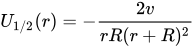
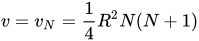
20.  [↑](https://en.wikipedia.org/wiki/Periodic_table/#cite_ref-260 "Jump up") For example, the early actinides continue to behave more like the d-block transition metals in their propensity towards high oxidation states all the way from actinium to uranium, even though it is actually only actinium and thorium that have d-block-like configurations in the gas phase; f-electrons appear already at protactinium.<sup about="#mwt2234" class="mw-ref reference" id="cite_ref-johnson_121-4" rel="dc:references" typeof="mw:Extension/ref" data-mw="{&quot;name&quot;:&quot;ref&quot;,&quot;attrs&quot;:{&quot;name&quot;:&quot;johnson&quot;}}"><a href="#cite_note-johnson-121" id="mwFKE"><span class="mw-reflink-text" id="mwFKI"><span class="cite-bracket" id="mwFKM">[</span>111<span class="cite-bracket" id="mwFKQ">]</span></span></a></sup> Uranium's actual configuration of \[Rn\]5f<sup id="mwFKU">3</sup>6d<sup id="mwFKY">1</sup>7s<sup id="mwFKc">2</sup> is in fact analogous to that Hund assumed for the lanthanides, but uranium does not favour the trivalent state, preferring to be tetravalent or hexavalent.<sup about="#mwt2236" class="mw-ref reference" id="cite_ref-rareearths_61-3" rel="dc:references" typeof="mw:Extension/ref" data-mw="{&quot;name&quot;:&quot;ref&quot;,&quot;attrs&quot;:{&quot;name&quot;:&quot;rareearths&quot;}}"><a href="#cite_note-rareearths-61" id="mwFKg"><span class="mw-reflink-text" id="mwFKk"><span class="cite-bracket" id="mwFKo">[</span>54<span class="cite-bracket" id="mwFKs">]</span></span></a></sup> On the other hand, lanthanide-like configurations for the actinides begin at plutonium, but the shift towards lanthanide-like behaviour is only clear at curium: the elements between uranium and curium form a transition from transition-metal-like behaviour to lanthanide-like behaviour.<sup about="#mwt2238" class="mw-ref reference" id="cite_ref-johnson_121-5" rel="dc:references" typeof="mw:Extension/ref" data-mw="{&quot;name&quot;:&quot;ref&quot;,&quot;attrs&quot;:{&quot;name&quot;:&quot;johnson&quot;}}"><a href="#cite_note-johnson-121" id="mwFKw"><span class="mw-reflink-text" id="mwFK0"><span class="cite-bracket" id="mwFK4">[</span>111<span class="cite-bracket" id="mwFK8">]</span></span></a></sup> Thus chemical behaviour and electron configuration do not exactly match each other.<sup about="#mwt2240" class="mw-ref reference" id="cite_ref-johnson_121-6" rel="dc:references" typeof="mw:Extension/ref" data-mw="{&quot;name&quot;:&quot;ref&quot;,&quot;attrs&quot;:{&quot;name&quot;:&quot;johnson&quot;}}"><a href="#cite_note-johnson-121" id="mwFLA"><span class="mw-reflink-text" id="mwFLE"><span class="cite-bracket" id="mwFLI">[</span>111<span class="cite-bracket" id="mwFLM">]</span></span></a></sup>
21.  [↑](https://en.wikipedia.org/wiki/Periodic_table/#cite_ref-263 "Jump up") Technetium, promethium, astatine, neptunium, and plutonium were eventually discovered to occur in nature as well, albeit in tiny traces. See [timeline of chemical element discoveries](https://en.wikipedia.org/wiki/Timeline_of_chemical_element_discoveries "Timeline of chemical element discoveries").

## References

1.  [↑](https://en.wikipedia.org/wiki/Periodic_table#cite_ref-2 "Jump up") ["Periodic Table of Elements"](https://iupac.org/what-we-do/periodic-table-of-elements/). _IUPAC | International Union of Pure and Applied Chemistry_. Retrieved 11 May 2024.
2.  [↑](https://en.wikipedia.org/wiki/Periodic_table#cite_ref-CIAAW2013_3-0 "Jump up") Meija, Juris; et al. (2016). ["Atomic weights of the elements 2013 (IUPAC Technical Report)"](https://doi.org/10.1515%2Fpac-2015-0305). _[Pure and Applied Chemistry](https://en.wikipedia.org/wiki/Pure_and_Applied_Chemistry "Pure and Applied Chemistry")_. **88** (3): 265–291\. [doi](https://en.wikipedia.org/wiki/Doi_(identifier) "Doi (identifier)"):[10.1515/pac-2015-0305](https://doi.org/10.1515%2Fpac-2015-0305).
3.  [↑](https://en.wikipedia.org/wiki/Periodic_table#cite_ref-CIAAW2021_4-0 "Jump up") Prohaska, Thomas; Irrgeher, Johanna; Benefield, Jacqueline; Böhlke, John K.; Chesson, Lesley A.; Coplen, Tyler B.; Ding, Tiping; Dunn, Philip J. H.; Gröning, Manfred; Holden, Norman E.; Meijer, Harro A. J. (4 May 2022). ["Standard atomic weights of the elements 2021 (IUPAC Technical Report)"](https://www.degruyter.com/document/doi/10.1515/pac-2019-0603/html). _Pure and Applied Chemistry_. [doi](https://en.wikipedia.org/wiki/Doi_(identifier) "Doi (identifier)"):[10.1515/pac-2019-0603](https://doi.org/10.1515%2Fpac-2019-0603). [ISSN](https://en.wikipedia.org/wiki/ISSN_(identifier) "ISSN (identifier)") [1365-3075](https://search.worldcat.org/issn/1365-3075).
4.  [↑](https://en.wikipedia.org/wiki/Periodic_table#cite_ref-neutronium_5-0 "Jump up") An [element zero](https://en.wikipedia.org/wiki/Neutronium "Neutronium") (i.e. a substance composed purely of neutrons), is included in a few alternate presentations, for example, in the [Chemical Galaxy](https://www.meta-synthesis.com/webbook/35_pt/pt_database.php?PT_id=22). See Labarca, M. (2016). "An element of atomic number zero?". _New Journal of Chemistry_. **40** (11): 9002–9006\. [doi](https://en.wikipedia.org/wiki/Doi_(identifier) "Doi (identifier)"):[10.1039/C6NJ02076C](https://doi.org/10.1039%2FC6NJ02076C). [hdl](https://en.wikipedia.org/wiki/Hdl_(identifier) "Hdl (identifier)"):[11336/46854](https://hdl.handle.net/11336%2F46854).
5.  [↑](https://en.wikipedia.org/wiki/Periodic_table#cite_ref-6 "Jump up") [IUPAC](https://en.wikipedia.org/wiki/International_Union_of_Pure_and_Applied_Chemistry "International Union of Pure and Applied Chemistry"), _[Compendium of Chemical Terminology](https://en.wikipedia.org/wiki/IUPAC_books#Gold_Book "IUPAC books")_, 5th ed. (the "Gold Book") (2025). Online version: (2006–) "[Chemical element](https://goldbook.iupac.org/terms/view/C01022.html)". [doi](https://en.wikipedia.org/wiki/Doi_(identifier) "Doi (identifier)"):[10.1351/goldbook.C01022](https://doi.org/10.1351%2Fgoldbook.C01022)
6.  [Jump up to: 1](https://en.wikipedia.org/wiki/Periodic_table#cite_ref-IUPAC-redbook_7-0) [2](https://en.wikipedia.org/wiki/Periodic_table#cite_ref-IUPAC-redbook_7-1) [3](https://en.wikipedia.org/wiki/Periodic_table#cite_ref-IUPAC-redbook_7-2) [4](https://en.wikipedia.org/wiki/Periodic_table#cite_ref-IUPAC-redbook_7-3) [5](https://en.wikipedia.org/wiki/Periodic_table#cite_ref-IUPAC-redbook_7-4) [6](https://en.wikipedia.org/wiki/Periodic_table#cite_ref-IUPAC-redbook_7-5) [7](https://en.wikipedia.org/wiki/Periodic_table#cite_ref-IUPAC-redbook_7-6) [8](https://en.wikipedia.org/wiki/Periodic_table#cite_ref-IUPAC-redbook_7-7) [9](https://en.wikipedia.org/wiki/Periodic_table#cite_ref-IUPAC-redbook_7-8) [10](https://en.wikipedia.org/wiki/Periodic_table#cite_ref-IUPAC-redbook_7-9) [11](https://en.wikipedia.org/wiki/Periodic_table#cite_ref-IUPAC-redbook_7-10) [12](https://en.wikipedia.org/wiki/Periodic_table#cite_ref-IUPAC-redbook_7-11) [13](https://en.wikipedia.org/wiki/Periodic_table#cite_ref-IUPAC-redbook_7-12) [14](https://en.wikipedia.org/wiki/Periodic_table#cite_ref-IUPAC-redbook_7-13) ["Periodic Table of Elements"](https://web.archive.org/web/20160410043726/https://iupac.org/what-we-do/periodic-table-of-elements/). _iupac.org_. IUPAC. 2021. Retrieved 3 April 2021.
7.  [↑](https://en.wikipedia.org/wiki/Periodic_table#cite_ref-ciaaw_8-0 "Jump up") ["Standard Atomic Weights"](https://www.ciaaw.org/atomic-weights.htm). _Commission on Isotopic Abundances and Atomic Weights_. International Union of Pure and Applied Chemistry. 2019. [Archived](https://web.archive.org/web/20200808155924/https://www.ciaaw.org/atomic-weights.htm) from the original on 8 August 2020. Retrieved 7 February 2021.
8.  [↑](https://en.wikipedia.org/wiki/Periodic_table#cite_ref-Greenwood_9-0 "Jump up") Greenwood & Earnshaw, pp. 24–27
9.  [↑](https://en.wikipedia.org/wiki/Periodic_table#cite_ref-10 "Jump up") Gray, p. 6
10.  [Jump up to: 1](https://en.wikipedia.org/wiki/Periodic_table#cite_ref-ThorntonBurdette_11-0) [2](https://en.wikipedia.org/wiki/Periodic_table#cite_ref-ThorntonBurdette_11-1) [3](https://en.wikipedia.org/wiki/Periodic_table#cite_ref-ThorntonBurdette_11-2) [4](https://en.wikipedia.org/wiki/Periodic_table#cite_ref-ThorntonBurdette_11-3) [5](https://en.wikipedia.org/wiki/Periodic_table#cite_ref-ThorntonBurdette_11-4) Thornton, Brett F.; Burdette, Shawn C. (2019). "Neutron stardust and the elements of Earth". _Nature Chemistry_. **11** (1): 4–10\. [Bibcode](https://en.wikipedia.org/wiki/Bibcode_(identifier) "Bibcode (identifier)"):[2019NatCh..11....4T](https://ui.adsabs.harvard.edu/abs/2019NatCh..11....4T). [doi](https://en.wikipedia.org/wiki/Doi_(identifier) "Doi (identifier)"):[10.1038/s41557-018-0190-9](https://doi.org/10.1038%2Fs41557-018-0190-9). [PMID](https://en.wikipedia.org/wiki/PMID_(identifier) "PMID (identifier)") [30552435](https://pubmed.ncbi.nlm.nih.gov/30552435). [S2CID](https://en.wikipedia.org/wiki/S2CID_(identifier) "S2CID (identifier)") [54632815](https://api.semanticscholar.org/CorpusID:54632815).
11.  [↑](https://en.wikipedia.org/wiki/Periodic_table#cite_ref-gopka08_12-0 "Jump up") Gopka, V.F.; Yushchenko, A.V.; Yushchenko, V.A.; Panov, I.V.; Kim, Ch. (15 May 2008). "Identification of absorption lines of short half-life actinides in the spectrum of Przybylski's star (HD 101065)". _Kinematics and Physics of Celestial Bodies_. **24** (2): 89–98\. [Bibcode](https://en.wikipedia.org/wiki/Bibcode_(identifier) "Bibcode (identifier)"):[2008KPCB...24...89G](https://ui.adsabs.harvard.edu/abs/2008KPCB...24...89G). [doi](https://en.wikipedia.org/wiki/Doi_(identifier) "Doi (identifier)"):[10.3103/S0884591308020049](https://doi.org/10.3103%2FS0884591308020049). [S2CID](https://en.wikipedia.org/wiki/S2CID_(identifier) "S2CID (identifier)") [120526363](https://api.semanticscholar.org/CorpusID:120526363).
12.  [Jump up to: 1](https://en.wikipedia.org/wiki/Periodic_table#cite_ref-emsley_13-0) [2](https://en.wikipedia.org/wiki/Periodic_table#cite_ref-emsley_13-1) Emsley, John (2011). _Nature's Building Blocks: An A-Z guide to the elements_ (New ed.). New York, NY: Oxford University Press. [ISBN](https://en.wikipedia.org/wiki/ISBN_(identifier) "ISBN (identifier)") [978-0-19-960563-7](https://en.wikipedia.org/wiki/Special:BookSources/978-0-19-960563-7 "Special:BookSources/978-0-19-960563-7").
13.  [↑](https://en.wikipedia.org/wiki/Periodic_table#cite_ref-14 "Jump up") Panov, I.V. (2017). "Formation of Superheavy Elements in Nature". _Physics of Atomic Nuclei_. **81** (1): 57–65\. [doi](https://en.wikipedia.org/wiki/Doi_(identifier) "Doi (identifier)"):[10.1134/S1063778818010167](https://doi.org/10.1134%2FS1063778818010167). [S2CID](https://en.wikipedia.org/wiki/S2CID_(identifier) "S2CID (identifier)") [125149409](https://api.semanticscholar.org/CorpusID:125149409).
14.  [↑](https://en.wikipedia.org/wiki/Periodic_table#cite_ref-15 "Jump up") Silva, Robert J. (2006). "Fermium, Mendelevium, Nobelium and Lawrencium". In Morss, L. R.; Edelstein, N. M.; Fuger, J. (eds.). _The Chemistry of the Actinide and Transactinide Elements_ (3rd ed.). Dordrecht: [Springer Science+Business Media](https://en.wikipedia.org/wiki/Springer_Science+Business_Media "Springer Science+Business Media"). [ISBN](https://en.wikipedia.org/wiki/ISBN_(identifier) "ISBN (identifier)") [978-1-4020-3555-5](https://en.wikipedia.org/wiki/Special:BookSources/978-1-4020-3555-5 "Special:BookSources/978-1-4020-3555-5").
15.  [↑](https://en.wikipedia.org/wiki/Periodic_table#cite_ref-Bi209alpha2_16-0 "Jump up") Marcillac, Pierre de; Noël Coron; Gérard Dambier; Jacques Leblanc; Jean-Pierre Moalic (April 2003). "Experimental detection of α-particles from the radioactive decay of natural bismuth". _Nature_. **422** (6934): 876–878\. [Bibcode](https://en.wikipedia.org/wiki/Bibcode_(identifier) "Bibcode (identifier)"):[2003Natur.422..876D](https://ui.adsabs.harvard.edu/abs/2003Natur.422..876D). [doi](https://en.wikipedia.org/wiki/Doi_(identifier) "Doi (identifier)"):[10.1038/nature01541](https://doi.org/10.1038%2Fnature01541). [PMID](https://en.wikipedia.org/wiki/PMID_(identifier) "PMID (identifier)") [12712201](https://pubmed.ncbi.nlm.nih.gov/12712201). [S2CID](https://en.wikipedia.org/wiki/S2CID_(identifier) "S2CID (identifier)") [4415582](https://api.semanticscholar.org/CorpusID:4415582).
16.  [↑](https://en.wikipedia.org/wiki/Periodic_table#cite_ref-bellidecay_17-0 "Jump up") Belli, P.; Bernabei, R.; Danevich, F. A.; et al. (2019). "Experimental searches for rare alpha and beta decays". _European Physical Journal A_. **55** (8): 140–1–140–7. [arXiv](https://en.wikipedia.org/wiki/ArXiv_(identifier) "ArXiv (identifier)"):[1908.11458](https://arxiv.org/abs/1908.11458). [Bibcode](https://en.wikipedia.org/wiki/Bibcode_(identifier) "Bibcode (identifier)"):[2019EPJA...55..140B](https://ui.adsabs.harvard.edu/abs/2019EPJA...55..140B). [doi](https://en.wikipedia.org/wiki/Doi_(identifier) "Doi (identifier)"):[10.1140/epja/i2019-12823-2](https://doi.org/10.1140%2Fepja%2Fi2019-12823-2). [S2CID](https://en.wikipedia.org/wiki/S2CID_(identifier) "S2CID (identifier)") [201664098](https://api.semanticscholar.org/CorpusID:201664098).
17.  [↑](https://en.wikipedia.org/wiki/Periodic_table#cite_ref-Tretyak2002_18-0 "Jump up") Tretyak, V.I.; Zdesenko, Yu.G. (2002). "Tables of Double Beta Decay Data — An Update". _[At. Data Nucl. Data Tables](https://en.wikipedia.org/wiki/At._Data_Nucl._Data_Tables "At. Data Nucl. Data Tables")_. **80** (1): 83–116\. [Bibcode](https://en.wikipedia.org/wiki/Bibcode_(identifier) "Bibcode (identifier)"):[2002ADNDT..80...83T](https://ui.adsabs.harvard.edu/abs/2002ADNDT..80...83T). [doi](https://en.wikipedia.org/wiki/Doi_(identifier) "Doi (identifier)"):[10.1006/adnd.2001.0873](https://doi.org/10.1006%2Fadnd.2001.0873).
18.  [↑](https://en.wikipedia.org/wiki/Periodic_table#cite_ref-PU244_20-0 "Jump up") Hoffman, D. C.; Lawrence, F. O.; Mewherter, J. L.; Rourke, F. M. (1971). "Detection of Plutonium-244 in Nature". _[Nature](https://en.wikipedia.org/wiki/Nature_(journal) "Nature (journal)")_. **234** (5325): 132–134\. [Bibcode](https://en.wikipedia.org/wiki/Bibcode_(identifier) "Bibcode (identifier)"):[1971Natur.234..132H](https://ui.adsabs.harvard.edu/abs/1971Natur.234..132H). [doi](https://en.wikipedia.org/wiki/Doi_(identifier) "Doi (identifier)"):[10.1038/234132a0](https://doi.org/10.1038%2F234132a0). [S2CID](https://en.wikipedia.org/wiki/S2CID_(identifier) "S2CID (identifier)") [4283169](https://api.semanticscholar.org/CorpusID:4283169).
19.  [↑](https://en.wikipedia.org/wiki/Periodic_table#cite_ref-PRC_21-0 "Jump up") Lachner, J.; et al. (2012). "Attempt to detect primordial <sup id="mwFck">244</sup>Pu on Earth". _Physical Review C_. **85** (1) 015801. [Bibcode](https://en.wikipedia.org/wiki/Bibcode_(identifier) "Bibcode (identifier)"):[2012PhRvC..85a5801L](https://ui.adsabs.harvard.edu/abs/2012PhRvC..85a5801L). [doi](https://en.wikipedia.org/wiki/Doi_(identifier) "Doi (identifier)"):[10.1103/PhysRevC.85.015801](https://doi.org/10.1103%2FPhysRevC.85.015801).
20.  [↑](https://en.wikipedia.org/wiki/Periodic_table#cite_ref-22 "Jump up") Wu, Yang; Dai, Xiongxin; Xing, Shan; Luo, Maoyi; Christl, Marcus; Synal, Hans-Arno; Hou, Shaochun (2022). "Direct search for primordial <sup id="mwFdU">244</sup>Pu in Bayan Obo bastnaesite". _Chinese Chemical Letters_. **33** (7): 3522–3526\. [doi](https://en.wikipedia.org/wiki/Doi_(identifier) "Doi (identifier)"):[10.1016/j.cclet.2022.03.036](https://doi.org/10.1016%2Fj.cclet.2022.03.036). [S2CID](https://en.wikipedia.org/wiki/S2CID_(identifier) "S2CID (identifier)") [247443809](https://api.semanticscholar.org/CorpusID:247443809).
21.  [↑](https://en.wikipedia.org/wiki/Periodic_table#cite_ref-WallnerFaestermann2015_24-0 "Jump up") Wallner, A.; Faestermann, T.; Feige, J.; Feldstein, C.; Knie, K.; Korschinek, G.; et al. (2015). ["Abundance of live <sup id="mwFeU">244</sup>Pu in deep-sea reservoirs on Earth points to rarity of actinide nucleosynthesis"](https://www.ncbi.nlm.nih.gov/pmc/articles/PMC4309418). _Nature Communications_. **6** 5956. [arXiv](https://en.wikipedia.org/wiki/ArXiv_(identifier) "ArXiv (identifier)"):[1509.08054](https://arxiv.org/abs/1509.08054). [Bibcode](https://en.wikipedia.org/wiki/Bibcode_(identifier) "Bibcode (identifier)"):[2015NatCo...6.5956W](https://ui.adsabs.harvard.edu/abs/2015NatCo...6.5956W). [doi](https://en.wikipedia.org/wiki/Doi_(identifier) "Doi (identifier)"):[10.1038/ncomms6956](https://doi.org/10.1038%2Fncomms6956). [PMC](https://en.wikipedia.org/wiki/PMC_(identifier) "PMC (identifier)") [4309418](https://www.ncbi.nlm.nih.gov/pmc/articles/PMC4309418). [PMID](https://en.wikipedia.org/wiki/PMID_(identifier) "PMID (identifier)") [25601158](https://pubmed.ncbi.nlm.nih.gov/25601158).
22.  [Jump up to: 1](https://en.wikipedia.org/wiki/Periodic_table#cite_ref-IUPAC_26-0) [2](https://en.wikipedia.org/wiki/Periodic_table#cite_ref-IUPAC_26-1) [3](https://en.wikipedia.org/wiki/Periodic_table#cite_ref-IUPAC_26-2) [4](https://en.wikipedia.org/wiki/Periodic_table#cite_ref-IUPAC_26-3) [5](https://en.wikipedia.org/wiki/Periodic_table#cite_ref-IUPAC_26-4) [6](https://en.wikipedia.org/wiki/Periodic_table#cite_ref-IUPAC_26-5) [7](https://en.wikipedia.org/wiki/Periodic_table#cite_ref-IUPAC_26-6) [8](https://en.wikipedia.org/wiki/Periodic_table#cite_ref-IUPAC_26-7) Connelly, N. G.; Damhus, T.; Hartshorn, R. M.; Hutton, A. T. (2005). [_Nomenclature of Inorganic Chemistry: IUPAC Recommendations 2005_](https://old.iupac.org/publications/books/rbook/Red_Book_2005.pdf) (PDF). RSC Publishing. p. 51\. [ISBN](https://en.wikipedia.org/wiki/ISBN_(identifier) "ISBN (identifier)") [978-0-85404-438-2](https://en.wikipedia.org/wiki/Special:BookSources/978-0-85404-438-2 "Special:BookSources/978-0-85404-438-2"). [Archived](https://web.archive.org/web/20181123034019/https://old.iupac.org/publications/books/rbook/Red_Book_2005.pdf) (PDF) from the original on 23 November 2018. Retrieved 26 November 2018.
23.  [Jump up to: 1](https://en.wikipedia.org/wiki/Periodic_table#cite_ref-Fluck_27-0) [2](https://en.wikipedia.org/wiki/Periodic_table#cite_ref-Fluck_27-1) [3](https://en.wikipedia.org/wiki/Periodic_table#cite_ref-Fluck_27-2) [4](https://en.wikipedia.org/wiki/Periodic_table#cite_ref-Fluck_27-3) [5](https://en.wikipedia.org/wiki/Periodic_table#cite_ref-Fluck_27-4) [6](https://en.wikipedia.org/wiki/Periodic_table#cite_ref-Fluck_27-5) [7](https://en.wikipedia.org/wiki/Periodic_table#cite_ref-Fluck_27-6) [8](https://en.wikipedia.org/wiki/Periodic_table#cite_ref-Fluck_27-7) [9](https://en.wikipedia.org/wiki/Periodic_table#cite_ref-Fluck_27-8) Fluck, E. (1988). ["New Notations in the Periodic Table"](https://www.iupac.org/publications/pac/1988/pdf/6003x0431.pdf) (PDF). _[Pure Appl. Chem.](https://en.wikipedia.org/wiki/Pure_and_Applied_Chemistry "Pure and Applied Chemistry")_ **60** (3): 431–436\. [doi](https://en.wikipedia.org/wiki/Doi_(identifier) "Doi (identifier)"):[10.1351/pac198860030431](https://doi.org/10.1351%2Fpac198860030431). [S2CID](https://en.wikipedia.org/wiki/S2CID_(identifier) "S2CID (identifier)") [96704008](https://api.semanticscholar.org/CorpusID:96704008). [Archived](https://web.archive.org/web/20120325152951/https://www.iupac.org/publications/pac/1988/pdf/6003x0431.pdf) (PDF) from the original on 25 March 2012. Retrieved 24 March 2012.
24.  [Jump up to: 1](https://en.wikipedia.org/wiki/Periodic_table#cite_ref-2021IUPAC_28-0) [2](https://en.wikipedia.org/wiki/Periodic_table#cite_ref-2021IUPAC_28-1) [3](https://en.wikipedia.org/wiki/Periodic_table#cite_ref-2021IUPAC_28-2) [4](https://en.wikipedia.org/wiki/Periodic_table#cite_ref-2021IUPAC_28-3) [5](https://en.wikipedia.org/wiki/Periodic_table#cite_ref-2021IUPAC_28-4) [6](https://en.wikipedia.org/wiki/Periodic_table#cite_ref-2021IUPAC_28-5) [7](https://en.wikipedia.org/wiki/Periodic_table#cite_ref-2021IUPAC_28-6) [8](https://en.wikipedia.org/wiki/Periodic_table#cite_ref-2021IUPAC_28-7) Scerri, Eric (18 January 2021). ["Provisional Report on Discussions on Group 3 of the Periodic Table"](https://iupac.org/wp-content/uploads/2021/04/ChemInt_Jan2021_PP.pdf) (PDF). _Chemistry International_. **43** (1): 31–34\. [doi](https://en.wikipedia.org/wiki/Doi_(identifier) "Doi (identifier)"):[10.1515/ci-2021-0115](https://doi.org/10.1515%2Fci-2021-0115). [S2CID](https://en.wikipedia.org/wiki/S2CID_(identifier) "S2CID (identifier)") [231694898](https://api.semanticscholar.org/CorpusID:231694898). [Archived](https://web.archive.org/web/20210413150110/https://iupac.org/wp-content/uploads/2021/04/ChemInt_Jan2021_PP.pdf) (PDF) from the original on 13 April 2021. Retrieved 9 April 2021.
25.  [Jump up to: 1](https://en.wikipedia.org/wiki/Periodic_table#cite_ref-Jensen1982_29-0) [2](https://en.wikipedia.org/wiki/Periodic_table#cite_ref-Jensen1982_29-1) [3](https://en.wikipedia.org/wiki/Periodic_table#cite_ref-Jensen1982_29-2) [4](https://en.wikipedia.org/wiki/Periodic_table#cite_ref-Jensen1982_29-3) [5](https://en.wikipedia.org/wiki/Periodic_table#cite_ref-Jensen1982_29-4) [6](https://en.wikipedia.org/wiki/Periodic_table#cite_ref-Jensen1982_29-5) [7](https://en.wikipedia.org/wiki/Periodic_table#cite_ref-Jensen1982_29-6) [8](https://en.wikipedia.org/wiki/Periodic_table#cite_ref-Jensen1982_29-7) [9](https://en.wikipedia.org/wiki/Periodic_table#cite_ref-Jensen1982_29-8) [10](https://en.wikipedia.org/wiki/Periodic_table#cite_ref-Jensen1982_29-9) William B. Jensen (1982). "The Positions of Lanthanum (Actinium) and Lutetium (Lawrencium) in the Periodic Table". _J. Chem. Educ_. **59** (8): 634–636\. [Bibcode](https://en.wikipedia.org/wiki/Bibcode_(identifier) "Bibcode (identifier)"):[1982JChEd..59..634J](https://ui.adsabs.harvard.edu/abs/1982JChEd..59..634J). [doi](https://en.wikipedia.org/wiki/Doi_(identifier) "Doi (identifier)"):[10.1021/ed059p634](https://doi.org/10.1021%2Fed059p634).
26.  [Jump up to: 1](https://en.wikipedia.org/wiki/Periodic_table#cite_ref-Landau_30-0) [2](https://en.wikipedia.org/wiki/Periodic_table#cite_ref-Landau_30-1) [3](https://en.wikipedia.org/wiki/Periodic_table#cite_ref-Landau_30-2) [L. D. Landau](https://en.wikipedia.org/wiki/Lev_Landau "Lev Landau"), [E. M. Lifshitz](https://en.wikipedia.org/wiki/Evgeny_Lifshitz "Evgeny Lifshitz") (1958). _Quantum Mechanics: Non-Relativistic Theory_. Vol. 3 (1st ed.). [Pergamon Press](https://en.wikipedia.org/wiki/Pergamon_Press "Pergamon Press"). pp. 256–7.
27.  [↑](https://en.wikipedia.org/wiki/Periodic_table#cite_ref-Jensen2015_31-0 "Jump up") Jensen, William B. (2015). ["The positions of lanthanum (actinium) and lutetium (lawrencium) in the periodic table: an update"](https://link.springer.com/article/10.1007/s10698-015-9216-1). _Foundations of Chemistry_. **17**: 23–31\. [doi](https://en.wikipedia.org/wiki/Doi_(identifier) "Doi (identifier)"):[10.1007/s10698-015-9216-1](https://doi.org/10.1007%2Fs10698-015-9216-1). [S2CID](https://en.wikipedia.org/wiki/S2CID_(identifier) "S2CID (identifier)") [98624395](https://api.semanticscholar.org/CorpusID:98624395). [Archived](https://web.archive.org/web/20210130011116/https://link.springer.com/article/10.1007/s10698-015-9216-1) from the original on 30 January 2021. Retrieved 28 January 2021.
28.  [Jump up to: 1](https://en.wikipedia.org/wiki/Periodic_table#cite_ref-Scerri2009_32-0) [2](https://en.wikipedia.org/wiki/Periodic_table#cite_ref-Scerri2009_32-1) [3](https://en.wikipedia.org/wiki/Periodic_table#cite_ref-Scerri2009_32-2) Scerri, Eric (2009). ["Which Elements Belong in Group 3?"](https://pubs.acs.org/doi/pdf/10.1021/ed086p1188). _Journal of Chemical Education_. **86** (10): 1188. [doi](https://en.wikipedia.org/wiki/Doi_(identifier) "Doi (identifier)"):[10.1021/ed086p1188](https://doi.org/10.1021%2Fed086p1188). Retrieved 1 January 2023.
29.  [Jump up to: 1](https://en.wikipedia.org/wiki/Periodic_table#cite_ref-Chemey_33-0) [2](https://en.wikipedia.org/wiki/Periodic_table#cite_ref-Chemey_33-1) Chemey, Alexander T.; Albrecht-Schmitt, Thomas E. (2019). "Evolution of the periodic table through the synthesis of new elements". _Radiochimica Acta_. **107** (9–11): 1–31\. [doi](https://en.wikipedia.org/wiki/Doi_(identifier) "Doi (identifier)"):[10.1515/ract-2018-3082](https://doi.org/10.1515%2Fract-2018-3082).
30.  [Jump up to: 1](https://en.wikipedia.org/wiki/Periodic_table#cite_ref-Petrucci331_34-0) [2](https://en.wikipedia.org/wiki/Periodic_table#cite_ref-Petrucci331_34-1) [3](https://en.wikipedia.org/wiki/Periodic_table#cite_ref-Petrucci331_34-2) [4](https://en.wikipedia.org/wiki/Periodic_table#cite_ref-Petrucci331_34-3) [5](https://en.wikipedia.org/wiki/Periodic_table#cite_ref-Petrucci331_34-4) [6](https://en.wikipedia.org/wiki/Periodic_table#cite_ref-Petrucci331_34-5) [7](https://en.wikipedia.org/wiki/Periodic_table#cite_ref-Petrucci331_34-6) [8](https://en.wikipedia.org/wiki/Periodic_table#cite_ref-Petrucci331_34-7) [9](https://en.wikipedia.org/wiki/Periodic_table#cite_ref-Petrucci331_34-8) [10](https://en.wikipedia.org/wiki/Periodic_table#cite_ref-Petrucci331_34-9) Petrucci et al., p. 331
31.  [↑](https://en.wikipedia.org/wiki/Periodic_table#cite_ref-35 "Jump up") Pfeiffer, Paul (1920). "Die Befruchtung der Chemie durch die Röntgenstrahlenphysik". _Naturwissenschaften_ (in German). **8** (50): 984–991\. [Bibcode](https://en.wikipedia.org/wiki/Bibcode_(identifier) "Bibcode (identifier)"):[1920NW......8..984P](https://ui.adsabs.harvard.edu/abs/1920NW......8..984P). [doi](https://en.wikipedia.org/wiki/Doi_(identifier) "Doi (identifier)"):[10.1007/BF02448807](https://doi.org/10.1007%2FBF02448807). [S2CID](https://en.wikipedia.org/wiki/S2CID_(identifier) "S2CID (identifier)") [7071495](https://api.semanticscholar.org/CorpusID:7071495).
32.  [Jump up to: 1](https://en.wikipedia.org/wiki/Periodic_table#cite_ref-cartoon_36-0) [2](https://en.wikipedia.org/wiki/Periodic_table#cite_ref-cartoon_36-1) [3](https://en.wikipedia.org/wiki/Periodic_table#cite_ref-cartoon_36-2) [4](https://en.wikipedia.org/wiki/Periodic_table#cite_ref-cartoon_36-3) [5](https://en.wikipedia.org/wiki/Periodic_table#cite_ref-cartoon_36-4) [6](https://en.wikipedia.org/wiki/Periodic_table#cite_ref-cartoon_36-5) [7](https://en.wikipedia.org/wiki/Periodic_table#cite_ref-cartoon_36-6) [8](https://en.wikipedia.org/wiki/Periodic_table#cite_ref-cartoon_36-7) [9](https://en.wikipedia.org/wiki/Periodic_table#cite_ref-cartoon_36-8) [10](https://en.wikipedia.org/wiki/Periodic_table#cite_ref-cartoon_36-9) [11](https://en.wikipedia.org/wiki/Periodic_table#cite_ref-cartoon_36-10) [12](https://en.wikipedia.org/wiki/Periodic_table#cite_ref-cartoon_36-11) [13](https://en.wikipedia.org/wiki/Periodic_table#cite_ref-cartoon_36-12) [14](https://en.wikipedia.org/wiki/Periodic_table#cite_ref-cartoon_36-13) [15](https://en.wikipedia.org/wiki/Periodic_table#cite_ref-cartoon_36-14) [16](https://en.wikipedia.org/wiki/Periodic_table#cite_ref-cartoon_36-15) [17](https://en.wikipedia.org/wiki/Periodic_table#cite_ref-cartoon_36-16) [18](https://en.wikipedia.org/wiki/Periodic_table#cite_ref-cartoon_36-17) [19](https://en.wikipedia.org/wiki/Periodic_table#cite_ref-cartoon_36-18) [20](https://en.wikipedia.org/wiki/Periodic_table#cite_ref-cartoon_36-19) Gonick, First; Criddle, Craig (2005). _The Cartoon Guide to Chemistry_. Collins. pp. 17–65\. [ISBN](https://en.wikipedia.org/wiki/ISBN_(identifier) "ISBN (identifier)") [0-06-093677-0](https://en.wikipedia.org/wiki/Special:BookSources/0-06-093677-0 "Special:BookSources/0-06-093677-0").
33.  [Jump up to: 1](https://en.wikipedia.org/wiki/Periodic_table#cite_ref-Thyssen_37-0) [2](https://en.wikipedia.org/wiki/Periodic_table#cite_ref-Thyssen_37-1) [3](https://en.wikipedia.org/wiki/Periodic_table#cite_ref-Thyssen_37-2) [4](https://en.wikipedia.org/wiki/Periodic_table#cite_ref-Thyssen_37-3) [5](https://en.wikipedia.org/wiki/Periodic_table#cite_ref-Thyssen_37-4) [6](https://en.wikipedia.org/wiki/Periodic_table#cite_ref-Thyssen_37-5) [7](https://en.wikipedia.org/wiki/Periodic_table#cite_ref-Thyssen_37-6) [8](https://en.wikipedia.org/wiki/Periodic_table#cite_ref-Thyssen_37-7) [9](https://en.wikipedia.org/wiki/Periodic_table#cite_ref-Thyssen_37-8) [10](https://en.wikipedia.org/wiki/Periodic_table#cite_ref-Thyssen_37-9) Thyssen, P.; Binnemans, K. (2011). "Accommodation of the Rare Earths in the Periodic Table: A Historical Analysis". In Gschneidner, K. A. Jr.; Bünzli, J-C.G; Vecharsky, Bünzli (eds.). _Handbook on the Physics and Chemistry of Rare Earths_. Vol. 41\. Amsterdam: Elsevier. pp. 1–93\. [doi](https://en.wikipedia.org/wiki/Doi_(identifier) "Doi (identifier)"):[10.1016/B978-0-444-53590-0.00001-7](https://doi.org/10.1016%2FB978-0-444-53590-0.00001-7). [ISBN](https://en.wikipedia.org/wiki/ISBN_(identifier) "ISBN (identifier)") [978-0-444-53590-0](https://en.wikipedia.org/wiki/Special:BookSources/978-0-444-53590-0 "Special:BookSources/978-0-444-53590-0").
34.  [↑](https://en.wikipedia.org/wiki/Periodic_table#cite_ref-38 "Jump up") Scerri, p. 375
35.  [Jump up to: 1](https://en.wikipedia.org/wiki/Periodic_table#cite_ref-2015IUPAC_39-0) [2](https://en.wikipedia.org/wiki/Periodic_table#cite_ref-2015IUPAC_39-1) ["The constitution of group 3 of the periodic table"](https://iupac.org/projects/project-details/?project_nr=2015-039-2-200). IUPAC. 2015. [Archived](https://web.archive.org/web/20160705053631/https://iupac.org/projects/project-details/?project_nr=2015-039-2-200) from the original on 5 July 2016. Retrieved 30 July 2016.
36.  [Jump up to: 1](https://en.wikipedia.org/wiki/Periodic_table#cite_ref-Scerri17_41-0) [2](https://en.wikipedia.org/wiki/Periodic_table#cite_ref-Scerri17_41-1) Scerri, p. 17
37.  [↑](https://en.wikipedia.org/wiki/Periodic_table#cite_ref-42 "Jump up") ["periodic law"](https://www.merriam-webster.com/dictionary/periodic%20law). _[Merriam-Webster.com Dictionary](https://en.wikipedia.org/wiki/Merriam-Webster "Merriam-Webster")_. Merriam-Webster. [OCLC](https://en.wikipedia.org/wiki/OCLC_(identifier) "OCLC (identifier)") [1032680871](https://search.worldcat.org/oclc/1032680871). Retrieved 29 March 2021.
38.  [Jump up to: 1](https://en.wikipedia.org/wiki/Periodic_table#cite_ref-Jensen2009_43-0) [2](https://en.wikipedia.org/wiki/Periodic_table#cite_ref-Jensen2009_43-1) [3](https://en.wikipedia.org/wiki/Periodic_table#cite_ref-Jensen2009_43-2) [Jensen, William B.](https://en.wikipedia.org/wiki/William_B._Jensen "William B. Jensen") (2009). ["Misapplying the Periodic Law"](https://doi.org/10.1021%2Fed086p1186). _Journal of Chemical Education_. **86** (10): 1186. [Bibcode](https://en.wikipedia.org/wiki/Bibcode_(identifier) "Bibcode (identifier)"):[2009JChEd..86.1186J](https://ui.adsabs.harvard.edu/abs/2009JChEd..86.1186J). [doi](https://en.wikipedia.org/wiki/Doi_(identifier) "Doi (identifier)"):[10.1021/ed086p1186](https://doi.org/10.1021%2Fed086p1186).
39.  [Jump up to: 1](https://en.wikipedia.org/wiki/Periodic_table#cite_ref-FIII19_44-0) [2](https://en.wikipedia.org/wiki/Periodic_table#cite_ref-FIII19_44-1) [3](https://en.wikipedia.org/wiki/Periodic_table#cite_ref-FIII19_44-2) [4](https://en.wikipedia.org/wiki/Periodic_table#cite_ref-FIII19_44-3) [5](https://en.wikipedia.org/wiki/Periodic_table#cite_ref-FIII19_44-4) [6](https://en.wikipedia.org/wiki/Periodic_table#cite_ref-FIII19_44-5) [7](https://en.wikipedia.org/wiki/Periodic_table#cite_ref-FIII19_44-6) [8](https://en.wikipedia.org/wiki/Periodic_table#cite_ref-FIII19_44-7) [9](https://en.wikipedia.org/wiki/Periodic_table#cite_ref-FIII19_44-8) [10](https://en.wikipedia.org/wiki/Periodic_table#cite_ref-FIII19_44-9) [11](https://en.wikipedia.org/wiki/Periodic_table#cite_ref-FIII19_44-10) Feynman, Richard; Leighton, Robert B.; Sands, Matthew (1970). "19. The Hydrogen Atom and The Periodic Table". [_The Feynman Lectures on Physics_](https://feynmanlectures.caltech.edu/III_19.html). Vol. 3\. Addison–Wesley. [ISBN](https://en.wikipedia.org/wiki/ISBN_(identifier) "ISBN (identifier)") [0-201-02115-3](https://en.wikipedia.org/wiki/Special:BookSources/0-201-02115-3 "Special:BookSources/0-201-02115-3"). [Archived](https://web.archive.org/web/20211019202245/https://www.feynmanlectures.caltech.edu/III_19.html) from the original on 19 October 2021. Retrieved 15 August 2021.
40.  [↑](https://en.wikipedia.org/wiki/Periodic_table#cite_ref-45 "Jump up") Petrucci et al., p. 323
41.  [↑](https://en.wikipedia.org/wiki/Periodic_table#cite_ref-46 "Jump up") Petrucci et al., p. 306
42.  [↑](https://en.wikipedia.org/wiki/Periodic_table#cite_ref-48 "Jump up") Petrucci et al., p. 322
43.  [↑](https://en.wikipedia.org/wiki/Periodic_table#cite_ref-49 "Jump up") Ball, David W.; Key, Jessie A. (2011). [_Introductory Chemistry_](https://opentextbc.ca/introductorychemistry/chapter/electronic-structure-and-the-periodic-table/) (1st Canadian ed.). Vancouver, British Columbia: BC Campus. [ISBN](https://en.wikipedia.org/wiki/ISBN_(identifier) "ISBN (identifier)") [978-1-77420-003-2](https://en.wikipedia.org/wiki/Special:BookSources/978-1-77420-003-2 "Special:BookSources/978-1-77420-003-2"). [Archived](https://web.archive.org/web/20210815072718/https://opentextbc.ca/introductorychemistry/chapter/electronic-structure-and-the-periodic-table/) from the original on 15 August 2021. Retrieved 15 August 2021.
44.  [↑](https://en.wikipedia.org/wiki/Periodic_table#cite_ref-50 "Jump up") ["Electron Configurations"](https://www.chem.fsu.edu/chemlab/chm1045/e_config.html). _chem.fsu.edu_. Florida State University. 6 May 2020. [Archived](https://web.archive.org/web/20220506074340/https://www.chem.fsu.edu/chemlab/chm1045/e_config.html) from the original on 6 May 2022. Retrieved 17 April 2022.
45.  [Jump up to: 1](https://en.wikipedia.org/wiki/Periodic_table#cite_ref-Goudsmit_51-0) [2](https://en.wikipedia.org/wiki/Periodic_table#cite_ref-Goudsmit_51-1) [3](https://en.wikipedia.org/wiki/Periodic_table#cite_ref-Goudsmit_51-2) [4](https://en.wikipedia.org/wiki/Periodic_table#cite_ref-Goudsmit_51-3) Goudsmit, S. A.; Richards, Paul I. (1964). ["The Order of Electron Shells in Ionized Atoms"](https://www.pnas.org/content/51/4/664.full.pdf) (PDF). _[Proc. Natl. Acad. Sci.](https://en.wikipedia.org/wiki/Proceedings_of_the_National_Academy_of_Sciences_of_the_United_States_of_America "Proceedings of the National Academy of Sciences of the United States of America")_ **51** (4): 664–671 (with correction on p 906). [Bibcode](https://en.wikipedia.org/wiki/Bibcode_(identifier) "Bibcode (identifier)"):[1964PNAS...51..664G](https://ui.adsabs.harvard.edu/abs/1964PNAS...51..664G). [doi](https://en.wikipedia.org/wiki/Doi_(identifier) "Doi (identifier)"):[10.1073/pnas.51.4.664](https://doi.org/10.1073%2Fpnas.51.4.664). [OSTI](https://en.wikipedia.org/wiki/OSTI_(identifier) "OSTI (identifier)") [4007960](https://www.osti.gov/biblio/4007960). [PMC](https://en.wikipedia.org/wiki/PMC_(identifier) "PMC (identifier)") [300183](https://www.ncbi.nlm.nih.gov/pmc/articles/PMC300183). [PMID](https://en.wikipedia.org/wiki/PMID_(identifier) "PMID (identifier)") [16591167](https://pubmed.ncbi.nlm.nih.gov/16591167). [Archived](https://web.archive.org/web/20171010113455/https://www.pnas.org/content/51/4/664.full.pdf) (PDF) from the original on 10 October 2017. Retrieved 15 August 2021.
46.  [↑](https://en.wikipedia.org/wiki/Periodic_table#cite_ref-Jolly_52-0 "Jump up") Jolly, William L. (1984). [_Modern Inorganic Chemistry_](https://archive.org/details/trent_0116300649799/page/10) (1st ed.). McGraw-Hill. pp. [10–12](https://archive.org/details/trent_0116300649799/page/10). [ISBN](https://en.wikipedia.org/wiki/ISBN_(identifier) "ISBN (identifier)") [0-07-032760-2](https://en.wikipedia.org/wiki/Special:BookSources/0-07-032760-2 "Special:BookSources/0-07-032760-2").
47.  [Jump up to: 1](https://en.wikipedia.org/wiki/Periodic_table#cite_ref-Ostrovsky_53-0) [2](https://en.wikipedia.org/wiki/Periodic_table#cite_ref-Ostrovsky_53-1) [3](https://en.wikipedia.org/wiki/Periodic_table#cite_ref-Ostrovsky_53-2) [4](https://en.wikipedia.org/wiki/Periodic_table#cite_ref-Ostrovsky_53-3) [5](https://en.wikipedia.org/wiki/Periodic_table#cite_ref-Ostrovsky_53-4) Ostrovsky, V. N. (May 2001). "What and How Physics Contributes to Understanding the Periodic Law". _Foundations of Chemistry_. **3** (2): 145–181\. [doi](https://en.wikipedia.org/wiki/Doi_(identifier) "Doi (identifier)"):[10.1023/A:1011476405933](https://doi.org/10.1023%2FA%3A1011476405933). [S2CID](https://en.wikipedia.org/wiki/S2CID_(identifier) "S2CID (identifier)") [15679915](https://api.semanticscholar.org/CorpusID:15679915).
48.  [Jump up to: 1](https://en.wikipedia.org/wiki/Periodic_table#cite_ref-Ostrovsky1981_54-0) [2](https://en.wikipedia.org/wiki/Periodic_table#cite_ref-Ostrovsky1981_54-1) Ostrovsky, V. N. (1981). "Dynamic symmetry of atomic potential". _Journal of Physics B: Atomic and Molecular Physics_. **14** (23): 4425–4439\. [Bibcode](https://en.wikipedia.org/wiki/Bibcode_(identifier) "Bibcode (identifier)"):[1981JPhB...14.4425O](https://ui.adsabs.harvard.edu/abs/1981JPhB...14.4425O). [doi](https://en.wikipedia.org/wiki/Doi_(identifier) "Doi (identifier)"):[10.1088/0022-3700/14/23/008](https://doi.org/10.1088%2F0022-3700%2F14%2F23%2F008).
49.  [Jump up to: 1](https://en.wikipedia.org/wiki/Periodic_table#cite_ref-Wong_55-0) [2](https://en.wikipedia.org/wiki/Periodic_table#cite_ref-Wong_55-1) Wong, D. Pan (1979). "Theoretical justification of Madelung's rule". _[J. Chem. Educ.](https://en.wikipedia.org/wiki/Journal_of_Chemical_Education "Journal of Chemical Education")_ **56** (11): 714–718\. [Bibcode](https://en.wikipedia.org/wiki/Bibcode_(identifier) "Bibcode (identifier)"):[1979JChEd..56..714W](https://ui.adsabs.harvard.edu/abs/1979JChEd..56..714W). [doi](https://en.wikipedia.org/wiki/Doi_(identifier) "Doi (identifier)"):[10.1021/ed056p714](https://doi.org/10.1021%2Fed056p714).
50.  [Jump up to: 1](https://en.wikipedia.org/wiki/Periodic_table#cite_ref-Petrucci328_57-0) [2](https://en.wikipedia.org/wiki/Periodic_table#cite_ref-Petrucci328_57-1) [3](https://en.wikipedia.org/wiki/Periodic_table#cite_ref-Petrucci328_57-2) Petrucci et al., p. 328
51.  [Jump up to: 1](https://en.wikipedia.org/wiki/Periodic_table#cite_ref-Cao_58-0) [2](https://en.wikipedia.org/wiki/Periodic_table#cite_ref-Cao_58-1) Cao, Changsu; Vernon, René E.; Schwarz, W. H. Eugen; Li, Jun (6 January 2021). ["Understanding Periodic and Non-periodic Chemistry in Periodic Tables"](https://www.ncbi.nlm.nih.gov/pmc/articles/PMC7818537). _Frontiers in Chemistry_. **8** (813): 813. [Bibcode](https://en.wikipedia.org/wiki/Bibcode_(identifier) "Bibcode (identifier)"):[2021FrCh....8..813S](https://ui.adsabs.harvard.edu/abs/2021FrCh....8..813S). [doi](https://en.wikipedia.org/wiki/Doi_(identifier) "Doi (identifier)"):[10.3389/fchem.2020.00813](https://doi.org/10.3389%2Ffchem.2020.00813). [PMC](https://en.wikipedia.org/wiki/PMC_(identifier) "PMC (identifier)") [7818537](https://www.ncbi.nlm.nih.gov/pmc/articles/PMC7818537). [PMID](https://en.wikipedia.org/wiki/PMID_(identifier) "PMID (identifier)") [33490030](https://pubmed.ncbi.nlm.nih.gov/33490030).
52.  [Jump up to: 1](https://en.wikipedia.org/wiki/Periodic_table#cite_ref-Jorgensen_59-0) [2](https://en.wikipedia.org/wiki/Periodic_table#cite_ref-Jorgensen_59-1) [3](https://en.wikipedia.org/wiki/Periodic_table#cite_ref-Jorgensen_59-2) [4](https://en.wikipedia.org/wiki/Periodic_table#cite_ref-Jorgensen_59-3) [5](https://en.wikipedia.org/wiki/Periodic_table#cite_ref-Jorgensen_59-4) [6](https://en.wikipedia.org/wiki/Periodic_table#cite_ref-Jorgensen_59-5) [7](https://en.wikipedia.org/wiki/Periodic_table#cite_ref-Jorgensen_59-6) Jørgensen, Christian (1973). "The Loose Connection between Electron Configuration and the Chemical Behavior of the Heavy Elements (Transuranics)". _Angewandte Chemie International Edition_. **12** (1): 12–19\. [doi](https://en.wikipedia.org/wiki/Doi_(identifier) "Doi (identifier)"):[10.1002/anie.197300121](https://doi.org/10.1002%2Fanie.197300121).
53.  [Jump up to: 1](https://en.wikipedia.org/wiki/Periodic_table#cite_ref-elyashevich_60-0) [2](https://en.wikipedia.org/wiki/Periodic_table#cite_ref-elyashevich_60-1) El'yashevich, M. A. (1953). _Spectra of the Rare Earths_. Moscow: State Publishing House of Technical-Theoretical Literature. pp. 382, 397.
54.  [Jump up to: 1](https://en.wikipedia.org/wiki/Periodic_table#cite_ref-rareearths_61-0) [2](https://en.wikipedia.org/wiki/Periodic_table#cite_ref-rareearths_61-1) [3](https://en.wikipedia.org/wiki/Periodic_table#cite_ref-rareearths_61-2) [4](https://en.wikipedia.org/wiki/Periodic_table#cite_ref-rareearths_61-3) [5](https://en.wikipedia.org/wiki/Periodic_table#cite_ref-rareearths_61-4) [6](https://en.wikipedia.org/wiki/Periodic_table#cite_ref-rareearths_61-5) Jørgensen, Christian Klixbüll (1988). "Influence of Rare Earths on Chemical Understanding and Classification". In Gschneidner Jr., Karl A.; Eyring, Leroy (eds.). _Handbook on the Physics and Chemistry of Rare Earths_. Vol. 11\. Elsevier. pp. 197–292\. [ISBN](https://en.wikipedia.org/wiki/ISBN_(identifier) "ISBN (identifier)") [978-0-444-87080-3](https://en.wikipedia.org/wiki/Special:BookSources/978-0-444-87080-3 "Special:BookSources/978-0-444-87080-3").
55.  [↑](https://en.wikipedia.org/wiki/Periodic_table#cite_ref-62 "Jump up") NIST (2023). ["NIST Atomic Spectra Database: Ionization Energies Data: All Ho-like"](https://physics.nist.gov/cgi-bin/ASD/ie.pl?spectra=Ho-like&submit=Retrieve+Data&units=1&format=0&order=0&at_num_out=on&sp_name_out=on&ion_charge_out=on&el_name_out=on&seq_out=on&shells_out=on&level_out=on&ion_conf_out=on&e_out=0&unc_out=on&biblio=on). _nist.gov_. NIST. Retrieved 5 January 2024.
56.  [↑](https://en.wikipedia.org/wiki/Periodic_table#cite_ref-63 "Jump up") Tossell, J.A. (1 November 1977). "Theoretical studies of valence orbital binding energies in solid zinc sulfide, zinc oxide, and zinc fluoride". _Inorganic Chemistry_. **16** (11): 2944–2949\. [doi](https://en.wikipedia.org/wiki/Doi_(identifier) "Doi (identifier)"):[10.1021/ic50177a056](https://doi.org/10.1021%2Fic50177a056).
57.  [Jump up to: 1](https://en.wikipedia.org/wiki/Periodic_table#cite_ref-KW_64-0) [2](https://en.wikipedia.org/wiki/Periodic_table#cite_ref-KW_64-1) [3](https://en.wikipedia.org/wiki/Periodic_table#cite_ref-KW_64-2) [4](https://en.wikipedia.org/wiki/Periodic_table#cite_ref-KW_64-3) [5](https://en.wikipedia.org/wiki/Periodic_table#cite_ref-KW_64-4) [6](https://en.wikipedia.org/wiki/Periodic_table#cite_ref-KW_64-5) [7](https://en.wikipedia.org/wiki/Periodic_table#cite_ref-KW_64-6) [8](https://en.wikipedia.org/wiki/Periodic_table#cite_ref-KW_64-7) [9](https://en.wikipedia.org/wiki/Periodic_table#cite_ref-KW_64-8) [10](https://en.wikipedia.org/wiki/Periodic_table#cite_ref-KW_64-9) Keeler, James; Wothers, Peter (2014). _Chemical Structure and Reactivity_ (2nd ed.). Oxford University Press. pp. 257–260\. [ISBN](https://en.wikipedia.org/wiki/ISBN_(identifier) "ISBN (identifier)") [978-0-19-9604135](https://en.wikipedia.org/wiki/Special:BookSources/978-0-19-9604135 "Special:BookSources/978-0-19-9604135").
58.  [Jump up to: 1](https://en.wikipedia.org/wiki/Periodic_table#cite_ref-jensenlaw_66-0) [2](https://en.wikipedia.org/wiki/Periodic_table#cite_ref-jensenlaw_66-1) [3](https://en.wikipedia.org/wiki/Periodic_table#cite_ref-jensenlaw_66-2) [4](https://en.wikipedia.org/wiki/Periodic_table#cite_ref-jensenlaw_66-3) [5](https://en.wikipedia.org/wiki/Periodic_table#cite_ref-jensenlaw_66-4) [6](https://en.wikipedia.org/wiki/Periodic_table#cite_ref-jensenlaw_66-5) [7](https://en.wikipedia.org/wiki/Periodic_table#cite_ref-jensenlaw_66-6) [8](https://en.wikipedia.org/wiki/Periodic_table#cite_ref-jensenlaw_66-7) [9](https://en.wikipedia.org/wiki/Periodic_table#cite_ref-jensenlaw_66-8) [10](https://en.wikipedia.org/wiki/Periodic_table#cite_ref-jensenlaw_66-9) [11](https://en.wikipedia.org/wiki/Periodic_table#cite_ref-jensenlaw_66-10) [12](https://en.wikipedia.org/wiki/Periodic_table#cite_ref-jensenlaw_66-11) [13](https://en.wikipedia.org/wiki/Periodic_table#cite_ref-jensenlaw_66-12) [14](https://en.wikipedia.org/wiki/Periodic_table#cite_ref-jensenlaw_66-13) [15](https://en.wikipedia.org/wiki/Periodic_table#cite_ref-jensenlaw_66-14) [16](https://en.wikipedia.org/wiki/Periodic_table#cite_ref-jensenlaw_66-15) [17](https://en.wikipedia.org/wiki/Periodic_table#cite_ref-jensenlaw_66-16) [18](https://en.wikipedia.org/wiki/Periodic_table#cite_ref-jensenlaw_66-17) [19](https://en.wikipedia.org/wiki/Periodic_table#cite_ref-jensenlaw_66-18) [20](https://en.wikipedia.org/wiki/Periodic_table#cite_ref-jensenlaw_66-19) [21](https://en.wikipedia.org/wiki/Periodic_table#cite_ref-jensenlaw_66-20) [22](https://en.wikipedia.org/wiki/Periodic_table#cite_ref-jensenlaw_66-21) [23](https://en.wikipedia.org/wiki/Periodic_table#cite_ref-jensenlaw_66-22) [24](https://en.wikipedia.org/wiki/Periodic_table#cite_ref-jensenlaw_66-23) [25](https://en.wikipedia.org/wiki/Periodic_table#cite_ref-jensenlaw_66-24) [Jensen, William B.](https://en.wikipedia.org/wiki/William_B._Jensen "William B. Jensen") (2000). ["The Periodic Law and Table"](https://web.archive.org/web/20201110113324/http://www.che.uc.edu/jensen/W.%20B.%20Jensen/Reprints/081.%20Periodic%20Table.pdf) (PDF). Archived from [the original](http://www.che.uc.edu/jensen/W.%20B.%20Jensen/Reprints/081.%20Periodic%20Table.pdf) (PDF) on 10 November 2020. Retrieved 10 December 2022.
59.  [Jump up to: 1](https://en.wikipedia.org/wiki/Periodic_table#cite_ref-nefedov_67-0) [2](https://en.wikipedia.org/wiki/Periodic_table#cite_ref-nefedov_67-1) [3](https://en.wikipedia.org/wiki/Periodic_table#cite_ref-nefedov_67-2) [4](https://en.wikipedia.org/wiki/Periodic_table#cite_ref-nefedov_67-3) [5](https://en.wikipedia.org/wiki/Periodic_table#cite_ref-nefedov_67-4) Nefedov, V.I.; Trzhaskovskaya, M.B.; Yarzhemskii, V.G. (2006). ["Electronic Configurations and the Periodic Table for Superheavy Elements"](https://www.primefan.ru/stuff/chem/nefedov.pdf) (PDF). _Doklady Physical Chemistry_. **408** (2): 149–151\. [doi](https://en.wikipedia.org/wiki/Doi_(identifier) "Doi (identifier)"):[10.1134/S0012501606060029](https://doi.org/10.1134%2FS0012501606060029). [S2CID](https://en.wikipedia.org/wiki/S2CID_(identifier) "S2CID (identifier)") [95738861](https://api.semanticscholar.org/CorpusID:95738861). [Archived](https://web.archive.org/web/20161013113837/https://www.primefan.ru/stuff/chem/nefedov.pdf) (PDF) from the original on 13 October 2016. Retrieved 15 August 2021.
60.  [↑](https://en.wikipedia.org/wiki/Periodic_table#cite_ref-69 "Jump up") Wulfsberg, p. 27
61.  [Jump up to: 1](https://en.wikipedia.org/wiki/Periodic_table#cite_ref-Petrucci326_70-0) [2](https://en.wikipedia.org/wiki/Periodic_table#cite_ref-Petrucci326_70-1) Petrucci et al., pp. 326–7
62.  [↑](https://en.wikipedia.org/wiki/Periodic_table#cite_ref-71 "Jump up") Farberovich, O. V.; Kurganskii, S. I.; Domashevskaya, E. P. (1980). "Problems of the OPW Method. II. Calculation of the Band Structure of ZnS and CdS". _Physica Status Solidi B_. **97** (2): 631–640\. [Bibcode](https://en.wikipedia.org/wiki/Bibcode_(identifier) "Bibcode (identifier)"):[1980PSSBR..97..631F](https://ui.adsabs.harvard.edu/abs/1980PSSBR..97..631F). [doi](https://en.wikipedia.org/wiki/Doi_(identifier) "Doi (identifier)"):[10.1002/pssb.2220970230](https://doi.org/10.1002%2Fpssb.2220970230).
63.  [Jump up to: 1](https://en.wikipedia.org/wiki/Periodic_table#cite_ref-Jensen-2015_72-0) [2](https://en.wikipedia.org/wiki/Periodic_table#cite_ref-Jensen-2015_72-1) [3](https://en.wikipedia.org/wiki/Periodic_table#cite_ref-Jensen-2015_72-2) [4](https://en.wikipedia.org/wiki/Periodic_table#cite_ref-Jensen-2015_72-3) Jensen, William B. (2015). "The positions of lanthanum (actinium) and lutetium (lawrencium) in the periodic table: an update". _Foundations of Chemistry_. **17**: 23–31\. [doi](https://en.wikipedia.org/wiki/Doi_(identifier) "Doi (identifier)"):[10.1007/s10698-015-9216-1](https://doi.org/10.1007%2Fs10698-015-9216-1). [S2CID](https://en.wikipedia.org/wiki/S2CID_(identifier) "S2CID (identifier)") [98624395](https://api.semanticscholar.org/CorpusID:98624395).
64.  [Jump up to: 1](https://en.wikipedia.org/wiki/Periodic_table#cite_ref-Hamilton_73-0) [2](https://en.wikipedia.org/wiki/Periodic_table#cite_ref-Hamilton_73-1) [3](https://en.wikipedia.org/wiki/Periodic_table#cite_ref-Hamilton_73-2) [4](https://en.wikipedia.org/wiki/Periodic_table#cite_ref-Hamilton_73-3) [5](https://en.wikipedia.org/wiki/Periodic_table#cite_ref-Hamilton_73-4) Hamilton, David C. (1965). "Position of Lanthanum in the Periodic Table". _American Journal of Physics_. **33** (8): 637–640\. [Bibcode](https://en.wikipedia.org/wiki/Bibcode_(identifier) "Bibcode (identifier)"):[1965AmJPh..33..637H](https://ui.adsabs.harvard.edu/abs/1965AmJPh..33..637H). [doi](https://en.wikipedia.org/wiki/Doi_(identifier) "Doi (identifier)"):[10.1119/1.1972042](https://doi.org/10.1119%2F1.1972042).
65.  [Jump up to: 1](https://en.wikipedia.org/wiki/Periodic_table#cite_ref-Cp3Ln_74-0) [2](https://en.wikipedia.org/wiki/Periodic_table#cite_ref-Cp3Ln_74-1) [3](https://en.wikipedia.org/wiki/Periodic_table#cite_ref-Cp3Ln_74-2) Krinsky, Jamin L.; Minasian, Stefan G.; Arnold, John (8 December 2010). "Covalent Lanthanide Chemistry Near the Limit of Weak Bonding: Observation of (CpSiMe<sub id="mwGS8">3</sub>)<sub id="mwGTA">3</sub>Ce−ECp\* and a Comprehensive Density Functional Theory Analysis of Cp<sub id="mwGTE">3</sub>Ln−ECp (E = Al, Ga)". _Inorganic Chemistry_. **50** (1). American Chemical Society (ACS): 345–357\. [doi](https://en.wikipedia.org/wiki/Doi_(identifier) "Doi (identifier)"):[10.1021/ic102028d](https://doi.org/10.1021%2Fic102028d). [PMID](https://en.wikipedia.org/wiki/PMID_(identifier) "PMID (identifier)") [21141834](https://pubmed.ncbi.nlm.nih.gov/21141834).
66.  [Jump up to: 1](https://en.wikipedia.org/wiki/Periodic_table#cite_ref-JensenLr_75-0) [2](https://en.wikipedia.org/wiki/Periodic_table#cite_ref-JensenLr_75-1) [3](https://en.wikipedia.org/wiki/Periodic_table#cite_ref-JensenLr_75-2) Jensen, W. B. (2015). ["Some Comments on the Position of Lawrencium in the Periodic Table"](https://web.archive.org/web/20151223091325/https://www.che.uc.edu/jensen/W.%20B.%20Jensen/Reprints/251.%20Lawrencium.pdf) (PDF). Archived from [the original](https://www.che.uc.edu/jensen/W.%20B.%20Jensen/Reprints/251.%20Lawrencium.pdf) (PDF) on 23 December 2015. Retrieved 20 September 2015.
67.  [↑](https://en.wikipedia.org/wiki/Periodic_table#cite_ref-76 "Jump up") Wang, Fan; Le-Min, Li (2002). "镧系元素 4f 轨道在成键中的作用的理论研究" \[Theoretical Study on the Role of Lanthanide 4f Orbitals in Bonding\]. _Acta Chimica Sinica_ (in Chinese). **62** (8): 1379–84.
68.  [↑](https://en.wikipedia.org/wiki/Periodic_table#cite_ref-LaF3_77-0 "Jump up") Xu, Wei; Ji, Wen-Xin; Qiu, Yi-Xiang; Schwarz, W. H. Eugen; Wang, Shu-Guang (2013). "On structure and bonding of lanthanoid trifluorides LnF<sub id="mwGVo">3</sub> (Ln = La to Lu)". _Physical Chemistry Chemical Physics_. **2013** (15): 7839–47\. [Bibcode](https://en.wikipedia.org/wiki/Bibcode_(identifier) "Bibcode (identifier)"):[2013PCCP...15.7839X](https://ui.adsabs.harvard.edu/abs/2013PCCP...15.7839X). [doi](https://en.wikipedia.org/wiki/Doi_(identifier) "Doi (identifier)"):[10.1039/C3CP50717C](https://doi.org/10.1039%2FC3CP50717C). [PMID](https://en.wikipedia.org/wiki/PMID_(identifier) "PMID (identifier)") [23598823](https://pubmed.ncbi.nlm.nih.gov/23598823).
69.  [↑](https://en.wikipedia.org/wiki/Periodic_table#cite_ref-Pyykko_78-0 "Jump up") Chi, Chaoxian; Pan, Sudip; Jin, Jiaye; Meng, Luyan; Luo, Mingbiao; Zhao, Lili; Zhou, Mingfei; Frenking, Gernot (2019). ["Octacarbonyl Ion Complexes of Actinides \[An(CO)8\]+/− (An=Th, U) and the Role of f Orbitals in Metal–Ligand Bonding"](https://www.ncbi.nlm.nih.gov/pmc/articles/PMC6772027). _[Chem. Eur. J.](https://en.wikipedia.org/wiki/Chemistry:_A_European_Journal "Chemistry: A European Journal")_ **25** (50): 11772–11784\. [Bibcode](https://en.wikipedia.org/wiki/Bibcode_(identifier) "Bibcode (identifier)"):[2019ChEuJ..2511772C](https://ui.adsabs.harvard.edu/abs/2019ChEuJ..2511772C). [doi](https://en.wikipedia.org/wiki/Doi_(identifier) "Doi (identifier)"):[10.1002/chem.201902625](https://doi.org/10.1002%2Fchem.201902625). [PMC](https://en.wikipedia.org/wiki/PMC_(identifier) "PMC (identifier)") [6772027](https://www.ncbi.nlm.nih.gov/pmc/articles/PMC6772027). [PMID](https://en.wikipedia.org/wiki/PMID_(identifier) "PMID (identifier)") [31276242](https://pubmed.ncbi.nlm.nih.gov/31276242).
70.  [↑](https://en.wikipedia.org/wiki/Periodic_table#cite_ref-79 "Jump up") Singh, Prabhakar P. (1994). "Relativistic effects in mercury: Atom, clusters, and bulk". _Physical Review B_. **49** (7): 4954–4958\. [Bibcode](https://en.wikipedia.org/wiki/Bibcode_(identifier) "Bibcode (identifier)"):[1994PhRvB..49.4954S](https://ui.adsabs.harvard.edu/abs/1994PhRvB..49.4954S). [doi](https://en.wikipedia.org/wiki/Doi_(identifier) "Doi (identifier)"):[10.1103/PhysRevB.49.4954](https://doi.org/10.1103%2FPhysRevB.49.4954). [PMID](https://en.wikipedia.org/wiki/PMID_(identifier) "PMID (identifier)") [10011429](https://pubmed.ncbi.nlm.nih.gov/10011429).
71.  [↑](https://en.wikipedia.org/wiki/Periodic_table#cite_ref-VI_80-0 "Jump up") Hu, Shu-Xian; Zou, Wenli (23 September 2021). "Stable copernicium hexafluoride (CnF<sub id="mwGZE">6</sub>) with an oxidation state of VI+". _Physical Chemistry Chemical Physics_. **2022** (24): 321–325\. [Bibcode](https://en.wikipedia.org/wiki/Bibcode_(identifier) "Bibcode (identifier)"):[2021PCCP...24..321H](https://ui.adsabs.harvard.edu/abs/2021PCCP...24..321H). [doi](https://en.wikipedia.org/wiki/Doi_(identifier) "Doi (identifier)"):[10.1039/D1CP04360A](https://doi.org/10.1039%2FD1CP04360A). [PMID](https://en.wikipedia.org/wiki/PMID_(identifier) "PMID (identifier)") [34889909](https://pubmed.ncbi.nlm.nih.gov/34889909).
72.  [↑](https://en.wikipedia.org/wiki/Periodic_table#cite_ref-Seth_81-0 "Jump up") Seth, Michael; Schwerdtfeger, Peter; Fægri, Knut (1999). ["The chemistry of superheavy elements. III. Theoretical studies on element 113 compounds"](https://doi.org/10.1063%2F1.480168). _Journal of Chemical Physics_. **111** (14): 6422–6433\. [Bibcode](https://en.wikipedia.org/wiki/Bibcode_(identifier) "Bibcode (identifier)"):[1999JChPh.111.6422S](https://ui.adsabs.harvard.edu/abs/1999JChPh.111.6422S). [doi](https://en.wikipedia.org/wiki/Doi_(identifier) "Doi (identifier)"):[10.1063/1.480168](https://doi.org/10.1063%2F1.480168). [hdl](https://en.wikipedia.org/wiki/Hdl_(identifier) "Hdl (identifier)"):[2292/5178](https://hdl.handle.net/2292%2F5178). [S2CID](https://en.wikipedia.org/wiki/S2CID_(identifier) "S2CID (identifier)") [41854842](https://api.semanticscholar.org/CorpusID:41854842).
73.  [↑](https://en.wikipedia.org/wiki/Periodic_table#cite_ref-83 "Jump up") Kelley, Morgan P.; Deblonde, Gauthier J.-P.; Su, Jing; Booth, Corwin H.; Abergel, Rebecca J.; Batista, Enrique R.; Yang, Ping (2018). ["Bond Covalency and Oxidation State of Actinide Ions Complexed with Therapeutic Chelating Agent 3,4,3-LI(1,2-HOPO)"](https://escholarship.org/uc/item/4tc1b0xz). _Inorganic Chemistry_. **57** (9): 5352–5363\. [doi](https://en.wikipedia.org/wiki/Doi_(identifier) "Doi (identifier)"):[10.1021/acs.inorgchem.8b00345](https://doi.org/10.1021%2Facs.inorgchem.8b00345). [OSTI](https://en.wikipedia.org/wiki/OSTI_(identifier) "OSTI (identifier)") [1458511](https://www.osti.gov/biblio/1458511). [PMID](https://en.wikipedia.org/wiki/PMID_(identifier) "PMID (identifier)") [29624372](https://pubmed.ncbi.nlm.nih.gov/29624372).
74.  [↑](https://en.wikipedia.org/wiki/Periodic_table#cite_ref-Johansson_84-0 "Jump up") Johansson, B.; Abuja, R.; Eriksson, O.; et al. (1995). ["Anomalous fcc crystal structure of thorium metal"](https://zenodo.org/record/1233903). _Physical Review Letters_. **75** (2): 280–283\. [Bibcode](https://en.wikipedia.org/wiki/Bibcode_(identifier) "Bibcode (identifier)"):[1995PhRvL..75..280J](https://ui.adsabs.harvard.edu/abs/1995PhRvL..75..280J). [doi](https://en.wikipedia.org/wiki/Doi_(identifier) "Doi (identifier)"):[10.1103/PhysRevLett.75.280](https://doi.org/10.1103%2FPhysRevLett.75.280). [PMID](https://en.wikipedia.org/wiki/PMID_(identifier) "PMID (identifier)") [10059654](https://pubmed.ncbi.nlm.nih.gov/10059654).
75.  [Jump up to: 1](https://en.wikipedia.org/wiki/Periodic_table#cite_ref-XuPyykko_85-0) [2](https://en.wikipedia.org/wiki/Periodic_table#cite_ref-XuPyykko_85-1) Xu, Wen-Hua; Pyykkö, Pekka (8 June 2016). ["Is the chemistry of lawrencium peculiar"](http://pubs.rsc.org/-/content/articlehtml/2016/cp/c6cp02706g). _Phys. Chem. Chem. Phys_. **2016** (18): 17351–5\. [Bibcode](https://en.wikipedia.org/wiki/Bibcode_(identifier) "Bibcode (identifier)"):[2016PCCP...1817351X](https://ui.adsabs.harvard.edu/abs/2016PCCP...1817351X). [doi](https://en.wikipedia.org/wiki/Doi_(identifier) "Doi (identifier)"):[10.1039/c6cp02706g](https://doi.org/10.1039%2Fc6cp02706g). [hdl](https://en.wikipedia.org/wiki/Hdl_(identifier) "Hdl (identifier)"):[10138/224395](https://hdl.handle.net/10138%2F224395). [PMID](https://en.wikipedia.org/wiki/PMID_(identifier) "PMID (identifier)") [27314425](https://pubmed.ncbi.nlm.nih.gov/27314425). [S2CID](https://en.wikipedia.org/wiki/S2CID_(identifier) "S2CID (identifier)") [31224634](https://api.semanticscholar.org/CorpusID:31224634). Retrieved 24 April 2017.
76.  [Jump up to: 1](https://en.wikipedia.org/wiki/Periodic_table#cite_ref-Scerri354_86-0) [2](https://en.wikipedia.org/wiki/Periodic_table#cite_ref-Scerri354_86-1) [3](https://en.wikipedia.org/wiki/Periodic_table#cite_ref-Scerri354_86-2) Scerri, p. 354–6
77.  [↑](https://en.wikipedia.org/wiki/Periodic_table#cite_ref-117s_87-0 "Jump up") [Oganessian, Yu.Ts.](https://en.wikipedia.org/wiki/Yuri_Oganessian "Yuri Oganessian"); Abdullin, F.Sh.; Bailey, P.D.; Benker, D.E.; Bennett, M.E.; Dmitriev, S.N.; et al. (2010). ["Synthesis of a new element with atomic number _Z_ = 117"](https://doi.org/10.1103%2FPhysRevLett.104.142502). _Physical Review Letters_. **104** (14) 142502. [Bibcode](https://en.wikipedia.org/wiki/Bibcode_(identifier) "Bibcode (identifier)"):[2010PhRvL.104n2502O](https://ui.adsabs.harvard.edu/abs/2010PhRvL.104n2502O). [doi](https://en.wikipedia.org/wiki/Doi_(identifier) "Doi (identifier)"):[10.1103/PhysRevLett.104.142502](https://doi.org/10.1103%2FPhysRevLett.104.142502). [PMID](https://en.wikipedia.org/wiki/PMID_(identifier) "PMID (identifier)") [20481935](https://pubmed.ncbi.nlm.nih.gov/20481935). [S2CID](https://en.wikipedia.org/wiki/S2CID_(identifier) "S2CID (identifier)") [3263480](https://api.semanticscholar.org/CorpusID:3263480).
78.  [↑](https://en.wikipedia.org/wiki/Periodic_table#cite_ref-pp2002_88-0 "Jump up") Oganessian, Yu. T.; et al. (2002). ["Results from the first <sup id="mwGhE">249</sup>Cf+<sup id="mwGhI">48</sup>Ca experiment"](https://web.archive.org/web/20041213100709/https://www.jinr.ru/publish/Preprints/2002/287%28D7-2002-287%29e.pdf) (PDF). _JINR Communication_. Archived from [the original](https://www.jinr.ru/publish/Preprints/2002/287(D7-2002-287)e.pdf) (PDF) on 13 December 2004. Retrieved 13 June 2009.
79.  [Jump up to: 1](https://en.wikipedia.org/wiki/Periodic_table#cite_ref-IUPAC-20161130_89-0) [2](https://en.wikipedia.org/wiki/Periodic_table#cite_ref-IUPAC-20161130_89-1) ["IUPAC Announces the Names of the Elements 113, 115, 117, and 118"](https://iupac.org/iupac-announces-the-names-of-the-elements-113-115-117-and-118/). _[IUPAC](https://en.wikipedia.org/wiki/IUPAC "IUPAC")_. 30 November 2016. [Archived](https://web.archive.org/web/20161130111959/https://iupac.org/iupac-announces-the-names-of-the-elements-113-115-117-and-118/) from the original on 30 November 2016. Retrieved 1 December 2016.
80.  [↑](https://en.wikipedia.org/wiki/Periodic_table#cite_ref-90 "Jump up") [National Institute of Standards and Technology](https://en.wikipedia.org/wiki/National_Institute_of_Standards_and_Technology "National Institute of Standards and Technology") (NIST) (August 2019). ["Periodic Table of the Elements"](https://www.nist.gov/pml/periodic-table-elements). _NIST_. [Archived](https://web.archive.org/web/20210208182536/https://www.nist.gov/pml/periodic-table-elements) from the original on 8 February 2021. Retrieved 7 February 2021.
81.  [↑](https://en.wikipedia.org/wiki/Periodic_table#cite_ref-91 "Jump up") Fricke, B. (1975). Dunitz, J. D. (ed.). "Superheavy elements a prediction of their chemical and physical properties". _Structure and Bonding_. **21**. Berlin: Springer-Verlag: 89–144\. [doi](https://en.wikipedia.org/wiki/Doi_(identifier) "Doi (identifier)"):[10.1007/BFb0116496](https://doi.org/10.1007%2FBFb0116496). [ISBN](https://en.wikipedia.org/wiki/ISBN_(identifier) "ISBN (identifier)") [978-3-540-07109-9](https://en.wikipedia.org/wiki/Special:BookSources/978-3-540-07109-9 "Special:BookSources/978-3-540-07109-9").`{{[cite journal](https://en.wikipedia.org/wiki/Template:Cite_journal "Template:Cite journal")}}`: CS1 maint: periodical has ISBN ([link](https://en.wikipedia.org/wiki/Category:CS1_maint:_periodical_has_ISBN "Category:CS1 maint: periodical has ISBN"))
82.  [Jump up to: 1](https://en.wikipedia.org/wiki/Periodic_table#cite_ref-Lemonick_92-0) [2](https://en.wikipedia.org/wiki/Periodic_table#cite_ref-Lemonick_92-1) [3](https://en.wikipedia.org/wiki/Periodic_table#cite_ref-Lemonick_92-2) Lemonick, Sam (2019). ["The periodic table is an icon. But chemists still can't agree on how to arrange it"](https://cen.acs.org/physical-chemistry/periodic-table/periodic-table-icon-chemists-still/97/i1). _C&EN News_. [Archived](https://web.archive.org/web/20210128031450/https://cen.acs.org/physical-chemistry/periodic-table/periodic-table-icon-chemists-still/97/i1) from the original on 28 January 2021. Retrieved 16 December 2020.
83.  [Jump up to: 1](https://en.wikipedia.org/wiki/Periodic_table#cite_ref-Gray12_93-0) [2](https://en.wikipedia.org/wiki/Periodic_table#cite_ref-Gray12_93-1) Gray, p. 12
84.  [Jump up to: 1](https://en.wikipedia.org/wiki/Periodic_table#cite_ref-Vlasov_94-0) [2](https://en.wikipedia.org/wiki/Periodic_table#cite_ref-Vlasov_94-1) [3](https://en.wikipedia.org/wiki/Periodic_table#cite_ref-Vlasov_94-2) [4](https://en.wikipedia.org/wiki/Periodic_table#cite_ref-Vlasov_94-3) [5](https://en.wikipedia.org/wiki/Periodic_table#cite_ref-Vlasov_94-4) Vlasov, L.; Trifonov, D. (1970). _107 Stories About Chemistry_. Translated by Sobolev, D. Mir Publishers. pp. 23–27\. [ISBN](https://en.wikipedia.org/wiki/ISBN_(identifier) "ISBN (identifier)") [978-0-8285-5067-3](https://en.wikipedia.org/wiki/Special:BookSources/978-0-8285-5067-3 "Special:BookSources/978-0-8285-5067-3").
85.  [Jump up to: 1](https://en.wikipedia.org/wiki/Periodic_table#cite_ref-raynercanham_95-0) [2](https://en.wikipedia.org/wiki/Periodic_table#cite_ref-raynercanham_95-1) [3](https://en.wikipedia.org/wiki/Periodic_table#cite_ref-raynercanham_95-2) [4](https://en.wikipedia.org/wiki/Periodic_table#cite_ref-raynercanham_95-3) [5](https://en.wikipedia.org/wiki/Periodic_table#cite_ref-raynercanham_95-4) Rayner-Canham, Geoffrey (2020). _The Periodic Table: Past, Present, Future_. World Scientific. pp. 53–70, 85–102\. [ISBN](https://en.wikipedia.org/wiki/ISBN_(identifier) "ISBN (identifier)") [978-981-12-1850-7](https://en.wikipedia.org/wiki/Special:BookSources/978-981-12-1850-7 "Special:BookSources/978-981-12-1850-7").
86.  [↑](https://en.wikipedia.org/wiki/Periodic_table#cite_ref-96 "Jump up") [Clayden, Jonathan](https://en.wikipedia.org/wiki/Jonathan_Clayden "Jonathan Clayden"); Greeves, Nick; [Warren, Stuart](https://en.wikipedia.org/wiki/Stuart_Warren "Stuart Warren"); [Wothers, Peter](https://en.wikipedia.org/wiki/Peter_Wothers "Peter Wothers") (2001). _Organic Chemistry_ (1st ed.). Oxford University Press. [ISBN](https://en.wikipedia.org/wiki/ISBN_(identifier) "ISBN (identifier)") [978-0-19-850346-0](https://en.wikipedia.org/wiki/Special:BookSources/978-0-19-850346-0 "Special:BookSources/978-0-19-850346-0").
87.  [↑](https://en.wikipedia.org/wiki/Periodic_table#cite_ref-97 "Jump up") Seaborg, G. (1945). "The chemical and radioactive properties of the heavy elements". _Chemical & Engineering News_. **23** (23): 2190–93\. [doi](https://en.wikipedia.org/wiki/Doi_(identifier) "Doi (identifier)"):[10.1021/cen-v023n023.p2190](https://doi.org/10.1021%2Fcen-v023n023.p2190).
88.  [Jump up to: 1](https://en.wikipedia.org/wiki/Periodic_table#cite_ref-Kaesz_98-0) [2](https://en.wikipedia.org/wiki/Periodic_table#cite_ref-Kaesz_98-1) Kaesz, Herb; Atkins, Peter (2009). ["A Central Position for Hydrogen in the Periodic Table"](https://doi.org/10.1515%2Fci.2003.25.6.14). _Chemistry International_. **25** (6): 14. [doi](https://en.wikipedia.org/wiki/Doi_(identifier) "Doi (identifier)"):[10.1515/ci.2003.25.6.14](https://doi.org/10.1515%2Fci.2003.25.6.14).
89.  [Jump up to: 1](https://en.wikipedia.org/wiki/Periodic_table#cite_ref-GE_99-0) [2](https://en.wikipedia.org/wiki/Periodic_table#cite_ref-GE_99-1) Greenwood & Earnshaw, throughout the book
90.  [↑](https://en.wikipedia.org/wiki/Periodic_table#cite_ref-100 "Jump up") Scerri, Eric (2004). "The Placement of Hydrogen in the Periodic Table". _Chemistry International_. **26** (3): 21–22\. [doi](https://en.wikipedia.org/wiki/Doi_(identifier) "Doi (identifier)"):[10.1515/ci.2004.26.3.21](https://doi.org/10.1515%2Fci.2004.26.3.21).
91.  [Jump up to: 1](https://en.wikipedia.org/wiki/Periodic_table#cite_ref-shattered_101-0) [2](https://en.wikipedia.org/wiki/Periodic_table#cite_ref-shattered_101-1) Thyssen, Pieter; Ceulemans, Arnout (2017). _Shattered Symmetry: Group Theory from the Eightfold Way to the Periodic Table_. Oxford University Press. pp. 336, 360–381\. [ISBN](https://en.wikipedia.org/wiki/ISBN_(identifier) "ISBN (identifier)") [978-0-19-061139-2](https://en.wikipedia.org/wiki/Special:BookSources/978-0-19-061139-2 "Special:BookSources/978-0-19-061139-2").
92.  [↑](https://en.wikipedia.org/wiki/Periodic_table#cite_ref-Kurushkin_102-0 "Jump up") Kurushkin, Mikhail (2020). ["Helium's placement in the Periodic Table from a crystal structure viewpoint"](https://www.researchgate.net/publication/342152661). _IUCrJ_. **7** (4): 577–578\. [Bibcode](https://en.wikipedia.org/wiki/Bibcode_(identifier) "Bibcode (identifier)"):[2020IUCrJ...7..577K](https://ui.adsabs.harvard.edu/abs/2020IUCrJ...7..577K). [doi](https://en.wikipedia.org/wiki/Doi_(identifier) "Doi (identifier)"):[10.1107/S2052252520007769](https://doi.org/10.1107%2FS2052252520007769). [PMC](https://en.wikipedia.org/wiki/PMC_(identifier) "PMC (identifier)") [7340260](https://www.ncbi.nlm.nih.gov/pmc/articles/PMC7340260). [PMID](https://en.wikipedia.org/wiki/PMID_(identifier) "PMID (identifier)") [32695406](https://pubmed.ncbi.nlm.nih.gov/32695406). [Archived](https://web.archive.org/web/20211019202250/https://www.researchgate.net/publication/342152661_Helium%27s_placement_in_the_Periodic_Table_from_a_crystal_structure_viewpoint) from the original on 19 October 2021. Retrieved 19 June 2020.
93.  [Jump up to: 1](https://en.wikipedia.org/wiki/Periodic_table#cite_ref-PTSS_103-0) [2](https://en.wikipedia.org/wiki/Periodic_table#cite_ref-PTSS_103-1) [3](https://en.wikipedia.org/wiki/Periodic_table#cite_ref-PTSS_103-2) [4](https://en.wikipedia.org/wiki/Periodic_table#cite_ref-PTSS_103-3) Scerri, pp. 392–401
94.  [Jump up to: 1](https://en.wikipedia.org/wiki/Periodic_table#cite_ref-grochala_104-0) [2](https://en.wikipedia.org/wiki/Periodic_table#cite_ref-grochala_104-1) Grochala, Wojciech (1 November 2017). ["On the position of helium and neon in the Periodic Table of Elements"](https://doi.org/10.1007%2Fs10698-017-9302-7). _Foundations of Chemistry_. **20** (2018): 191–207\. [doi](https://en.wikipedia.org/wiki/Doi_(identifier) "Doi (identifier)"):[10.1007/s10698-017-9302-7](https://doi.org/10.1007%2Fs10698-017-9302-7).
95.  [↑](https://en.wikipedia.org/wiki/Periodic_table#cite_ref-105 "Jump up") Bent Weberg, Libby (18 January 2019). [""The" periodic table"](https://cen.acs.org/articles/97/i3/Reactions.html). _Chemical & Engineering News_. **97** (3). [Archived](https://web.archive.org/web/20200201200009/https://cen.acs.org/articles/97/i3/Reactions.html) from the original on 1 February 2020. Retrieved 27 March 2020.
96.  [↑](https://en.wikipedia.org/wiki/Periodic_table#cite_ref-106 "Jump up") Grandinetti, Felice (23 April 2013). ["Neon behind the signs"](https://doi.org/10.1038%2Fnchem.1631). _Nature Chemistry_. **5** (2013): 438. [Bibcode](https://en.wikipedia.org/wiki/Bibcode_(identifier) "Bibcode (identifier)"):[2013NatCh...5..438G](https://ui.adsabs.harvard.edu/abs/2013NatCh...5..438G). [doi](https://en.wikipedia.org/wiki/Doi_(identifier) "Doi (identifier)"):[10.1038/nchem.1631](https://doi.org/10.1038%2Fnchem.1631). [PMID](https://en.wikipedia.org/wiki/PMID_(identifier) "PMID (identifier)") [23609097](https://pubmed.ncbi.nlm.nih.gov/23609097).
97.  [Jump up to: 1](https://en.wikipedia.org/wiki/Periodic_table#cite_ref-SB23_107-0) [2](https://en.wikipedia.org/wiki/Periodic_table#cite_ref-SB23_107-1) [3](https://en.wikipedia.org/wiki/Periodic_table#cite_ref-SB23_107-2) [4](https://en.wikipedia.org/wiki/Periodic_table#cite_ref-SB23_107-3) [5](https://en.wikipedia.org/wiki/Periodic_table#cite_ref-SB23_107-4) [6](https://en.wikipedia.org/wiki/Periodic_table#cite_ref-SB23_107-5) Siekierski and Burgess, pp. 23–26
98.  [↑](https://en.wikipedia.org/wiki/Periodic_table#cite_ref-108 "Jump up") Siekierski and Burgess, p. 128
99.  [↑](https://en.wikipedia.org/wiki/Periodic_table#cite_ref-109 "Jump up") Lewars, Errol G. (5 December 2008). [_Modeling Marvels: Computational Anticipation of Novel Molecules_](https://books.google.com/books?id=IoFzgBSSCwEC). Springer Science & Business Media. pp. 69–71\. [ISBN](https://en.wikipedia.org/wiki/ISBN_(identifier) "ISBN (identifier)") [978-1-4020-6973-4](https://en.wikipedia.org/wiki/Special:BookSources/978-1-4020-6973-4 "Special:BookSources/978-1-4020-6973-4"). [Archived](https://web.archive.org/web/20160519021952/https://books.google.com/books?id=IoFzgBSSCwEC) from the original on 19 May 2016.
100.  [Jump up to: 1](https://en.wikipedia.org/wiki/Periodic_table#cite_ref-wulfsberg53_110-0) [2](https://en.wikipedia.org/wiki/Periodic_table#cite_ref-wulfsberg53_110-1) Wulfsberg, p. 53: "As pointed out by W. B. Jensen, the metallurgical resemblance \[to yttrium\] is much stronger for lutetium than for lanthanum, so we have adopted the metallurgist's convention of listing Lu (and by extension Lr) below Sc and Y. An important additional advantage of this is that the periodic table becomes more symmetrical, and it becomes easier to predict electron configurations. E. R. Scerri points out that recent determinations of the electron configurations of most of the _f_\-block elements now are more compatible with this placement of Lu and Lr."
101.  [Jump up to: 1](https://en.wikipedia.org/wiki/Periodic_table#cite_ref-Kondo_111-0) [2](https://en.wikipedia.org/wiki/Periodic_table#cite_ref-Kondo_111-1) Kondō, Jun (January 1963). ["Superconductivity in Transition Metals"](https://doi.org/10.1143%2FPTP.29.1). _Progress of Theoretical Physics_. **29** (1): 1–9\. [Bibcode](https://en.wikipedia.org/wiki/Bibcode_(identifier) "Bibcode (identifier)"):[1963PThPh..29....1K](https://ui.adsabs.harvard.edu/abs/1963PThPh..29....1K). [doi](https://en.wikipedia.org/wiki/Doi_(identifier) "Doi (identifier)"):[10.1143/PTP.29.1](https://doi.org/10.1143%2FPTP.29.1).
102.  [↑](https://en.wikipedia.org/wiki/Periodic_table#cite_ref-JWP_112-0 "Jump up") Barber, Robert C.; Karol, Paul J; Nakahara, Hiromichi; Vardaci, Emanuele; Vogt, Erich W. (2011). ["Discovery of the elements with atomic numbers greater than or equal to 113 (IUPAC Technical Report)"](https://doi.org/10.1351%2FPAC-REP-10-05-01). _Pure Appl. Chem_. **83** (7): 1485. [doi](https://en.wikipedia.org/wiki/Doi_(identifier) "Doi (identifier)"):[10.1351/PAC-REP-10-05-01](https://doi.org/10.1351%2FPAC-REP-10-05-01).
103.  [↑](https://en.wikipedia.org/wiki/Periodic_table#cite_ref-Karol_113-0 "Jump up") Karol, Paul J.; Barber, Robert C.; Sherrill, Bradley M.; Vardaci, Emanuele; Yamazaki, Toshimitsu (22 December 2015). ["Discovery of the elements with atomic numbers Z = 113, 115 and 117 (IUPAC Technical Report)"](https://doi.org/10.1515%2Fpac-2015-0502). _Pure Appl. Chem_. **88** (1–2): 139–153\. [doi](https://en.wikipedia.org/wiki/Doi_(identifier) "Doi (identifier)"):[10.1515/pac-2015-0502](https://doi.org/10.1515%2Fpac-2015-0502).
104.  [↑](https://en.wikipedia.org/wiki/Periodic_table#cite_ref-114 "Jump up") Pyykkö, Pekka (2019). ["An essay on periodic tables"](http://www.chem.helsinki.fi/~pyykko/pekka/No330b.pdf) (PDF). _Pure and Applied Chemistry_. **91** (12): 1959–1967\. [doi](https://en.wikipedia.org/wiki/Doi_(identifier) "Doi (identifier)"):[10.1515/pac-2019-0801](https://doi.org/10.1515%2Fpac-2019-0801). [S2CID](https://en.wikipedia.org/wiki/S2CID_(identifier) "S2CID (identifier)") [203944816](https://api.semanticscholar.org/CorpusID:203944816). Retrieved 27 November 2022.
105.  [Jump up to: 1](https://en.wikipedia.org/wiki/Periodic_table#cite_ref-smits_115-0) [2](https://en.wikipedia.org/wiki/Periodic_table#cite_ref-smits_115-1) [3](https://en.wikipedia.org/wiki/Periodic_table#cite_ref-smits_115-2) [4](https://en.wikipedia.org/wiki/Periodic_table#cite_ref-smits_115-3) [5](https://en.wikipedia.org/wiki/Periodic_table#cite_ref-smits_115-4) Smits, Odile R.; Düllmann, Christoph E.; Indelicato, Paul; Nazarewicz, Witold; Schwerdtfeger, Peter (2023). "The quest for superheavy elements and the limit of the periodic table". _Nature Reviews Physics_. **6** (2): 86–98\. [doi](https://en.wikipedia.org/wiki/Doi_(identifier) "Doi (identifier)"):[10.1038/s42254-023-00668-y](https://doi.org/10.1038%2Fs42254-023-00668-y). [OSTI](https://en.wikipedia.org/wiki/OSTI_(identifier) "OSTI (identifier)") [2315603](https://www.osti.gov/biblio/2315603). [S2CID](https://en.wikipedia.org/wiki/S2CID_(identifier) "S2CID (identifier)") [266276980](https://api.semanticscholar.org/CorpusID:266276980).
106.  [↑](https://en.wikipedia.org/wiki/Periodic_table#cite_ref-116 "Jump up") Leigh, G. Jeffrey (2009). ["Periodic Tables and IUPAC"](https://publications.iupac.org/ci/2009/3101/1_leigh.html). _Chemistry International_. **31** (1): 4–6\. [doi](https://en.wikipedia.org/wiki/Doi_(identifier) "Doi (identifier)"):[10.1515/ci.2009.31.1.4](https://doi.org/10.1515%2Fci.2009.31.1.4). Retrieved 8 January 2024.
107.  [↑](https://en.wikipedia.org/wiki/Periodic_table#cite_ref-117 "Jump up") Leigh, G. Jeffrey, ed. (1990). [_Nomenclature of inorganic chemistry: recommendations 1990_](https://archive.org/details/nomenclatureofin0000unse/page/282/mode/2up). Blackwell Scientific Publications. p. 283\. [ISBN](https://en.wikipedia.org/wiki/ISBN_(identifier) "ISBN (identifier)") [0-632-02319-8](https://en.wikipedia.org/wiki/Special:BookSources/0-632-02319-8 "Special:BookSources/0-632-02319-8").
108.  [↑](https://en.wikipedia.org/wiki/Periodic_table#cite_ref-118 "Jump up") Vernon, R (2021). ["The location and composition of Group 3 of the periodic table"](https://doi.org/10.1007%2Fs10698-020-09384-2). _Foundations of Chemistry_. **23** (2): 155–197\. [doi](https://en.wikipedia.org/wiki/Doi_(identifier) "Doi (identifier)"):[10.1007/s10698-020-09384-2](https://doi.org/10.1007%2Fs10698-020-09384-2). [S2CID](https://en.wikipedia.org/wiki/S2CID_(identifier) "S2CID (identifier)") [254501533](https://api.semanticscholar.org/CorpusID:254501533).
109.  [↑](https://en.wikipedia.org/wiki/Periodic_table#cite_ref-119 "Jump up") Cotton, SA; Raithby, BR; Shield, A (2022). ["A comparison of the structural chemistry of scandium, yttrium, lanthanum and lutetium: A contribution to the group 3 debate"](https://purehost.bath.ac.uk/ws/files/227604162/CCR_SC_Y_Ln_Manuscript_accepted_131221.pdf) (PDF). _Coordination Chemistry Reviews_. **455** 214366. [doi](https://en.wikipedia.org/wiki/Doi_(identifier) "Doi (identifier)"):[10.1016/j.ccr.2021.214366](https://doi.org/10.1016%2Fj.ccr.2021.214366). [S2CID](https://en.wikipedia.org/wiki/S2CID_(identifier) "S2CID (identifier)") [245712597](https://api.semanticscholar.org/CorpusID:245712597).
110.  [↑](https://en.wikipedia.org/wiki/Periodic_table#cite_ref-Lavelle_120-0 "Jump up") Lavelle, Laurence (2008). ["Lanthanum (La) and Actinium (Ac) Should Remain in the d-block"](https://doi.org/10.1021%2Fed085p1482). _Journal of Chemical Education_. **85** (11): 1482–1483\. [Bibcode](https://en.wikipedia.org/wiki/Bibcode_(identifier) "Bibcode (identifier)"):[2008JChEd..85.1482L](https://ui.adsabs.harvard.edu/abs/2008JChEd..85.1482L). [doi](https://en.wikipedia.org/wiki/Doi_(identifier) "Doi (identifier)"):[10.1021/ed085p1482](https://doi.org/10.1021%2Fed085p1482).
111.  [Jump up to: 1](https://en.wikipedia.org/wiki/Periodic_table#cite_ref-johnson_121-0) [2](https://en.wikipedia.org/wiki/Periodic_table#cite_ref-johnson_121-1) [3](https://en.wikipedia.org/wiki/Periodic_table#cite_ref-johnson_121-2) [4](https://en.wikipedia.org/wiki/Periodic_table#cite_ref-johnson_121-3) [5](https://en.wikipedia.org/wiki/Periodic_table#cite_ref-johnson_121-4) [6](https://en.wikipedia.org/wiki/Periodic_table#cite_ref-johnson_121-5) [7](https://en.wikipedia.org/wiki/Periodic_table#cite_ref-johnson_121-6) Johnson, David (1984). [_The Periodic Law_](https://www.rsc.org/images/23_The_Periodic_Law_tcm18-30005.pdf) (PDF). The Royal Society of Chemistry. [ISBN](https://en.wikipedia.org/wiki/ISBN_(identifier) "ISBN (identifier)") [0-85186-428-7](https://en.wikipedia.org/wiki/Special:BookSources/0-85186-428-7 "Special:BookSources/0-85186-428-7").
112.  [↑](https://en.wikipedia.org/wiki/Periodic_table#cite_ref-Wittig_122-0 "Jump up") Wittig, Jörg (1973). "The pressure variable in solid state physics: What about 4f-band superconductors?". In H. J. Queisser (ed.). _Festkörper Probleme: Plenary Lectures of the Divisions Semiconductor Physics, Surface Physics, Low Temperature Physics, High Polymers, Thermodynamics and Statistical Mechanics, of the German Physical Society, Münster, March 19–24, 1973_. Advances in Solid State Physics. Vol. 13\. Berlin, Heidelberg: Springer. pp. 375–396\. [doi](https://en.wikipedia.org/wiki/Doi_(identifier) "Doi (identifier)"):[10.1007/BFb0108579](https://doi.org/10.1007%2FBFb0108579). [ISBN](https://en.wikipedia.org/wiki/ISBN_(identifier) "ISBN (identifier)") [978-3-528-08019-8](https://en.wikipedia.org/wiki/Special:BookSources/978-3-528-08019-8 "Special:BookSources/978-3-528-08019-8").
113.  [Jump up to: 1](https://en.wikipedia.org/wiki/Periodic_table#cite_ref-wulfsberg26_123-0) [2](https://en.wikipedia.org/wiki/Periodic_table#cite_ref-wulfsberg26_123-1) Wulfsberg, p. 26
114.  [Jump up to: 1](https://en.wikipedia.org/wiki/Periodic_table#cite_ref-Greenwood27_124-0) [2](https://en.wikipedia.org/wiki/Periodic_table#cite_ref-Greenwood27_124-1) [3](https://en.wikipedia.org/wiki/Periodic_table#cite_ref-Greenwood27_124-2) [4](https://en.wikipedia.org/wiki/Periodic_table#cite_ref-Greenwood27_124-3) [5](https://en.wikipedia.org/wiki/Periodic_table#cite_ref-Greenwood27_124-4) Greenwood and Earnshaw, pp. 27–9
115.  [↑](https://en.wikipedia.org/wiki/Periodic_table#cite_ref-125 "Jump up") Messler, R. W. (2010). _The essence of materials for engineers_. Sudbury, MA: Jones & Bartlett Publishers. p. 32\. [ISBN](https://en.wikipedia.org/wiki/ISBN_(identifier) "ISBN (identifier)") [978-0-7637-7833-0](https://en.wikipedia.org/wiki/Special:BookSources/978-0-7637-7833-0 "Special:BookSources/978-0-7637-7833-0").
116.  [↑](https://en.wikipedia.org/wiki/Periodic_table#cite_ref-Myers_126-0 "Jump up") Myers, R. (2003). [_The basics of chemistry_](https://archive.org/details/basicschemistry00myer_641). Westport, CT: Greenwood Publishing Group. pp. [61](https://archive.org/details/basicschemistry00myer_641/page/n74)–67. [ISBN](https://en.wikipedia.org/wiki/ISBN_(identifier) "ISBN (identifier)") [978-0-313-31664-7](https://en.wikipedia.org/wiki/Special:BookSources/978-0-313-31664-7 "Special:BookSources/978-0-313-31664-7").
117.  [↑](https://en.wikipedia.org/wiki/Periodic_table#cite_ref-chang2_127-0 "Jump up") Chang, R. (2002). [_Chemistry_](https://archive.org/details/riimchemistry00chan/page/289) (7 ed.). New York: McGraw-Hill. pp. [289–310, 340–42](https://archive.org/details/riimchemistry00chan/page/289). [ISBN](https://en.wikipedia.org/wiki/ISBN_(identifier) "ISBN (identifier)") [978-0-07-112072-2](https://en.wikipedia.org/wiki/Special:BookSources/978-0-07-112072-2 "Special:BookSources/978-0-07-112072-2").
118.  [↑](https://en.wikipedia.org/wiki/Periodic_table#cite_ref-128 "Jump up") Haas, Arthur Erich (1884–1941) Uber die elektrodynamische Bedeutung des Planckschen Strahlungsgesetzes und uber eine neue Bestimmung des elektrischen Elementarquantums und der dimension des wasserstoffatoms. Sitzungsberichte der kaiserlichen Akademie der Wissenschaften in Wien. 2a, 119 pp 119–144 (1910). Haas AE. Die Entwicklungsgeschichte des Satzes von der Erhaltung der Kraft. Habilitation Thesis, Vienna, 1909. Hermann, A. Arthur Erich Haas, Der erste Quantenansatz für das Atom. Stuttgart, 1965 \[contains a reprint\]
119.  [Jump up to: 1](https://en.wikipedia.org/wiki/Periodic_table#cite_ref-chemguidear_129-0) [2](https://en.wikipedia.org/wiki/Periodic_table#cite_ref-chemguidear_129-1) Clark, Jim (2012). ["Atomic and Ionic Radius"](https://www.chemguide.co.uk/atoms/properties/atradius.html). _Chemguide_. [Archived](https://web.archive.org/web/20201114002613/https://www.chemguide.co.uk/atoms/properties/atradius.html) from the original on 14 November 2020. Retrieved 30 March 2021.
120.  [↑](https://en.wikipedia.org/wiki/Periodic_table#cite_ref-130 "Jump up") Cao, Chang-Su; Hu, Han-Shi; Li, Jun; Schwarz, W. H. Eugen (2019). ["Physical origin of chemical periodicities in the system of elements"](https://doi.org/10.1515%2Fpac-2019-0901). _Pure and Applied Chemistry_. **91** (12): 1969–1999\. [doi](https://en.wikipedia.org/wiki/Doi_(identifier) "Doi (identifier)"):[10.1515/pac-2019-0901](https://doi.org/10.1515%2Fpac-2019-0901). [S2CID](https://en.wikipedia.org/wiki/S2CID_(identifier) "S2CID (identifier)") [208868546](https://api.semanticscholar.org/CorpusID:208868546).
121.  [↑](https://en.wikipedia.org/wiki/Periodic_table#cite_ref-Kaupp_131-0 "Jump up") Kaupp, Martin (1 December 2006). ["The role of radial nodes of atomic orbitals for chemical bonding and the periodic table"](https://doi.org/10.1002%2Fjcc.20522). _Journal of Computational Chemistry_. **28** (1): 320–25\. [doi](https://en.wikipedia.org/wiki/Doi_(identifier) "Doi (identifier)"):[10.1002/jcc.20522](https://doi.org/10.1002%2Fjcc.20522). [PMID](https://en.wikipedia.org/wiki/PMID_(identifier) "PMID (identifier)") [17143872](https://pubmed.ncbi.nlm.nih.gov/17143872). [S2CID](https://en.wikipedia.org/wiki/S2CID_(identifier) "S2CID (identifier)") [12677737](https://api.semanticscholar.org/CorpusID:12677737).
122.  [Jump up to: 1](https://en.wikipedia.org/wiki/Periodic_table#cite_ref-PTSS2_132-0) [2](https://en.wikipedia.org/wiki/Periodic_table#cite_ref-PTSS2_132-1) [3](https://en.wikipedia.org/wiki/Periodic_table#cite_ref-PTSS2_132-2) [4](https://en.wikipedia.org/wiki/Periodic_table#cite_ref-PTSS2_132-3) Scerri, pp. 407–420
123.  [↑](https://en.wikipedia.org/wiki/Periodic_table#cite_ref-Greenwood29_133-0 "Jump up") Greenwood and Earnshaw, p. 29
124.  [↑](https://en.wikipedia.org/wiki/Periodic_table#cite_ref-135 "Jump up") Imyanitov, Naum S. (2018). "Is the periodic table appears doubled? Two variants of division of elements into two subsets. Internal and secondary periodicity". _Foundations of Chemistry_. **21**: 255–284\. [doi](https://en.wikipedia.org/wiki/Doi_(identifier) "Doi (identifier)"):[10.1007/s10698-018-9321-z](https://doi.org/10.1007%2Fs10698-018-9321-z). [S2CID](https://en.wikipedia.org/wiki/S2CID_(identifier) "S2CID (identifier)") [254514910](https://api.semanticscholar.org/CorpusID:254514910).
125.  [↑](https://en.wikipedia.org/wiki/Periodic_table#cite_ref-136 "Jump up") Chistyakov, V. M. (1968). ["Biron's Secondary Periodicity of the Side d-subgroups of Mendeleev's Short Table"](https://archive.org/details/sim_russian-journal-of-general-chemistry_1968-02_38_2/page/212/mode/2up). _Journal of General Chemistry of the USSR_. **38** (2): 213–214. Retrieved 6 January 2024.
126.  [↑](https://en.wikipedia.org/wiki/Periodic_table#cite_ref-Calc1_137-0 "Jump up") P. Pyykkö; M. Atsumi (2009). "Molecular Single-Bond Covalent Radii for Elements 1-118". _Chemistry: A European Journal_. **15** (1): 186–197\. [Bibcode](https://en.wikipedia.org/wiki/Bibcode_(identifier) "Bibcode (identifier)"):[2009ChEuJ..15..186P](https://ui.adsabs.harvard.edu/abs/2009ChEuJ..15..186P). [doi](https://en.wikipedia.org/wiki/Doi_(identifier) "Doi (identifier)"):[10.1002/chem.200800987](https://doi.org/10.1002%2Fchem.200800987). [PMID](https://en.wikipedia.org/wiki/PMID_(identifier) "PMID (identifier)") [19058281](https://pubmed.ncbi.nlm.nih.gov/19058281).
127.  [Jump up to: 1](https://en.wikipedia.org/wiki/Periodic_table#cite_ref-PekkaPyykko_138-0) [2](https://en.wikipedia.org/wiki/Periodic_table#cite_ref-PekkaPyykko_138-1) Pyykkö, Pekka; Desclaux, Jean Paul (1979). "Relativity and the periodic system of elements". _Accounts of Chemical Research_. **12** (8): 276. [Bibcode](https://en.wikipedia.org/wiki/Bibcode_(identifier) "Bibcode (identifier)"):[1979AcChR..12..276P](https://ui.adsabs.harvard.edu/abs/1979AcChR..12..276P). [doi](https://en.wikipedia.org/wiki/Doi_(identifier) "Doi (identifier)"):[10.1021/ar50140a002](https://doi.org/10.1021%2Far50140a002).
128.  [↑](https://en.wikipedia.org/wiki/Periodic_table#cite_ref-Norrby_139-0 "Jump up") Norrby, Lars J. (1991). "Why is mercury liquid? Or, why do relativistic effects not get into chemistry textbooks?". _Journal of Chemical Education_. **68** (2): 110. [Bibcode](https://en.wikipedia.org/wiki/Bibcode_(identifier) "Bibcode (identifier)"):[1991JChEd..68..110N](https://ui.adsabs.harvard.edu/abs/1991JChEd..68..110N). [doi](https://en.wikipedia.org/wiki/Doi_(identifier) "Doi (identifier)"):[10.1021/ed068p110](https://doi.org/10.1021%2Fed068p110).
129.  [Jump up to: 1](https://en.wikipedia.org/wiki/Periodic_table#cite_ref-actrev_140-0) [2](https://en.wikipedia.org/wiki/Periodic_table#cite_ref-actrev_140-1) [3](https://en.wikipedia.org/wiki/Periodic_table#cite_ref-actrev_140-2) [4](https://en.wikipedia.org/wiki/Periodic_table#cite_ref-actrev_140-3) [5](https://en.wikipedia.org/wiki/Periodic_table#cite_ref-actrev_140-4) [6](https://en.wikipedia.org/wiki/Periodic_table#cite_ref-actrev_140-5) Fricke, Burkhard; Waber, J. T. (1971). ["Theoretical Predictions of the Chemistry of Superheavy Elements: Continuation of the Periodic Table up to Z=184"](https://kobra.uni-kassel.de/bitstream/handle/123456789/2008100124269/Fricke_theoretical_1971.pdf) (PDF). _Actinides Reviews_. **1**: 433–485. Retrieved 5 January 2024.
130.  [↑](https://en.wikipedia.org/wiki/Periodic_table#cite_ref-Sch%C3%A4ndel_2003_277_141-0 "Jump up") Schädel, M. (2003). _The Chemistry of Superheavy Elements_. Dordrecht: Kluwer Academic Publishers. p. 277\. [ISBN](https://en.wikipedia.org/wiki/ISBN_(identifier) "ISBN (identifier)") [978-1-4020-1250-1](https://en.wikipedia.org/wiki/Special:BookSources/978-1-4020-1250-1 "Special:BookSources/978-1-4020-1250-1").
131.  [↑](https://en.wikipedia.org/wiki/Periodic_table#cite_ref-moscovium_142-0 "Jump up") Yakushev, A.; Khuyagbaatar, J.; Düllmann, Ch. E.; Block, M.; Cantemir, R. A.; Cox, D. M.; Dietzel, D.; Giacoppo, F.; Hrabar, Y.; Iliaš, M.; Jäger, E.; Krier, J.; Krupp, D.; Kurz, N.; Lens, L.; Löchner, S.; Mokry, Ch.; Mošať, P.; Pershina, V.; Raeder, S.; Rudolph, D.; Runke, J.; Sarmiento, L. G.; Schausten, B.; Scherer, U.; Thörle-Pospiesch, P.; Trautmann, N.; Wegrzecki, M.; Wieczorek, P. (23 September 2024). ["Manifestation of relativistic effects in the chemical properties of nihonium and moscovium revealed by gas chromatography studies"](https://www.ncbi.nlm.nih.gov/pmc/articles/PMC11464923). _Frontiers in Chemistry_. **12** 1474820. [Bibcode](https://en.wikipedia.org/wiki/Bibcode_(identifier) "Bibcode (identifier)"):[2024FrCh...1274820Y](https://ui.adsabs.harvard.edu/abs/2024FrCh...1274820Y). [doi](https://en.wikipedia.org/wiki/Doi_(identifier) "Doi (identifier)"):[10.3389/fchem.2024.1474820](https://doi.org/10.3389%2Ffchem.2024.1474820). [PMC](https://en.wikipedia.org/wiki/PMC_(identifier) "PMC (identifier)") [11464923](https://www.ncbi.nlm.nih.gov/pmc/articles/PMC11464923). [PMID](https://en.wikipedia.org/wiki/PMID_(identifier) "PMID (identifier)") [39391836](https://pubmed.ncbi.nlm.nih.gov/39391836).
132.  [↑](https://en.wikipedia.org/wiki/Periodic_table#cite_ref-143 "Jump up") Wulfsberg, pp. 33–34
133.  [↑](https://en.wikipedia.org/wiki/Periodic_table#cite_ref-Greenwood294_144-0 "Jump up") Greenwood and Earnshaw, pp. 24–5
134.  [Jump up to: 1](https://en.wikipedia.org/wiki/Periodic_table#cite_ref-chemguideIE_145-0) [2](https://en.wikipedia.org/wiki/Periodic_table#cite_ref-chemguideIE_145-1) Clark, Jim (2016). ["Ionisation Energy"](https://www.chemguide.co.uk/atoms/properties/ies.html). _Chemguide_. [Archived](https://web.archive.org/web/20210422032340/https://www.chemguide.co.uk/atoms/properties/ies.html) from the original on 22 April 2021. Retrieved 30 March 2021.
135.  [Jump up to: 1](https://en.wikipedia.org/wiki/Periodic_table#cite_ref-chemguideea_146-0) [2](https://en.wikipedia.org/wiki/Periodic_table#cite_ref-chemguideea_146-1) Clark, Jim (2012). ["Electron Affinity"](https://www.chemguide.co.uk/atoms/properties/eas.html). _Chemguide_. [Archived](https://web.archive.org/web/20210423195854/https://www.chemguide.co.uk/atoms/properties/eas.html) from the original on 23 April 2021. Retrieved 30 March 2021.
136.  [↑](https://en.wikipedia.org/wiki/Periodic_table#cite_ref-147 "Jump up") Cárdenas, Carlos; Ayers, Paul; De Proft, Frank; Tozer, David J.; Geerlings, Paul (2010). ["Should negative electron affinities be used for evaluating the chemical hardness?"](http://americanae.aecid.es/americanae/es/registros/registro.do?tipoRegistro=MTD&idBib=3332434). _Physical Chemistry Chemical Physics_. **13** (6): 2285–2293\. [doi](https://en.wikipedia.org/wiki/Doi_(identifier) "Doi (identifier)"):[10.1039/C0CP01785J](https://doi.org/10.1039%2FC0CP01785J). [hdl](https://en.wikipedia.org/wiki/Hdl_(identifier) "Hdl (identifier)"):[10533/132245](https://hdl.handle.net/10533%2F132245). [PMID](https://en.wikipedia.org/wiki/PMID_(identifier) "PMID (identifier)") [21113528](https://pubmed.ncbi.nlm.nih.gov/21113528).
137.  [↑](https://en.wikipedia.org/wiki/Periodic_table#cite_ref-148 "Jump up") Schmidt, H. T.; Reinhed, P.; Orbán, A.; Rosén, S.; Thomas, R. D.; Johansson, H. A. B.; Werner, J.; Misra, D.; Björkhage, M.; Brännholm, L.; Löfgren, P.; Liljeby, L.; Cederquist, H. (2012). ["The lifetime of the helium anion"](https://doi.org/10.1088%2F1742-6596%2F388%2F1%2F012006). _Journal of Physics: Conference Series_. **388** (1) 012006. [Bibcode](https://en.wikipedia.org/wiki/Bibcode_(identifier) "Bibcode (identifier)"):[2012JPhCS.388a2006S](https://ui.adsabs.harvard.edu/abs/2012JPhCS.388a2006S). [doi](https://en.wikipedia.org/wiki/Doi_(identifier) "Doi (identifier)"):[10.1088/1742-6596/388/1/012006](https://doi.org/10.1088%2F1742-6596%2F388%2F1%2F012006).
138.  [↑](https://en.wikipedia.org/wiki/Periodic_table#cite_ref-150 "Jump up") Wulfsberg, p. 28
139.  [↑](https://en.wikipedia.org/wiki/Periodic_table#cite_ref-151 "Jump up") Wulfsberg, p. 274
140.  [↑](https://en.wikipedia.org/wiki/Periodic_table#cite_ref-Greenwood113_152-0 "Jump up") Greenwood and Earnshaw, p. 113
141.  [Jump up to: 1](https://en.wikipedia.org/wiki/Periodic_table#cite_ref-sb45_153-0) [2](https://en.wikipedia.org/wiki/Periodic_table#cite_ref-sb45_153-1) [3](https://en.wikipedia.org/wiki/Periodic_table#cite_ref-sb45_153-2) Siekierski and Burgess, pp. 45–54
142.  [↑](https://en.wikipedia.org/wiki/Periodic_table#cite_ref-Amador_154-0 "Jump up") Amador, J.; Puebla, E. Gutierrez; Monge, M. A.; Rasines, I.; Valero, C. Ruiz (1988). "Diantimony Tetraoxides Revisited". _Inorganic Chemistry_. **27** (8): 1367–1370\. [doi](https://en.wikipedia.org/wiki/Doi_(identifier) "Doi (identifier)"):[10.1021/ic00281a011](https://doi.org/10.1021%2Fic00281a011).
143.  [Jump up to: 1](https://en.wikipedia.org/wiki/Periodic_table#cite_ref-sb134_156-0) [2](https://en.wikipedia.org/wiki/Periodic_table#cite_ref-sb134_156-1) [3](https://en.wikipedia.org/wiki/Periodic_table#cite_ref-sb134_156-2) Siekierski and Burgess, pp. 134–137
144.  [Jump up to: 1](https://en.wikipedia.org/wiki/Periodic_table#cite_ref-sb178_157-0) [2](https://en.wikipedia.org/wiki/Periodic_table#cite_ref-sb178_157-1) Siekierski and Burgess, pp. 178–180
145.  [Jump up to: 1](https://en.wikipedia.org/wiki/Periodic_table#cite_ref-Scerri14_158-0) [2](https://en.wikipedia.org/wiki/Periodic_table#cite_ref-Scerri14_158-1) Scerri, pp. 14–15
146.  [Jump up to: 1](https://en.wikipedia.org/wiki/Periodic_table#cite_ref-Greenwood25_159-0) [2](https://en.wikipedia.org/wiki/Periodic_table#cite_ref-Greenwood25_159-1) [3](https://en.wikipedia.org/wiki/Periodic_table#cite_ref-Greenwood25_159-2) [4](https://en.wikipedia.org/wiki/Periodic_table#cite_ref-Greenwood25_159-3) Greenwood and Earnshaw, pp. 25–6
147.  [↑](https://en.wikipedia.org/wiki/Periodic_table#cite_ref-160 "Jump up") Allen, Leland C. (1989). "Electronegativity is the average one-electron energy of the valence-shell electrons in ground-state free atoms". _Journal of the American Chemical Society_. **111** (25): 9003–9014\. [Bibcode](https://en.wikipedia.org/wiki/Bibcode_(identifier) "Bibcode (identifier)"):[1989JAChS.111.9003A](https://ui.adsabs.harvard.edu/abs/1989JAChS.111.9003A). [doi](https://en.wikipedia.org/wiki/Doi_(identifier) "Doi (identifier)"):[10.1021/ja00207a003](https://doi.org/10.1021%2Fja00207a003).
148.  [↑](https://en.wikipedia.org/wiki/Periodic_table#cite_ref-161 "Jump up") Dieter, R. K.; Watson, R. T. (2009). ["Transmetalation reactions producing organocopper compounds"](https://books.google.com/books?id=263AXB0Q6tAC). In Rappoport, Z.; Marek, I. (eds.). _The Chemistry of Organocopper Compounds_. Vol. 1\. John Wiley & Sons. pp. 443–526\. [ISBN](https://en.wikipedia.org/wiki/ISBN_(identifier) "ISBN (identifier)") [978-0-470-77296-6](https://en.wikipedia.org/wiki/Special:BookSources/978-0-470-77296-6 "Special:BookSources/978-0-470-77296-6"). [Archived](https://web.archive.org/web/20221017193845/https://books.google.com/books?id=263AXB0Q6tAC) from the original on 17 October 2022. Retrieved 6 April 2022.
149.  [↑](https://en.wikipedia.org/wiki/Periodic_table#cite_ref-162 "Jump up") Carrasco, Rigo A.; Zamarripa, Cesy M.; Zollner, Stefan; Menéndez, José; Chastang, Stephanie A.; Duan, Jinsong; Grzybowski, Gordon J.; Claflin, Bruce B.; Kiefer, Arnold M. (2018). "The direct bandgap of gray α-tin investigated by infrared ellipsometry". _Applied Physics Letters_. **113** (23): 232104. [Bibcode](https://en.wikipedia.org/wiki/Bibcode_(identifier) "Bibcode (identifier)"):[2018ApPhL.113w2104C](https://ui.adsabs.harvard.edu/abs/2018ApPhL.113w2104C). [doi](https://en.wikipedia.org/wiki/Doi_(identifier) "Doi (identifier)"):[10.1063/1.5053884](https://doi.org/10.1063%2F1.5053884). [S2CID](https://en.wikipedia.org/wiki/S2CID_(identifier) "S2CID (identifier)") [125130534](https://api.semanticscholar.org/CorpusID:125130534).
150.  [↑](https://en.wikipedia.org/wiki/Periodic_table#cite_ref-163 "Jump up") ["Intermolecular bonding – van der Waals forces"](https://www.chemguide.co.uk/atoms/bonding/vdw.html). [Archived](https://web.archive.org/web/20220122154740/https://www.chemguide.co.uk/atoms/bonding/vdw.html) from the original on 22 January 2022. Retrieved 17 November 2021.
151.  [↑](https://en.wikipedia.org/wiki/Periodic_table#cite_ref-chemguidemetal_164-0 "Jump up") Clark, Jim (2019). ["Metallic Bonding"](https://www.chemguide.co.uk/atoms/bonding/metallic.html). _Chemguide_. [Archived](https://web.archive.org/web/20210421105423/https://www.chemguide.co.uk/atoms/bonding/metallic.html) from the original on 21 April 2021. Retrieved 30 March 2021.
152.  [↑](https://en.wikipedia.org/wiki/Periodic_table#cite_ref-165 "Jump up") Pastor, G. M.; Stampfli, P.; Bennemann, K. (1988). "On the transition from Van der Waals- to metallic bonding in Hg-clusters as a function of cluster size". _Physica Scripta_. **38** (4): 623–626\. [Bibcode](https://en.wikipedia.org/wiki/Bibcode_(identifier) "Bibcode (identifier)"):[1988PhyS...38..623P](https://ui.adsabs.harvard.edu/abs/1988PhyS...38..623P). [doi](https://en.wikipedia.org/wiki/Doi_(identifier) "Doi (identifier)"):[10.1088/0031-8949/38/4/022](https://doi.org/10.1088%2F0031-8949%2F38%2F4%2F022). [S2CID](https://en.wikipedia.org/wiki/S2CID_(identifier) "S2CID (identifier)") [250842014](https://api.semanticscholar.org/CorpusID:250842014).
153.  [Jump up to: 1](https://en.wikipedia.org/wiki/Periodic_table#cite_ref-Siekierski_167-0) [2](https://en.wikipedia.org/wiki/Periodic_table#cite_ref-Siekierski_167-1) [3](https://en.wikipedia.org/wiki/Periodic_table#cite_ref-Siekierski_167-2) [4](https://en.wikipedia.org/wiki/Periodic_table#cite_ref-Siekierski_167-3) [5](https://en.wikipedia.org/wiki/Periodic_table#cite_ref-Siekierski_167-4) [6](https://en.wikipedia.org/wiki/Periodic_table#cite_ref-Siekierski_167-5) [7](https://en.wikipedia.org/wiki/Periodic_table#cite_ref-Siekierski_167-6) Siekierski and Burgess, pp. 60–66
154.  [Jump up to: 1](https://en.wikipedia.org/wiki/Periodic_table#cite_ref-steudel_168-0) [2](https://en.wikipedia.org/wiki/Periodic_table#cite_ref-steudel_168-1) [3](https://en.wikipedia.org/wiki/Periodic_table#cite_ref-steudel_168-2) [4](https://en.wikipedia.org/wiki/Periodic_table#cite_ref-steudel_168-3) Steudel, Ralf; Scheschkewitz, David (2020). _Chemistry of the Non-Metals_. Walter de Gruyter. pp. 154–155, 425, 436. [ISBN](https://en.wikipedia.org/wiki/ISBN_(identifier) "ISBN (identifier)") [978-3-11-057805-8](https://en.wikipedia.org/wiki/Special:BookSources/978-3-11-057805-8 "Special:BookSources/978-3-11-057805-8"). In Group 15 of the Periodic Table, as in both neighboring groups, the metallic character increases when going down. More specifically, there is a transition from a purely non-metallic element (N) via elements with nonmetallic and metallic modifications to purely metallic elements (Sb, Bi). This chapter addresses the two elements besides nitrogen, which are clearly nonmetallic under standard conditions: phosphorus and arsenic. The chemistry of arsenic, however, is only briefly described as many of the arsenic compounds resemble the corresponding phosphorus species.
155.  [↑](https://en.wikipedia.org/wiki/Periodic_table#cite_ref-169 "Jump up") McMinis, J.; Clay, R.C.; Lee, D.; Morales, M.A. (2015). ["Molecular to Atomic Phase Transition in Hydrogen under High Pressure"](https://doi.org/10.1103%2FPhysRevLett.114.105305). _[Phys. Rev. Lett.](https://en.wikipedia.org/wiki/Physical_Review_Letters "Physical Review Letters")_ **114** (10) 105305. [Bibcode](https://en.wikipedia.org/wiki/Bibcode_(identifier) "Bibcode (identifier)"):[2015PhRvL.114j5305M](https://ui.adsabs.harvard.edu/abs/2015PhRvL.114j5305M). [doi](https://en.wikipedia.org/wiki/Doi_(identifier) "Doi (identifier)"):[10.1103/PhysRevLett.114.105305](https://doi.org/10.1103%2FPhysRevLett.114.105305). [PMID](https://en.wikipedia.org/wiki/PMID_(identifier) "PMID (identifier)") [25815944](https://pubmed.ncbi.nlm.nih.gov/25815944).
156.  [Jump up to: 1](https://en.wikipedia.org/wiki/Periodic_table#cite_ref-hawkes_171-0) [2](https://en.wikipedia.org/wiki/Periodic_table#cite_ref-hawkes_171-1) [3](https://en.wikipedia.org/wiki/Periodic_table#cite_ref-hawkes_171-2) Hawkes, Stephen J. (2001). "Semimetallicity?". _Journal of Chemical Education_. **78** (12): 1686. [Bibcode](https://en.wikipedia.org/wiki/Bibcode_(identifier) "Bibcode (identifier)"):[2001JChEd..78.1686H](https://ui.adsabs.harvard.edu/abs/2001JChEd..78.1686H). [doi](https://en.wikipedia.org/wiki/Doi_(identifier) "Doi (identifier)"):[10.1021/ed078p1686](https://doi.org/10.1021%2Fed078p1686).
157.  [↑](https://en.wikipedia.org/wiki/Periodic_table#cite_ref-semiconductor_172-0 "Jump up") Mewes, Jan-Michael; Smits, Odile Rosette; Jerabek, Paul; Schwerdtfeger, Peter (25 July 2019). ["Oganesson is a Semiconductor: On the Relativistic Band-Gap Narrowing in the Heaviest Noble-Gas Solids"](https://www.ncbi.nlm.nih.gov/pmc/articles/PMC6790653). _Angewandte Chemie_. **58** (40): 14260–14264\. [doi](https://en.wikipedia.org/wiki/Doi_(identifier) "Doi (identifier)"):[10.1002/anie.201908327](https://doi.org/10.1002%2Fanie.201908327). [PMC](https://en.wikipedia.org/wiki/PMC_(identifier) "PMC (identifier)") [6790653](https://www.ncbi.nlm.nih.gov/pmc/articles/PMC6790653). [PMID](https://en.wikipedia.org/wiki/PMID_(identifier) "PMID (identifier)") [31343819](https://pubmed.ncbi.nlm.nih.gov/31343819).
158.  [↑](https://en.wikipedia.org/wiki/Periodic_table#cite_ref-173 "Jump up") Smith, J. D. (1973). _The Chemistry of Arsenic, Antimony and Bismuth_. Pergamon Press. p. 556.
159.  [↑](https://en.wikipedia.org/wiki/Periodic_table#cite_ref-174 "Jump up") Rayner-Canham, Geoff; Overton, Tina (2008). _Descriptive Inorganic Chemistry_ (5th ed.). New York: W. H. Freeman and Company. p. 194\. [ISBN](https://en.wikipedia.org/wiki/ISBN_(identifier) "ISBN (identifier)") [978-1-4292-2434-5](https://en.wikipedia.org/wiki/Special:BookSources/978-1-4292-2434-5 "Special:BookSources/978-1-4292-2434-5").
160.  [Jump up to: 1](https://en.wikipedia.org/wiki/Periodic_table#cite_ref-CRNL_175-0) [2](https://en.wikipedia.org/wiki/Periodic_table#cite_ref-CRNL_175-1) Mewes, J.-M.; Smits, O. R.; Kresse, G.; Schwerdtfeger, P. (2019). ["Copernicium is a Relativistic Noble Liquid"](https://www.ncbi.nlm.nih.gov/pmc/articles/PMC6916354). _Angewandte Chemie International Edition_. **58** (50): 17964–17968\. [Bibcode](https://en.wikipedia.org/wiki/Bibcode_(identifier) "Bibcode (identifier)"):[2019ACIE...5817964M](https://ui.adsabs.harvard.edu/abs/2019ACIE...5817964M). [doi](https://en.wikipedia.org/wiki/Doi_(identifier) "Doi (identifier)"):[10.1002/anie.201906966](https://doi.org/10.1002%2Fanie.201906966). [PMC](https://en.wikipedia.org/wiki/PMC_(identifier) "PMC (identifier)") [6916354](https://www.ncbi.nlm.nih.gov/pmc/articles/PMC6916354). [PMID](https://en.wikipedia.org/wiki/PMID_(identifier) "PMID (identifier)") [31596013](https://pubmed.ncbi.nlm.nih.gov/31596013).
161.  [Jump up to: 1](https://en.wikipedia.org/wiki/Periodic_table#cite_ref-Florez_176-0) [2](https://en.wikipedia.org/wiki/Periodic_table#cite_ref-Florez_176-1) Florez, Edison; Smits, Odile R.; Mewes, Jan-Michael; Jerabek, Paul; Schwerdtfeger, Peter (2022). "From the gas phase to the solid state: The chemical bonding in the superheavy element flerovium". _The Journal of Chemical Physics_. **157** (6): 064304. [Bibcode](https://en.wikipedia.org/wiki/Bibcode_(identifier) "Bibcode (identifier)"):[2022JChPh.157f4304F](https://ui.adsabs.harvard.edu/abs/2022JChPh.157f4304F). [doi](https://en.wikipedia.org/wiki/Doi_(identifier) "Doi (identifier)"):[10.1063/5.0097642](https://doi.org/10.1063%2F5.0097642). [PMID](https://en.wikipedia.org/wiki/PMID_(identifier) "PMID (identifier)") [35963734](https://pubmed.ncbi.nlm.nih.gov/35963734). [S2CID](https://en.wikipedia.org/wiki/S2CID_(identifier) "S2CID (identifier)") [250539378](https://api.semanticscholar.org/CorpusID:250539378).
162.  [Jump up to: 1](https://en.wikipedia.org/wiki/Periodic_table#cite_ref-superheavy_177-0) [2](https://en.wikipedia.org/wiki/Periodic_table#cite_ref-superheavy_177-1) Gäggeler, H. W. (2007). ["Gas Phase Chemistry of Superheavy Elements"](https://web.archive.org/web/20120220090755/https://lch.web.psi.ch/files/lectures/TexasA%26M/TexasA%26M.pdf) (PDF). [Paul Scherrer Institute](https://en.wikipedia.org/wiki/Paul_Scherrer_Institute "Paul Scherrer Institute"). pp. 26–28\. Archived from [the original](https://lch.web.psi.ch/files/lectures/TexasA&M/TexasA&M.pdf) (PDF) on 20 February 2012.
163.  [Jump up to: 1](https://en.wikipedia.org/wiki/Periodic_table#cite_ref-Ingo_178-0) [2](https://en.wikipedia.org/wiki/Periodic_table#cite_ref-Ingo_178-1) Ingo, Peter (15 September 2022). ["Study shows flerovium is the most volatile metal in the periodic table"](https://phys.org/news/2022-09-flerovium-volatile-metal-periodic-table.html). _phys.org_. Retrieved 22 November 2022.
164.  [Jump up to: 1](https://en.wikipedia.org/wiki/Periodic_table#cite_ref-Yakushev_179-0) [2](https://en.wikipedia.org/wiki/Periodic_table#cite_ref-Yakushev_179-1) Yakushev, A.; Lens, L.; Düllmann, Ch. E.; et al. (25 August 2022). ["On the adsorption and reactivity of element 114, flerovium"](https://www.ncbi.nlm.nih.gov/pmc/articles/PMC9453156). _Frontiers in Chemistry_. **10** 976635. [Bibcode](https://en.wikipedia.org/wiki/Bibcode_(identifier) "Bibcode (identifier)"):[2022FrCh...10.6635Y](https://ui.adsabs.harvard.edu/abs/2022FrCh...10.6635Y). [doi](https://en.wikipedia.org/wiki/Doi_(identifier) "Doi (identifier)"):[10.3389/fchem.2022.976635](https://doi.org/10.3389%2Ffchem.2022.976635). [PMC](https://en.wikipedia.org/wiki/PMC_(identifier) "PMC (identifier)") [9453156](https://www.ncbi.nlm.nih.gov/pmc/articles/PMC9453156). [PMID](https://en.wikipedia.org/wiki/PMID_(identifier) "PMID (identifier)") [36092655](https://pubmed.ncbi.nlm.nih.gov/36092655).
165.  [↑](https://en.wikipedia.org/wiki/Periodic_table#cite_ref-Hermann_180-0 "Jump up") Hermann, A.; Hoffmann, R.; Ashcroft, N. W. (2013). "Condensed Astatine: Monatomic and Metallic". _Physical Review Letters_. **111** (11): 116404-1 – 116404-5. [Bibcode](https://en.wikipedia.org/wiki/Bibcode_(identifier) "Bibcode (identifier)"):[2013PhRvL.111k6404H](https://ui.adsabs.harvard.edu/abs/2013PhRvL.111k6404H). [doi](https://en.wikipedia.org/wiki/Doi_(identifier) "Doi (identifier)"):[10.1103/PhysRevLett.111.116404](https://doi.org/10.1103%2FPhysRevLett.111.116404). [PMID](https://en.wikipedia.org/wiki/PMID_(identifier) "PMID (identifier)") [24074111](https://pubmed.ncbi.nlm.nih.gov/24074111).
166.  [↑](https://en.wikipedia.org/wiki/Periodic_table#cite_ref-181 "Jump up") Ball, Philip (13 September 2013). ["Metallic properties predicted for astatine"](https://www.chemistryworld.com/news/metallic-properties-predicted-for-astatine/6582.article). _Chemistry World_. Retrieved 7 April 2023.
167.  [Jump up to: 1](https://en.wikipedia.org/wiki/Periodic_table#cite_ref-chemguidem_183-0) [2](https://en.wikipedia.org/wiki/Periodic_table#cite_ref-chemguidem_183-1) Clark, Jim (2012). ["Metallic Structures"](https://www.chemguide.co.uk/atoms/structures/metals.html). _Chemguide_. [Archived](https://web.archive.org/web/20210424070514/https://www.chemguide.co.uk/atoms/structures/metals.html) from the original on 24 April 2021. Retrieved 30 March 2021.
168.  [↑](https://en.wikipedia.org/wiki/Periodic_table#cite_ref-Holl_184-0 "Jump up") Holleman, Arnold F.; Wiberg, Egon; Wiberg, Nils (1985). "Mangan". _Lehrbuch der Anorganischen Chemie_ (in German) (91–100 ed.). Walter de Gruyter. pp. 1110–1117\. [ISBN](https://en.wikipedia.org/wiki/ISBN_(identifier) "ISBN (identifier)") [978-3-11-007511-3](https://en.wikipedia.org/wiki/Special:BookSources/978-3-11-007511-3 "Special:BookSources/978-3-11-007511-3").
169.  [↑](https://en.wikipedia.org/wiki/Periodic_table#cite_ref-wiberg_holleman_185-0 "Jump up") Wiberg, Egon; Wiberg, Nils & Holleman, Arnold Frederick (2001). _Inorganic chemistry_. Academic Press. p. 758\. [ISBN](https://en.wikipedia.org/wiki/ISBN_(identifier) "ISBN (identifier)") [978-0-12-352651-9](https://en.wikipedia.org/wiki/Special:BookSources/978-0-12-352651-9 "Special:BookSources/978-0-12-352651-9").
170.  [↑](https://en.wikipedia.org/wiki/Periodic_table#cite_ref-CRC_186-0 "Jump up") Hammond, C. R. (2004). [_The Elements, in Handbook of Chemistry and Physics_](https://archive.org/details/crchandbookofche81lide/page/4) (81st ed.). Boca Raton (FL, US): CRC press. pp. [4–1](https://archive.org/details/crchandbookofche81lide/page/4). [ISBN](https://en.wikipedia.org/wiki/ISBN_(identifier) "ISBN (identifier)") [978-0-8493-0485-9](https://en.wikipedia.org/wiki/Special:BookSources/978-0-8493-0485-9 "Special:BookSources/978-0-8493-0485-9").
171.  [↑](https://en.wikipedia.org/wiki/Periodic_table#cite_ref-r1_187-0 "Jump up") G.V. Samsonov, ed. (1968). "Mechanical Properties of the Elements". [_Handbook of the Physicochemical Properties of the Elements_](https://web.archive.org/web/20150402123344/https://ihtik.lib.ru/2011.08_ihtik_nauka-tehnika/2011.08_ihtik_nauka-tehnika_3560.rar). New York, USA: IFI-Plenum. pp. 387–446\. [doi](https://en.wikipedia.org/wiki/Doi_(identifier) "Doi (identifier)"):[10.1007/978-1-4684-6066-7\_7](https://doi.org/10.1007%2F978-1-4684-6066-7_7). [ISBN](https://en.wikipedia.org/wiki/ISBN_(identifier) "ISBN (identifier)") [978-1-4684-6066-7](https://en.wikipedia.org/wiki/Special:BookSources/978-1-4684-6066-7 "Special:BookSources/978-1-4684-6066-7"). Archived from [the original](https://ihtik.lib.ru/2011.08_ihtik_nauka-tehnika/2011.08_ihtik_nauka-tehnika_3560.rar) on 2 April 2015.
172.  [↑](https://en.wikipedia.org/wiki/Periodic_table#cite_ref-189 "Jump up") Hammer, B.; Norskov, J. K. (1995). "Why gold is the noblest of all the metals". _Nature_. **376** (6537): 238–240\. [Bibcode](https://en.wikipedia.org/wiki/Bibcode_(identifier) "Bibcode (identifier)"):[1995Natur.376..238H](https://ui.adsabs.harvard.edu/abs/1995Natur.376..238H). [doi](https://en.wikipedia.org/wiki/Doi_(identifier) "Doi (identifier)"):[10.1038/376238a0](https://doi.org/10.1038%2F376238a0). [S2CID](https://en.wikipedia.org/wiki/S2CID_(identifier) "S2CID (identifier)") [4334587](https://api.semanticscholar.org/CorpusID:4334587).
173.  [↑](https://en.wikipedia.org/wiki/Periodic_table#cite_ref-190 "Jump up") Johnson, P. B.; Christy, R. W. (1972). "Optical Constants of the Noble Metals". _Physical Review B_. **6** (12): 4370–4379\. [Bibcode](https://en.wikipedia.org/wiki/Bibcode_(identifier) "Bibcode (identifier)"):[1972PhRvB...6.4370J](https://ui.adsabs.harvard.edu/abs/1972PhRvB...6.4370J). [doi](https://en.wikipedia.org/wiki/Doi_(identifier) "Doi (identifier)"):[10.1103/PhysRevB.6.4370](https://doi.org/10.1103%2FPhysRevB.6.4370).
174.  [↑](https://en.wikipedia.org/wiki/Periodic_table#cite_ref-191 "Jump up") Clark, Jim (2018). ["Atomic and Physical Properties of the Period 3 Elements"](https://www.chemguide.co.uk/inorganic/period3/elementsphys.html). _Chemguide_. [Archived](https://web.archive.org/web/20210422142013/https://www.chemguide.co.uk/inorganic/period3/elementsphys.html) from the original on 22 April 2021. Retrieved 30 March 2021.
175.  [Jump up to: 1](https://en.wikipedia.org/wiki/Periodic_table#cite_ref-group4_192-0) [2](https://en.wikipedia.org/wiki/Periodic_table#cite_ref-group4_192-1) Clark, Jim (2015). ["The Trend From Non-Metal to Metal In the Group 4 Elements"](https://www.chemguide.co.uk/inorganic/group4/properties.html). _Chemguide_. [Archived](https://web.archive.org/web/20210427234147/https://www.chemguide.co.uk/inorganic/group4/properties.html) from the original on 27 April 2021. Retrieved 30 March 2021.
176.  [↑](https://en.wikipedia.org/wiki/Periodic_table#cite_ref-PNU_193-0 "Jump up") Wei, Lanhua; Kuo, P. K.; Thomas, R. L.; Anthony, T. R.; Banholzer, W. F. (1993). "Thermal conductivity of isotopically modified single crystal diamond". _Physical Review Letters_. **70** (24): 3764–3767\. [Bibcode](https://en.wikipedia.org/wiki/Bibcode_(identifier) "Bibcode (identifier)"):[1993PhRvL..70.3764W](https://ui.adsabs.harvard.edu/abs/1993PhRvL..70.3764W). [doi](https://en.wikipedia.org/wiki/Doi_(identifier) "Doi (identifier)"):[10.1103/PhysRevLett.70.3764](https://doi.org/10.1103%2FPhysRevLett.70.3764). [PMID](https://en.wikipedia.org/wiki/PMID_(identifier) "PMID (identifier)") [10053956](https://pubmed.ncbi.nlm.nih.gov/10053956).
177.  [Jump up to: 1](https://en.wikipedia.org/wiki/Periodic_table#cite_ref-ACS_194-0) [2](https://en.wikipedia.org/wiki/Periodic_table#cite_ref-ACS_194-1) [3](https://en.wikipedia.org/wiki/Periodic_table#cite_ref-ACS_194-2) [4](https://en.wikipedia.org/wiki/Periodic_table#cite_ref-ACS_194-3) ["Periodic Table of Chemical Elements"](https://www.acs.org/content/acs/en/education/whatischemistry/periodictable.html). _www.acs.org_. [American Chemical Society](https://en.wikipedia.org/wiki/American_Chemical_Society "American Chemical Society"). 2021. [Archived](https://web.archive.org/web/20210203123434/https://www.acs.org/content/acs/en/education/whatischemistry/periodictable.html) from the original on 3 February 2021. Retrieved 27 March 2021.
178.  [↑](https://en.wikipedia.org/wiki/Periodic_table#cite_ref-195 "Jump up") ["Periodic Table"](https://www.rsc.org/periodic-table). _www.rsc.org_. [Royal Society of Chemistry](https://en.wikipedia.org/wiki/Royal_Society_of_Chemistry "Royal Society of Chemistry"). 2021. [Archived](https://web.archive.org/web/20210321033913/https://www.rsc.org/periodic-table) from the original on 21 March 2021. Retrieved 27 March 2021.
179.  [Jump up to: 1](https://en.wikipedia.org/wiki/Periodic_table#cite_ref-EB_196-0) [2](https://en.wikipedia.org/wiki/Periodic_table#cite_ref-EB_196-1) [3](https://en.wikipedia.org/wiki/Periodic_table#cite_ref-EB_196-2) [4](https://en.wikipedia.org/wiki/Periodic_table#cite_ref-EB_196-3) [5](https://en.wikipedia.org/wiki/Periodic_table#cite_ref-EB_196-4) Seaborg, G. (c. 2006). ["transuranium element (chemical element)"](https://www.britannica.com/EBchecked/topic/603220/transuranium-element). _Encyclopædia Britannica_. [Archived](https://web.archive.org/web/20101130112151/https://www.britannica.com/EBchecked/topic/603220/transuranium-element) from the original on 30 November 2010. Retrieved 16 March 2010.
180.  [↑](https://en.wikipedia.org/wiki/Periodic_table#cite_ref-197 "Jump up") Sherwin, E.; Weston, G. J. (1966). Spice, J. E. (ed.). _Chemistry of the Non-Metallic Elements_. Pergamon Press. [ISBN](https://en.wikipedia.org/wiki/ISBN_(identifier) "ISBN (identifier)") [978-1-4831-3905-0](https://en.wikipedia.org/wiki/Special:BookSources/978-1-4831-3905-0 "Special:BookSources/978-1-4831-3905-0").
181.  [Jump up to: 1](https://en.wikipedia.org/wiki/Periodic_table#cite_ref-Jensen_199-0) [2](https://en.wikipedia.org/wiki/Periodic_table#cite_ref-Jensen_199-1) Jensen, William B. (January–April 1986). "Classification, symmetry and the periodic table". _Comp. & Maths. With Appls_. **12** (1–2 Part B): 487–510\. [doi](https://en.wikipedia.org/wiki/Doi_(identifier) "Doi (identifier)"):[10.1016/0898-1221(86)90167-7](https://doi.org/10.1016%2F0898-1221%2886%2990167-7).
182.  [↑](https://en.wikipedia.org/wiki/Periodic_table#cite_ref-Greenwood29bis_200-0 "Jump up") Greenwood and Earnshaw, pp. 29–31
183.  [↑](https://en.wikipedia.org/wiki/Periodic_table#cite_ref-201 "Jump up") Fernelius, W. C.; Loening, Kurt; Adams, Roy M. (1971). "Names of groups and elements". _Journal of Chemical Education_. **48** (11): 730–731\. [Bibcode](https://en.wikipedia.org/wiki/Bibcode_(identifier) "Bibcode (identifier)"):[1971JChEd..48..730F](https://ui.adsabs.harvard.edu/abs/1971JChEd..48..730F). [doi](https://en.wikipedia.org/wiki/Doi_(identifier) "Doi (identifier)"):[10.1021/ed048p730](https://doi.org/10.1021%2Fed048p730).
184.  [↑](https://en.wikipedia.org/wiki/Periodic_table#cite_ref-202 "Jump up") Jensen, William B. (2003). ["The Place of Zinc, Cadmium, and Mercury in the Periodic Table"](https://web.archive.org/web/20100611152417/https://www.che.uc.edu/jensen/W.%20B.%20Jensen/Reprints/091.%20Zn-Cd-Hg.pdf) (PDF). _Journal of Chemical Education_. **80** (8): 952–961\. [Bibcode](https://en.wikipedia.org/wiki/Bibcode_(identifier) "Bibcode (identifier)"):[2003JChEd..80..952J](https://ui.adsabs.harvard.edu/abs/2003JChEd..80..952J). [doi](https://en.wikipedia.org/wiki/Doi_(identifier) "Doi (identifier)"):[10.1021/ed080p952](https://doi.org/10.1021%2Fed080p952). Archived from [the original](https://www.che.uc.edu/jensen/W.%20B.%20Jensen/Reprints/091.%20Zn-Cd-Hg.pdf) (PDF) on 11 June 2010. Retrieved 6 May 2012.
185.  [↑](https://en.wikipedia.org/wiki/Periodic_table#cite_ref-203 "Jump up") Leigh, G. J., ed. (2011). [_Principles of Chemical Nomenclature_](https://iupac.org/wp-content/uploads/2021/12/Principles_Leigh2011-compressed.pdf) (PDF). The Royal Society of Chemistry. p. 9\. [ISBN](https://en.wikipedia.org/wiki/ISBN_(identifier) "ISBN (identifier)") [978-1-84973-007-5](https://en.wikipedia.org/wiki/Special:BookSources/978-1-84973-007-5 "Special:BookSources/978-1-84973-007-5").
186.  [↑](https://en.wikipedia.org/wiki/Periodic_table#cite_ref-204 "Jump up") Winter, Mark (1993–2022). ["WebElements"](https://www.webelements.com/). The University of Sheffield and WebElements Ltd, UK. Retrieved 5 December 2022.
187.  [↑](https://en.wikipedia.org/wiki/Periodic_table#cite_ref-205 "Jump up") Cowan, Robert D. (1981). _The Theory of Atomic Structure and Spectra_. University of California Press. p. 598\. [ISBN](https://en.wikipedia.org/wiki/ISBN_(identifier) "ISBN (identifier)") [978-0-520-90615-0](https://en.wikipedia.org/wiki/Special:BookSources/978-0-520-90615-0 "Special:BookSources/978-0-520-90615-0").
188.  [↑](https://en.wikipedia.org/wiki/Periodic_table#cite_ref-206 "Jump up") Villar, G. E. (1966). "A suggested modification to the periodic chart". _Journal of Inorganic and Nuclear Chemistry_. **28** (1): 25–29\. [doi](https://en.wikipedia.org/wiki/Doi_(identifier) "Doi (identifier)"):[10.1016/0022-1902(66)80224-5](https://doi.org/10.1016%2F0022-1902%2866%2980224-5).
189.  [Jump up to: 1](https://en.wikipedia.org/wiki/Periodic_table#cite_ref-sacotton_207-0) [2](https://en.wikipedia.org/wiki/Periodic_table#cite_ref-sacotton_207-1) Cotton, S. A. (1996). "After the actinides, then what?". _Chemical Society Reviews_. **25** (3): 219–227\. [doi](https://en.wikipedia.org/wiki/Doi_(identifier) "Doi (identifier)"):[10.1039/CS9962500219](https://doi.org/10.1039%2FCS9962500219).
190.  [↑](https://en.wikipedia.org/wiki/Periodic_table#cite_ref-Neve_208-0 "Jump up") Neve, Francesco (2022). ["Chemistry of superheavy transition metals"](https://doi.org/10.1080%2F00958972.2022.2084394). _Journal of Coordination Chemistry_. **75** (17–18): 2287–2307\. [doi](https://en.wikipedia.org/wiki/Doi_(identifier) "Doi (identifier)"):[10.1080/00958972.2022.2084394](https://doi.org/10.1080%2F00958972.2022.2084394). [S2CID](https://en.wikipedia.org/wiki/S2CID_(identifier) "S2CID (identifier)") [254097024](https://api.semanticscholar.org/CorpusID:254097024).
191.  [↑](https://en.wikipedia.org/wiki/Periodic_table#cite_ref-Mingos_209-0 "Jump up") [Mingos, Michael](https://en.wikipedia.org/wiki/Michael_Mingos "Michael Mingos") (1998). _Essential Trends in Inorganic Chemistry_. Oxford University Press. p. 387\. [ISBN](https://en.wikipedia.org/wiki/ISBN_(identifier) "ISBN (identifier)") [978-0-19-850109-1](https://en.wikipedia.org/wiki/Special:BookSources/978-0-19-850109-1 "Special:BookSources/978-0-19-850109-1").
192.  [↑](https://en.wikipedia.org/wiki/Periodic_table#cite_ref-210 "Jump up") ["A New Era of Discovery: the 2023 Long Range Plan for Nuclear Science"](https://web.archive.org/web/20231005134013/https://science.osti.gov/-/media/np/nsac/pdf/202310/October-4-LRP-Report.pdf) (PDF). U.S. Department of Energy. October 2023. Archived from [the original](https://science.osti.gov/-/media/np/nsac/pdf/202310/October-4-LRP-Report.pdf) (PDF) on 5 October 2023. Retrieved 20 October 2023 – via OSTI. Superheavy elements (_Z_ > 102) are teetering at the limits of mass and charge.
193.  [↑](https://en.wikipedia.org/wiki/Periodic_table#cite_ref-211 "Jump up") Kragh, Helge (2017). "The search for superheavy elements: Historical and philosophical perspectives". [arXiv](https://en.wikipedia.org/wiki/ArXiv_(identifier) "ArXiv (identifier)"):[1708.04064](https://arxiv.org/abs/1708.04064) \[[physics.hist-ph](https://arxiv.org/archive/physics.hist-ph)\].
194.  [↑](https://en.wikipedia.org/wiki/Periodic_table#cite_ref-212 "Jump up") Theuns, Tom. ["Metallicity of stars"](https://icc.dur.ac.uk/~tt/Lectures/Galaxies/TeX/lec/node27.html). _icc.dur.ac.uk_. Durham University. [Archived](https://web.archive.org/web/20210927160927/https://icc.dur.ac.uk/~tt/Lectures/Galaxies/TeX/lec/node27.html) from the original on 27 September 2021. Retrieved 27 March 2021.
195.  [↑](https://en.wikipedia.org/wiki/Periodic_table#cite_ref-213 "Jump up") Burns, Gerald (1985). _Solid State Physics_. Academic Press, Inc. pp. 339–40\. [ISBN](https://en.wikipedia.org/wiki/ISBN_(identifier) "ISBN (identifier)") [978-0-12-146070-9](https://en.wikipedia.org/wiki/Special:BookSources/978-0-12-146070-9 "Special:BookSources/978-0-12-146070-9").
196.  [↑](https://en.wikipedia.org/wiki/Periodic_table#cite_ref-214 "Jump up") Duffus, John H. (2002). [""Heavy Metals"–A Meaningless Term?"](https://publications.iupac.org/pac/2002/pdf/7405x0793.pdf) (PDF). _Pure and Applied Chemistry_. **74** (5): 793–807\. [doi](https://en.wikipedia.org/wiki/Doi_(identifier) "Doi (identifier)"):[10.1351/pac200274050793](https://doi.org/10.1351%2Fpac200274050793). [S2CID](https://en.wikipedia.org/wiki/S2CID_(identifier) "S2CID (identifier)") [46602106](https://api.semanticscholar.org/CorpusID:46602106). [Archived](https://web.archive.org/web/20210411012337/https://publications.iupac.org/pac/2002/pdf/7405x0793.pdf) (PDF) from the original on 11 April 2021. Retrieved 27 March 2021.
197.  [↑](https://en.wikipedia.org/wiki/Periodic_table#cite_ref-215 "Jump up") Koppenol, W. (2016). ["How to name new chemical elements"](https://rua.ua.es/dspace/bitstream/10045/55935/1/2016_Koppenol_etal_PureApplChem.pdf) (PDF). _Pure and Applied Chemistry_. DeGruyter. [doi](https://en.wikipedia.org/wiki/Doi_(identifier) "Doi (identifier)"):[10.1515/pac-2015-0802](https://doi.org/10.1515%2Fpac-2015-0802). [hdl](https://en.wikipedia.org/wiki/Hdl_(identifier) "Hdl (identifier)"):[10045/55935](https://hdl.handle.net/10045%2F55935). [S2CID](https://en.wikipedia.org/wiki/S2CID_(identifier) "S2CID (identifier)") [102245448](https://api.semanticscholar.org/CorpusID:102245448). [Archived](https://web.archive.org/web/20200511193435/https://rua.ua.es/dspace/bitstream/10045/55935/1/2016_Koppenol_etal_PureApplChem.pdf) (PDF) from the original on 11 May 2020. Retrieved 15 August 2021.
198.  [↑](https://en.wikipedia.org/wiki/Periodic_table#cite_ref-216 "Jump up") Roth, Klaus (3 April 2018). ["Is Element 118 a Noble Gas?"](https://www.chemistryviews.org/details/ezine/10907570/New_Kids_on_the_Table_Is_Element_118_a_Noble_Gas__Part_1.html). _Chemie in unserer Zeit_. [doi](https://en.wikipedia.org/wiki/Doi_(identifier) "Doi (identifier)"):[10.1002/chemv.201800029](https://doi.org/10.1002%2Fchemv.201800029). [Archived](https://web.archive.org/web/20210302084128/https://www.chemistryviews.org/details/ezine/10907570/New_Kids_on_the_Table_Is_Element_118_a_Noble_Gas__Part_1.html) from the original on 2 March 2021. Retrieved 27 March 2021.
199.  [↑](https://en.wikipedia.org/wiki/Periodic_table#cite_ref-217 "Jump up") The Chemical Society of Japan (25 January 2018). ["【お知らせ】高等学校化学で用いる用語に関する提案（1）への反応"](https://www.chemistry.or.jp/news/information/1-2.html). _www.chemistry.or.jp_. The Chemical Society of Japan. [Archived](https://web.archive.org/web/20210516062728/https://www.chemistry.or.jp/news/information/1-2.html) from the original on 16 May 2021. Retrieved 3 April 2021. 「12．アルカリ土類金属」の範囲についても，△を含めれば，すべての教科書で提案が考慮されている。歴史的には第4 周期のカルシウム以下を指していた用語だったが，「周期表の2 族に対応する用語とする」というIUPAC の勧告1）に従うのは現在では自然な流れだろう。
200.  [↑](https://en.wikipedia.org/wiki/Periodic_table#cite_ref-218 "Jump up") Wurzer, Ferdinand (1817). ["Auszug eines Briefes vom Hofrath Wurzer, Prof. der Chemie zu Marburg"](https://babel.hathitrust.org/cgi/pt?id=chi.096071138;view=1up;seq=351) \[Excerpt of a letter from Court Advisor Wurzer, Professor of Chemistry at Marburg\]. _Annalen der Physik_ (in German). **56** (7): 331–334\. [Bibcode](https://en.wikipedia.org/wiki/Bibcode_(identifier) "Bibcode (identifier)"):[1817AnP....56..331.](https://ui.adsabs.harvard.edu/abs/1817AnP....56..331.). [doi](https://en.wikipedia.org/wiki/Doi_(identifier) "Doi (identifier)"):[10.1002/andp.18170560709](https://doi.org/10.1002%2Fandp.18170560709). [Archived](https://web.archive.org/web/20211008024621/https://babel.hathitrust.org/cgi/pt?id=chi.096071138;view=1up;seq=351) from the original on 8 October 2021. Retrieved 15 August 2021. Here, Döbereiner found that strontium's properties were intermediate to those of calcium and barium.
201.  [↑](https://en.wikipedia.org/wiki/Periodic_table#cite_ref-219 "Jump up") Döbereiner, J. W. (1829). ["Versuch zu einer Gruppirung der elementaren Stoffe nach ihrer Analogie"](https://babel.hathitrust.org/cgi/pt?id=mdp.39015065410634;view=1up;seq=315) \[An attempt to group elementary substances according to their analogies\]. _Annalen der Physik und Chemie_. 2nd series (in German). **15** (2): 301–307\. [Bibcode](https://en.wikipedia.org/wiki/Bibcode_(identifier) "Bibcode (identifier)"):[1829AnP....91..301D](https://ui.adsabs.harvard.edu/abs/1829AnP....91..301D). [doi](https://en.wikipedia.org/wiki/Doi_(identifier) "Doi (identifier)"):[10.1002/andp.18290910217](https://doi.org/10.1002%2Fandp.18290910217). [Archived](https://web.archive.org/web/20211008024625/https://babel.hathitrust.org/cgi/pt?id=mdp.39015065410634;view=1up;seq=315) from the original on 8 October 2021. Retrieved 15 August 2021. For an English translation of this article, see: [Johann Wolfgang Döbereiner: "An Attempt to Group Elementary Substances according to Their Analogies" (Lemoyne College (Syracuse, New York, USA))](https://web.lemoyne.edu/~giunta/dobereiner.html) [Archived](https://web.archive.org/web/20190309161429/https://web.lemoyne.edu/~GIUNTA/dobereiner.html) 9 March 2019 at the [Wayback Machine](https://en.wikipedia.org/wiki/Wayback_Machine "Wayback Machine")
202.  [↑](https://en.wikipedia.org/wiki/Periodic_table#cite_ref-220 "Jump up") Horvitz, L. (2002). _Eureka!: Scientific Breakthroughs That Changed The World_. New York: John Wiley. p. 43\. [Bibcode](https://en.wikipedia.org/wiki/Bibcode_(identifier) "Bibcode (identifier)"):[2001esbt.book.....H](https://ui.adsabs.harvard.edu/abs/2001esbt.book.....H). [ISBN](https://en.wikipedia.org/wiki/ISBN_(identifier) "ISBN (identifier)") [978-0-471-23341-1](https://en.wikipedia.org/wiki/Special:BookSources/978-0-471-23341-1 "Special:BookSources/978-0-471-23341-1"). [OCLC](https://en.wikipedia.org/wiki/OCLC_(identifier) "OCLC (identifier)") [50766822](https://search.worldcat.org/oclc/50766822).
203.  [↑](https://en.wikipedia.org/wiki/Periodic_table#cite_ref-221 "Jump up") Scerri, p. 47
204.  [↑](https://en.wikipedia.org/wiki/Periodic_table#cite_ref-222 "Jump up") [Ball, P.](https://en.wikipedia.org/wiki/Philip_Ball "Philip Ball") (2002). _The Ingredients: A Guided Tour of the Elements_. Oxford: Oxford University Press. p. 100\. [ISBN](https://en.wikipedia.org/wiki/ISBN_(identifier) "ISBN (identifier)") [978-0-19-284100-1](https://en.wikipedia.org/wiki/Special:BookSources/978-0-19-284100-1 "Special:BookSources/978-0-19-284100-1").
205.  [Jump up to: 1](https://en.wikipedia.org/wiki/Periodic_table#cite_ref-EB1911_223-0) [2](https://en.wikipedia.org/wiki/Periodic_table#cite_ref-EB1911_223-1) [Chisholm, Hugh](https://en.wikipedia.org/wiki/Hugh_Chisholm "Hugh Chisholm"), ed. (1911). ["Newlands, John Alexander Reina"](https://en.wikisource.org/wiki/1911_Encyclop%C3%A6dia_Britannica/Newlands,_John_Alexander_Reina) . _[Encyclopædia Britannica](https://en.wikipedia.org/wiki/Encyclop%C3%A6dia_Britannica_Eleventh_Edition "Encyclopædia Britannica Eleventh Edition")_. Vol. 19 (11th ed.). Cambridge University Press. p. 515.
206.  [↑](https://en.wikipedia.org/wiki/Periodic_table#cite_ref-Meyer_table_224-0 "Jump up") Meyer, Julius Lothar; Die modernen Theorien der Chemie (1864); [table on page 137](https://reader.digitale-sammlungen.de/de/fs1/object/goToPage/bsb10073411.html?pageNo=147) [Archived](https://web.archive.org/web/20190102050414/https://reader.digitale-sammlungen.de/de/fs1/object/goToPage/bsb10073411.html?pageNo=147) 2 January 2019 at the [Wayback Machine](https://en.wikipedia.org/wiki/Wayback_Machine "Wayback Machine")
207.  [↑](https://en.wikipedia.org/wiki/Periodic_table#cite_ref-225 "Jump up") Scerri, pp. 106–108
208.  [↑](https://en.wikipedia.org/wiki/Periodic_table#cite_ref-226 "Jump up") Scerri, p. 113
209.  [Jump up to: 1](https://en.wikipedia.org/wiki/Periodic_table#cite_ref-Scerri117_227-0) [2](https://en.wikipedia.org/wiki/Periodic_table#cite_ref-Scerri117_227-1) Scerri, pp. 117–123
210.  [↑](https://en.wikipedia.org/wiki/Periodic_table#cite_ref-mendeleev1871_228-0 "Jump up") Mendeleev, D. (1871). ["The natural system of elements and its application to the indication of the properties of undiscovered elements"](https://web.archive.org/web/20170813142644/https://www.knigafund.ru/books/56718/read#page31). _Journal of the Russian Chemical Society_ (in Russian). **3**: 25–56\. Archived from [the original](https://www.knigafund.ru/books/56718/read#page31) on 13 August 2017. Retrieved 23 August 2017.
211.  [↑](https://en.wikipedia.org/wiki/Periodic_table#cite_ref-229 "Jump up") Scerri, p. 149
212.  [↑](https://en.wikipedia.org/wiki/Periodic_table#cite_ref-230 "Jump up") Scerri, p. 151–2
213.  [↑](https://en.wikipedia.org/wiki/Periodic_table#cite_ref-231 "Jump up") Rouvray, R. ["Dmitri Mendeleev"](https://www.newscientist.com/people/dmitri-mendeleev/). _New Scientist_. [Archived](https://web.archive.org/web/20210815074119/https://www.newscientist.com/people/dmitri-mendeleev/) from the original on 15 August 2021. Retrieved 19 April 2020.
214.  [↑](https://en.wikipedia.org/wiki/Periodic_table#cite_ref-Scerri164_232-0 "Jump up") Scerri, pp. 164–169
215.  [Jump up to: 1](https://en.wikipedia.org/wiki/Periodic_table#cite_ref-moseley2010_233-0) [2](https://en.wikipedia.org/wiki/Periodic_table#cite_ref-moseley2010_233-1) [3](https://en.wikipedia.org/wiki/Periodic_table#cite_ref-moseley2010_233-2) Marshall, J.L.; Marshall, V.R. (2010). ["Rediscovery of the Elements: Moseley and Atomic Numbers"](https://web.archive.org/web/20190716215907/https://pdfs.semanticscholar.org/afe4/8822cd0871e65dc5401166e7df68dc0ecb7f.pdf) (PDF). _The Hexagon_. Vol. 101, no. 3\. [Alpha Chi Sigma](https://en.wikipedia.org/wiki/Alpha_Chi_Sigma "Alpha Chi Sigma"). pp. 42–47\. [S2CID](https://en.wikipedia.org/wiki/S2CID_(identifier) "S2CID (identifier)") [94398490](https://api.semanticscholar.org/CorpusID:94398490). Archived from [the original](https://pdfs.semanticscholar.org/afe4/8822cd0871e65dc5401166e7df68dc0ecb7f.pdf) (PDF) on 16 July 2019. Retrieved 15 August 2021.
216.  [Jump up to: 1](https://en.wikipedia.org/wiki/Periodic_table#cite_ref-broek_234-0) [2](https://en.wikipedia.org/wiki/Periodic_table#cite_ref-broek_234-1) van den Broek, A. (1913). "Die Radioelemente, das periodische System und die Konstitution der Atom". _Physikalische Zeitschrift_. **14**: 32–41.
217.  [↑](https://en.wikipedia.org/wiki/Periodic_table#cite_ref-235 "Jump up") Scerri, p. 185
218.  [↑](https://en.wikipedia.org/wiki/Periodic_table#cite_ref-236 "Jump up") Rutherford, E. (1914). ["LVII. The structure of the atom"](https://atomfizika.elte.hu/akos/orak/archive/atfsz/atom/rutherford_atom13.pdf) (PDF). _Phil. Mag_. **27**: 488–499\. [doi](https://en.wikipedia.org/wiki/Doi_(identifier) "Doi (identifier)"):[10.1080/14786440308635117](https://doi.org/10.1080%2F14786440308635117). This has led to an interesting suggestion by van Broek that the number of units of charge on the nucleus, and consequently the number of external electrons, may be equal to the number of the elements when arranged in order of increasing atomic weight. On this view, the nucleus charges of hydrogen, helium, and carbon are 1, 2, 6 respectively, and so on for the other elements, provided there is no gap due to a missing element. This view has been taken by Bohr in his theory of the constitution of simple atoms and molecules.
219.  [↑](https://en.wikipedia.org/wiki/Periodic_table#cite_ref-237 "Jump up") [Atkins, P. W.](https://en.wikipedia.org/wiki/P._W._Atkins "P. W. Atkins") (1995). [_The Periodic Kingdom_](https://archive.org/details/periodickingdomj00atki/page/87). HarperCollins Publishers, Inc. p. [87](https://archive.org/details/periodickingdomj00atki/page/87). [ISBN](https://en.wikipedia.org/wiki/ISBN_(identifier) "ISBN (identifier)") [978-0-465-07265-1](https://en.wikipedia.org/wiki/Special:BookSources/978-0-465-07265-1 "Special:BookSources/978-0-465-07265-1").
220.  [↑](https://en.wikipedia.org/wiki/Periodic_table#cite_ref-238 "Jump up") Egdell, Russell G.; Bruton, Elizabeth (2020). ["Henry Moseley, X-ray spectroscopy and the periodic table"](https://doi.org/10.1002%2Fchem.202004775). _Philosophical Transactions of the Royal Society A: Mathematical, Physical and Engineering Sciences_. **378** (2180). [doi](https://en.wikipedia.org/wiki/Doi_(identifier) "Doi (identifier)"):[10.1002/chem.202004775](https://doi.org/10.1002%2Fchem.202004775). [PMID](https://en.wikipedia.org/wiki/PMID_(identifier) "PMID (identifier)") [32811359](https://pubmed.ncbi.nlm.nih.gov/32811359).
221.  [↑](https://en.wikipedia.org/wiki/Periodic_table#cite_ref-nipponium2022_239-0 "Jump up") Hisamatsu, Yoji; Egashira, Kazuhiro; Maeno, Yoshiteru (2022). ["Ogawa's nipponium and its re-assignment to rhenium"](https://doi.org/10.1007%2Fs10698-021-09410-x). _Foundations of Chemistry_. **24**: 15–57\. [doi](https://en.wikipedia.org/wiki/Doi_(identifier) "Doi (identifier)"):[10.1007/s10698-021-09410-x](https://doi.org/10.1007%2Fs10698-021-09410-x).
222.  [Jump up to: 1](https://en.wikipedia.org/wiki/Periodic_table#cite_ref-7elements_240-0) [2](https://en.wikipedia.org/wiki/Periodic_table#cite_ref-7elements_240-1) [3](https://en.wikipedia.org/wiki/Periodic_table#cite_ref-7elements_240-2) Scerri, Eric (2013). _A Tale of Seven Elements_. Oxford University Press. pp. 47–53, 115. [ISBN](https://en.wikipedia.org/wiki/ISBN_(identifier) "ISBN (identifier)") [978-0-19-539131-2](https://en.wikipedia.org/wiki/Special:BookSources/978-0-19-539131-2 "Special:BookSources/978-0-19-539131-2").
223.  [↑](https://en.wikipedia.org/wiki/Periodic_table#cite_ref-241 "Jump up") See Bohr table from 1913 paper below.
224.  [↑](https://en.wikipedia.org/wiki/Periodic_table#cite_ref-242 "Jump up") Kragh, Helge (2012). ["Lars Vegard, Atomic Structure, and the Periodic System"](https://web.archive.org/web/20151230173734/http://www.scs.illinois.edu/~mainzv/HIST/bulletin_open_access/v37-1/v37-1%20p42-49.pdf) (PDF). _Bull. Hist. Chem_. **37** (1): 43.
225.  [↑](https://en.wikipedia.org/wiki/Periodic_table#cite_ref-Scerri208_243-0 "Jump up") Scerri, pp. 208–218
226.  [↑](https://en.wikipedia.org/wiki/Periodic_table#cite_ref-244 "Jump up") Bohr, Niels (1913). ["On the Constitution of Atoms and Molecules, Part III, Systems containing several nuclei"](https://www.nba-old.nbi.dk/pdffiles/trilogypart3.pdf) (PDF). _Philosophical Magazine_. **26**: 857–875.
227.  [↑](https://en.wikipedia.org/wiki/Periodic_table#cite_ref-245 "Jump up") Kragh, Helge (1 January 1979). "Niels Bohr's Second Atomic Theory". _Historical Studies in the Physical Sciences_. **10**: 123–186\. [doi](https://en.wikipedia.org/wiki/Doi_(identifier) "Doi (identifier)"):[10.2307/27757389](https://doi.org/10.2307%2F27757389). [JSTOR](https://en.wikipedia.org/wiki/JSTOR_(identifier) "JSTOR (identifier)") [27757389](https://www.jstor.org/stable/27757389).
228.  [↑](https://en.wikipedia.org/wiki/Periodic_table#cite_ref-246 "Jump up") Kossel, W. (1916). "Über Molekülbildung als Folge des Atombaues". _Ann. Phys_. **49**: 229–362 (237). Translated in Kragh, Helge (2012). ["Lars Vegard, Atomic Structure, and the Periodic System"](https://web.archive.org/web/20151230173734/http://www.scs.illinois.edu/~mainzv/HIST/bulletin_open_access/v37-1/v37-1%20p42-49.pdf) (PDF). _Bull. Hist. Chem_. **37** (1): 43.
229.  [↑](https://en.wikipedia.org/wiki/Periodic_table#cite_ref-247 "Jump up") [Langmuir, Irving](https://en.wikipedia.org/wiki/Irving_Langmuir "Irving Langmuir") (June 1919). ["The Arrangement of Electrons in Atoms and Molecules"](https://web.archive.org/web/20210126003324/https://zenodo.org/record/1429026). _[Journal of the American Chemical Society](https://en.wikipedia.org/wiki/Journal_of_the_American_Chemical_Society "Journal of the American Chemical Society")_. **41** (6): 868–934\. [Bibcode](https://en.wikipedia.org/wiki/Bibcode_(identifier) "Bibcode (identifier)"):[1919JAChS..41..868L](https://ui.adsabs.harvard.edu/abs/1919JAChS..41..868L). [doi](https://en.wikipedia.org/wiki/Doi_(identifier) "Doi (identifier)"):[10.1021/ja02227a002](https://doi.org/10.1021%2Fja02227a002). Archived from [the original](https://zenodo.org/record/1429026) on 26 January 2021.
230.  [Jump up to: 1](https://en.wikipedia.org/wiki/Periodic_table#cite_ref-Bury_248-0) [2](https://en.wikipedia.org/wiki/Periodic_table#cite_ref-Bury_248-1) [Bury, Charles R.](https://en.wikipedia.org/wiki/Charles_Rugeley_Bury "Charles Rugeley Bury") (July 1921). ["Langmuir's Theory of the Arrangement of Electrons in Atoms and Molecules"](https://web.archive.org/web/20211030145903/https://zenodo.org/record/1428812). _[Journal of the American Chemical Society](https://en.wikipedia.org/wiki/Journal_of_the_American_Chemical_Society "Journal of the American Chemical Society")_. **43** (7): 1602–1609\. [Bibcode](https://en.wikipedia.org/wiki/Bibcode_(identifier) "Bibcode (identifier)"):[1921JAChS..43.1602B](https://ui.adsabs.harvard.edu/abs/1921JAChS..43.1602B). [doi](https://en.wikipedia.org/wiki/Doi_(identifier) "Doi (identifier)"):[10.1021/ja01440a023](https://doi.org/10.1021%2Fja01440a023). Archived from [the original](https://zenodo.org/record/1428812) on 30 October 2021.
231.  [↑](https://en.wikipedia.org/wiki/Periodic_table#cite_ref-Jensen2003_249-0 "Jump up") Jensen, William B. (2003). ["The Place of Zinc, Cadmium, and Mercury in the Periodic Table"](https://www.uv.es/~borrasj/ingenieria_web/temas/tema_1/lecturas_comp/p952.pdf) (PDF). _Journal of Chemical Education_. **80** (8): 952–961\. [Bibcode](https://en.wikipedia.org/wiki/Bibcode_(identifier) "Bibcode (identifier)"):[2003JChEd..80..952J](https://ui.adsabs.harvard.edu/abs/2003JChEd..80..952J). [doi](https://en.wikipedia.org/wiki/Doi_(identifier) "Doi (identifier)"):[10.1021/ed080p952](https://doi.org/10.1021%2Fed080p952). [Archived](https://web.archive.org/web/20120419082806/https://www.uv.es/~borrasj/ingenieria_web/temas/tema_1/lecturas_comp/p952.pdf) (PDF) from the original on 19 April 2012. Retrieved 18 September 2021. The first use of the term "transition" in its modern electronic sense appears to be due to the British chemist C. R.Bury, who first used the term in his 1921 paper on the electronic structure of atoms and the periodic table
232.  [↑](https://en.wikipedia.org/wiki/Periodic_table#cite_ref-CosterHevesy1923_250-0 "Jump up") Coster, D.; Hevesy, G. (1923). ["On the Missing Element of Atomic Number 72"](https://doi.org/10.1038%2F111079a0). _Nature_. **111** (2777): 79. [Bibcode](https://en.wikipedia.org/wiki/Bibcode_(identifier) "Bibcode (identifier)"):[1923Natur.111...79C](https://ui.adsabs.harvard.edu/abs/1923Natur.111...79C). [doi](https://en.wikipedia.org/wiki/Doi_(identifier) "Doi (identifier)"):[10.1038/111079a0](https://doi.org/10.1038%2F111079a0).
233.  [↑](https://en.wikipedia.org/wiki/Periodic_table#cite_ref-251 "Jump up") Fernelius, W. C. (1982). ["Hafnium"](https://web.archive.org/web/20200315031648/http://www.jce.divched.org/Journal/Issues/1982/Mar/jceSubscriber/JCE1982p0242.pdf) (PDF). _Journal of Chemical Education_. **59** (3): 242. [Bibcode](https://en.wikipedia.org/wiki/Bibcode_(identifier) "Bibcode (identifier)"):[1982JChEd..59..242F](https://ui.adsabs.harvard.edu/abs/1982JChEd..59..242F). [doi](https://en.wikipedia.org/wiki/Doi_(identifier) "Doi (identifier)"):[10.1021/ed059p242](https://doi.org/10.1021%2Fed059p242). Archived from [the original](http://www.jce.divched.org/Journal/Issues/1982/Mar/jceSubscriber/JCE1982p0242.pdf) (PDF) on 15 March 2020. Retrieved 3 September 2009.
234.  [↑](https://en.wikipedia.org/wiki/Periodic_table#cite_ref-252 "Jump up") Burdette, Shawn C.; Thornton, Brett F. (2018). ["Hafnium the lutécium I used to be"](https://www.nature.com/articles/s41557-018-0140-6). _Nature Chemistry_. **10** (10): 1074. [Bibcode](https://en.wikipedia.org/wiki/Bibcode_(identifier) "Bibcode (identifier)"):[2018NatCh..10.1074B](https://ui.adsabs.harvard.edu/abs/2018NatCh..10.1074B). [doi](https://en.wikipedia.org/wiki/Doi_(identifier) "Doi (identifier)"):[10.1038/s41557-018-0140-6](https://doi.org/10.1038%2Fs41557-018-0140-6). [PMID](https://en.wikipedia.org/wiki/PMID_(identifier) "PMID (identifier)") [30237529](https://pubmed.ncbi.nlm.nih.gov/30237529). Retrieved 8 February 2024.
235.  [↑](https://en.wikipedia.org/wiki/Periodic_table#cite_ref-Scerri218_253-0 "Jump up") Scerri, pp. 218–23
236.  [↑](https://en.wikipedia.org/wiki/Periodic_table#cite_ref-254 "Jump up") Jensen, William B. (2007). ["The Origin of the s, p, d, f Orbital Labels"](https://web.archive.org/web/20181123140649/https://www.che.uc.edu/jensen/w.%20b.%20jensen/reprints/137.%20s,%20p,%20d,%20f.pdf) (PDF). _Journal of Chemical Education_. **84** (5): 757–8\. [Bibcode](https://en.wikipedia.org/wiki/Bibcode_(identifier) "Bibcode (identifier)"):[2007JChEd..84..757J](https://ui.adsabs.harvard.edu/abs/2007JChEd..84..757J). [doi](https://en.wikipedia.org/wiki/Doi_(identifier) "Doi (identifier)"):[10.1021/ed084p757](https://doi.org/10.1021%2Fed084p757). Archived from [the original](https://www.che.uc.edu/jensen/w.%20b.%20jensen/reprints/137.%20s,%20p,%20d,%20f.pdf) (PDF) on 23 November 2018. Retrieved 15 August 2021.
237.  [↑](https://en.wikipedia.org/wiki/Periodic_table#cite_ref-255 "Jump up") Karapetoff, Vladimir (1930). "A chart of consecutive sets of electronic orbits within atoms of chemical elements". _Journal of the Franklin Institute_. **210** (5): 609–624\. [Bibcode](https://en.wikipedia.org/wiki/Bibcode_(identifier) "Bibcode (identifier)"):[1930FrInJ.210..609K](https://ui.adsabs.harvard.edu/abs/1930FrInJ.210..609K). [doi](https://en.wikipedia.org/wiki/Doi_(identifier) "Doi (identifier)"):[10.1016/S0016-0032(30)91131-3](https://doi.org/10.1016%2FS0016-0032%2830%2991131-3).
238.  [↑](https://en.wikipedia.org/wiki/Periodic_table#cite_ref-Ostro_256-0 "Jump up") Ostrovsky, Valentin N. (2003). "Physical Explanation of the Periodic Table". _Annals of the New York Academy of Sciences_. **988** (1): 182–192\. [Bibcode](https://en.wikipedia.org/wiki/Bibcode_(identifier) "Bibcode (identifier)"):[2003NYASA.988..182O](https://ui.adsabs.harvard.edu/abs/2003NYASA.988..182O). [doi](https://en.wikipedia.org/wiki/Doi_(identifier) "Doi (identifier)"):[10.1111/j.1749-6632.2003.tb06097.x](https://doi.org/10.1111%2Fj.1749-6632.2003.tb06097.x). [PMID](https://en.wikipedia.org/wiki/PMID_(identifier) "PMID (identifier)") [12796101](https://pubmed.ncbi.nlm.nih.gov/12796101). [S2CID](https://en.wikipedia.org/wiki/S2CID_(identifier) "S2CID (identifier)") [21629328](https://api.semanticscholar.org/CorpusID:21629328).
239.  [↑](https://en.wikipedia.org/wiki/Periodic_table#cite_ref-257 "Jump up") Klechkovskii, V.M. (1962). ["Justification of the Rule for Successive Filling of (n+l) Groups"](http://jetp.ras.ru/cgi-bin/e/index?t=&au=+Klechkovskii&yf=2022&yt=2022&se=1&a=s). _Journal of Experimental and Theoretical Physics_. **14** (2): 334. Retrieved 23 June 2022.
240.  [Jump up to: 1](https://en.wikipedia.org/wiki/Periodic_table#cite_ref-DO_258-0) [2](https://en.wikipedia.org/wiki/Periodic_table#cite_ref-DO_258-1) Demkov, Yury N.; Ostrovsky, Valentin N. (1972). ["n+l Filling Rule in the Periodic System and Focusing Potentials"](http://jetp.ras.ru/cgi-bin/e/index/e/35/1/p66?a=list). _Journal of Experimental and Theoretical Physics_. **35** (1): 66–69\. [Bibcode](https://en.wikipedia.org/wiki/Bibcode_(identifier) "Bibcode (identifier)"):[1972JETP...35...66D](https://ui.adsabs.harvard.edu/abs/1972JETP...35...66D). Retrieved 25 November 2022.
241.  [↑](https://en.wikipedia.org/wiki/Periodic_table#cite_ref-261 "Jump up") Scerri, pp. 313–321
242.  [↑](https://en.wikipedia.org/wiki/Periodic_table#cite_ref-262 "Jump up") Scerri, pp. 322–340
243.  [Jump up to: 1](https://en.wikipedia.org/wiki/Periodic_table#cite_ref-Seaborg_264-0) [2](https://en.wikipedia.org/wiki/Periodic_table#cite_ref-Seaborg_264-1) Seaborg, Glenn T. (1997). ["Source of the Actinide Concept"](https://fas.org/sgp/othergov/doe/lanl/orgs/nmt/97summer.pdf) (PDF). _fas.org_. Los Alamos National Laboratory. [Archived](https://web.archive.org/web/20210815074120/https://fas.org/sgp/othergov/doe/lanl/orgs/nmt/97summer.pdf) (PDF) from the original on 15 August 2021. Retrieved 28 March 2021.
244.  [↑](https://en.wikipedia.org/wiki/Periodic_table#cite_ref-265 "Jump up") Scerri, pp. 356–9
245.  [↑](https://en.wikipedia.org/wiki/Periodic_table#cite_ref-266 "Jump up") Öhrström, Lars; Holden, Norman E. (2016). ["The Three-letter Element Symbols"](https://doi.org/10.1515%2Fci-2016-0204). _Chemistry International_. **38** (2): 4–8\. [doi](https://en.wikipedia.org/wiki/Doi_(identifier) "Doi (identifier)"):[10.1515/ci-2016-0204](https://doi.org/10.1515%2Fci-2016-0204). [S2CID](https://en.wikipedia.org/wiki/S2CID_(identifier) "S2CID (identifier)") [124737708](https://api.semanticscholar.org/CorpusID:124737708).
246.  [↑](https://en.wikipedia.org/wiki/Periodic_table#cite_ref-267 "Jump up") Wapstra, A. H. (1991). ["Criteria that must be satisfied for the discovery of a new chemical element to be recognized"](https://old.iupac.org/reports/1991/6306wapstra/index.html). _Pure and Applied Chemistry_. **63** (6): 879–886\. [doi](https://en.wikipedia.org/wiki/Doi_(identifier) "Doi (identifier)"):[10.1351/pac199163060879](https://doi.org/10.1351%2Fpac199163060879). [S2CID](https://en.wikipedia.org/wiki/S2CID_(identifier) "S2CID (identifier)") [95737691](https://api.semanticscholar.org/CorpusID:95737691). Retrieved 18 October 2022.
247.  [↑](https://en.wikipedia.org/wiki/Periodic_table#cite_ref-268 "Jump up") ["Names and symbols of transfermium elements (IUPAC Recommendations 1997)"](https://doi.org/10.1351%2Fpac199769122471). _Pure and Applied Chemistry_. **69** (12): 2471–2474\. 1997. [doi](https://en.wikipedia.org/wiki/Doi_(identifier) "Doi (identifier)"):[10.1351/pac199769122471](https://doi.org/10.1351%2Fpac199769122471).
248.  [↑](https://en.wikipedia.org/wiki/Periodic_table#cite_ref-269 "Jump up") Hofmann, Sigurd (2019). ["Criteria for New Element Discovery"](https://doi.org/10.1515%2Fci-2019-0103). _Chemistry International_. **41** (1): 10–15\. [doi](https://en.wikipedia.org/wiki/Doi_(identifier) "Doi (identifier)"):[10.1515/ci-2019-0103](https://doi.org/10.1515%2Fci-2019-0103).
249.  [↑](https://en.wikipedia.org/wiki/Periodic_table#cite_ref-finally_270-0 "Jump up") [Scerri, E.](https://en.wikipedia.org/wiki/Eric_Scerri "Eric Scerri") (2012). ["Mendeleev's Periodic Table Is Finally Completed and What To Do about Group 3?"](https://www.iupac.org/publications/ci/2012/3404/ud.html). _Chemistry International_. **34** (4). [doi](https://en.wikipedia.org/wiki/Doi_(identifier) "Doi (identifier)"):[10.1515/ci.2012.34.4.28](https://doi.org/10.1515%2Fci.2012.34.4.28). [Archived](https://web.archive.org/web/20170705051357/https://www.iupac.org/publications/ci/2012/3404/ud.html) from the original on 5 July 2017.
250.  [↑](https://en.wikipedia.org/wiki/Periodic_table#cite_ref-271 "Jump up") Scerri, pp. 356–363
251.  [Jump up to: 1](https://en.wikipedia.org/wiki/Periodic_table#cite_ref-Chapman_272-0) [2](https://en.wikipedia.org/wiki/Periodic_table#cite_ref-Chapman_272-1) Chapman, Kit (30 November 2016). ["What it takes to make a new element"](https://www.chemistryworld.com/what-it-takes-to-make-a-new-element/1017677.article). _[Chemistry World](https://en.wikipedia.org/wiki/Chemistry_World "Chemistry World")_. [Royal Society of Chemistry](https://en.wikipedia.org/wiki/Royal_Society_of_Chemistry "Royal Society of Chemistry"). [Archived](https://web.archive.org/web/20171028122035/https://www.chemistryworld.com/what-it-takes-to-make-a-new-element/1017677.article) from the original on 28 October 2017. Retrieved 22 March 2022.
252.  [↑](https://en.wikipedia.org/wiki/Periodic_table#cite_ref-:1_273-0 "Jump up") Briggs, Helen (29 January 2019). ["150 years of the periodic table: Test your knowledge"](https://www.bbc.com/news/science-environment-47008289). [Archived](https://web.archive.org/web/20190209210210/https://www.bbc.com/news/science-environment-47008289) from the original on 9 February 2019. Retrieved 8 February 2019.
253.  [↑](https://en.wikipedia.org/wiki/Periodic_table#cite_ref-274 "Jump up") Hofmann, Sigurd; Dmitriev, Sergey N.; Fahlander, Claes; Gates, Jacklyn M.; Roberto, James B.; Sakai, Hideyuki (4 August 2020). ["On the discovery of new elements (IUPAC/IUPAP Report)"](https://doi.org/10.1515%2Fpac-2020-2926). _Pure and Applied Chemistry_. **92** (9): 1387–1446\. [doi](https://en.wikipedia.org/wiki/Doi_(identifier) "Doi (identifier)"):[10.1515/pac-2020-2926](https://doi.org/10.1515%2Fpac-2020-2926). [S2CID](https://en.wikipedia.org/wiki/S2CID_(identifier) "S2CID (identifier)") [225377737](https://api.semanticscholar.org/CorpusID:225377737).
254.  [Jump up to: 1](https://en.wikipedia.org/wiki/Periodic_table#cite_ref-BFricke_275-0) [2](https://en.wikipedia.org/wiki/Periodic_table#cite_ref-BFricke_275-1) Fricke, Burkhard (1975). ["Superheavy elements: a prediction of their chemical and physical properties"](https://archive.org/details/recentimpactofph0000unse/page/89). _Recent Impact of Physics on Inorganic Chemistry_. Structure and Bonding. **21**: [89–144](https://archive.org/details/recentimpactofph0000unse/page/89). [doi](https://en.wikipedia.org/wiki/Doi_(identifier) "Doi (identifier)"):[10.1007/BFb0116498](https://doi.org/10.1007%2FBFb0116498). [ISBN](https://en.wikipedia.org/wiki/ISBN_(identifier) "ISBN (identifier)") [978-3-540-07109-9](https://en.wikipedia.org/wiki/Special:BookSources/978-3-540-07109-9 "Special:BookSources/978-3-540-07109-9"). Retrieved 4 October 2013.`{{[cite journal](https://en.wikipedia.org/wiki/Template:Cite_journal "Template:Cite journal")}}`: CS1 maint: periodical has ISBN ([link](https://en.wikipedia.org/wiki/Category:CS1_maint:_periodical_has_ISBN "Category:CS1 maint: periodical has ISBN"))
255.  [Jump up to: 1](https://en.wikipedia.org/wiki/Periodic_table#cite_ref-BFricke1977_276-0) [2](https://en.wikipedia.org/wiki/Periodic_table#cite_ref-BFricke1977_276-1) [3](https://en.wikipedia.org/wiki/Periodic_table#cite_ref-BFricke1977_276-2) Fricke, Burkhard (1977). ["Dirac–Fock–Slater calculations for the elements Z = 100, fermium, to Z = 173"](https://web.archive.org/web/20160322072636/http://kobra.bibliothek.uni-kassel.de/bitstream/urn:nbn:de:hebis:34-2008071622807/1/Fricke_Dirac_1977.pdf) (PDF). _Recent Impact of Physics on Inorganic Chemistry_. **19**: 83–192\. [Bibcode](https://en.wikipedia.org/wiki/Bibcode_(identifier) "Bibcode (identifier)"):[1977ADNDT..19...83F](https://ui.adsabs.harvard.edu/abs/1977ADNDT..19...83F). [doi](https://en.wikipedia.org/wiki/Doi_(identifier) "Doi (identifier)"):[10.1016/0092-640X(77)90010-9](https://doi.org/10.1016%2F0092-640X%2877%2990010-9). Archived from [the original](http://kobra.bibliothek.uni-kassel.de/bitstream/urn:nbn:de:hebis:34-2008071622807/1/Fricke_Dirac_1977.pdf) (PDF) on 22 March 2016. Retrieved 25 February 2016.
256.  [↑](https://en.wikipedia.org/wiki/Periodic_table#cite_ref-277 "Jump up") Pontzen, Andrew (10 September 2025). ["BBC Podcast: New Elements"](https://nuclearscience.lbl.gov/2025/09/10/bbc-podcast-new-elements/). Retrieved 15 November 2025.
257.  [↑](https://en.wikipedia.org/wiki/Periodic_table#cite_ref-JINR2026_278-0 "Jump up") ["63-я сессия ПКК ЯФ: на пути к 119-му элементу и новому источнику нейтронов"](https://www.jinr.ru/posts/63-ya-sessiya-pkk-yaf-na-puti-k-119-mu-elementu-i-novomu-istochniku-neytronov/) \[63rd meeting of the PAC NP: On the Way to Element 119 and a New Neutron Source\] (in Russian). Joint Institute for Nuclear Research. 25 June 2026. Retrieved 16 July 2016.`{{[cite news](https://en.wikipedia.org/wiki/Template:Cite_news "Template:Cite news")}}`: CS1 maint: url-status ([link](https://en.wikipedia.org/wiki/Category:CS1_maint:_url-status "Category:CS1 maint: url-status"))
258.  [↑](https://en.wikipedia.org/wiki/Periodic_table#cite_ref-nature2019_279-0 "Jump up") Ball, P. (2019). ["Extreme chemistry: experiments at the edge of the periodic table"](https://doi.org/10.1038%2Fd41586-019-00285-9). _Nature_. **565** (7741): 552–555\. [Bibcode](https://en.wikipedia.org/wiki/Bibcode_(identifier) "Bibcode (identifier)"):[2019Natur.565..552B](https://ui.adsabs.harvard.edu/abs/2019Natur.565..552B). [doi](https://en.wikipedia.org/wiki/Doi_(identifier) "Doi (identifier)"):[10.1038/d41586-019-00285-9](https://doi.org/10.1038%2Fd41586-019-00285-9). [PMID](https://en.wikipedia.org/wiki/PMID_(identifier) "PMID (identifier)") [30700884](https://pubmed.ncbi.nlm.nih.gov/30700884).
259.  [↑](https://en.wikipedia.org/wiki/Periodic_table#cite_ref-SHEfactory_280-0 "Jump up") Dmitriev, Sergey; Itkis, Mikhail; Oganessian, Yuri (2016). [_Status and perspectives of the Dubna superheavy element factory_](https://www.epj-conferences.org/articles/epjconf/pdf/2016/26/epjconf-NS160-08001.pdf) (PDF). Nobel Symposium NS160 – Chemistry and Physics of Heavy and Superheavy Elements. [doi](https://en.wikipedia.org/wiki/Doi_(identifier) "Doi (identifier)"):[10.1051/epjconf/201613108001](https://doi.org/10.1051%2Fepjconf%2F201613108001). [Archived](https://web.archive.org/web/20210828071031/https://www.epj-conferences.org/articles/epjconf/pdf/2016/26/epjconf-NS160-08001.pdf) (PDF) from the original on 28 August 2021. Retrieved 15 August 2021.
260.  [↑](https://en.wikipedia.org/wiki/Periodic_table#cite_ref-281 "Jump up") Sokolova, Svetlana; Popeko, Andrei (24 May 2021). ["How are new chemical elements born?"](https://www.jinr.ru/posts/how-are-new-chemical-elements-born/). _jinr.ru_. JINR. [Archived](https://web.archive.org/web/20211104173902/https://www.jinr.ru/posts/how-are-new-chemical-elements-born/) from the original on 4 November 2021. Retrieved 4 November 2021.
261.  [↑](https://en.wikipedia.org/wiki/Periodic_table#cite_ref-282 "Jump up") Chapman, Kit (10 October 2023). ["Berkeley Lab to lead US hunt for element 120 after breakdown of collaboration with Russia"](https://www.chemistryworld.com/news/berkeley-lab-to-lead-us-hunt-for-element-120-after-breakdown-of-collaboration-with-russia/4018207.article). _Chemistry World_. Retrieved 20 October 2023.
262.  [↑](https://en.wikipedia.org/wiki/Periodic_table#cite_ref-283 "Jump up") Biron, Lauren (16 October 2023). ["Berkeley Lab to Test New Approach to Making Superheavy Elements"](https://physicalsciences.lbl.gov/2023/10/16/berkeley-lab-to-test-new-approach-to-making-superheavy-elements/). _lbl.gov_. [Lawrence Berkeley National Laboratory](https://en.wikipedia.org/wiki/Lawrence_Berkeley_National_Laboratory "Lawrence Berkeley National Laboratory"). Retrieved 20 October 2023.
263.  [↑](https://en.wikipedia.org/wiki/Periodic_table#cite_ref-284 "Jump up") Gan, Z. G.; Huang, W. X.; Zhang, Z. Y.; Zhou, X. H.; Xu, H. S. (2022). "Results and perspectives for study of heavy and super-heavy nuclei and elements at IMP/CAS". _The European Physical Journal A_. **58** (158) 158. [Bibcode](https://en.wikipedia.org/wiki/Bibcode_(identifier) "Bibcode (identifier)"):[2022EPJA...58..158G](https://ui.adsabs.harvard.edu/abs/2022EPJA...58..158G). [doi](https://en.wikipedia.org/wiki/Doi_(identifier) "Doi (identifier)"):[10.1140/epja/s10050-022-00811-w](https://doi.org/10.1140%2Fepja%2Fs10050-022-00811-w).
264.  [Jump up to: 1](https://en.wikipedia.org/wiki/Periodic_table#cite_ref-recentattempts_285-0) [2](https://en.wikipedia.org/wiki/Periodic_table#cite_ref-recentattempts_285-1) Scerri, Eric (2020). ["Recent attempts to change the periodic table"](https://doi.org/10.1098%2Frsta.2019.0300). _Philosophical Transactions of the Royal Society A_. **378** (2180). [Bibcode](https://en.wikipedia.org/wiki/Bibcode_(identifier) "Bibcode (identifier)"):[2020RSPTA.37890300S](https://ui.adsabs.harvard.edu/abs/2020RSPTA.37890300S). [doi](https://en.wikipedia.org/wiki/Doi_(identifier) "Doi (identifier)"):[10.1098/rsta.2019.0300](https://doi.org/10.1098%2Frsta.2019.0300). [PMID](https://en.wikipedia.org/wiki/PMID_(identifier) "PMID (identifier)") [32811365](https://pubmed.ncbi.nlm.nih.gov/32811365). [S2CID](https://en.wikipedia.org/wiki/S2CID_(identifier) "S2CID (identifier)") [221136189](https://api.semanticscholar.org/CorpusID:221136189).
265.  [↑](https://en.wikipedia.org/wiki/Periodic_table#cite_ref-286 "Jump up") Frazier, K. (1978). "Superheavy Elements". _Science News_. **113** (15): 236–38\. [doi](https://en.wikipedia.org/wiki/Doi_(identifier) "Doi (identifier)"):[10.2307/3963006](https://doi.org/10.2307%2F3963006). [JSTOR](https://en.wikipedia.org/wiki/JSTOR_(identifier) "JSTOR (identifier)") [3963006](https://www.jstor.org/stable/3963006).
266.  [Jump up to: 1](https://en.wikipedia.org/wiki/Periodic_table#cite_ref-Fricke_287-0) [2](https://en.wikipedia.org/wiki/Periodic_table#cite_ref-Fricke_287-1) [3](https://en.wikipedia.org/wiki/Periodic_table#cite_ref-Fricke_287-2) Fricke, B.; Greiner, W.; Waber, J. T. (1971). "The continuation of the periodic table up to Z = 172. The chemistry of superheavy elements". _Theoretica Chimica Acta_. **21** (3): 235–60\. [doi](https://en.wikipedia.org/wiki/Doi_(identifier) "Doi (identifier)"):[10.1007/BF01172015](https://doi.org/10.1007%2FBF01172015). [S2CID](https://en.wikipedia.org/wiki/S2CID_(identifier) "S2CID (identifier)") [117157377](https://api.semanticscholar.org/CorpusID:117157377).
267.  [Jump up to: 1](https://en.wikipedia.org/wiki/Periodic_table#cite_ref-PT172_288-0) [2](https://en.wikipedia.org/wiki/Periodic_table#cite_ref-PT172_288-1) [Pyykkö, P.](https://en.wikipedia.org/wiki/Pekka_Pyykk%C3%B6 "Pekka Pyykkö") (2011). "A suggested periodic table up to Z ≤ 172, based on Dirac–Fock calculations on atoms and ions". _Physical Chemistry Chemical Physics_. **13** (1): 161–68\. [Bibcode](https://en.wikipedia.org/wiki/Bibcode_(identifier) "Bibcode (identifier)"):[2011PCCP...13..161P](https://ui.adsabs.harvard.edu/abs/2011PCCP...13..161P). [doi](https://en.wikipedia.org/wiki/Doi_(identifier) "Doi (identifier)"):[10.1039/c0cp01575j](https://doi.org/10.1039%2Fc0cp01575j). [PMID](https://en.wikipedia.org/wiki/PMID_(identifier) "PMID (identifier)") [20967377](https://pubmed.ncbi.nlm.nih.gov/20967377). [S2CID](https://en.wikipedia.org/wiki/S2CID_(identifier) "S2CID (identifier)") [31590563](https://api.semanticscholar.org/CorpusID:31590563).
268.  [↑](https://en.wikipedia.org/wiki/Periodic_table#cite_ref-oganesson-elf_289-0 "Jump up") Jerabek, Paul; Schuetrumpf, Bastian; Schwerdtfeger, Peter; Nazarewicz, Witold (2018). "Electron and Nucleon Localization Functions of Oganesson: Approaching the Thomas-Fermi Limit". _Phys. Rev. Lett_. **120** (5) 053001. [arXiv](https://en.wikipedia.org/wiki/ArXiv_(identifier) "ArXiv (identifier)"):[1707.08710](https://arxiv.org/abs/1707.08710). [Bibcode](https://en.wikipedia.org/wiki/Bibcode_(identifier) "Bibcode (identifier)"):[2018PhRvL.120e3001J](https://ui.adsabs.harvard.edu/abs/2018PhRvL.120e3001J). [doi](https://en.wikipedia.org/wiki/Doi_(identifier) "Doi (identifier)"):[10.1103/PhysRevLett.120.053001](https://doi.org/10.1103%2FPhysRevLett.120.053001). [PMID](https://en.wikipedia.org/wiki/PMID_(identifier) "PMID (identifier)") [29481184](https://pubmed.ncbi.nlm.nih.gov/29481184). [S2CID](https://en.wikipedia.org/wiki/S2CID_(identifier) "S2CID (identifier)") [3575243](https://api.semanticscholar.org/CorpusID:3575243).
269.  [↑](https://en.wikipedia.org/wiki/Periodic_table#cite_ref-wothers_290-0 "Jump up") Wothers, Peter (2019). _Antimony, Gold, and Jupiter's Wolf_. Oxford University Press. p. vii. [ISBN](https://en.wikipedia.org/wiki/ISBN_(identifier) "ISBN (identifier)") [978-0-19-965272-3](https://en.wikipedia.org/wiki/Special:BookSources/978-0-19-965272-3 "Special:BookSources/978-0-19-965272-3").
270.  [Jump up to: 1](https://en.wikipedia.org/wiki/Periodic_table#cite_ref-gamowstates_291-0) [2](https://en.wikipedia.org/wiki/Periodic_table#cite_ref-gamowstates_291-1) [3](https://en.wikipedia.org/wiki/Periodic_table#cite_ref-gamowstates_291-2) Smits, O. R.; Indelicato, P.; Nazarewicz, W.; Piibeleht, M.; Schwerdtfeger, P. (2023). "Pushing the limits of the periodic table—A review on atomic relativistic electronic structure theory and calculations for the superheavy elements". _Physics Reports_. **1035**: 1–57\. [arXiv](https://en.wikipedia.org/wiki/ArXiv_(identifier) "ArXiv (identifier)"):[2301.02553](https://arxiv.org/abs/2301.02553). [Bibcode](https://en.wikipedia.org/wiki/Bibcode_(identifier) "Bibcode (identifier)"):[2023PhR..1035....1S](https://ui.adsabs.harvard.edu/abs/2023PhR..1035....1S). [doi](https://en.wikipedia.org/wiki/Doi_(identifier) "Doi (identifier)"):[10.1016/j.physrep.2023.09.004](https://doi.org/10.1016%2Fj.physrep.2023.09.004).
271.  [↑](https://en.wikipedia.org/wiki/Periodic_table#cite_ref-292 "Jump up") Pershina, Valeria (2020). ["Relativistic effects on the electronic structure of the heaviest elements. Is the Periodic Table endless?"](https://comptes-rendus.academie-sciences.fr/chimie/article/CRCHIM_2020__23_3_255_0.pdf) (PDF). _Comptes Rendus Chimie_. **23** (3): 255–265\. [doi](https://en.wikipedia.org/wiki/Doi_(identifier) "Doi (identifier)"):[10.5802/crchim.25](https://doi.org/10.5802%2Fcrchim.25). [S2CID](https://en.wikipedia.org/wiki/S2CID_(identifier) "S2CID (identifier)") [222225772](https://api.semanticscholar.org/CorpusID:222225772). [Archived](https://web.archive.org/web/20201211103843/https://comptes-rendus.academie-sciences.fr/chimie/article/CRCHIM_2020__23_3_255_0.pdf) (PDF) from the original on 11 December 2020. Retrieved 28 March 2021.
272.  [↑](https://en.wikipedia.org/wiki/Periodic_table#cite_ref-physorg_293-0 "Jump up") ["Superheavy Element 114 Confirmed: A Stepping Stone to the Island of Stability"](https://newscenter.lbl.gov/2009/09/24/114-confirmed/). [Berkeley Lab](https://en.wikipedia.org/wiki/Lawrence_Berkeley_National_Laboratory "Lawrence Berkeley National Laboratory"). 2009. [Archived](https://web.archive.org/web/20190720200414/https://newscenter.lbl.gov/2009/09/24/114-confirmed/) from the original on 20 July 2019. Retrieved 23 October 2019.
273.  [↑](https://en.wikipedia.org/wiki/Periodic_table#cite_ref-nuclei_294-0 "Jump up") Oganessian, Yu. Ts. (2012). ["Nuclei in the "Island of Stability" of Superheavy Elements"](https://doi.org/10.1088%2F1742-6596%2F337%2F1%2F012005). _[Journal of Physics: Conference Series](https://en.wikipedia.org/wiki/Journal_of_Physics:_Conference_Series "Journal of Physics: Conference Series")_. **337** (1) 012005. [Bibcode](https://en.wikipedia.org/wiki/Bibcode_(identifier) "Bibcode (identifier)"):[2012JPhCS.337a2005O](https://ui.adsabs.harvard.edu/abs/2012JPhCS.337a2005O). [doi](https://en.wikipedia.org/wiki/Doi_(identifier) "Doi (identifier)"):[10.1088/1742-6596/337/1/012005](https://doi.org/10.1088%2F1742-6596%2F337%2F1%2F012005).
274.  [Jump up to: 1](https://en.wikipedia.org/wiki/Periodic_table#cite_ref-relqed_295-0) [2](https://en.wikipedia.org/wiki/Periodic_table#cite_ref-relqed_295-1) Schwerdtfeger, Peter; Pašteka, Lukáš F.; Punnett, Andrew; Bowman, Patrick O. (2015). "Relativistic and quantum electrodynamic effects in superheavy elements". _Nuclear Physics A_. **944** (December 2015): 551–577\. [Bibcode](https://en.wikipedia.org/wiki/Bibcode_(identifier) "Bibcode (identifier)"):[2015NuPhA.944..551S](https://ui.adsabs.harvard.edu/abs/2015NuPhA.944..551S). [doi](https://en.wikipedia.org/wiki/Doi_(identifier) "Doi (identifier)"):[10.1016/j.nuclphysa.2015.02.005](https://doi.org/10.1016%2Fj.nuclphysa.2015.02.005).
275.  [Jump up to: 1](https://en.wikipedia.org/wiki/Periodic_table#cite_ref-greinernuclei_296-0) [2](https://en.wikipedia.org/wiki/Periodic_table#cite_ref-greinernuclei_296-1) Greiner, W. (2013). ["Nuclei: superheavy-superneutronic-strange-and of antimatter"](https://inspirehep.net/record/1221632/files/jpconf13_413_012002.pdf) (PDF). _Journal of Physics: Conference Series_. **413** (1): 012002-1 – 012002-9. [Bibcode](https://en.wikipedia.org/wiki/Bibcode_(identifier) "Bibcode (identifier)"):[2013JPhCS.413a2002G](https://ui.adsabs.harvard.edu/abs/2013JPhCS.413a2002G). [doi](https://en.wikipedia.org/wiki/Doi_(identifier) "Doi (identifier)"):[10.1088/1742-6596/413/1/012002](https://doi.org/10.1088%2F1742-6596%2F413%2F1%2F012002). [Archived](https://web.archive.org/web/20190330183222/https://inspirehep.net/record/1221632/files/jpconf13_413_012002.pdf) (PDF) from the original on 30 March 2019. Retrieved 15 August 2021.
276.  [↑](https://en.wikipedia.org/wiki/Periodic_table#cite_ref-radiochimica_297-0 "Jump up") Hofmann, Sigurd (2019). "Synthesis and properties of isotopes of the transactinides". _Radiochimica Acta_. **107** (9–11): 879–915\. [doi](https://en.wikipedia.org/wiki/Doi_(identifier) "Doi (identifier)"):[10.1515/ract-2019-3104](https://doi.org/10.1515%2Fract-2019-3104). [S2CID](https://en.wikipedia.org/wiki/S2CID_(identifier) "S2CID (identifier)") [203848120](https://api.semanticscholar.org/CorpusID:203848120).
277.  [↑](https://en.wikipedia.org/wiki/Periodic_table#cite_ref-PTSS1_298-0 "Jump up") Scerri, p. 386
278.  [↑](https://en.wikipedia.org/wiki/Periodic_table#cite_ref-299 "Jump up") Peter Möller (2016). ["The limits of the nuclear chart set by fission and alpha decay | EPJ Web of Conferences"](https://www.epj-conferences.org/articles/epjconf/abs/2016/26/epjconf-NS160-03002/epjconf-NS160-03002.html). _European Physical Journal Web of Conferences_. **131**. Epj-conferences.org: 03002. [Bibcode](https://en.wikipedia.org/wiki/Bibcode_(identifier) "Bibcode (identifier)"):[2016EPJWC.13103002M](https://ui.adsabs.harvard.edu/abs/2016EPJWC.13103002M). [doi](https://en.wikipedia.org/wiki/Doi_(identifier) "Doi (identifier)"):[10.1051/epjconf/201613103002](https://doi.org/10.1051%2Fepjconf%2F201613103002). [Archived](https://web.archive.org/web/20220620210806/https://www.epj-conferences.org/articles/epjconf/abs/2016/26/epjconf-NS160-03002/epjconf-NS160-03002.html) from the original on 20 June 2022. Retrieved 13 June 2022.
279.  [↑](https://en.wikipedia.org/wiki/Periodic_table#cite_ref-udQM_300-0 "Jump up") Holdom, B.; Ren, J.; Zhang, C. (2018). "Quark matter may not be strange". _Physical Review Letters_. **120** (1): 222001-1 – 222001-6. [arXiv](https://en.wikipedia.org/wiki/ArXiv_(identifier) "ArXiv (identifier)"):[1707.06610](https://arxiv.org/abs/1707.06610). [Bibcode](https://en.wikipedia.org/wiki/Bibcode_(identifier) "Bibcode (identifier)"):[2018PhRvL.120v2001H](https://ui.adsabs.harvard.edu/abs/2018PhRvL.120v2001H). [doi](https://en.wikipedia.org/wiki/Doi_(identifier) "Doi (identifier)"):[10.1103/PhysRevLett.120.222001](https://doi.org/10.1103%2FPhysRevLett.120.222001). [PMID](https://en.wikipedia.org/wiki/PMID_(identifier) "PMID (identifier)") [29906186](https://pubmed.ncbi.nlm.nih.gov/29906186). [S2CID](https://en.wikipedia.org/wiki/S2CID_(identifier) "S2CID (identifier)") [49216916](https://api.semanticscholar.org/CorpusID:49216916).
280.  [↑](https://en.wikipedia.org/wiki/Periodic_table#cite_ref-udQMnew_301-0 "Jump up") Cheng-Jun, Xia; She-Sheng, Xue; Ren-Xin, Xu; Shan-Gui, Zhou (2020). "Supercritically charged objects and electron-positron pair creation". _Physical Review D_. **101** (10) 103031. [arXiv](https://en.wikipedia.org/wiki/ArXiv_(identifier) "ArXiv (identifier)"):[2001.03531](https://arxiv.org/abs/2001.03531). [Bibcode](https://en.wikipedia.org/wiki/Bibcode_(identifier) "Bibcode (identifier)"):[2020PhRvD.101j3031X](https://ui.adsabs.harvard.edu/abs/2020PhRvD.101j3031X). [doi](https://en.wikipedia.org/wiki/Doi_(identifier) "Doi (identifier)"):[10.1103/PhysRevD.101.103031](https://doi.org/10.1103%2FPhysRevD.101.103031). [S2CID](https://en.wikipedia.org/wiki/S2CID_(identifier) "S2CID (identifier)") [210157134](https://api.semanticscholar.org/CorpusID:210157134).
281.  [↑](https://en.wikipedia.org/wiki/Periodic_table#cite_ref-colloq_302-0 "Jump up") Giuliani, S. A.; Matheson, Z.; Nazarewicz, W.; Olsen, E.; Reinhard, P.-G.; Sadhukhan, J.; Schtruempf, B.; Schunck, N.; Schwerdtfeger, P. (2019). ["Colloquium: Superheavy elements: Oganesson and beyond"](https://doi.org/10.1103%2FRevModPhys.91.011001). _Reviews of Modern Physics_. **91** (1): 011001-1 – 011001-25. [Bibcode](https://en.wikipedia.org/wiki/Bibcode_(identifier) "Bibcode (identifier)"):[2019RvMP...91a1001G](https://ui.adsabs.harvard.edu/abs/2019RvMP...91a1001G). [doi](https://en.wikipedia.org/wiki/Doi_(identifier) "Doi (identifier)"):[10.1103/RevModPhys.91.011001](https://doi.org/10.1103%2FRevModPhys.91.011001). [S2CID](https://en.wikipedia.org/wiki/S2CID_(identifier) "S2CID (identifier)") [126906074](https://api.semanticscholar.org/CorpusID:126906074).
282.  [↑](https://en.wikipedia.org/wiki/Periodic_table#cite_ref-303 "Jump up") Giardina, G.; Fazio, G.; Mandaglio, G.; Manganaro, M.; Nasirov, A.K.; Romaniuk, M.V.; Saccà, C. (2010). ["Expectations and limits to synthesize nuclei with Z ≥ 120"](https://www.researchgate.net/publication/263915732). _International Journal of Modern Physics E_. **19** (5 & 6): 882–893\. [Bibcode](https://en.wikipedia.org/wiki/Bibcode_(identifier) "Bibcode (identifier)"):[2010IJMPE..19..882G](https://ui.adsabs.harvard.edu/abs/2010IJMPE..19..882G). [doi](https://en.wikipedia.org/wiki/Doi_(identifier) "Doi (identifier)"):[10.1142/S0218301310015333](https://doi.org/10.1142%2FS0218301310015333). [Archived](https://web.archive.org/web/20211019202251/https://www.researchgate.net/publication/263915732_EXPECTATIONS_AND_LIMITS_TO_SYNTHESIZE_NUCLEI_WITH_Z_120) from the original on 19 October 2021. Retrieved 15 August 2021.
283.  [↑](https://en.wikipedia.org/wiki/Periodic_table#cite_ref-Zagrebaev_304-0 "Jump up") Zagrebaev, Valeriy; Karpov, Alexander; Greiner, Walter (2013). ["Future of superheavy element research: Which nuclei could be synthesized within the next few years?"](https://nrv.jinr.ru/pdf_file/J_phys_2013.pdf) (PDF). _Journal of Physics_. **420** (1) 012001. IOP Publishing Ltd. [arXiv](https://en.wikipedia.org/wiki/ArXiv_(identifier) "ArXiv (identifier)"):[1207.5700](https://arxiv.org/abs/1207.5700). [Bibcode](https://en.wikipedia.org/wiki/Bibcode_(identifier) "Bibcode (identifier)"):[2013JPhCS.420a2001Z](https://ui.adsabs.harvard.edu/abs/2013JPhCS.420a2001Z). [doi](https://en.wikipedia.org/wiki/Doi_(identifier) "Doi (identifier)"):[10.1088/1742-6596/420/1/012001](https://doi.org/10.1088%2F1742-6596%2F420%2F1%2F012001). [S2CID](https://en.wikipedia.org/wiki/S2CID_(identifier) "S2CID (identifier)") [55434734](https://api.semanticscholar.org/CorpusID:55434734). [Archived](https://web.archive.org/web/20151003154020/https://nrv.jinr.ru/pdf_file/J_phys_2013.pdf) (PDF) from the original on 3 October 2015. Retrieved 1 December 2020.
284.  [↑](https://en.wikipedia.org/wiki/Periodic_table#cite_ref-Bloomberg_305-0 "Jump up") [Subramanian, S.](https://en.wikipedia.org/wiki/Samanth_Subramanian "Samanth Subramanian") (2019). ["Making New Elements Doesn't Pay. Just Ask This Berkeley Scientist"](https://www.bloomberg.com/news/features/2019-08-28/making-new-elements-doesn-t-pay-just-ask-this-berkeley-scientist). _[Bloomberg Businessweek](https://en.wikipedia.org/wiki/Bloomberg_Businessweek "Bloomberg Businessweek")_. [Archived](https://web.archive.org/web/20191211191525/https://www.bloomberg.com/news/features/2019-08-28/making-new-elements-doesn-t-pay-just-ask-this-berkeley-scientist) from the original on 11 December 2019. Retrieved 18 January 2020.
285.  [↑](https://en.wikipedia.org/wiki/Periodic_table#cite_ref-306 "Jump up") Scerri, p. 20
286.  [↑](https://en.wikipedia.org/wiki/Periodic_table#cite_ref-Papers_307-0 "Jump up") [_Edward G. Mazurs Collection of Periodic Systems Images_](https://othmerlib.sciencehistory.org/record=b1069103~S6) (Finding Aid). [Science History Institute](https://en.wikipedia.org/wiki/Science_History_Institute "Science History Institute"). [Archived](https://web.archive.org/web/20190327082328/https://othmerlib.sciencehistory.org/record%3Db1069103~S6) from the original on 27 March 2019. Retrieved 2 October 2018. Click on 'Finding Aid' to go to full finding aid.
287.  [↑](https://en.wikipedia.org/wiki/Periodic_table#cite_ref-308 "Jump up") Francl, M. (May 2009). ["Table manners"](https://ericscerri.com/Michelle-Nat%20Chem.pdf) (PDF). _Nature Chemistry_. **1** (2): 97–98\. [Bibcode](https://en.wikipedia.org/wiki/Bibcode_(identifier) "Bibcode (identifier)"):[2009NatCh...1...97F](https://ui.adsabs.harvard.edu/abs/2009NatCh...1...97F). [doi](https://en.wikipedia.org/wiki/Doi_(identifier) "Doi (identifier)"):[10.1038/nchem.183](https://doi.org/10.1038%2Fnchem.183). [PMID](https://en.wikipedia.org/wiki/PMID_(identifier) "PMID (identifier)") [21378810](https://pubmed.ncbi.nlm.nih.gov/21378810). [Archived](https://web.archive.org/web/20121025135145/https://ericscerri.com/Michelle-Nat%20Chem.pdf) (PDF) from the original on 25 October 2012.
288.  [Jump up to: 1](https://en.wikipedia.org/wiki/Periodic_table#cite_ref-Scerri402_309-0) [2](https://en.wikipedia.org/wiki/Periodic_table#cite_ref-Scerri402_309-1) Scerri, pp. 402–3
289.  [↑](https://en.wikipedia.org/wiki/Periodic_table#cite_ref-sesqui_310-0 "Jump up") Scerri, Eric (29 January 2019). ["Happy sesquicentennial to the periodic table of the elements"](https://blog.oup.com/2019/01/happy-sesquicentennial-periodic-table-elements/). Oxford University Press. [Archived](https://web.archive.org/web/20190327082337/https://blog.oup.com/2019/01/happy-sesquicentennial-periodic-table-elements/) from the original on 27 March 2019. Retrieved 12 April 2019.
290.  [↑](https://en.wikipedia.org/wiki/Periodic_table#cite_ref-311 "Jump up") Scerri, p. 255
291.  [↑](https://en.wikipedia.org/wiki/Periodic_table#cite_ref-312 "Jump up") Scerri, ER (2021). "The Impact of Twentieth-Century Physics on the Periodic Table and Some Remaining Questions in the Twenty-First Century". In Giunta, CJ; Mainz, VV; Girolami, GS (eds.). _150 Years of the Periodic Table: Perspectives on the History of Chemistry_. Book Publishers. pp. 409–423 (414). [doi](https://en.wikipedia.org/wiki/Doi_(identifier) "Doi (identifier)"):[10.1007/978-3-030-67910-1\_16](https://doi.org/10.1007%2F978-3-030-67910-1_16). [ISBN](https://en.wikipedia.org/wiki/ISBN_(identifier) "ISBN (identifier)") [978-3-030-67909-5](https://en.wikipedia.org/wiki/Special:BookSources/978-3-030-67909-5 "Special:BookSources/978-3-030-67909-5").
292.  [↑](https://en.wikipedia.org/wiki/Periodic_table#cite_ref-313 "Jump up")
    
    -   Scerri, ER (2009). "The dual sense of the term 'element', attempts to derive the Madelung rule and the optimal form of the periodic table, if any". _Int J Quantum Chem_. **109** (5): 959–971\. [Bibcode](https://en.wikipedia.org/wiki/Bibcode_(identifier) "Bibcode (identifier)"):[2009IJQC..109..959S](https://ui.adsabs.harvard.edu/abs/2009IJQC..109..959S). [doi](https://en.wikipedia.org/wiki/Doi_(identifier) "Doi (identifier)"):[10.1002/qua.21914](https://doi.org/10.1002%2Fqua.21914).
    -   Bent, HA; Weinhold, F (2007). "News from the periodic table: an introduction to periodicity symbols, tables and models for higher order valency and donor-acceptor kinships". _J Chem Educ_. **84**: 1145–1146\. [doi](https://en.wikipedia.org/wiki/Doi_(identifier) "Doi (identifier)"):[10.1021/ed084p1145](https://doi.org/10.1021%2Fed084p1145).
    -   Allen, LC; Knight, ET (2002). "The Löwdin challenge: origin of the (Madelung) rule for filling the orbital configurations of the periodic table". _J Quantum Chem_. **90**: 80–82\. [doi](https://en.wikipedia.org/wiki/Doi_(identifier) "Doi (identifier)"):[10.1002/qua.965](https://doi.org/10.1002%2Fqua.965).
    -   Wong, DP (1979). "Theoretical justification of Madelung's rule". _J Chem Educ_. **56** (11): 714–717\. [Bibcode](https://en.wikipedia.org/wiki/Bibcode_(identifier) "Bibcode (identifier)"):[1979JChEd..56..714W](https://ui.adsabs.harvard.edu/abs/1979JChEd..56..714W). [doi](https://en.wikipedia.org/wiki/Doi_(identifier) "Doi (identifier)"):[10.1021/ed056p714](https://doi.org/10.1021%2Fed056p714).
    -   Demkov, YN; Ostrovsky, V (1972). ["n + ' filling rule in the periodic system and focusing potentials"](http://www.jetp.ras.ru/cgi-bin/dn/e_035_01_0066.pdf) (PDF). _Soviet Physics JETP_. **35**: 66–69. Retrieved 8 February 2024.
    
293.  [↑](https://en.wikipedia.org/wiki/Periodic_table#cite_ref-314 "Jump up") Ostrovsky, V. N. (2005). "On Recent Discussion Concerning Quantum Justification of the Periodic Table of the Elements". _Foundations of Chemistry_. **7** (3): 235–239\. [doi](https://en.wikipedia.org/wiki/Doi_(identifier) "Doi (identifier)"):[10.1007/s10698-005-2141-y](https://doi.org/10.1007%2Fs10698-005-2141-y). [S2CID](https://en.wikipedia.org/wiki/S2CID_(identifier) "S2CID (identifier)") [93589189](https://api.semanticscholar.org/CorpusID:93589189).
294.  [↑](https://en.wikipedia.org/wiki/Periodic_table#cite_ref-315 "Jump up") Scerri, Eric (2012). ["What is an element? What is the periodic table? And what does quantum mechanics contribute to the question?"](https://philpapers.org/archive/SCEWIA.pdf) (PDF). _Foundations of Chemistry_. **14**: 69–81\. [doi](https://en.wikipedia.org/wiki/Doi_(identifier) "Doi (identifier)"):[10.1007/s10698-011-9124-y](https://doi.org/10.1007%2Fs10698-011-9124-y). [S2CID](https://en.wikipedia.org/wiki/S2CID_(identifier) "S2CID (identifier)") [254503469](https://api.semanticscholar.org/CorpusID:254503469).
295.  [↑](https://en.wikipedia.org/wiki/Periodic_table#cite_ref-316 "Jump up") Scerri, Eric (2021). "Various forms of the periodic table including the left-step table, the regularization of atomic number triads and first-member anomalies". _ChemTexts_. **8** (6) 6. [doi](https://en.wikipedia.org/wiki/Doi_(identifier) "Doi (identifier)"):[10.1007/s40828-021-00157-8](https://doi.org/10.1007%2Fs40828-021-00157-8). [S2CID](https://en.wikipedia.org/wiki/S2CID_(identifier) "S2CID (identifier)") [245540088](https://api.semanticscholar.org/CorpusID:245540088).

## Bibliography

-   [Greenwood, Norman N.](https://en.wikipedia.org/wiki/Norman_Greenwood "Norman Greenwood"); Earnshaw, Alan (1997). _Chemistry of the Elements_ (2nd ed.). Butterworth-Heinemann. [doi](https://en.wikipedia.org/wiki/Doi_(identifier) "Doi (identifier)"):[10.1016/C2009-0-30414-6](https://doi.org/10.1016%2FC2009-0-30414-6). [ISBN](https://en.wikipedia.org/wiki/ISBN_(identifier) "ISBN (identifier)") [978-0-08-037941-8](https://en.wikipedia.org/wiki/Special:BookSources/978-0-08-037941-8 "Special:BookSources/978-0-08-037941-8").
-   Petrucci, Ralph H.; Harwood, William S.; Herring, F. Geoffrey (2002). [_General Chemistry: Principles and Modern Applications_](https://archive.org/details/generalchemistry00hill) (8th ed.). Upper Saddle River, N.J.: Prentice Hall. [ISBN](https://en.wikipedia.org/wiki/ISBN_(identifier) "ISBN (identifier)") [978-0-13-014329-7](https://en.wikipedia.org/wiki/Special:BookSources/978-0-13-014329-7 "Special:BookSources/978-0-13-014329-7"). [LCCN](https://en.wikipedia.org/wiki/LCCN_(identifier) "LCCN (identifier)") [2001032331](https://lccn.loc.gov/2001032331). [OCLC](https://en.wikipedia.org/wiki/OCLC_(identifier) "OCLC (identifier)") [46872308](https://search.worldcat.org/oclc/46872308).
-   [Scerri, Eric R.](https://en.wikipedia.org/wiki/Eric_Scerri "Eric Scerri") (2020). _The Periodic Table, Its Story and Its Significance_ (2nd ed.). New York: Oxford University Press. [ISBN](https://en.wikipedia.org/wiki/ISBN_(identifier) "ISBN (identifier)") [978-0-19-091436-3](https://en.wikipedia.org/wiki/Special:BookSources/978-0-19-091436-3 "Special:BookSources/978-0-19-091436-3").
-   Siekierski, S.; Burgess, J. (2002). _Concise Chemistry of the Elements_. Horwood. [ISBN](https://en.wikipedia.org/wiki/ISBN_(identifier) "ISBN (identifier)") [978-1-898563-71-6](https://en.wikipedia.org/wiki/Special:BookSources/978-1-898563-71-6 "Special:BookSources/978-1-898563-71-6").
-   Wulfsberg, Gary (2000). _Inorganic Chemistry_. University Science Books. [ISBN](https://en.wikipedia.org/wiki/ISBN_(identifier) "ISBN (identifier)") [978-1-891389-01-6](https://en.wikipedia.org/wiki/Special:BookSources/978-1-891389-01-6 "Special:BookSources/978-1-891389-01-6").

## Further reading

-   Calvo, Miguel (2019). _Construyendo la Tabla Periódica_. Zaragoza, Spain: Prames. p. 407\. [ISBN](https://en.wikipedia.org/wiki/ISBN_(identifier) "ISBN (identifier)") [978-84-8321-908-9](https://en.wikipedia.org/wiki/Special:BookSources/978-84-8321-908-9 "Special:BookSources/978-84-8321-908-9").
-   [Emsley, J.](https://en.wikipedia.org/wiki/John_Emsley "John Emsley") (2011). "The Periodic Table". _Nature's Building Blocks: An A–Z Guide to the Elements_ (New ed.). Oxford: Oxford University Press. pp. 634–651\. [ISBN](https://en.wikipedia.org/wiki/ISBN_(identifier) "ISBN (identifier)") [978-0-19-960563-7](https://en.wikipedia.org/wiki/Special:BookSources/978-0-19-960563-7 "Special:BookSources/978-0-19-960563-7").
-   Fontani, Marco; Costa, Mariagrazia; Orna, Mary Virginia (2007). _The Lost Elements: The Periodic Table's Shadow Side_. Oxford: Oxford University Press. p. 508\. [ISBN](https://en.wikipedia.org/wiki/ISBN_(identifier) "ISBN (identifier)") [978-0-19-938334-4](https://en.wikipedia.org/wiki/Special:BookSources/978-0-19-938334-4 "Special:BookSources/978-0-19-938334-4").
-   [Mazurs, E. G.](https://en.wikipedia.org/wiki/John_Emsley "John Emsley") (1974). _Graphic Representations of the Periodic System During One Hundred Years_. Alabama: University of Alabama Press. [ISBN](https://en.wikipedia.org/wiki/ISBN_(identifier) "ISBN (identifier)") [978-0-19-960563-7](https://en.wikipedia.org/wiki/Special:BookSources/978-0-19-960563-7 "Special:BookSources/978-0-19-960563-7").
-   Rouvray, D.H.; King, R. B., eds. (2004). _The Periodic Table: Into the 21st Century_. Proceedings of the 2nd International Conference on the Periodic Table, part 1, Kananaskis Guest Ranch, Alberta, 14–20 July 2003. Baldock, Hertfordshire: Research Studies Press. [ISBN](https://en.wikipedia.org/wiki/ISBN_(identifier) "ISBN (identifier)") [978-0-86380-292-8](https://en.wikipedia.org/wiki/Special:BookSources/978-0-86380-292-8 "Special:BookSources/978-0-86380-292-8").
-   Rouvray, D.H.; King, R. B., eds. (2006). _The Mathematics of the Periodic Table_. Proceedings of the 2nd International Conference on the Periodic Table, part 2, Kananaskis Guest Ranch, Alberta, 14–20 July 2003. New York: Nova Science. [ISBN](https://en.wikipedia.org/wiki/ISBN_(identifier) "ISBN (identifier)") [978-1-59454-259-6](https://en.wikipedia.org/wiki/Special:BookSources/978-1-59454-259-6 "Special:BookSources/978-1-59454-259-6").
-   Scerri, E (n.d.). ["Books on the Elements and the Periodic Table"](https://www.ericscerri.com/books_elements.pdf) (PDF). [Archived](https://web.archive.org/web/20200811052254/https://www.ericscerri.com/books_elements.pdf) (PDF) from the original on 11 August 2020. Retrieved 9 July 2018.
-   Scerri, E.; Restrepo, G, eds. (2018). _Mendeleev to Oganesson: A Multidisciplinary Perspective on the Periodic Table_. Proceedings of the 3rd International Conference on the Periodic Table, Cuzco, Peru 14–16 August 2012. Oxford: Oxford University Press. [ISBN](https://en.wikipedia.org/wiki/ISBN_(identifier) "ISBN (identifier)") [978-0-86380-292-8](https://en.wikipedia.org/wiki/Special:BookSources/978-0-86380-292-8 "Special:BookSources/978-0-86380-292-8").
-   van Spronsen, J. W. (1969). _The Periodic System of Chemical Elements: A History of the First Hundred Years_. Amsterdam: Elsevier. [ISBN](https://en.wikipedia.org/wiki/ISBN_(identifier) "ISBN (identifier)") [978-0-444-40776-4](https://en.wikipedia.org/wiki/Special:BookSources/978-0-444-40776-4 "Special:BookSources/978-0-444-40776-4").
-   Verde, M., ed. (1971). _Atti del convegno Mendeleeviano: Periodicità e simmetrie nella struttura elementare della materia_ \[_Proceedings of the Mendeleevian conference: Periodicity and symmetry in the elementary structure of matter_\]. 1st International Conference on the Periodic Table, Torino-Roma, 15–21 September 1969. Torino: Accademia delle Scienze di Torino.

## External links

**Periodic table** at Wikipedia's [sister projects](https://en.wikipedia.org/wiki/Wikipedia:Wikimedia_sister_projects "Wikipedia:Wikimedia sister projects")

-   [![Wiktionary logo](https://en.wikipedia.org//thumb.wikimedia.org/wikipedia/commons/thumb/9/99/Wiktionary-logo-en-v2.svg/40px-Wiktionary-logo-en-v2.svg.png?utm_source=en.wikipedia.org&utm_campaign=parser&utm_content=thumbnail)](https://en.wikipedia.org/wiki/File:Wiktionary-logo-en-v2.svg)[Definitions](https://en.wiktionary.org/wiki/Special:Search/Periodic%20table "wikt:Special:Search/Periodic table") from Wiktionary
-   [![Wikimedia Commons logo](https://en.wikipedia.org//thumb.wikimedia.org/wikipedia/en/thumb/4/4a/Commons-logo.svg/20px-Commons-logo.svg.png?utm_source=en.wikipedia.org&utm_campaign=parser&utm_content=thumbnail)](https://en.wikipedia.org/wiki/File:Commons-logo.svg)[Media](https://commons.wikimedia.org/wiki/Periodic%20table%20of%20elements "c:Periodic table of elements") from Commons
-   ![](https://en.wikipedia.org//thumb.wikimedia.org/wikipedia/commons/thumb/f/fa/Wikiquote-logo.svg/40px-Wikiquote-logo.svg.png?utm_source=en.wikipedia.org&utm_campaign=parser&utm_content=thumbnail)[Quotations](https://en.wikiquote.org/wiki/Special:Search/Periodic%20table "q:Special:Search/Periodic table") from Wikiquote
-   [![Wikisource logo](https://en.wikipedia.org//thumb.wikimedia.org/wikipedia/commons/thumb/4/4c/Wikisource-logo.svg/40px-Wikisource-logo.svg.png?utm_source=en.wikipedia.org&utm_campaign=parser&utm_content=thumbnail)](https://en.wikipedia.org/wiki/File:Wikisource-logo.svg)[Texts](https://en.wikisource.org/wiki/Special:Search/Periodic%20table "s:Special:Search/Periodic table") from Wikisource
-   [![Wikibooks logo](https://en.wikipedia.org//thumb.wikimedia.org/wikipedia/commons/thumb/f/fa/Wikibooks-logo.svg/40px-Wikibooks-logo.svg.png?utm_source=en.wikipedia.org&utm_campaign=parser&utm_content=thumbnail)](https://en.wikipedia.org/wiki/File:Wikibooks-logo.svg)[Textbooks](https://en.wikibooks.org/wiki/General%20Chemistry/Periodic%20Table "b:General Chemistry/Periodic Table") from Wikibooks
-   [![Wikiversity logo](https://en.wikipedia.org//thumb.wikimedia.org/wikipedia/commons/thumb/0/0b/Wikiversity_logo_2017.svg/40px-Wikiversity_logo_2017.svg.png?utm_source=en.wikipedia.org&utm_campaign=parser&utm_content=thumbnail)](https://en.wikipedia.org/wiki/File:Wikiversity_logo_2017.svg)[Resources](https://en.wikiversity.org/wiki/The%20periodic%20table "v:The periodic table") from Wikiversity

-   [Periodic Table](https://digital.sciencehistory.org/focus/periodic-tables) featured topic page on [Science History Institute](https://en.wikipedia.org/wiki/Science_History_Institute "Science History Institute") [Digital Collections](https://web.archive.org/web/20190202042542/https://digital.sciencehistory.org/) featuring select visual representations of the periodic table of the elements, with an emphasis on alternative layouts including circular, cylindrical, pyramidal, spiral, and triangular forms.
-   [IUPAC Periodic Table of the Elements](https://iupac.org/what-we-do/periodic-table-of-elements)
-   [Dynamic periodic table](https://www.ptable.com/), with interactive layouts
-   [Eric Scerri](https://web.archive.org/web/20131014171011/https://www.ericscerri.com/), leading philosopher of science specializing in the history and philosophy of the periodic table
-   [The Internet Database of Periodic Tables](https://www.meta-synthesis.com/webbook//35_pt/pt_database.php)
-   [Periodic table of endangered elements](https://web.archive.org/web/20180112160406/https://www.acs.org/content/acs/en/greenchemistry/research-innovation/research-topics/endangered-elements.html)
-   [Periodic table of samples](https://periodictable.com)
-   [Periodic table of videos](https://periodicvideos.com) [Archived](https://web.archive.org/web/20230703042907/https://www.periodicvideos.com/) 3 July 2023 at the [Wayback Machine](https://en.wikipedia.org/wiki/Wayback_Machine "Wayback Machine")
-   [WebElements](https://webelements.com)
-   [The Periodic Graphics of Elements](https://www.periodicgraphicsofelements.com/) [Archived](https://web.archive.org/web/20221230200920/https://www.periodicgraphicsofelements.com/) 30 December 2022 at the [Wayback Machine](https://en.wikipedia.org/wiki/Wayback_Machine "Wayback Machine")

| show

-   v
-   t
-   e

Periodic table | show

-   v
-   t
-   e

Periodic table |
|--------------------------------------------------------------------------------------------------------------------------------------------------------------------------------------------------------------------------------------------------------------------------------------------------------------------------------------------------------------------------------------------------------------------------------------------------------------------------------------------------------------------------------------------------------------|--------------------------------------------------------------------------------------------------------------------------------------------------------------------------------------------------------------------------------------------------------------------------------------------------------------------------------------------------------------------------------------------------------------------------------------------------------------------------------------------------------------------------------------------------------------|
| 1

2

3

4

5

6

7

8

9

10

11

12

13

14

15

16

17

18

1

H

He

2

Li

Be

B

C

N

O

F

Ne

3

Na

Mg

Al

Si

P

S

Cl

Ar

4

K

Ca

Sc

Ti

V

Cr

Mn

Fe

Co

Ni

Cu

Zn

Ga

Ge

As

Se

Br

Kr

5

Rb

Sr

Y

Zr

Nb

Mo

Tc

Ru

Rh

Pd

Ag

Cd

In

Sn

Sb

Te

I

Xe

6

Cs

Ba

La

Ce

Pr

Nd

Pm

Sm

Eu

Gd

Tb

Dy

Ho

Er

Tm

Yb

Lu

Hf

Ta

W

Re

Os

Ir

Pt

Au

Hg

Tl

Pb

Bi

Po

At

Rn

7

Fr

Ra

Ac

Th

Pa

U

Np

Pu

Am

Cm

Bk

Cf

Es

Fm

Md

No

Lr

Rf

Db

Sg

Bh

Hs

Mt

Ds

Rg

Cn

Nh

Fl

Mc

Lv

Ts

Og | 1

2

3

4

5

6

7

8

9

10

11

12

13

14

15

16

17

18

1

H

He

2

Li

Be

B

C

N

O

F

Ne

3

Na

Mg

Al

Si

P

S

Cl

Ar

4

K

Ca

Sc

Ti

V

Cr

Mn

Fe

Co

Ni

Cu

Zn

Ga

Ge

As

Se

Br

Kr

5

Rb

Sr

Y

Zr

Nb

Mo

Tc

Ru

Rh

Pd

Ag

Cd

In

Sn

Sb

Te

I

Xe

6

Cs

Ba

La

Ce

Pr

Nd

Pm

Sm

Eu

Gd

Tb

Dy

Ho

Er

Tm

Yb

Lu

Hf

Ta

W

Re

Os

Ir

Pt

Au

Hg

Tl

Pb

Bi

Po

At

Rn

7

Fr

Ra

Ac

Th

Pa

U

Np

Pu

Am

Cm

Bk

Cf

Es

Fm

Md

No

Lr

Rf

Db

Sg

Bh

Hs

Mt

Ds

Rg

Cn

Nh

Fl

Mc

Lv

Ts

Og |
| s-block

f-block

d-block

p-block | s-block

f-block

d-block

p-block |

| show

-   v
-   t
-   e

Periodic table | show

-   v
-   t
-   e

Periodic table |
|-----------------------------------------|-----------------------------------------------------------------------------------------------------------------------------------------------------------------------------------------------------------------------------------------------------------------------------------------------------------------------------------------------------------------------------------------------------------------------------------------------------------------------------------------------------------------------------------------------------------------------------------------------------------------------------------------------------------------------------------------------------------------------------------------------------------------------------------------------------------------------------------------------------------------------------------------------------------------|
|          Periodic table forms           | -   Alternatives
-   Extended periodic table |
|            Sets of elements             | By periodic table structure

Groups

-   1 (Hydrogen and alkali metals)
-   2 (Alkaline earth metals)
-   3
-   4
-   5
-   6
-   7
-   8
-   9
-   10
-   11
-   12
-   13 (Triels)
-   14 (Tetrels)
-   15 (Pnictogens)
-   16 (Chalcogens)
-   17 (Halogens)
-   18 (Noble gases)

Periods

-   1
-   2
-   3
-   4
-   5
-   6
-   7
-   8+
    -   Aufbau
    -   Fricke
    -   Pyykkö

Blocks

-   Aufbau principle

By metallicity

Metals

-   Lanthanides
-   Actinides
-   Transition metals
-   Post-transition metals

Metalloids

-   Lists of metalloids by source
-   Dividing line

Nonmetals

-   Noble gases

Other sets

-   Platinum-group metals (PGM)
-   Rare-earth elements
-   Refractory metals
-   Precious metals
-   Coinage metals
-   Noble metals
-   Heavy metals
-   Native metals
-   Transuranium elements
-   Superheavy elements
-   Major actinides
-   Minor actinides |
|                Elements                 | Lists

-   By: Abundance (in humans)
-   Atomic properties
-   Nuclear stability
-   Symbol

Properties

-   Aqueous chemistry
-   Crystal structure
-   Electron configuration
-   Electronegativity
-   Goldschmidt classification
-   Term symbol

Data pages

-   Abundance
-   Atomic radius
-   Boiling point
-   Critical point
-   Density
-   Elasticity
-   Electrical resistivity
-   Electron affinity
-   Electron configuration
-   Electronegativity
-   Hardness
-   Heat capacity
-   Heat of fusion
-   Heat of vaporization
-   Ionization energy
-   Melting point
-   Oxidation state
-   Speed of sound
-   Thermal conductivity
-   Thermal expansion coefficient
-   Vapor pressure |
|                 History                 | -   Element discoveries
    -   Dmitri Mendeleev
    -   1871 table
    -   1869 predictions
-   Naming
    -   etymology
    -   controversies
    -   for places
    -   for people
    -   in East Asian languages |
|                See also                 | -   IUPAC
    -   nomenclature
    -   systematic element name
-   Trivial name
-   Dmitri Mendeleev |
|              -   ![](https://en.wikipedia.org//thumb.wikimedia.org/wikipedia/en/thumb/9/96/Symbol_category_class.svg/20px-Symbol_category_class.svg.png?utm_source=en.wikipedia.org&utm_campaign=parser&utm_content=thumbnail) Category              |                                                                                                                                                                                                                                                                                                                                                                                                                                                  -   ![](https://en.wikipedia.org//thumb.wikimedia.org/wikipedia/en/thumb/9/96/Symbol_category_class.svg/20px-Symbol_category_class.svg.png?utm_source=en.wikipedia.org&utm_campaign=parser&utm_content=thumbnail) Category                                                                                                                                                                                                                                                                                                                                                                                                                                                  |

| show

-   v
-   t
-   e

Branches of chemistry | show

-   v
-   t
-   e

Branches of chemistry |
|---------------------------------------------------------------------------------------------------------------|-----------------------------------------------------------------------------------------------------------------------------------------------------------------------------------------------------------------------------------------------------------------------------------------------------------------------------------------------------------------------------------------------------------------------------------------------------------------------------------------------------------------------------------------------------------------------------------------------------------------------------------------------------------------------------------------------------------------------------------------------------------------------------------------------------------------------------------------------------------------------------------------------------------------------------------------------------------------------------------------------------------------|
| -   Glossary of chemical formulae
-   List of biomolecules
-   List of inorganic compounds
-   Periodic table | -   Glossary of chemical formulae
-   List of biomolecules
-   List of inorganic compounds
-   Periodic table |
|                                                  Analytical                                                   | -   Calorimetry
-   Characterization
-   Chromatography
    -   GC
    -   HPLC
-   Crystallography
-   Electroanalytical methods
-   Elemental analysis
-   Instrumental chemistry
-   Mass spectrometry
    -   EI
    -   ICP
    -   MALDI
-   Separation process
-   Spectroscopy
    -   IR
    -   Raman
    -   UV-Vis
    -   NMR
-   Titration
-   Wet chemistry |
|                                                  Theoretical                                                  | -   Computational chemistry
    -   Mathematical chemistry
-   Molecular modelling
-   Molecular mechanics
-   Molecular dynamics
-   Molecular geometry
    -   VSEPR theory
-   Quantum chemistry |
|                                                   Physical                                                    | -   Chemical kinetics
-   Chemical physics
    -   Molecular physics
-   Chemical thermodynamics
-   Cryochemistry
-   Electrochemistry
    -   Spectroelectrochemistry
    -   Photoelectrochemistry
-   Equilibrium chemistry
-   Femtochemistry
-   Interface and colloid science
    -   Micromeritics
-   Mechanochemistry
-   Microwave chemistry
-   Photochemistry
-   Sonochemistry
-   Spectroscopy
-   Spin chemistry
-   Structural chemistry
-   Surface science
-   Thermochemistry |
|                                                   Inorganic                                                   | -   Ceramic chemistry
-   Cluster chemistry
-   Coordination chemistry
-   Magnetochemistry
-   Organometallic chemistry
    -   Organolanthanide chemistry
-   Solid-state chemistry |
|                                                    Organic                                                    | -   Dynamic covalent chemistry
-   Enantioselective synthesis
-   Fullerene chemistry
-   Organic reactions
-   Organic synthesis
-   Petrochemistry
-   Physical organic chemistry
-   Polymer chemistry
-   Retrosynthetic analysis
-   Stereochemistry
    -   Alkane stereochemistry
-   Total synthesis / Semisynthesis |
|                                                  Biological                                                   | -   Biochemistry
    -   Molecular biology
    -   Cell biology
-   Bioinorganic chemistry
-   Bioorganic chemistry
-   Bioorganometallic chemistry
-   Biophysical chemistry
-   Chemical biology
    -   Bioorthogonal chemistry
-   Clinical chemistry
-   Medicinal chemistry
    -   Pharmacology
-   Neurochemistry |
|                                              Interdisciplinarity                                              | -   Nuclear chemistry
    -   Radiochemistry
    -   Radiation chemistry
    -   Actinide chemistry
-   Cosmochemistry / Astrochemistry / Stellar chemistry
-   Geochemistry
    -   Biogeochemistry
    -   Photogeochemistry

-   Environmental chemistry
    -   Atmospheric chemistry
    -   Ocean chemistry
-   Clay chemistry
-   Carbochemistry
-   Food chemistry
    -   Carbohydrate chemistry
    -   Food physical chemistry
-   Agricultural chemistry
    -   Soil chemistry

-   Chemistry education
    -   Amateur chemistry
    -   General chemistry
-   Clandestine chemistry
-   Forensic chemistry
    -   Forensic toxicology
    -   Post-mortem chemistry

-   Nanochemistry
    -   Supramolecular chemistry
-   Chemical synthesis
    -   Green chemistry
    -   Click chemistry
    -   Combinatorial chemistry
    -   Biosynthesis
-   Chemical engineering
    -   Stoichiometry
-   Materials science
    -   Metallurgy
    -   Ceramic engineering
    -   Polymer science |
|                                                   See also                                                    | -   History of chemistry
-   Nobel Prize in Chemistry
-   Timeline of chemistry
    -   of element discoveries
-   "The central science"
-   Chemical reaction
    -   Catalysis
-   Chemical element
-   Chemical compound
-   Atom
-   Molecule
-   Ion
-   Chemical substance
-   Chemical bond
-   Alchemy
-   Quantum mechanics |
| -   ![](https://en.wikipedia.org//thumb.wikimedia.org/wikipedia/en/thumb/9/96/Symbol_category_class.svg/20px-Symbol_category_class.svg.png?utm_source=en.wikipedia.org&utm_campaign=parser&utm_content=thumbnail) **Category**
-   ![](https://en.wikipedia.org//thumb.wikimedia.org/wikipedia/en/thumb/4/4a/Commons-logo.svg/20px-Commons-logo.svg.png?utm_source=en.wikipedia.org&utm_campaign=parser&utm_content=thumbnail) **Commons**
-   ![](https://en.wikipedia.org//thumb.wikimedia.org/wikipedia/en/thumb/e/e2/Symbol_portal_class.svg/20px-Symbol_portal_class.svg.png?utm_source=en.wikipedia.org&utm_campaign=parser&utm_content=thumbnail) **Portal**
-   ![](https://en.wikipedia.org//thumb.wikimedia.org/wikipedia/commons/thumb/3/37/People_icon.svg/20px-People_icon.svg.png?utm_source=en.wikipedia.org&utm_campaign=parser&utm_content=thumbnail) **WikiProject** | -   ![](https://en.wikipedia.org//thumb.wikimedia.org/wikipedia/en/thumb/9/96/Symbol_category_class.svg/20px-Symbol_category_class.svg.png?utm_source=en.wikipedia.org&utm_campaign=parser&utm_content=thumbnail) **Category**
-   ![](https://en.wikipedia.org//thumb.wikimedia.org/wikipedia/en/thumb/4/4a/Commons-logo.svg/20px-Commons-logo.svg.png?utm_source=en.wikipedia.org&utm_campaign=parser&utm_content=thumbnail) **Commons**
-   ![](https://en.wikipedia.org//thumb.wikimedia.org/wikipedia/en/thumb/e/e2/Symbol_portal_class.svg/20px-Symbol_portal_class.svg.png?utm_source=en.wikipedia.org&utm_campaign=parser&utm_content=thumbnail) **Portal**
-   ![](https://en.wikipedia.org//thumb.wikimedia.org/wikipedia/commons/thumb/3/37/People_icon.svg/20px-People_icon.svg.png?utm_source=en.wikipedia.org&utm_campaign=parser&utm_content=thumbnail) **WikiProject** |

| show

Authority control databases ![Edit this at Wikidata](https://en.wikipedia.org//thumb.wikimedia.org/wikipedia/en/thumb/8/8a/OOjs_UI_icon_edit-ltr-progressive.svg/20px-OOjs_UI_icon_edit-ltr-progressive.svg.png?utm_source=en.wikipedia.org&utm_campaign=parser&utm_content=thumbnail) | show

Authority control databases ![Edit this at Wikidata](https://en.wikipedia.org//thumb.wikimedia.org/wikipedia/en/thumb/8/8a/OOjs_UI_icon_edit-ltr-progressive.svg/20px-OOjs_UI_icon_edit-ltr-progressive.svg.png?utm_source=en.wikipedia.org&utm_campaign=parser&utm_content=thumbnail) |
|---------------------------------------------------------|-----------------------------------------------------------------------------------|
|                      International                      | -   VIAF
    -   2
-   GND
-   FAST |
|                        National                         | -   United States
-   France
-   BnF data
-   Czech Republic
-   Spain
-   Israel |
|                          Other                          | -   IdRef
-   Yale LUX |